A 3D optical scanner is like a super-smart camera that can see the world in three dimensions. Instead of just taking a flat photo, it “feels” the shape of objects using light—sometimes a laser, sometimes patterns—and records every bump, curve, and edge. The result is a digital copy of the object in 3D that you can rotate, measure, or even print with a 3D printer.
Think of it as a magic wand for capturing reality. Want to preserve a small antique statue? Measure a machine part with perfect precision? Or make a 3D avatar of a person? That’s exactly what 3D scanners do. They’re widely used in medicine, industry, art, and entertainment.
There are different types: some scan tiny objects with extreme accuracy, some capture rooms or buildings, and some can even reconstruct objects from a bunch of photos. What they all have in common is their ability to take the real world and turn it into a digital world—point by point, curve by curve, shape by shape.
What are 3d optical scanners?
A 3D optical scanner is a powerful device that captures the shape, size, and surface details of real-world objects using light. Unlike a traditional camera that only records flat, 2D images, a 3D scanner “sees” in three dimensions. It collects data about every curve, edge, and contour of an object, creating a digital 3D model that can be rotated, measured, and analyzed on a computer. This technology turns the physical world into a virtual one, making it possible to study, reproduce, or modify objects digitally.
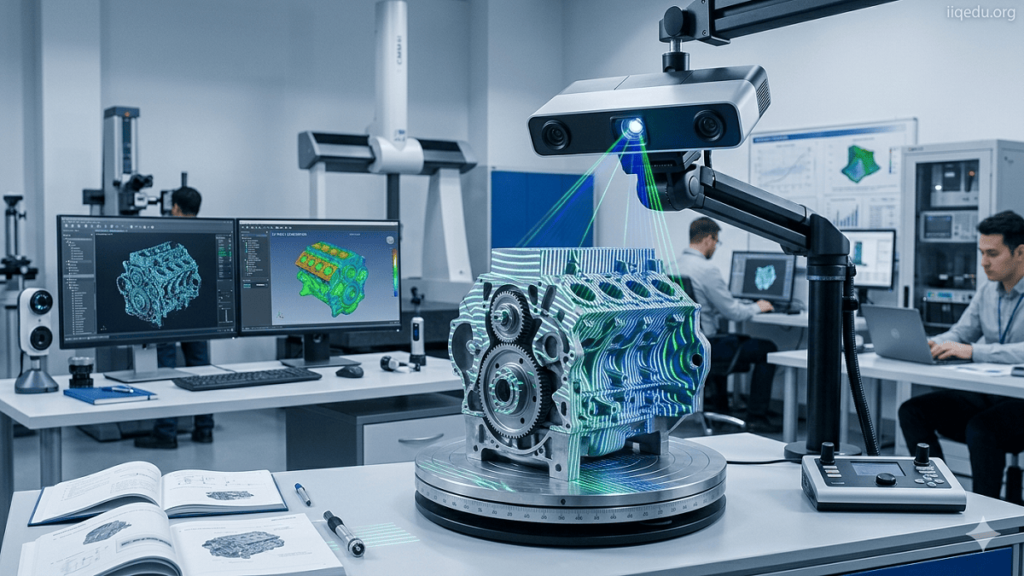
3D optical scanners work by projecting light—usually a laser, structured light, or patterns—onto an object. Sensors then capture how the light reflects off the surface. The scanner measures the distance and shape at thousands or even millions of points, creating a point cloud, which is a set of data points representing the object’s surface. This point cloud can then be converted into a full 3D model suitable for design, quality control, medical applications, or 3D printing.
Who are 3d optical scanners?
A 3D optical scanner is a high-tech device used to capture the exact shape and surface details of objects in three dimensions. Unlike ordinary cameras that only take flat, two-dimensional photos, 3D optical scanners “see” depth, curves, edges, and textures, turning real-world objects into precise digital models. These devices are widely used in industries, medicine, art, entertainment, and research, because they allow humans to study and replicate objects with incredible accuracy.
Think of a 3D optical scanner as a digital mold. It doesn’t have feelings, thoughts, or consciousness, but it “reads” the shape of an object and converts it into digital data that humans can use. The scanner projects light—often lasers or structured patterns—onto an object. Special sensors capture the reflected light and calculate the distance and position of millions of points on the surface. The result is called a point cloud, which is later processed into a complete 3D model.
There are several types of 3D optical scanners, each suited for different tasks:
- Laser Triangulation Scanners – Shine a laser on small objects and measure angles to get extremely precise details.
- Structured Light Scanners – Project patterns of light onto objects and track how the patterns bend over surfaces, capturing details quickly.
- Time-of-Flight Scanners – Measure the time it takes for light to return from large objects, like rooms or vehicles.
- Photogrammetry Scanners – Use multiple photographs taken from different angles to reconstruct a 3D model digitally.
3D optical scanners are tools created by humans, but their role is critical. They “observe” objects in ways the human eye cannot, enabling engineers to reverse-engineer parts, designers to prototype products, archaeologists to preserve artifacts, and medical professionals to create custom prosthetics or dental solutions.
When are 3d optical scanners required?
3D optical scanners are specialized tools that are required whenever precision, speed, and accuracy in measuring or replicating the physical world are crucial. They are not just luxury gadgets—they solve real-world problems across industries, medicine, art, and research. Here are the key situations when 3D optical scanners are required:
1. Precision Engineering and Manufacturing
When creating complex machinery, automotive parts, or aerospace components, even a tiny deviation can cause malfunctions. 3D optical scanners are required to measure intricate parts, detect defects, and ensure that every component matches exact specifications. They help engineers reverse-engineer parts and maintain tight tolerances that traditional measurement tools cannot achieve.
2. Product Design and Prototyping
In modern product development, speed matters as much as precision. Scanners are required to capture prototypes quickly and create digital models for testing, simulation, and modifications. This reduces the need for multiple physical prototypes, saving both time and money.
3. Medical Applications
Doctors, dentists, and prosthetics specialists require 3D optical scanners to create customized medical devices that perfectly fit patients. Scanners are used to capture body shapes for prosthetics, dental implants, or orthotics without invasive procedures, making treatment faster and more comfortable.
4. Cultural Heritage and Art Preservation
Museums, archaeologists, and artists require 3D scanners to digitally preserve priceless artifacts and historical sites. By scanning objects and sculptures, institutions can study, restore, or replicate them without risking damage to the original pieces.
5. Entertainment and Virtual Reality
In movies, video games, and VR experiences, creators require scanners to digitally capture real objects, people, and environments. This enables lifelike 3D models that can be animated or used in digital storytelling.
6. Research and Scientific Study
Scientists require scanners to analyze complex structures such as fossils, biological specimens, or geological formations. Scanners allow detailed study without harming delicate samples.
7. Quality Control and Inspection
3D scanners are required in production lines to inspect parts rapidly and accurately. They detect defects, deviations, or damage that could affect functionality or safety, ensuring consistent quality.
In short, 3D optical scanners are required whenever detailed, precise, and fast digital capture of real-world objects is needed. They bridge the gap between physical reality and the digital world, enabling innovation, safety, and creativity across multiple fields
Where are 3d optical scanners required?
In today’s fast-paced, technology-driven world, precision, speed, and accuracy are essential. That’s why 3D optical scanners have become indispensable tools across multiple industries. These devices capture the exact shape, size, and surface details of real-world objects and turn them into digital 3D models. Unlike traditional cameras or manual measurement tools, 3D scanners provide a highly detailed, accurate, and fast way to record the physical world.
Manufacturing and Industrial Applications
Factories and production lines rely heavily on 3D optical scanners. They are required to inspect parts, measure components, and ensure quality control. For example, automotive and aerospace industries use scanners to measure engine parts, turbine blades, or intricate machinery components. The scanners detect defects and deviations that could otherwise go unnoticed, ensuring that products meet strict specifications and standards.
Medical and Healthcare Fields
In medicine, 3D optical scanners are required to create custom prosthetics, dental implants, and orthotic devices. They allow doctors and technicians to capture the precise shape of a patient’s body or teeth non-invasively. This results in perfectly fitted medical devices, reduces discomfort, and speeds up treatment. Additionally, surgeons use 3D scans for pre-operative planning, helping them study complex anatomical structures in detail before performing procedures.
Cultural Heritage and Museums
Museums, archaeologists, and art conservationists require 3D scanners to digitally preserve priceless artifacts, sculptures, and historical sites. By creating accurate digital replicas, they can study, restore, or display objects without risking damage to the originals. This technology also allows for virtual exhibitions and educational experiences for people around the world.
Entertainment and Media
Film studios, video game developers, and virtual reality designers require 3D optical scanners to capture realistic models of characters, props, and environments. Scanners allow creators to turn real-world objects into highly detailed digital assets, enhancing realism in movies, games, and VR experiences.
Research, Education, and Construction
Researchers and universities require scanners to analyze fossils, plants, biological specimens, and geological structures in fine detail. In construction and architecture, scanners capture buildings, rooms, and landscapes accurately, enabling precise planning, renovation, and restoration without relying solely on manual measurements.
Why Are 3D Optical Scanners Required?
In today’s world, precision, efficiency, and innovation are more important than ever. That’s why 3D optical scanners have become essential tools across industries, medicine, art, and science. These devices are required whenever there is a need to capture the exact shape and surface details of objects in three dimensions—something traditional cameras or measuring tools cannot do.
- Precision in Manufacturing and Engineering
Modern manufacturing demands parts that fit together perfectly, often with tolerances measured in microns. 3D optical scanners are required for quality control, reverse engineering, and product development. They can quickly measure complex parts, detect defects, or help recreate an existing component without original designs. This saves time, reduces errors, and improves product quality. - Medical and Healthcare Applications
In medicine, precision can literally save lives. 3D optical scanners are required to design custom prosthetics, dental implants, or even orthotic devices that perfectly match a patient’s anatomy. They allow doctors and technicians to create highly accurate models without invasive procedures. - Cultural Heritage and Art Preservation
Historical artifacts and artworks are irreplaceable. 3D optical scanners are required to digitally preserve artifacts, sculptures, and archaeological sites. These digital replicas ensure that future generations can study and enjoy these treasures, even if the originals are damaged or lost. - Entertainment and Virtual Reality
From movies to video games, realistic 3D models are in high demand. Scanners are required to create lifelike characters, props, or even entire environments. They allow artists to capture real-world objects and bring them into digital media with astonishing realism. - Efficiency and Cost-Effectiveness
Using 3D optical scanners reduces the need for manual measurements, repeated prototyping, or trial-and-error processes. They are required whenever speed, accuracy, and repeatability are critical. Businesses save time, resources, and costs while achieving higher precision. - Scientific Research and Innovation
Researchers require 3D optical scanners to study complex structures—such as fossils, biological specimens, or geological formations—without damaging them. The scanners allow for detailed analysis and modeling that would be impossible with traditional methods.
In short, 3D optical scanners are required whenever precise, detailed, and fast digital capture of the physical world is needed. They bridge the gap between reality and the digital world, enabling innovation, creativity, preservation, and accuracy in countless fields. Without them, achieving modern standards of precision and efficiency would be extremely difficult or even impossible.
Case study of 3d optical scanners
Background
A leading automotive company faced a challenge: designing complex engine components with extreme precision while reducing production time. Traditional measurement tools were slow and prone to errors, and prototypes often required multiple iterations. To overcome these issues, the company turned to 3D optical scanning technology.
Implementation
The company used laser triangulation 3D scanners to capture the exact geometry of existing engine parts. The scanners projected laser lines onto the components, while sensors recorded millions of points on their surfaces. This process created highly accurate digital 3D models that engineers could analyze directly in their design software.
Structured light scanners were also used to measure larger engine housings and assemblies. These scanners quickly captured surfaces with complex curves and patterns, providing detailed models that were previously impossible to obtain manually.
Results
The introduction of 3D optical scanners had immediate and significant benefits:
- Precision and Accuracy: The digital models captured every curve and surface detail down to fractions of a millimeter, eliminating measurement errors.
- Faster Design Cycles: Engineers could create, test, and modify parts virtually without repeatedly manufacturing physical prototypes.
- Cost Savings: Reducing prototype iterations and minimizing errors led to lower material and labor costs.
- Reverse Engineering: Older parts with missing or outdated blueprints could be scanned and reproduced with perfect accuracy.
- Quality Control: The scanners allowed for rapid inspection of finished parts, ensuring consistency across production batches.
source : Holocreators GmbH
White paper of 3d optical scanners
Executive Summary
3D optical scanners are revolutionizing the way industries, healthcare, research, and entertainment interact with the physical world. These devices use light-based technologies—such as lasers, structured patterns, or photogrammetry—to capture the exact shape and surface details of objects, creating precise digital 3D models. This white paper explores the technology, applications, benefits, and future of 3D optical scanners, providing insights into why they are essential in modern workflows.
1. Introduction
The ability to digitize the real world with high accuracy has transformed how businesses, scientists, and creatives work. Traditional measurement methods—manual tools, calipers, or 2D photography—are limited in scope and prone to human error. 3D optical scanners overcome these limitations by capturing the complete geometry of objects and environments quickly and accurately.
These scanners are used to create point clouds, which are dense collections of 3D data points representing the object’s surface. Point clouds can then be converted into CAD models, meshes, or digital twins for analysis, simulation, or reproduction.
2. Types of 3D Optical Scanners
2.1 Laser Triangulation Scanners
Laser triangulation scanners project a laser line or dot onto the object and measure the reflection angle to determine distance. They are highly accurate and ideal for small-to-medium objects, such as mechanical parts, jewelry, or medical devices.
2.2 Structured Light Scanners
These scanners project patterns (grids, stripes, or dots) and analyze how the patterns deform across the object’s surface. They provide rapid, high-resolution scans suitable for detailed surfaces and medium-sized objects.
2.3 Time-of-Flight Scanners
Time-of-flight (ToF) scanners measure how long it takes for a light pulse to reflect from an object back to the sensor. They are best for large objects or environments, such as buildings, vehicles, or industrial plants.
2.4 Photogrammetry
Photogrammetry uses multiple photographs from different angles to reconstruct a 3D model digitally. While less precise than laser or structured light scanning, it is scalable, cost-effective, and ideal for large or outdoor objects.
3. Applications
3.1 Manufacturing and Industry
- Quality control: Rapid inspection of parts and assemblies for defects or deviations.
- Reverse engineering: Recreating parts with missing blueprints or outdated designs.
- Prototyping: Streamlining design and testing cycles with precise digital models.
3.2 Medical and Healthcare
- Custom prosthetics, dental implants, and orthotics.
- Pre-surgical planning using digital anatomical models.
- Non-invasive body and organ scanning.
3.3 Cultural Heritage and Museums
- Digital preservation of artifacts, sculptures, and historical sites.
- Virtual exhibitions and global access to rare objects.
- Restoration planning without risking damage to originals.
3.4 Entertainment and Media
- Capturing realistic models of characters, props, and sets for films, games, and virtual reality.
- Animation and visual effects integration.
3.5 Research and Education
- Studying fossils, geological formations, and biological specimens in detail.
- Accurate 3D modeling for teaching, simulations, and publications.
3.6 Construction and Architecture
- Scanning buildings, rooms, and landscapes for planning, renovation, or restoration.
- Creating accurate digital twins for facility management.
4. Benefits of 3D Optical Scanners
- Precision: Capture fine details down to fractions of a millimeter.
- Speed: Scan objects in minutes or even seconds, reducing manual effort.
- Cost-efficiency: Reduces prototyping, errors, and material waste.
- Non-contact: Suitable for delicate, rare, or sensitive objects.
- Versatility: Applicable across industries, from healthcare to entertainment.
5. Challenges
- Surface Limitations: Highly reflective or transparent objects can be difficult to scan.
- Environmental Conditions: Ambient light or vibrations may affect accuracy.
- Data Management: Large scans produce massive datasets that require storage and processing.
- Cost: High-end scanners can be expensive, though prices are gradually decreasing.
6. Future Trends
- Portable 3D Scanners: Lightweight and handheld scanners are making scanning accessible outside labs and factories.
- AI Integration: Software algorithms improve scan accuracy, noise reduction, and object recognition.
- Cloud-Based Collaboration: Digital models can be stored, shared, and edited remotely.
- Hybrid Technologies: Combining multiple scanning methods for enhanced precision.
INDUSTRY APPLICATION OF 3D OPTICAL SCANNERS
Industry Applications of 3D Optical Scanners
3D optical scanners have become essential tools across various industries, offering precision, speed, and efficiency that traditional measurement methods cannot match. These devices capture the exact shape, size, and surface details of objects, turning them into digital 3D models that can be analyzed, modified, or reproduced. Below is a detailed look at how different industries are leveraging 3D optical scanners.
1. Automotive Industry
The automotive industry relies heavily on 3D optical scanners for design, prototyping, and quality control. Scanners allow engineers to capture complex engine components, body panels, and interior parts with high precision. This technology enables reverse engineering, allowing manufacturers to recreate parts with missing or outdated blueprints. It also improves efficiency by reducing errors and accelerating prototyping and production cycles.
2. Aerospace and Aviation
In aerospace, precision is critical. 3D optical scanners are used to measure turbine blades, fuselage components, and other intricate parts. By scanning parts, engineers can detect microscopic deviations or defects that could affect performance or safety. Scanners also assist in maintenance and repair operations, allowing digital inspection of aircraft components without disassembling them entirely.
3. Medical and Healthcare Industry
3D optical scanners are widely used to create custom prosthetics, dental implants, and orthotics. They allow medical professionals to capture a patient’s exact anatomy non-invasively, ensuring a perfect fit. Scanners are also used in pre-surgical planning, creating detailed models of organs or skeletal structures to guide complex procedures.
4. Consumer Products and Electronics
In product design and development, 3D scanners help designers digitally capture prototypes and existing objects. They are used for ergonomic studies, reverse engineering, and rapid prototyping of electronics, household products, and wearable devices. By using scanners, companies can reduce development time and ensure high accuracy in design.
5. Construction and Architecture
3D optical scanners are required in construction and architecture to capture buildings, rooms, and landscapes accurately. They provide precise measurements for renovation, restoration, and construction planning. Digital scans also help create BIM (Building Information Models) and detailed architectural visualizations.
6. Cultural Heritage and Museums
Although not traditionally an “industry,” cultural institutions use 3D scanners to digitally preserve artifacts, historical sites, and sculptures. High-resolution scans allow museums to create virtual exhibits, reproduce artifacts, and conduct detailed studies without risking damage to the originals.
7. Entertainment and Media
Film studios, gaming companies, and VR/AR developers use scanners to capture realistic 3D models of actors, props, and environments. This technology enhances visual effects, animation, and interactive experiences, enabling lifelike realism in digital media.
What is a 3D optical scanner?
A 3D optical scanner is a device that captures the exact shape, dimensions, and surface details of a real-world object using light, such as lasers, structured patterns, or photogrammetry. Unlike traditional cameras, which capture flat images, 3D scanners create detailed digital 3D models called point clouds, which can be converted into CAD models, 3D prints, or virtual simulations. They are widely used in industries, healthcare, art preservation, and entertainment.
How do 3D optical scanners work?
3D optical scanners work by projecting light onto an object and capturing the way it interacts with the surface. Sensors or cameras measure the reflected light, recording thousands or millions of points in space. These points, known as a point cloud, represent the exact shape and contours of the object. Software then processes this data into a complete 3D model for design, inspection, or visualization. Different technologies, such as laser triangulation, structured light, time-of-flight, and photogrammetry, are used depending on the object’s size and detail.
What are the main types of 3D optical scanners?
Laser Triangulation Scanners: Highly accurate for small-to-medium objects, using laser light to calculate distances.
Structured Light Scanners: Project patterns and measure how they deform across surfaces; fast and precise for detailed objects.
Time-of-Flight (ToF) Scanners: Measure the time light takes to return, ideal for large objects or environments.
Photogrammetry: Uses multiple photographs to reconstruct 3D models, suitable for large or outdoor objects.
Where are 3D optical scanners commonly used?
3D optical scanners are required in many fields:
Manufacturing and Industry: Quality control, reverse engineering, and prototyping.
Medical and Healthcare: Custom prosthetics, dental implants, and surgical planning.
Cultural Heritage: Digitally preserving artifacts, sculptures, and historical sites.
Entertainment: Creating realistic models for films, games, and virtual reality.
Construction and Architecture: Capturing buildings and landscapes for planning and visualization.
Why should I use a 3D optical scanner instead of traditional measurement tools?
Traditional tools like calipers or manual measurement methods are slow, limited, and prone to errors, especially for complex shapes. 3D optical scanners offer:
High precision: Capture fine details down to fractions of a millimeter.
Speed: Scan objects quickly, saving time.
Non-contact measurement: Ideal for delicate, valuable, or hazardous objects.
Digital models: Allow for virtual inspection, simulation, or 3D printing.
They are indispensable in modern industries and creative fields where accuracy, efficiency, and repeatability are critical.
source : ExplainingComputers
Table of Contents
Disclaimer
The content on this site about 3D optical scanners is for informational purposes only. It is not professional, technical, or legal advice. Accuracy and results may vary, and readers should verify information and consult qualified professionals or manufacturers before using any 3D scanning equipment. The authors are not responsible for any outcomes