Hyperspectral Imaging for Product Inspection
Hyperspectral Imaging (HSI) is an advanced, non-destructive technology used to inspect products by capturing data across a broad range of light wavelengths beyond the visible spectrum. Unlike conventional RGB cameras, which record only red, green, and blue channels, hyperspectral cameras capture hundreds of spectral bands, producing a detailed “spectral signature” for each pixel. These signatures reveal chemical composition, surface defects, moisture content, and contamination that are invisible to the naked eye.
In product inspection, HSI systems illuminate the item and record the reflected or transmitted light. Specialized software analyzes these spectral patterns to identify anomalies or deviations from quality standards. This allows manufacturers to detect defects, foreign materials, or inconsistencies early in the production process, ensuring safety and compliance.
What is Hyperspectral Imaging for Product Inspection?
Hyperspectral Imaging (HSI) for Product Inspection is an advanced non-destructive technology that uses cameras to capture data across hundreds of light wavelengths, far beyond what the human eye or conventional RGB cameras can see. Each pixel in a hyperspectral image contains a full spectral signature representing the chemical composition and physical properties of the material being scanned.
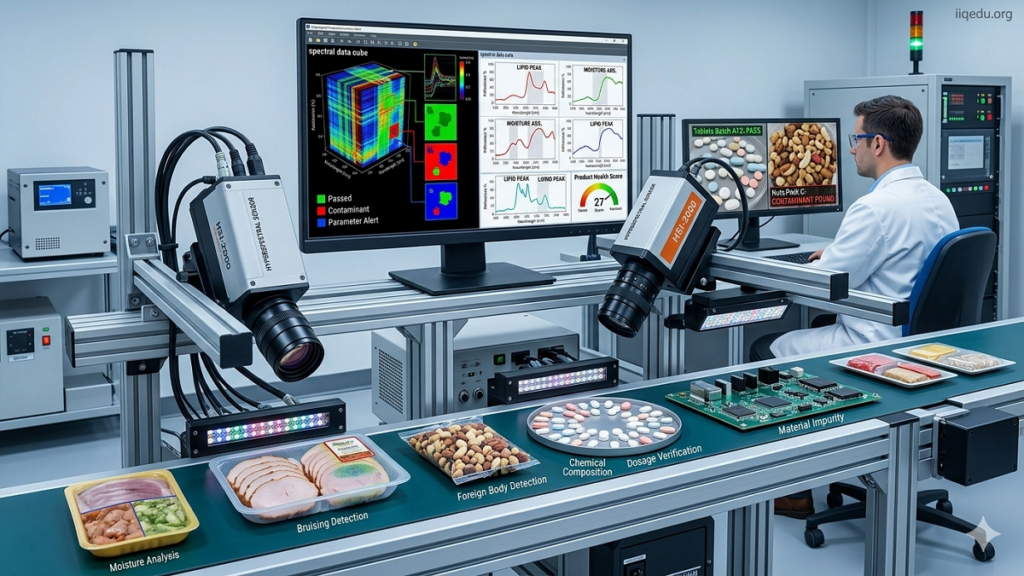
In product inspection, this technology is used to detect defects, contamination, or inconsistencies that are invisible to standard visual inspection methods. For example, HSI can identify:
- Bruising, ripeness, or foreign objects in fruits and vegetables
- Counterfeit or improperly coated pharmaceutical tablets
- Surface cracks or coating inconsistencies in manufactured components
- Labeling errors or contamination in packaged goods
The process works by illuminating the product, capturing the reflected or transmitted light at multiple wavelengths, and then analyzing the resulting spectral data using specialized software. Any deviation from a predefined “normal” spectral signature can indicate a quality issue or defect.
Key Advantages:
- Non-destructive: Products remain intact during inspection.
- Highly precise: Detects defects invisible to the naked eye.
- Real-time: Can be integrated into production lines for continuous monitoring.
- Versatile: Works with solids, liquids, powders, and packaged products.
In short, Hyperspectral Imaging for Product Inspection enables manufacturers to maintain high quality, ensure safety, and reduce waste by identifying hidden defects and inconsistencies early in the production process.
Who is Hyperspectral Imaging for Product Inspection required?
Hyperspectral Imaging (HSI) for product inspection is primarily required by industries where quality, safety, and compliance are critical. Because HSI can detect defects, contamination, or inconsistencies invisible to the human eye or traditional cameras, it is essential for businesses that need high-precision quality control.
1. Food and Beverage Industry
HSI is required by food manufacturers and processors to detect bruising, ripeness, contamination, foreign objects, or spoilage in fruits, vegetables, packaged foods, and beverages. It ensures food safety and consistency, helping companies comply with regulatory standards.
2. Pharmaceutical Industry
Pharmaceutical manufacturers require HSI to verify drug composition, detect counterfeit tablets, and ensure uniform coatings. It helps maintain product safety and regulatory compliance, reducing the risk of defective or unsafe medicines reaching consumers.
3. Manufacturing Industry
In electronics, automotive, and other precision manufacturing sectors, HSI is required to inspect surface defects, coatings, or material inconsistencies. This ensures that high-value components meet strict quality and safety standards.
4. Packaging and Consumer Goods
HSI is used by packaging companies to check label quality, printed codes, and sealed package integrity, detecting contamination or foreign objects in packaged goods.
5. Research and Development
HSI is also required in R&D labs for testing new materials, evaluating chemical composition, or analyzing product behavior under different conditions.
When is Hyperspectral Imaging for Product Inspection required?
Hyperspectral Imaging (HSI) for product inspection is required whenever high precision, early defect detection, and safety compliance are critical in the production or quality control process. It is especially valuable when conventional visual inspection or RGB cameras cannot detect hidden defects or inconsistencies.
1. During Production Line Quality Control
HSI is required when manufacturers need real-time monitoring of products on the production line. For example, in the food industry, HSI can detect bruising, ripeness, or contamination in fruits and vegetables as they move through the conveyor, ensuring only high-quality products reach customers.
2. When Detecting Invisible Defects
HSI is required when defects are not visible to the naked eye or standard cameras. This includes:
- Surface cracks or coating inconsistencies in manufactured parts
- Foreign object contamination in packaged goods
- Chemical composition variations in pharmaceuticals
By detecting these issues early, companies prevent defective or unsafe products from reaching the market.
3. For Regulatory Compliance
Industries like food, pharmaceuticals, and medical devices are often legally required to meet strict quality and safety standards. HSI is required in these cases to ensure compliance by verifying chemical composition, uniformity, and contamination-free products.
4. During Research and Development
HSI is required in laboratories or R&D departments when testing new materials, formulations, or product prototypes. It helps identify material inconsistencies or performance issues before mass production.
5. For Safety-Critical Products
Products where safety is paramount—such as medicines, aerospace components, or high-precision electronics—require HSI to ensure defect-free quality and reduce the risk of failures that could have serious consequences.
Where is Hyperspectral Imaging for Product Inspection required?
Hyperspectral Imaging (HSI) is required in industries and environments where product quality, safety, and regulatory compliance are critical. By capturing data across hundreds of light wavelengths, HSI can detect hidden defects, contamination, or chemical inconsistencies that are invisible to standard cameras or human inspection.
1. Food and Beverage Industry
HSI is widely used in food processing and packaging plants to inspect fruits, vegetables, packaged foods, and beverages. It helps detect bruising, ripeness, contamination, foreign objects, or spoilage. By integrating HSI into production lines, food manufacturers ensure that only high-quality, safe products reach consumers.
2. Pharmaceutical Industry
HSI is required in pharmaceutical labs and production facilities to inspect tablets, capsules, and liquid formulations. It detects incorrect composition, coating inconsistencies, and counterfeit drugs, helping manufacturers comply with strict regulatory standards and ensuring patient safety.
3. Manufacturing and Electronics
In precision manufacturing and electronics, HSI is applied to check coating uniformity, surface defects, material inconsistencies, or contamination. Components such as circuit boards, automotive parts, and industrial products benefit from this high-resolution, non-destructive inspection.
4. Packaging Industry
HSI is used to inspect packaged goods for proper labeling, print quality, seal integrity, and the presence of foreign materials. It ensures that products leaving the factory meet both quality and safety standards.
5. Research and Development
HSI is required in R&D labs for analyzing new materials, chemical composition, and product prototypes. Researchers use it to identify defects, optimize formulations, and improve product quality before mass production.
How is Hyperspectral Imaging for Product Inspection required?
Hyperspectral Imaging (HSI) is a non-destructive, high-precision technology used for product inspection, and it is required in industries where quality, safety, and compliance are critical. It works by capturing hundreds of light wavelengths per pixel, creating a spectral signature that reveals chemical composition, surface defects, and hidden inconsistencies.
1. Installation and Setup
HSI systems require specialized cameras and lighting configured for the product and production environment. Products are scanned on conveyor belts, laboratory tables, or stationary setups depending on the application. Proper calibration ensures the captured spectral data accurately represents the material’s properties.
2. Data Acquisition
During inspection, the HSI camera collects reflected or transmitted light across multiple wavelengths. Each pixel of the image contains a full spectral profile, capturing information that traditional RGB cameras cannot detect.
3. Analysis and Interpretation
Specialized software analyzes the spectral data, comparing it to predefined standards or reference signatures. Deviations indicate potential defects, contamination, or inconsistencies. For example:
- Food: bruising, ripeness, contamination, or foreign objects.
- Pharmaceuticals: incorrect composition, coating inconsistencies, or counterfeit tablets.
- Manufacturing: surface defects, material irregularities, or coating problems.
4. Actionable Results
Once the software identifies anomalies, operators or engineers can take immediate action, such as removing defective products from the production line, adjusting manufacturing processes, or performing targeted maintenance.
5. Who Is Required
Performing HSI requires a team of trained professionals, including:
- Operators to run the HSI system
- Engineers or analysts to interpret spectral data
- Quality control staff to make decisions based on results
source : VISIONLab
case study of Hyperspectral Imaging for Product Inspection
Background
A large food processing company faced challenges with quality control in its packaged salad products. Traditional visual inspections and standard cameras were unable to detect small foreign particles or subtle discoloration caused by early spoilage. Contamination or product inconsistency could lead to consumer complaints, regulatory penalties, and brand reputation damage. To address this, the company implemented Hyperspectral Imaging (HSI) for real-time inspection on the production line.
Implementation
HSI cameras were installed above the conveyor system to scan each salad package as it moved along the line. The cameras captured hundreds of spectral bands for every pixel in the image, analyzing color, chemical composition, and texture. Specialized software compared each package’s spectral signature to a reference standard for uncontaminated, fresh salad.
When the system detected deviations—such as foreign objects, spoilage, or moisture inconsistencies—it flagged the package for removal. Operators were notified in real time, allowing immediate corrective action without slowing down production.
Results
The implementation of HSI led to:
- Early detection of contaminants invisible to the naked eye, reducing the risk of unsafe products reaching consumers.
- Reduced waste, as only defective packages were removed rather than entire batches.
- Improved efficiency, since real-time inspection eliminated the need for manual sampling and delayed lab testing.
- Enhanced brand reputation, as product consistency and safety were maintained at a high level.
White paper of Hyperspectral Imaging for Product Inspection
Executive Summary
Hyperspectral Imaging (HSI) is an advanced, non-destructive inspection technology that captures data across hundreds of light wavelengths. By analyzing the full spectrum of reflected or transmitted light, HSI allows manufacturers to detect hidden defects, contamination, and chemical inconsistencies in products. Unlike conventional RGB imaging, HSI provides high-precision, real-time monitoring, making it indispensable for industries where product quality, safety, and compliance are critical. This white paper explores the principles, technology, applications, benefits, challenges, and future trends of HSI in product inspection.
1. Introduction
Modern industries demand high-quality, defect-free products. Traditional inspection methods often fail to detect subtle defects, internal contamination, or chemical inconsistencies. Hyperspectral Imaging addresses these limitations by capturing hundreds of spectral bands per pixel, creating a detailed spectral signature that reveals the material’s chemical and physical properties.
HSI is increasingly adopted across sectors such as food and beverage, pharmaceuticals, electronics manufacturing, packaging, and research laboratories, ensuring safety, regulatory compliance, and operational efficiency.
2. Principles of Hyperspectral Imaging
HSI works by:
- Illuminating the product and capturing light across multiple wavelengths
- Recording spectral data for each pixel, representing chemical composition, moisture content, or surface defects
- Comparing spectral signatures against reference standards to identify anomalies
- Generating actionable insights through software analysis
This enables early detection of defects that are invisible to the human eye or conventional cameras.
3. Technology and Equipment
Key components of HSI systems include:
- Hyperspectral Cameras: Capture hundreds of spectral bands
- Illumination Sources: Ensure consistent lighting for accurate results
- Data Acquisition Systems: Record high-resolution spectral data
- Analysis Software: Processes and visualizes data to detect defects or inconsistencies
4. Applications
4.1 Food Industry
Detects bruising, ripeness, spoilage, and foreign objects in fruits, vegetables, and packaged foods.
4.2 Pharmaceuticals
Ensures correct composition, uniform coating, and detects counterfeit drugs.
4.3 Manufacturing and Electronics
Inspects surface defects, coatings, and material inconsistencies in high-precision components.
4.4 Packaging
Verifies labels, print quality, and detects contamination or sealing defects.
4.5 Research and Development
Analyzes new materials and formulations for quality, composition, and structural integrity.
5. Benefits
- Non-destructive: Products remain intact during inspection
- High precision: Detects hidden defects or contamination
- Real-time monitoring: Ideal for production lines
- Versatility: Works with solids, liquids, powders, and packaged products
6. Challenges
- High cost: HSI equipment can be expensive
- Data complexity: Requires skilled operators and advanced software
- Environmental sensitivity: Needs controlled lighting and stable conditions for accurate results
7. Case Study Highlight
A food manufacturer used HSI to inspect packaged salads. The system detected foreign particles and early spoilage that manual inspection could not catch, reducing waste, improving safety, and maintaining quality compliance.
8. Future Trends
- Portable HSI devices for flexible inspection
- AI and machine learning integration for faster defect detection
- Integration with Industry 4.0 and digital twins for predictive quality monitoring
source : Pixxel
Industry application of Hyperspectral Imaging for Product Inspection
Hyperspectral Imaging (HSI) is a non-destructive, high-precision technology that captures hundreds of spectral bands for each pixel of an image. By analyzing these spectral signatures, HSI can detect hidden defects, contamination, chemical inconsistencies, and quality issues that are invisible to traditional cameras or human inspection. Its ability to provide real-time, non-destructive, and highly accurate monitoring makes it indispensable across multiple industries.
1. Food and Beverage Industry
HSI is extensively used to inspect fruits, vegetables, packaged foods, and beverages. It can detect:
- Bruising or early spoilage in fruits and vegetables
- Foreign materials like glass or plastic
- Moisture content and ripeness
- Contamination in packaged foods
This ensures food safety, quality, and regulatory compliance, reducing the risk of recalls and consumer complaints.
2. Pharmaceutical Industry
HSI is applied in pharmaceutical manufacturing to:
- Verify the composition of tablets and capsules
- Detect counterfeit drugs
- Ensure uniformity in coatings and active ingredients
This maintains product safety, compliance with regulatory standards, and prevents costly recalls.
3. Manufacturing and Electronics
In high-precision manufacturing, HSI is used to:
- Inspect surface coatings, materials, and components
- Detect micro-cracks, contamination, or structural inconsistencies
- Ensure product reliability in electronics, automotive, and aerospace components
4. Packaging Industry
HSI helps in inspecting:
- Label quality and print accuracy
- Sealing integrity of packaged products
- Detection of foreign objects inside packages
This guarantees brand consistency, safety, and consumer trust.
5. Research and Development
HSI is required in labs for:
- Testing new materials, formulations, and prototypes
- Monitoring chemical composition, structural integrity, and quality
- Supporting innovation in food, pharmaceuticals, and manufacturing
What is Hyperspectral Imaging (HSI) for Product Inspection?
Hyperspectral Imaging is a non-destructive inspection technology that captures data across hundreds of light wavelengths. Each pixel in a hyperspectral image contains a full spectral signature, allowing detection of defects, contamination, chemical inconsistencies, and material properties invisible to the naked eye or traditional cameras.
How does HSI work in product inspection?
HSI illuminates a product and captures reflected or transmitted light across multiple spectral bands. Software analyzes these spectral signatures, comparing them to reference standards. Any deviation indicates potential defects, contamination, or quality inconsistencies, enabling real-time inspection without damaging the product
Who uses Hyperspectral Imaging for product inspection?
HSI is used by industries where precision and quality are critical, including:
Food and beverage manufacturers
Pharmaceutical companies
Electronics and manufacturing firms
Packaging companies
Research and development laboratories
Trained operators, engineers, and analysts are required to operate the system and interpret the data.
What products can be inspected using HSI?
HSI can inspect solids, liquids, powders, and packaged products. Examples include:
Fruits, vegetables, and processed foods
Pharmaceutical tablets and capsules
Electronic components and coatings
Packaged goods for labeling and contamination
What are the advantages of Hyperspectral Imaging in product inspection?
Non-destructive: Products remain intact
High precision: Detects invisible defects and contamination
Real-time inspection: Can be integrated into production lines
Versatile: Works across food, pharmaceuticals, manufacturing, and R&D
Quality assurance: Ensures compliance and reduces waste
Table of Contents
Disclaimer:
The information provided about Hyperspectral Imaging for Product Inspection is for educational and informational purposes only. It is not professional, technical, or legal advice. Consult certified specialists or industry professionals before applying HSI in production or quality control.