Acoustic Emission Testing.
Acoustic Emission (AE) Testing is a non-destructive testing (NDT) method used to detect and monitor defects, cracks, or structural changes in materials and components. Unlike some tests that require disassembling or cutting into a material, AE testing listens to the sounds that materials naturally produce when they are stressed. These “sounds” are high-frequency elastic waves generated by internal events such as crack growth, corrosion, or deformation.
AE testing relies on sensitive sensors attached to the surface of a material. When the material undergoes stress—either during operation or during controlled testing—microstructural changes release energy in the form of acoustic waves. The sensors detect these waves,which are then analyzed to determine the location, intensity, and nature of potential defects.
Unlike ultrasonic testing, which actively sends waves into a material, AE testing is a passive monitoring technique. It listens for sounds produced naturally by the material under stress, making it especially useful for monitoring in-service equipment such as pressure vessels, pipelines, bridges, and aircraft components.
What is acoustic emission testing?
Acoustic Emission (AE) Testing is a non-destructive testing (NDT) method used to detect and monitor defects, cracks, or structural changes in materials and components without damaging them.
Unlike traditional tests that actively send waves into a material (like ultrasonic testing), AE testing is passive—it “listens” to the high-frequency acoustic waves that materials naturally produce when they are stressed. These waves are generated by internal events such as crack formation, crack growth, corrosion, or deformation.
During testing, sensors are placed on the surface of the material or structure. When stress is applied—either during normal operation or controlled testing—these sensors pick up the emitted sound waves. The data is then analyzed to determine the location, severity, and type of defect, allowing engineers to identify potential problems early, often before visible damage occurs.
Key Points:
- Non-destructive: The material remains intact.
- Real-time monitoring: Detects problems as they happen.
- Applications: Used in pipelines, pressure vessels, bridges, aircraft, welds, and composite materials.
- Purpose: Early detection of micro-cracks, corrosion, or fatigue to prevent failures.
In simple terms, AE testing is like “listening to the material”—it picks up the tiny sounds that indicate something is going wrong inside, helping engineers prevent catastrophic failures and maintain safety.
Who is required for acoustic emission testing?
Acoustic Emission (AE) testing is a specialized non-destructive testing (NDT) method that requires skilled professionals to perform, interpret, and act on the results. It is not a test that can be done casually; it involves technical expertise, knowledge of materials, and an understanding of structural behavior.
1. Certified NDT Professionals
AE testing should be carried out by trained and certified non-destructive testing technicians or engineers. These professionals are trained in:
- Placing AE sensors correctly on the material or structure.
- Setting up the test parameters, such as stress levels, load cycles, and sensitivity.
- Monitoring equipment and signals during the test.
Many AE professionals hold certifications from recognized organizations such as ASNT (American Society for Nondestructive Testing), PCN, or other national certification programs, ensuring they meet industry standards.
2. Material and Structural Engineers
Engineers with expertise in the material being tested (metal, composite, or concrete) are often required to analyze the AE signals. They interpret the data to determine:
- The location of a defect within the material.
- The severity of damage or crack growth.
- Whether the structure is safe for continued operation.
3. Maintenance and Operations Personnel
In industrial settings—such as pipelines, pressure vessels, bridges, or aircraft—AE testing is often performed while the system is in operation. In these cases, operations staff are required to coordinate with AE specialists to safely apply stress, monitor the system, and ensure that testing does not interfere with normal operations.
4. Data Analysts / NDT Software Specialists
Modern AE testing produces large amounts of data. Analysts or software specialists are often required to process, filter, and visualize the acoustic emission signals to identify patterns, locate sources, and generate reports.
Summary
In short, AE testing requires a collaborative team:
- Certified NDT technicians to perform the test.
- Material and structural engineers to interpret results.
- Operations staff for safe in-service testing.
- Data analysts to handle and process signals.
AE testing is highly specialized because it requires both technical skill and knowledge of the material behavior. Using untrained personnel could lead to misinterpretation, missed defects, or unsafe conclusions.
when is required for acoustic emission testing?
Acoustic Emission (AE) Testing is a non-destructive testing (NDT) method used to detect hidden defects, monitor structural integrity, and prevent catastrophic failures in materials and components. It is required in situations where early detection of cracks, corrosion, or material fatigue is critical. Unlike traditional tests, AE testing can monitor materials while they are in service, making it highly valuable for safety-critical applications.
1. Structural Health Monitoring
AE testing is required when monitoring bridges, pipelines, pressure vessels, tanks, and aircraft components. Structures under continuous stress or load can develop micro-cracks or fatigue damage, which may not be visible on the surface. AE testing detects these early-stage defects before they escalate into major failures, ensuring safety and reliability.
2. Weld Inspection
Welded joints are prone to cracks, porosity, or stress-induced defects. AE testing is required during weld quality assessment because it can detect active crack growth in real time, helping engineers prevent structural failures in manufacturing, construction, or repair projects.
3. Composite Materials and Advanced Structures
Composite materials, used in aerospace, automotive, and wind turbine industries, are susceptible to delamination, fiber breakage, or internal damage. AE testing is required to monitor these materials because traditional visual inspections cannot detect internal damage effectively.
4. Leak Detection in Pressure Vessels or Pipelines
AE testing is required to identify leaks, cracks, or corrosion in pipelines, storage tanks, or pressurized vessels. It allows for real-time detection without shutting down operations, which saves time and reduces operational risks.
5. Research and Laboratory Testing
In experimental studies or material research, AE testing is required to observe how materials behave under stress, such as fracture propagation or fatigue testing. Researchers rely on AE to gather data on material performance and improve design or manufacturing processes.
6. Critical Safety Scenarios
AE testing is required in high-risk or safety-critical environments, such as nuclear plants, oil and gas facilities, or aerospace components. Early detection of structural problems in these contexts can prevent catastrophic accidents, equipment failure, and loss of life.
Where is required for acoustic emission testing?how
Acoustic Emission (AE) Testing is a non-destructive testing (NDT) technique used to detect defects, monitor structural health, and prevent failures in materials and components. It is required in a wide range of industries and environments where safety, reliability, and early detection of structural issues are critical.
1. Aerospace and Aviation
AE testing is required in the aerospace sector to monitor aircraft components, fuselage panels, wings, and engine parts. Aircraft are subject to continuous stress, vibration, and fatigue, and AE testing helps detect micro-cracks, delamination, or material fatigue before they compromise safety.
2. Oil and Gas Industry
Pipelines, storage tanks, and pressure vessels in the oil and gas sector require AE testing to identify corrosion, leaks, or structural cracks. AE allows real-time monitoring of these systems without shutting down operations, which is essential for preventing environmental hazards and costly downtime.
3. Power and Energy Sector
In power plants—including nuclear, thermal, and renewable energy facilities—AE testing is required to monitor boilers, turbines, reactors, and wind turbine blades. It detects internal defects, fatigue, or stress accumulation in critical components that could lead to system failures or accidents.
4. Construction and Civil Infrastructure
AE testing is required in civil engineering projects for bridges, tunnels, dams, and buildings. Large structures are subject to environmental stress, vibrations, and material fatigue over time. AE testing provides early warnings of cracks or structural weaknesses, ensuring safety and longevity.
5. Manufacturing and Industrial Components
AE testing is required to monitor pressure vessels, storage tanks, and welded joints during manufacturing and in-service inspection. It detects defects like cracks, porosity, or weld failures that may affect product quality or operational safety.
6. Research and Development
Laboratories and research centers require AE testing for material testing, fatigue analysis, and fracture studies. It helps researchers understand material behavior under stress and develop safer, stronger, and more durable products.
source : TÜV SÜD AG
How is required for acoustic emission testing?
Acoustic Emission (AE) Testing is a specialized non-destructive testing (NDT) method that requires skilled professionals, proper equipment, and a structured testing procedure to detect defects, cracks, or structural changes in materials. The process is highly technical and must be performed by trained personnel to ensure accurate results and safe operation.
1. Qualified NDT Technicians
AE testing requires certified non-destructive testing (NDT) technicians. These professionals are trained to:
- Correctly place acoustic sensors on the surface of the material or structure.
- Configure the AE system, including sensitivity, gain, threshold, and filtering parameters.
- Monitor the acoustic signals during testing.
Certified technicians often hold qualifications from recognized bodies like ASNT (American Society for Nondestructive Testing), PCN, or national certification programs, ensuring they meet industry standards.
2. Engineers and Material Specialists
Structural or materials engineers are required to interpret AE signals. AE testing generates a large volume of data in the form of acoustic waves, which indicate:
- Location of defects or crack propagation
- Severity of the damage
- Rate of material deterioration
Engineers combine this data with knowledge of material properties and structural loads to make safety and maintenance decisions.
3. Operations and Maintenance Staff
For in-service equipment like pipelines, pressure vessels, or bridges, AE testing is often performed while the system is operational. Operations staff are required to:
- Ensure safe application of loads or pressure during the test
- Coordinate with AE specialists to prevent interference with normal operations
- Monitor the system for safety during testing
4. Data Analysts and Software Specialists
Modern AE systems produce complex data. Analysts or software specialists are required to process, filter, and visualize AE signals, helping technicians and engineers accurately locate defects and generate reports.
Summary
In short, AE testing is required to be performed by a team of trained professionals, including:
- Certified NDT technicians to conduct the test
- Engineers to interpret results
- Operations staff to manage safe testing conditions
- Data analysts to process and visualize signals
AE testing is highly specialized because it involves interpreting subtle acoustic signals that indicate stress, crack growth, or material failure. Using untrained personnel can lead to misinterpretation, missed defects, or unsafe conclusions.
Case study of acoustic emission testing
Background
A leading oil and gas company faced a critical challenge: monitoring the structural integrity of its long-distance high-pressure pipelines. These pipelines transport fuel across hundreds of kilometers, and even minor cracks or corrosion could lead to catastrophic failures, environmental hazards, and huge financial losses. Traditional inspection methods required shutting down the pipelines, which was costly and disruptive. The company decided to implement Acoustic Emission (AE) Testing to detect defects in real time without interrupting operations.
Implementation
Certified NDT technicians installed AE sensors at key points along the pipeline, focusing on welds, bends, and areas historically prone to stress. These sensors were connected to a central monitoring system, capable of recording high-frequency acoustic waves emitted by the pipeline under operational pressure.
During normal operation, the pipeline naturally experiences stress due to fluid pressure, temperature fluctuations, and external environmental factors. As micro-cracks began forming or small leaks developed, they released energy in the form of acoustic emissions, which were picked up by the sensors.
Structural engineers monitored the data in real time, analyzing the signals for location, intensity, and growth rate of potential defects. The AE software also filtered out background noise and environmental vibrations, ensuring accurate detection of genuine structural problems.
Results
Within weeks, AE testing identified several small but active cracks near weld joints that were not visible through external inspection or traditional methods. Because the defects were detected early:
- The company could schedule targeted maintenance without shutting down the entire pipeline.
- Repair costs were minimized compared to replacing entire sections.
- Operational safety improved, preventing potential leaks or catastrophic failures.
- The company gained detailed data for long-term monitoring, helping predict future weak points.
This case demonstrated that AE testing is not only effective for detecting hidden defects but also for continuous monitoring of in-service infrastructure, where safety and reliability are paramount.
White paper of acoustic emission testing
Acoustic Emission (AE) Testing is a non-destructive testing (NDT) technique that allows industries to detect defects, monitor structural health, and prevent failures in critical components. Unlike conventional NDT methods, AE testing listens to the high-frequency acoustic waves emitted by materials under stress. This method enables real-time monitoring, early detection of cracks or fatigue, and improved safety for in-service equipment. This white paper explores AE testing principles, technologies, applications, benefits, limitations, and future trends.
1. Introduction
Industrial and structural safety depends on early detection of defects in materials such as metals, composites, and concrete. Traditional inspection methods may require shutdowns, partial disassembly, or invasive techniques, often missing incipient defects.
Acoustic Emission Testing addresses these limitations by passively listening to the material itself. When stress or deformation occurs, energy is released in the form of acoustic waves, which can be detected and analyzed to locate and evaluate defects. AE testing is widely used across industries like oil and gas, aerospace, power generation, civil infrastructure, and research.
2. Principles of AE Testing
AE testing is based on the following principles:
- Stress-induced Acoustic Waves: Cracks, corrosion, fiber breakage, or delamination release energy as elastic waves.
- Sensor Detection: Piezoelectric sensors detect these high-frequency signals on the surface of the material.
- Signal Processing: Advanced software filters noise, analyzes waveforms, and locates defect sources.
- Interpretation: Engineers assess the data to determine defect severity, location, and growth rate.
Unlike ultrasonic testing, AE is a passive monitoring system, making it ideal for in-service inspections.
3. Technologies and Equipment
- Piezoelectric Sensors: Capture high-frequency waves generated by internal defects.
- Pre-amplifiers and Signal Conditioners: Enhance weak signals and reduce background noise.
- Data Acquisition Systems: Record signals, timestamps, and amplitudes.
- Software Platforms: Analyze waveforms, generate defect location maps, and provide alerts for maintenance.
4. Applications
4.1 Industrial Components
- Pipelines and Pressure Vessels: Detect leaks, cracks, and corrosion without shutdown.
- Welded Joints: Monitor active crack propagation.
4.2 Aerospace and Automotive
- Aircraft Structures: Detect fatigue, delamination, and micro-cracks in wings and fuselage.
- Composite Materials: Monitor fiber breakage and delamination in automotive and aerospace components.
4.3 Civil Infrastructure
- Bridges, Dams, and Buildings: Identify structural weaknesses in concrete, steel, and composite structures.
4.4 Research and Laboratory Applications
- Material Testing: Monitor fracture, fatigue, and stress responses for new materials.
5. Benefits
- Non-destructive: No damage to tested components.
- Real-time monitoring: Detect defects as they develop.
- High sensitivity: Captures micro-cracks and early-stage damage.
- Applicable to large structures: Effective for in-service monitoring of pipelines, bridges, and industrial equipment.
6. Challenges
- Background noise interference: Requires proper filtering and sensor placement.
- Data complexity: Large datasets require skilled interpretation.
- Specialized training required: Certified NDT technicians and engineers are necessary.
7. Case Study Highlight
A high-pressure oil pipeline was monitored using AE testing. Sensors detected micro-cracks near welds that were invisible to visual inspection. Targeted maintenance prevented leaks, reduced costs, and enhanced safety. This demonstrates AE testing’s effectiveness for critical infrastructure monitoring.
8. Future Trends
- Portable and Wireless AE Systems: Simplify deployment and expand monitoring capabilities.
- AI and Machine Learning: Improve defect detection and signal interpretation.
- Integration with Digital Twins: Enables predictive maintenance and long-term structural health monitoring.
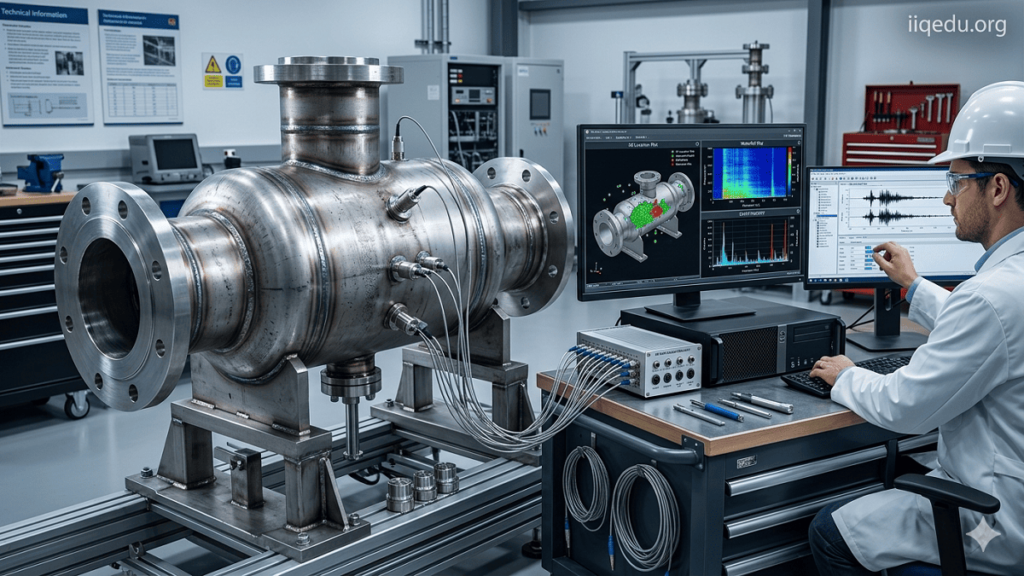
Industry application of acoustic emission testing
Acoustic Emission (AE) Testing is a non-destructive testing (NDT) method that detects cracks, structural flaws, and material fatigue by “listening” to the high-frequency acoustic waves emitted by stressed materials. Its ability to provide real-time, in-service monitoring makes it a powerful tool across multiple industries where safety, reliability, and early defect detection are critical.
1. Oil and Gas Industry
Pipelines, storage tanks, and pressure vessels in the oil and gas sector are constantly exposed to high pressure, temperature variations, and environmental stress. AE testing is widely applied to detect leaks, corrosion, and developing cracks in these systems without requiring shutdowns. By continuously monitoring critical infrastructure, companies can prevent environmental hazards, operational downtime, and catastrophic failures.
2. Aerospace and Aviation
Aircraft components, including fuselage, wings, and turbine parts, are subject to extreme stress and fatigue. AE testing is used to monitor micro-cracks, delamination, or material fatigue in composites and metals. By detecting early-stage defects, engineers can perform maintenance before safety is compromised, ensuring longer lifespan and airworthiness of aircraft components.
3. Power Generation and Energy Sector
In power plants—nuclear, thermal, and renewable energy facilities—AE testing monitors turbines, boilers, reactors, and wind turbine blades. It identifies early signs of structural fatigue, cracking, or corrosion. Continuous AE monitoring enables predictive maintenance, preventing unexpected outages and costly repairs while improving overall plant safety.
4. Construction and Civil Engineering
AE testing is applied to bridges, tunnels, dams, and high-rise buildings. Concrete, steel, and composite structures can develop micro-cracks or stress-related defects over time. AE testing allows engineers to detect and locate structural weaknesses before they escalate, ensuring the safety and longevity of infrastructure.
5. Manufacturing and Industrial Components
Industrial equipment, including pressure vessels, tanks, and welded joints, requires AE testing for quality assurance and in-service monitoring. It helps identify weld defects, material fatigue, and crack propagation, ensuring products meet stringent safety and quality standards.
6. Research and Material Development
In laboratories and research facilities, AE testing is used to study material behavior under stress, including fracture mechanics, fatigue testing, and performance of new composites. Researchers rely on AE data to improve material design and predict failure modes, supporting innovation in engineering and manufacturing.
What is Acoustic Emission (AE) Testing?
Acoustic Emission (AE) Testing is a non-destructive testing (NDT) method that detects cracks, defects, or material fatigue by “listening” to high-frequency acoustic waves emitted by a stressed material. Sensors placed on the surface capture these waves, which are then analyzed to identify the location, severity, and growth of defects without damaging the material.
How does AE Testing work?
AE Testing works by detecting the sound energy released by materials under stress. When a material experiences internal events such as crack growth, corrosion, or delamination, it emits high-frequency acoustic waves. Sensors capture these signals, and software analyzes them to determine where and how serious the defect is. This method allows real-time monitoring of in-service structures.
Who should perform Acoustic Emission Testing?
AE Testing should be performed by certified NDT technicians and engineers. Technicians install and operate the sensors and equipment, while engineers interpret the data to assess the condition of the material or structure. In industrial settings, operations staff may also be involved to safely coordinate the test, and data analysts may process the signals for accurate reporting.
Where is AE Testing commonly used?
AE Testing is used in industries where safety and structural integrity are critical, including:
Oil and Gas: Pipelines, pressure vessels, and tanks
Aerospace: Aircraft fuselage, wings, and turbine components
Power Generation: Boilers, turbines, and wind turbines
Construction: Bridges, dams, tunnels, and high-rise buildings
Research & Development: Material fatigue and fracture testing
What are the advantages of Acoustic Emission Testing?
AE Testing offers several key advantages:
Non-destructive: Does not damage the material.
Early detection: Identifies defects before visible damage occurs.
Real-time monitoring: Can be done while structures are in service.
Applicable to large structures: Effective for pipelines, bridges, and industrial equipment.
Cost-efficient: Prevents costly downtime or catastrophic failures by allowing targeted maintenance.
source : Material Welding- Online Welding and NDT Training
Table of Contents
Description:
The information provided about Acoustic Emission Testing is for educational and informational purposes only. It is not professional, technical, or legal advice. Accuracy may vary, and readers should consult certified NDT professionals, engineers, or manufacturers before applying AE testing. The authors are not responsible for any outcomes or damages