Technology is evolving rapidly, and machines today are becoming more intelligent and capable than ever before. One of the key innovations behind this transformation is Advanced Sensing and Vision. This technology enables machines and digital systems to detect their surroundings, interpret visual information, and make decisions based on what they observe.
In simple terms, Advanced Sensing and Vision refers to technologies that allow machines to sense the environment and understand visual data, similar to how humans use their eyes and other senses to interact with the world.
WHAT IS ADVANCE SENSING AND VISION
Advanced Sensing and Vision is a modern technology that enables machines and digital systems to detect their surroundings and understand visual information. It combines different types of sensors, cameras, and intelligent algorithms to help machines observe, analyze, and interpret the environment in a way similar to how humans use their senses and vision.
Advanced sensing refers to the use of specialized sensors that collect data from the physical world. Sensors act like the “sensory organs” of machines. They can measure different types of information such as distance, light, motion, temperature, and location. Some commonly used sensors include cameras, LiDAR sensors, radar sensors, ultrasonic sensors, and GPS devices. These sensors gather raw data from the surroundings and send it to a computer system for further processing.
The vision part of this technology focuses on how machines interpret and understand visual information. This area is closely related to Computer Vision, which allows computers to analyze images and videos. Using computer vision techniques, machines can identify objects, recognize faces, track movement, and understand scenes captured by cameras. For example, a system can analyze a picture to detect whether it contains a person, a vehicle, or another object.
To make these systems more accurate and intelligent, technologies such as Machine Learning and Deep Learning are often used. These technologies allow machines to learn from large amounts of data and improve their ability to recognize patterns and make decisions. Over time, the system becomes more efficient at interpreting sensory and visual information.
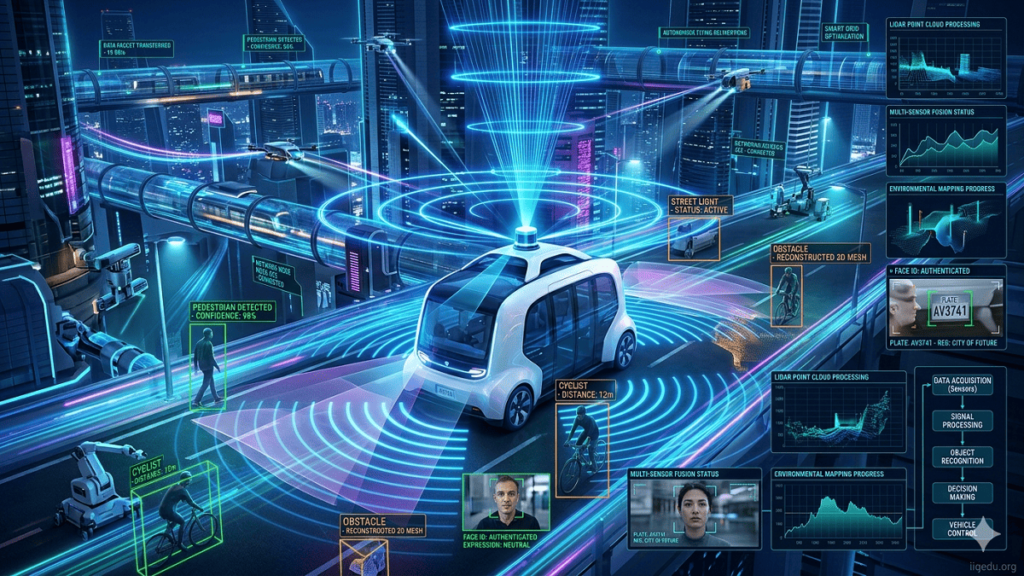
Advanced Sensing and Vision technologies are widely used in many real-world applications. One important example is autonomous or self-driving cars. These vehicles use cameras, LiDAR, radar, and other sensors to detect roads, traffic signals, pedestrians, and obstacles. The vehicle’s computer system processes this data and makes driving decisions to ensure safety. In healthcare, advanced vision systems help doctors analyze medical images such as X-rays, CT scans, and MRIs to detect diseases more accurately.
This technology is also used in manufacturing industries for quality inspection, in smartphones for facial recognition and augmented reality features, and in security systems for surveillance and monitoring. By enabling machines to sense and understand their environment, Advanced Sensing and Vision plays a crucial role in automation and intelligent systems.
In conclusion, Advanced Sensing and Vision is an important field that combines sensors, cameras, and artificial intelligence to help machines perceive and understand the world. As technology continues to develop, it will become even more essential in improving safety, efficiency, and innovation across many industries.
WHO IS REQUIRED FOR ADVANCE SENSING AND VISION
Advanced Sensing and Vision is a multidisciplinary field that requires professionals from several technical backgrounds to design and develop intelligent systems capable of sensing and understanding their environment. Since this technology combines sensors, cameras, data processing, and artificial intelligence, a team of experts with different skills is necessary to build and maintain these systems.
One of the most important professionals in this field is a computer vision engineer. These experts work in the area of Computer Vision, where they develop algorithms that allow machines to interpret images and videos. Their work involves tasks such as object detection, image recognition, motion tracking, and scene understanding. Computer vision engineers design systems that help machines recognize people, vehicles, objects, and other elements in visual data.
Another key role is played by machine learning engineers. They apply techniques from Machine Learning and Deep Learning to train systems to learn from large datasets. These engineers build intelligent models that improve the accuracy of sensing and vision systems over time. Their work helps machines recognize patterns, make predictions, and make better decisions based on the data collected from sensors.
Electronics and sensor engineers are also essential in Advanced Sensing and Vision systems. They design and develop the hardware components such as cameras, LiDAR sensors, radar sensors, and ultrasonic sensors. These sensors collect information from the environment, such as distance, motion, light, and temperature. Sensor engineers ensure that these devices function properly and provide accurate data for processing.
Another important group of professionals are robotics engineers, who work in the field of Robotics. They integrate sensing and vision technologies into robots so that robots can navigate their surroundings, avoid obstacles, and interact with objects or people. Robotics engineers often combine mechanical design, electronics, and software to build intelligent robotic systems.
In addition, software developers and embedded systems engineers play a significant role in creating the programs and platforms that control sensing and vision systems. They ensure that sensors, cameras, and processing units communicate effectively and operate in real time.
WHEN IS REQUIRED FOR ADVANCE SENSING AND VISION
Advanced Sensing and Vision is required when machines or systems need to detect, analyze, and understand their surroundings automatically. It becomes essential in situations where real-time observation, accurate detection, and intelligent decision-making are needed without constant human involvement.
One important situation where Advanced Sensing and Vision is required is in autonomous transportation. Self-driving vehicles use cameras, sensors, and intelligent software to identify roads, traffic signals, pedestrians, and obstacles. In such systems, technologies related to Computer Vision help vehicles interpret visual information and make safe driving decisions.
Advanced Sensing and Vision is also required in industrial automation and manufacturing. Many modern factories use machine vision systems to inspect products, detect defects, and maintain high quality in production lines. These systems can work faster and more accurately than manual inspection, making manufacturing more efficient.
Another area where this technology is necessary is healthcare and medical imaging. Advanced sensing and vision systems are used to analyze medical images such as X-rays, CT scans, and MRI scans. Doctors use these systems to detect diseases, monitor patient conditions, and improve diagnostic accuracy.
In addition, Advanced Sensing and Vision is required in robotics and smart devices. Robots use sensors and cameras to understand their surroundings, navigate spaces, and perform tasks such as object picking or assistance in hospitals and warehouses. These systems often use techniques from Machine Learning to improve their ability to recognize patterns and respond intelligently.
This technology is also widely used in security and surveillance systems. Smart cameras can monitor environments, detect suspicious activities, and recognize faces or objects in real time. Such systems help improve safety in public places, offices, and homes.
WHERE IS REQUIRED FOR ADVANCE SENSING AND VISION
Advanced Sensing and Vision is required in many industries and environments where machines need to detect, analyze, and understand their surroundings. It is widely used in modern technologies that rely on sensors, cameras, and intelligent software to perform tasks automatically and accurately.
One of the main areas where Advanced Sensing and Vision is required is in transportation systems, especially autonomous or self-driving vehicles. These vehicles use cameras, LiDAR, and radar sensors to detect roads, pedestrians, traffic signs, and obstacles. With the help of Computer Vision, the vehicle can analyze visual data and make safe driving decisions.
Another important area is manufacturing and industrial automation. Factories use machine vision systems to inspect products, identify defects, and ensure quality control in production lines. These systems can quickly detect errors that may be difficult for humans to notice, improving efficiency and reducing production costs.
Advanced Sensing and Vision is also widely required in healthcare. Medical imaging systems use advanced vision technologies to analyze images from X-rays, CT scans, and MRI machines. Doctors and medical professionals rely on these systems to detect diseases, study internal body structures, and make accurate diagnoses.
In addition, this technology is used in robotics and smart machines. Robots equipped with sensors and cameras can navigate their surroundings, avoid obstacles, and interact with objects. These systems often use techniques from Machine Learning to improve their ability to recognize patterns and respond intelligently.
Another common application area is security and surveillance systems. Smart cameras are used in airports, offices, public places, and homes to monitor activities, recognize faces, and detect unusual behavior. This helps improve safety and prevent security threats.
Advanced Sensing and Vision is also used in smartphones and consumer electronics. Features such as facial recognition, augmented reality, and gesture detection rely on cameras and sensors to understand user actions and provide better user experiences
HOW IS REQUIRED FOR ADVANCE SENSING AND VISION
Advanced Sensing and Vision is required through the integration of sensors, cameras, and intelligent algorithms that enable machines to observe and interpret their environment. This technology works by collecting data from the physical world, processing that data, and then using it to make intelligent decisions.
First, different types of sensors such as cameras, LiDAR, radar, and ultrasonic sensors are used to capture information from the environment. These sensors act as the “eyes and senses” of a machine, collecting raw data such as images, distance measurements, motion, and light intensity. This data provides important information about the surroundings.
Next, the collected data is processed using computer systems and advanced software. Technologies related to Computer Vision help machines analyze images and videos to identify objects, recognize patterns, and detect movements. For example, a system may detect pedestrians, vehicles, or obstacles from camera images.
To improve the accuracy and intelligence of these systems, techniques from Machine Learning and Deep Learning are used. These technologies allow machines to learn from large datasets and improve their ability to recognize objects and make predictions. Over time, the system becomes more efficient at understanding complex environments.
Finally, the processed information is used to make decisions or perform actions. For instance, in a self-driving vehicle, the system analyzes sensor data to determine when to accelerate, brake, or change direction. Similarly, in industrial automation, machines can inspect products and detect defects automatically.

CASE STUDY OF ADVANCE SENSING AND VISION
A well-known example of Advanced Sensing and Vision can be seen in the development of autonomous or self-driving vehicles. These vehicles rely heavily on sensing and vision technologies to navigate roads safely and make driving decisions without direct human control.
One of the leading companies working on this technology is Tesla, which uses a combination of cameras, sensors, and artificial intelligence to create advanced driver-assistance systems. The vehicle is equipped with multiple cameras placed around the car to capture images of the road, nearby vehicles, traffic signs, and pedestrians. In addition, sensors such as radar and ultrasonic sensors help measure distances and detect obstacles that may not be clearly visible.
The captured visual data is then processed using systems based on Computer Vision. These systems analyze the images in real time to identify objects such as lanes, traffic lights, vehicles, and pedestrians. This allows the vehicle to understand its surroundings and react appropriately while driving.
To improve accuracy and decision-making, the system also uses Machine Learning and Deep Learning techniques. These technologies enable the vehicle to learn from large amounts of driving data collected from many cars. Over time, the system becomes better at recognizing complex road situations and predicting possible risks.
For example, when the car approaches a pedestrian crossing, the cameras detect the pedestrian while radar sensors measure the distance. The computer system quickly analyzes this information and decides whether the car should slow down or stop. This entire process happens within seconds, ensuring safety and smooth driving.
The use of Advanced Sensing and Vision in autonomous vehicles has significantly improved road safety and driving efficiency. It reduces human errors such as distraction or fatigue and helps vehicles respond quickly to unexpected situations.
WHITE PAPER ON ADVANCE SENSING AND VISION
Executive Summary
Advanced Sensing and Vision is an emerging technological field that enables machines and intelligent systems to perceive, analyze, and understand their surroundings. By combining advanced sensors, cameras, data processing systems, and artificial intelligence algorithms, machines can interpret real-world environments and make automated decisions. This technology is widely used in autonomous vehicles, healthcare, robotics, industrial automation, and security systems. The purpose of this white paper is to explain the concept of advanced sensing and vision, its core technologies, applications, benefits, and the future potential of this rapidly evolving field.
Introduction
The rapid development of digital technologies has increased the demand for intelligent systems that can interact with the physical world. Advanced sensing and vision technologies play a vital role in enabling machines to observe and understand their surroundings. These technologies combine sensing devices with visual data processing to provide real-time insights and decision-making capabilities.
Sensing technologies collect information from the environment through devices such as cameras, LiDAR sensors, radar, and other measurement instruments. Vision technologies then analyze this data using computer algorithms to identify objects, patterns, and movements. Together, they create systems that can detect, analyze, and respond to environmental conditions.
Core Technologies
Advanced sensing and vision systems rely on several key technologies that work together to process environmental data.
Sensor Technologies
Sensors are responsible for capturing information from the environment. They detect parameters such as light, distance, temperature, motion, and location. Common sensors include optical cameras, LiDAR sensors, radar sensors, ultrasonic sensors, and GPS modules.
Computer Vision
Computer vision technology allows machines to interpret images and videos. It uses image processing techniques to detect objects, recognize faces, track movement, and analyze scenes captured by cameras.
Artificial Intelligence and Machine Learning
Artificial intelligence and machine learning algorithms enable systems to learn from large datasets and improve their ability to recognize patterns. These technologies enhance the accuracy and efficiency of sensing and vision systems.
Data Processing and Integration
Collected sensor data is processed using advanced computing systems. Data integration techniques combine information from multiple sensors to provide a more accurate understanding of the environment.
Key Applications
Advanced sensing and vision technologies are transforming several industries and sectors.
Autonomous Transportation
Self-driving vehicles use advanced sensing and vision systems to detect roads, obstacles, pedestrians, and traffic signals. These technologies help vehicles navigate safely and make real-time driving decisions.
Healthcare and Medical Imaging
In healthcare, vision systems analyze medical images such as X-rays, CT scans, and MRI scans to support doctors in diagnosing diseases and planning treatments.
Industrial Automation
Manufacturing industries use machine vision systems to inspect products, identify defects, and ensure quality control in production processes.
Robotics
Robots equipped with sensors and cameras can navigate environments, interact with objects, and perform complex tasks with minimal human intervention.
Security and Surveillance
Smart surveillance systems use vision technologies to monitor environments, detect suspicious activities, and enhance public safety.
Benefits
The adoption of advanced sensing and vision technologies offers several advantages. These systems improve automation, increase operational efficiency, and enhance safety in various environments. They also enable faster and more accurate decision-making by processing real-time data from multiple sensors.
Challenges
Despite its advantages, advanced sensing and vision technology faces several challenges. Processing large volumes of sensor data requires high computing power and advanced algorithms. Environmental factors such as poor lighting, weather conditions, and sensor limitations can affect system performance. Additionally, concerns related to privacy, data security, and ethical use must be carefully addressed.
Future Outlook
The future of advanced sensing and vision is highly promising. With continued advancements in artificial intelligence, sensor technology, and data processing capabilities, these systems will become more powerful and widely adopted. Future developments may include smarter autonomous vehicles, improved medical diagnostic systems, intelligent robots, and smart city infrastructure.
source : AI Sciences
INDUSTRY APPLICATION OF ADVANCE SENSING AND VISION
Advanced Sensing and Vision is widely used across many industries to improve automation, efficiency, safety, and accuracy. By combining sensors, cameras, and intelligent software, machines can detect objects, analyze environments, and make smart decisions without constant human intervention.
Manufacturing Industry
In manufacturing, Advanced Sensing and Vision systems are used for quality inspection and defect detection. Machine vision systems can examine products on production lines to identify faults, measure dimensions, and ensure that items meet quality standards. This reduces human error and increases production efficiency.
Automotive Industry
The automotive sector uses sensing and vision technologies in autonomous and driver-assistance systems. Vehicles use cameras, radar, and LiDAR sensors to detect lanes, traffic signs, pedestrians, and other vehicles. These systems rely on Computer Vision to analyze visual data and help vehicles drive safely.
Healthcare Industry
In healthcare, advanced sensing and vision technologies are used in medical imaging and diagnostics. Doctors use systems that analyze X-rays, MRI scans, and CT scans to detect diseases and abnormalities. These technologies assist medical professionals in making faster and more accurate diagnoses.
Robotics and Automation
Robots in industries and warehouses use sensors and cameras to navigate environments, recognize objects, and perform tasks such as picking, sorting, and assembling products. These robots often use techniques from Machine Learning to improve their performance over time.
Security and Surveillance
Security systems use intelligent cameras to monitor public spaces, offices, and homes. Vision systems can detect suspicious activities, recognize faces, and track movements in real time, improving safety and surveillance capabilities.
Agriculture
In agriculture, sensing and vision technologies help farmers monitor crops, detect plant diseases, and analyze soil conditions. Drones and smart cameras are often used to collect images of farmland and provide valuable insights for better crop management.
Retail Industry
Retail stores use advanced vision systems for customer behavior analysis, automated checkout systems, and inventory monitoring. These technologies help businesses improve customer experiences and manage store operations more efficiently.
ASK FAQ
What is Advanced Sensing and Vision?
Advanced Sensing and Vision is a technology that allows machines to detect, analyze, and understand their surroundings using sensors, cameras, and intelligent algorithms. It combines sensing technologies with Computer Vision to process images and environmental data, enabling systems such as autonomous vehicles, smart cameras, and robots to make decisions automatically.
How does Advanced Sensing and Vision work?
Advanced Sensing and Vision works by collecting data through sensors like cameras, radar, and LiDAR. The data is then processed using artificial intelligence techniques such as Machine Learning and Deep Learning. These technologies analyze images, detect objects, recognize patterns, and help machines understand the environment.
What are the main applications of Advanced Sensing and Vision?
Advanced Sensing and Vision is used in many industries, including autonomous vehicles, healthcare, robotics, manufacturing, agriculture, and security systems. For example, self-driving cars use sensors and cameras to detect roads and obstacles, while healthcare systems use vision technology to analyze medical images for disease detection.
What technologies are used in Advanced Sensing and Vision systems?
Several technologies are involved in Advanced Sensing and Vision systems, including sensors, cameras, artificial intelligence, computer vision, and data processing systems. These technologies work together to collect environmental data, analyze visual information, and enable machines to make intelligent decisions.
What are the benefits of Advanced Sensing and Vision?
Advanced Sensing and Vision provides many benefits such as improved automation, higher accuracy in object detection, enhanced safety, and faster decision-making. It helps industries reduce human error, increase efficiency, and develop smarter technologies for transportation, healthcare, manufacturing, and security.
Table of Contents
Disclaimer
The information provided about Advanced Sensing and Vision is for educational and informational purposes only. While efforts have been made to ensure accuracy, the content may not always reflect the latest developments in technologies such as Computer Vision and Machine Learning. The author is not responsible for any errors, omissions, or outcomes resulting from the use of this information. Readers are encouraged to verify details from reliable sources.