AI & Machine Learning in QC/QA
Artificial Intelligence (AI) and Machine Learning (ML) in QC/QA refer to the use of advanced algorithms and models to automate, optimize, and improve quality control and assurance processes in manufacturing and production.
AI systems can analyze large volumes of data from sensors, cameras, and production lines to identify defects, predict failures, and ensure product quality. Machine learning allows the system to learn from past inspection data, continuously improving its accuracy and decision-making capabilities over time.
How It Works
- Data Collection:
- Sensors, cameras, and machines collect production data, images, and measurements in real time.
- Data Analysis Using AI/ML:
- Algorithms process the data to detect defects, anomalies, or deviations from quality standards.
- Machine learning models improve over time by learning from historical data and inspection results.
- Decision Making & Automation:
- AI can flag defective items, trigger alerts, or adjust production processes automatically.
- Integration with robotics or automated production systems enables real-time corrective actions.
- Reporting & Insights:
- Generates predictive analytics, trend reports, and quality dashboards for better decision-making.
Applications
- Manufacturing: Detect surface defects, misalignments, or dimensional inconsistencies on production lines.
- Electronics: Inspect PCB boards, solder joints, and microchips for hidden faults.
- Pharmaceuticals & Food Industry: Monitor product safety, packaging integrity, and contamination.
- Automotive & Aerospace: Detect weld defects, material fatigue, and critical component failures.
- R&D Labs: Optimize product designs and test prototypes efficiently using predictive quality analysis.
Benefits
- Higher Accuracy: Detect defects that humans may miss.
- Real-Time Quality Control: Immediate detection and corrective actions.
- Predictive Maintenance: Identify potential equipment failures before they occur.
- Data-Driven Insights: Helps optimize production processes and reduce waste.
- Scalability: Can manage high-volume production lines efficiently.
What is AI & Machine Learning in QC/QA?
AI (Artificial Intelligence) and Machine Learning (ML) in Quality Control (QC) and Quality Assurance (QA) refer to the application of advanced computational algorithms to automate, optimize, and improve quality management processes in manufacturing and production.
Unlike traditional inspection methods, AI & ML systems can analyze large volumes of data from sensors, cameras, and production lines to:
- Detect defects in products automatically
- Predict potential failures before they occur
- Optimize production processes for higher efficiency and consistency
Machine Learning allows the system to learn from past data and inspection results, continuously improving its ability to identify anomalies and make accurate decisions.
In simple terms:
AI & ML in QC/QA enable manufacturers to “see, predict, and correct” quality issues in real time, reducing human error, minimizing waste, and ensuring consistent product quality across high-volume production.
Who is AI & Machine Learning in QC/QA required?
AI and Machine Learning in QC/QA are required by organizations and professionals responsible for ensuring product quality, safety, and process efficiency, especially in industries with high-volume production or safety-critical components.
Key Users Who Require AI & ML in QC/QA
- Quality Assurance (QA) Teams
- To automatically detect defects, deviations, or inconsistencies in production.
- Manufacturing Engineers
- To optimize production processes, reduce waste, and ensure consistent quality.
- Production Managers
- To monitor real-time quality data and make informed operational decisions.
- Electronics & Semiconductor Inspectors
- To analyze complex PCBs, microchips, and soldering joints for hidden faults.
- Pharmaceutical & Food Industry Professionals
- To ensure product safety, packaging integrity, and regulatory compliance.
- Aerospace & Automotive Engineers
- To detect material fatigue, weld defects, or structural inconsistencies in critical components.
- R&D Teams
- To evaluate prototypes and improve product designs using predictive quality analytics.
In simple terms:
AI & ML in QC/QA are required by engineers, QA specialists, production managers, and inspectors who need to analyze large datasets, detect defects in real time, predict failures, and optimize manufacturing processes for superior quality and efficiency.
When is AI & Machine Learning in QC/QA required?
AI & Machine Learning in QC/QA are required whenever organizations need real-time, accurate, and automated quality inspection to ensure product reliability, safety, and efficiency. They are especially critical in industries with high-volume production, complex components, or safety-critical products.
Key Situations When AI & ML Are Required
- High-Volume Production Lines
- Manual inspections may be too slow or inconsistent; AI enables automated, real-time defect detection.
- Complex or Precision Components
- Electronics, microchips, turbine blades, or 3D-printed parts where small defects can have serious consequences.
- Predictive Quality & Maintenance
- When early detection of potential failures or defects is needed to prevent downtime or recalls.
- Regulatory Compliance
- Ensures products meet industry standards in pharmaceuticals, food, medical devices, aerospace, and automotive.
- Research & Development (R&D)
- Evaluates prototypes or new materials for hidden defects and optimizes production processes.
- When Reducing Waste & Cost is Critical
- AI can flag defective items early, reducing scrap, rework, and production costs.
In simple terms:
AI & ML in QC/QA are required anytime production quality, defect detection, or predictive maintenance needs to be automated, accurate, and efficient, particularly in high-precision, high-volume, or safety-critical industries.
Where is AI & Machine Learning in QC/QA required?
AI & Machine Learning in QC/QA are required in environments and industries where high accuracy, real-time defect detection, and process optimization are critical. These technologies are especially valuable where manual inspection is inefficient or prone to error.
Key Locations and Industries
- Manufacturing Plants
- Automated assembly lines for electronics, automotive parts, or consumer goods.
- Detect defects in real-time to maintain consistent quality.
- Electronics and Semiconductor Facilities
- Inspect PCBs, microchips, and soldering joints for hidden faults.
- Pharmaceutical & Food Industries
- Ensure product safety, packaging integrity, and compliance with strict regulatory standards.
- Automotive & Aerospace Plants
- Detect structural defects, weld issues, or material fatigue in critical components.
- R&D Laboratories
- Test prototypes, new materials, or experimental designs for defects and optimize manufacturing processes.
- Industrial IoT and Smart Factories
- Monitor production equipment and processes continuously for predictive maintenance and anomaly detection.
In simple terms:
AI & ML in QC/QA are required wherever product quality, defect detection, and process efficiency need to be automated, precise, and scalable—from high-volume factories to R&D labs and smart industrial facilities.
How is AI & Machine Learning in QC/QA required?
AI & Machine Learning in QC/QA are required by integrating advanced algorithms into the quality control and assurance processes to automate defect detection, optimize production, and provide predictive insights. They work by analyzing large volumes of data from sensors, cameras, and production lines to detect anomalies faster and more accurately than manual inspection.
How AI & ML Are Implemented in QC/QA
- Data Collection
- Collect real-time data from sensors, vision systems, cameras, and production equipment.
- Data Analysis with AI/ML Algorithms
- AI models analyze data to identify defects, anomalies, or deviations from quality standards.
- Machine learning models improve over time by learning from historical data and inspection results.
- Decision-Making and Automation
- AI can flag defective items, trigger alerts, or even adjust production parameters automatically.
- Enables real-time corrective actions without human intervention.
- Visualization and Reporting
- Generates dashboards showing defect trends, predictive maintenance alerts, and quality metrics.
- Provides actionable insights to improve production efficiency and reduce waste.
In simple terms:
AI & ML are required in QC/QA by analyzing production data in real time, detecting defects automatically, predicting failures, and optimizing manufacturing processes, ensuring higher efficiency, consistency, and product quality.
Source: Sarcastic Sindhi
Case study of AI & Machine Learning in QC/QA
Background
A leading electronics manufacturer faced challenges with high-volume production of printed circuit boards (PCBs). Manual inspection of solder joints and component placement was time-consuming and prone to human error, leading to higher defect rates, production delays, and increased rework costs.
Objective
- Automate quality control processes to reduce defects.
- Increase inspection speed without compromising accuracy.
- Predict and prevent potential failures in production.
Solution
The company implemented AI and Machine Learning-based QC systems:
- Automated Vision Systems
- High-resolution cameras captured images of PCBs in real time.
- AI algorithms analyzed images to detect misaligned components, soldering defects, and missing parts.
- Machine Learning Models
- Historical production and defect data were used to train ML models to recognize common defects.
- The system improved over time, reducing false positives and increasing accuracy.
- Integration with Production Line
- AI-driven inspection systems were integrated into the assembly line.
- Defective boards were automatically flagged and removed, while corrective alerts were sent to production teams.
Results
- Defect Detection Accuracy: Improved from 85% (manual inspection) to over 98%.
- Inspection Speed: Real-time inspection reduced inspection time by 70%.
- Reduced Waste and Rework: Fewer defective boards reached packaging, saving material costs.
- Data-Driven Insights: Production data helped engineers optimize assembly processes.
- Predictive Maintenance: Identified machinery anomalies early, preventing line stoppages.
White paper of AI & Machine Learning in QC/QA
1. Executive Summary
AI (Artificial Intelligence) and Machine Learning (ML) are revolutionizing Quality Control (QC) and Quality Assurance (QA) in modern manufacturing. By leveraging advanced algorithms and predictive analytics, AI & ML can automate defect detection, improve inspection accuracy, and optimize production processes.
This white paper explores the technology, implementation, benefits, challenges, and future trends of AI & ML in QC/QA across industries such as electronics, automotive, aerospace, pharmaceuticals, and food manufacturing.
2. Introduction
Traditional QC/QA methods often rely on manual inspection or rule-based automation, which can be slow, error-prone, and inefficient for high-volume or high-precision production. AI & ML systems address these limitations by:
- Analyzing large datasets from sensors, cameras, and production equipment
- Learning from historical inspection data to improve accuracy over time
- Predicting defects or failures before they occur
- Providing actionable insights to optimize processes and reduce waste
3. What is AI & Machine Learning in QC/QA?
AI & ML in QC/QA refer to technologies that automate quality inspection and decision-making using algorithms that can:
- Detect defects, anomalies, or deviations in real time
- Predict future failures or maintenance needs
- Optimize production processes for efficiency and consistency
- Continuously learn and improve from historical production data
4. How AI & ML Work in QC/QA
- Data Collection
- Gather images, sensor readings, and production metrics from machinery and production lines.
- Analysis with AI & ML
- AI algorithms detect visible and subtle defects.
- ML models improve defect recognition over time using historical data and feedback loops.
- Decision-Making & Automation
- Automatically flag defective items, adjust production parameters, or trigger alerts.
- Integrates with robotics or automated systems for real-time corrective action.
- Reporting & Insights
- Dashboards display defect trends, predictive maintenance alerts, and quality metrics.
- Provides actionable insights to optimize production efficiency and reduce waste.
5. Applications
- Electronics Manufacturing: Detect defects in PCBs, microchips, and soldering joints.
- Automotive & Aerospace: Inspect welds, structural components, and critical safety parts.
- Pharmaceuticals & Food Industry: Monitor product safety, packaging integrity, and contamination.
- Industrial Manufacturing & 3D Printing: Detect flaws in castings, additive-manufactured parts, and complex assemblies.
- R&D Labs: Optimize prototype quality and predict potential production issues.
6. Benefits
- Higher Accuracy: Detect defects beyond human capability.
- Real-Time Quality Control: Immediate detection and corrective action.
- Predictive Maintenance: Prevent equipment failures before they disrupt production.
- Data-Driven Optimization: Reduce waste, improve efficiency, and optimize production workflows.
- Scalable Solutions: Handle high-volume production lines efficiently.
7. Challenges
- High Initial Investment: AI & ML systems require advanced hardware and software.
- Training & Expertise: Skilled personnel are needed to implement and maintain AI systems.
- Data Quality: Accurate defect detection depends on high-quality data collection.
- Integration: Incorporating AI into existing production lines may require significant customization.
8. Future Trends
- AI-Powered Automation: Fully autonomous production lines with real-time quality control.
- IoT & Cloud Integration: Centralized monitoring and predictive quality analysis across multiple facilities.
- Advanced Machine Learning Models: Improved anomaly detection and defect prediction using deep learning.
- Miniaturized AI Solutions: Compact, edge-deployed AI devices for flexible inspection points.
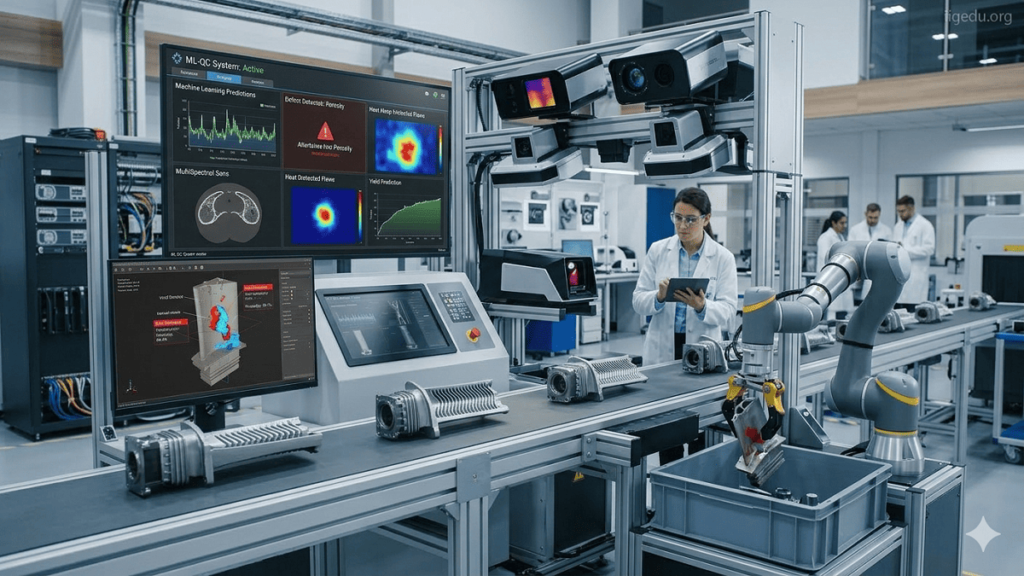
Idustry application of AI & Machine Learning in QC/QA
AI & Machine Learning (ML) in Quality Control (QC) and Quality Assurance (QA) are applied across industries where precision, efficiency, and defect detection are critical. By analyzing large volumes of production data in real time, these technologies help companies automate inspections, reduce defects, predict failures, and optimize processes.
1. Electronics & Semiconductor Industry
- Application: Inspect PCBs, microchips, and soldering joints for defects.
- Purpose: Detect hidden faults, misaligned components, and soldering issues that human inspectors might miss.
2. Automotive Industry
- Application: Monitor welds, engine parts, and complex assemblies on production lines.
- Purpose: Ensure structural integrity, reduce defects, and maintain high safety standards.
3. Aerospace Industry
- Application: Inspect turbine blades, composite materials, and critical safety components.
- Purpose: Detect cracks, voids, and material fatigue to prevent catastrophic failures.
4. Pharmaceuticals & Food Industry
- Application: Monitor product safety, packaging integrity, and contamination levels.
- Purpose: Ensure regulatory compliance, maintain product quality, and prevent recalls.
5. Industrial Manufacturing & 3D Printing
- Application: Examine castings, additive-manufactured parts, and complex assemblies.
- Purpose: Detect porosity, voids, or structural anomalies in high-value components.
6. R&D Laboratories
- Application: Test prototypes, new materials, and experimental designs.
- Purpose: Predict potential defects, optimize designs, and accelerate product development.
7. Smart Factories / Industrial IoT
- Application: Monitor connected production equipment in real time.
- Purpose: Predict equipment failures, detect anomalies, and optimize overall production efficiency.
Ask FAQs
What is AI & Machine Learning in QC/QA?
AI & Machine Learning in QC/QA involve using advanced algorithms and models to automate defect detection, optimize production processes, and improve product quality. They analyze data from sensors, cameras, and production lines to detect defects and predict potential failures.
Who uses AI & Machine Learning in QC/QA?
It is used by quality assurance teams, manufacturing engineers, production managers, electronics inspectors, pharmaceutical and food industry professionals, aerospace and automotive engineers, and R&D teams to ensure consistent product quality and safety.
When is AI & Machine Learning required in QC/QA?
AI & ML are required when high-volume production, precision components, or safety-critical products need accurate, real-time defect detection. They are also used for predictive maintenance, regulatory compliance, and R&D testing.
Where is AI & Machine Learning applied in QC/QA?
AI & ML are applied in electronics, automotive, aerospace, pharmaceuticals, food manufacturing, industrial manufacturing, 3D printing, R&D labs, and smart factories where automated, real-time inspection and defect prediction are critical.
What are the benefits of AI & Machine Learning in QC/QA?
Higher Accuracy: Detect defects beyond human capability
Real-Time Quality Control: Immediate defect detection and correction
Predictive Maintenance: Prevent equipment failures
Data-Driven Insights: Optimize processes and reduce waste
Scalability: Handle high-volume production efficiently
Source: Vedantu Upskill Academy
Table of Contents
Disclaimer:
The information on AI & Machine Learning in QC/QA is for general educational purposes only. Implementation should be carried out by trained professionals following industry standards and safety guidelines.