LIDAR-based Quality Monitoring
LIDAR (Light Detection and Ranging) is an advanced sensing technology that uses laser light to measure distances and capture precise 3D information about objects and surfaces. When applied to quality monitoring, LIDAR enables industries to inspect products and structures with high accuracy, speed, and non-contact measurement.
Unlike traditional inspection methods, LIDAR can rapidly scan surfaces to detect dimensional deviations, defects, misalignments, or surface inconsistencies. The technology generates a 3D point cloud, which can be analyzed with specialized software to compare real-time measurements against design specifications or quality standards.
What is LIDAR-based Quality Monitoring?
LIDAR-Based Quality Monitoring is a non-contact inspection technology that uses laser light to measure distances and capture 3D information about products, components, or structures. By scanning surfaces with high-resolution lasers, LIDAR generates precise 3D point clouds that can be analyzed to detect dimensional deviations, surface defects, misalignments, or inconsistencies.
Unlike traditional inspection methods, which may require manual measurements or physical contact, LIDAR allows rapid, accurate, and automated monitoring. This makes it ideal for manufacturing, construction, aerospace, automotive, and industrial equipment applications, where maintaining high precision and quality standards is critical.
In essence, LIDAR-based quality monitoring enables organizations to ensure product quality, prevent defects, and maintain operational efficiency by providing real-time, precise, and data-rich insights into the geometry and condition of components or structures.
Who is LIDAR-based Quality Monitoring required?
LIDAR-based quality monitoring is required by industries and organizations where precision, accuracy, and defect detection are critical. Its ability to provide non-contact, real-time, and highly accurate 3D measurements makes it indispensable for modern manufacturing and inspection processes.
1. Manufacturing Industry
Automotive, aerospace, electronics, and machinery manufacturers use LIDAR to inspect parts and assemblies for dimensional accuracy, surface defects, and alignment issues. It ensures that components meet strict design specifications and reduces costly production errors.
2. Construction and Civil Engineering
Construction companies and civil engineers require LIDAR to monitor buildings, bridges, and infrastructure. It checks structural alignment, detects deviations from blueprints, and identifies potential construction errors early, improving safety and reducing rework.
3. Industrial Equipment Monitoring
Industries with heavy machinery or critical equipment use LIDAR to monitor wear, deformation, and surface integrity. This prevents equipment failures and extends the operational life of machines.
4. Research and Development
R&D teams require LIDAR for prototype testing and material evaluation, enabling precise measurement of complex geometries and ensuring quality before mass production.
5. Logistics and Packaging
Companies in logistics and packaging use LIDAR to verify product dimensions, packaging accuracy, and alignment without physical contact, reducing damage and improving efficiency.
When is LIDAR-based Quality Monitoring required?
LIDAR-based quality monitoring is required whenever precision, accuracy, and early defect detection are critical to maintaining product or structural integrity. Its non-contact, high-resolution, and real-time scanning capabilities make it ideal for industries that cannot rely solely on visual inspection or manual measurements.
1. During Production and Manufacturing
LIDAR is required on production lines to monitor the dimensional accuracy of components, surface quality, and assembly alignment. For example, automotive and aerospace manufacturers use it to ensure parts meet exact design specifications, preventing defective products from reaching the market.
2. For Structural Verification
In construction and civil engineering, LIDAR is required during and after construction to verify that buildings, bridges, and other structures are built according to design plans. It detects misalignments, deviations, or structural anomalies early, reducing costly rework and safety risks.
3. Maintenance and Wear Monitoring
LIDAR is required during routine maintenance of industrial machinery and equipment. By scanning components over time, companies can detect wear, deformation, or surface defects, preventing unexpected failures and extending equipment lifespan.
4. Prototype Testing and R&D
During research and development, LIDAR is required to analyze prototypes, test new materials, and ensure quality before scaling production. It provides precise measurements of complex geometries that are difficult to inspect manually.
5. Packaging and Logistics
In packaging or logistics, LIDAR is required to verify product dimensions, alignment, and packaging integrity without physical contact, ensuring consistent quality and reducing damage.
Where is LIDAR-based Quality Monitoring required?
LIDAR-based quality monitoring is required in industries and environments where high precision, safety, and quality control are critical. Its ability to generate accurate 3D data, detect defects, and measure dimensional deviations without contact makes it highly versatile across multiple sectors.
1. Manufacturing Plants
LIDAR is widely used in automotive, aerospace, electronics, and machinery manufacturing to inspect parts, assemblies, and surface finishes. It ensures that components meet design specifications and quality standards before reaching customers.
2. Construction and Civil Engineering Sites
In construction, LIDAR is applied to buildings, bridges, tunnels, and infrastructure to verify structural alignment, detect deviations from design plans, and ensure construction accuracy. This reduces rework, improves safety, and maintains project timelines.
3. Industrial Equipment Facilities
Heavy industries and factories use LIDAR to monitor machinery, pipelines, and equipment for wear, deformation, or surface defects. This helps prevent unexpected failures and extends the operational life of critical assets.
4. Research and Development Laboratories
LIDAR is required in R&D labs for prototype testing, material evaluation, and precise measurement of complex geometries. It helps engineers and scientists ensure that new products meet exact specifications before scaling production.
5. Logistics and Packaging Centers
In logistics and packaging, LIDAR is used to verify product dimensions, check packaging integrity, and detect misaligned items without physical contact. This improves operational efficiency and reduces product damage.
source : Geospatial World
How Is LIDAR-Based Quality Monitoring Required?
LIDAR-based quality monitoring is required whenever industries need precise, non-contact, and real-time inspection of products, components, or structures. It is implemented through a systematic workflow that combines laser scanning, 3D data collection, and advanced software analysis to ensure high-quality standards and operational efficiency.
1. Setup and Installation
LIDAR systems are installed in production lines, laboratories, or on-site locations depending on the application. The system includes laser sensors, scanning devices, and data acquisition units calibrated to capture accurate 3D measurements of the target objects.
2. Data Acquisition
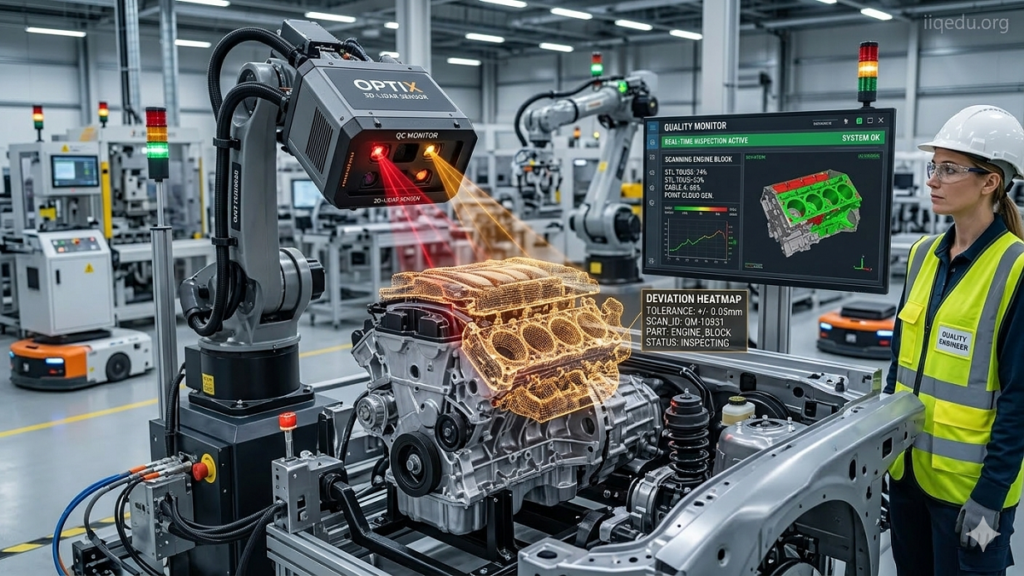
During inspection, LIDAR emits laser pulses that reflect off surfaces and return to the sensors. The time-of-flight or phase shift of the laser is measured to create a detailed 3D point cloud, capturing surface geometry, dimensions, and potential defects.
3. Analysis and Comparison
Advanced software analyzes the 3D point cloud, comparing it to design specifications, reference models, or quality standards. Any deviations, surface defects, misalignments, or dimensional errors are automatically flagged for review.
4. Actionable Results
The insights from LIDAR scanning allow operators, engineers, or quality control teams to:
- Remove defective products from production lines
- Adjust manufacturing or assembly processes
- Ensure packaging or construction compliance
- Monitor equipment wear and prevent failures
5. Who Performs It
LIDAR-based quality monitoring requires trained operators for scanning, engineers or analysts to interpret the 3D data, and quality control personnel to take corrective action based on the findings.
Case study of LIDAR-based Quality Monitoring
Background
A leading automotive manufacturer faced challenges ensuring dimensional accuracy and surface quality of car body panels during production. Traditional manual inspections were slow, inconsistent, and sometimes missed subtle defects, leading to rework, delays, and higher production costs. To improve quality and efficiency, the company implemented a LIDAR-based quality monitoring system on its assembly line.
Implementation
High-resolution LIDAR scanners were installed above the conveyor line to scan each car body panel as it passed. The scanners emitted laser pulses to measure the 3D geometry of the panels, generating detailed point clouds in real time. Advanced software compared these measurements against the CAD design specifications, identifying deviations, surface imperfections, and alignment issues.
The system flagged defective panels immediately, allowing operators to remove or correct them without halting production. Over time, the data also provided insights into recurring defects, helping engineers adjust machinery and assembly processes to prevent further issues.
Results
- Improved Accuracy: LIDAR detected micro-deviations and surface defects that manual inspection often missed.
- Reduced Rework and Waste: Early detection of defects decreased material wastage and production delays.
- Real-Time Monitoring: Operators received immediate alerts, enabling faster corrective action.
- Enhanced Operational Efficiency: Automation reduced reliance on manual inspections and increased throughput.
- Data-Driven Insights: The system provided a historical record for continuous quality improvement and predictive maintenance.
White paper of LIDAR-based Quality Monitoring
Executive Summary
LIDAR (Light Detection and Ranging) is a non-contact inspection technology that uses laser pulses to measure distances and create high-resolution 3D models of objects, surfaces, and components. In industrial settings, LIDAR enables real-time quality monitoring, allowing companies to detect defects, misalignments, dimensional deviations, and surface inconsistencies with unprecedented accuracy. This white paper explores the principles, technology, applications, benefits, challenges, and future trends of LIDAR-based quality monitoring.
1. Introduction
Maintaining product quality and precision is a critical challenge across industries such as automotive, aerospace, manufacturing, construction, and packaging. Traditional inspection methods, such as manual measurement or visual inspection, are often time-consuming, inconsistent, and prone to human error.
LIDAR-based quality monitoring addresses these limitations by providing fast, accurate, and non-destructive inspection. It generates 3D point clouds, which allow engineers and quality control teams to compare products or structures against design specifications and detect defects early in the production process.
2. Principles of LIDAR-Based Quality Monitoring
LIDAR works by:
- Emitting laser pulses toward the object or surface.
- Measuring the time-of-flight or phase shift of the returning light.
- Generating a 3D point cloud representing precise dimensions and surface details.
- Analyzing deviations compared to CAD models, reference standards, or quality benchmarks.
This enables non-contact, high-precision inspection of components, machinery, and structures in real time.
3. Technology and Equipment
Key components include:
- LIDAR sensors and scanners: Capture accurate distance and surface data
- Data acquisition systems: Record and process high-resolution point clouds
- Analysis software: Compares data against specifications and highlights anomalies
- Display systems: Visualize results for operators and engineers
4. Industry Applications
4.1 Automotive and Manufacturing
- Inspect car panels, engine parts, and assembly lines
- Detect surface defects, alignment issues, and dimensional deviations
4.2 Aerospace
- Monitor aircraft components and turbine blades
- Ensure compliance with safety and precision standards
4.3 Construction and Civil Engineering
- Verify building, bridge, and tunnel alignment
- Detect deviations from design plans efficiently
4.4 Industrial Equipment
- Monitor pipelines, machinery, and equipment for wear or deformation
- Enable predictive maintenance and reduce downtime
4.5 Logistics and Packaging
- Inspect product dimensions, packaging alignment, and integrity
- Reduce damaged goods and improve operational efficiency
5. Benefits
- Non-destructive inspection: No contact with products or equipment
- High precision: Detects micro-defects and dimensional deviations
- Real-time monitoring: Immediate alerts and corrective actions
- Data-rich: Detailed 3D models for analysis, reporting, and continuous improvement
- Efficiency: Reduces manual inspection, rework, and operational downtime
6. Challenges
- High initial cost: Equipment and software investment can be significant
- Data complexity: Requires skilled operators and engineers
- Environmental sensitivity: Accuracy depends on stable lighting and controlled conditions
7. Case Study Highlight
An automotive manufacturer implemented LIDAR to scan car body panels. The system detected misalignments and surface defects missed by manual inspection. As a result, rework decreased by 25%, production efficiency improved, and product quality consistency increased.
8. Future Trends
- Portable LIDAR systems for flexible inspection
- AI and machine learning integration for faster defect detection
- Industry 4.0 integration for predictive maintenance and digital twin modeling
Industry aapplication of LIDAR-based Quality Monitoring
LIDAR (Light Detection and Ranging) is a powerful, non-contact technology used for precise 3D measurement and quality monitoring across industries. By generating detailed point clouds and analyzing surface geometry, LIDAR detects defects, misalignments, and dimensional deviations, helping organizations maintain quality, safety, and operational efficiency.
1. Automotive and Manufacturing
- Inspect car body panels, engine components, and assembly lines for dimensional accuracy.
- Detect surface defects, dents, and misalignments in real time.
- Reduce rework, material wastage, and improve production efficiency.
2. Aerospace
- Monitor aircraft parts, fuselage structures, and turbine blades for critical tolerances.
- Ensure compliance with strict safety and quality standards.
- Facilitate predictive maintenance by identifying wear or deformation early.
3. Construction and Civil Engineering
- Verify alignment, dimensions, and structural integrity of buildings, bridges, and tunnels.
- Detect deviations from design plans and prevent costly rework.
- Enable fast inspection of large structures with minimal manual labor.
4. Industrial Equipment and Machinery
- Scan pipelines, turbines, and heavy machinery to monitor wear, deformation, or surface defects.
- Reduce downtime by enabling predictive maintenance.
- Ensure equipment operates safely and efficiently.
5. Logistics and Packaging
- Inspect product dimensions, packaging alignment, and integrity without physical contact.
- Detect misaligned or damaged items on production lines.
- Improve consistency and reduce damaged goods.
What is LIDAR-Based Quality Monitoring?
LIDAR-Based Quality Monitoring is a non-contact inspection technology that uses laser light to measure distances and capture precise 3D information. It detects surface defects, dimensional deviations, misalignments, and inconsistencies in products, components, or structures in real time.
How does LIDAR work in quality monitoring?
LIDAR emits laser pulses that reflect off surfaces to create a 3D point cloud. Specialized software compares these measurements against design specifications or quality standards to identify deviations, defects, or misalignments, allowing for real-time corrective action.
Who uses LIDAR-Based Quality Monitoring?
Industries that require high precision and non-destructive inspection use LIDAR, including:
Automotive and aerospace manufacturing
Industrial machinery and equipment monitoring
Construction and civil engineering
Logistics and packaging
Research and development laboratories
What are the benefits of using LIDAR for quality monitoring?
Non-contact: Prevents product or equipment damage
High precision: Detects micro deviations and surface defects
Real-time monitoring: Immediate feedback on quality issues
Data-rich: Generates detailed 3D point clouds for analysis
Efficiency: Reduces manual inspections, rework, and operational downtime
What types of products or structures can LIDAR inspect?
LIDAR can inspect a wide range of items, including:
Vehicle parts and assemblies
Aerospace components
Industrial machinery and pipelines
Buildings, bridges, and infrastructure
Packaged goods and product dimensions
source : Technical Guruji
Table of Contents
Disclaimer:
The information provided about LIDAR-Based Quality Monitoring is for educational and informational purposes only. It is not professional, technical, or legal advice. Consult certified specialists or industry professionals before implementing LIDAR systems for quality inspection.