Multi-sensor Fusion in QC
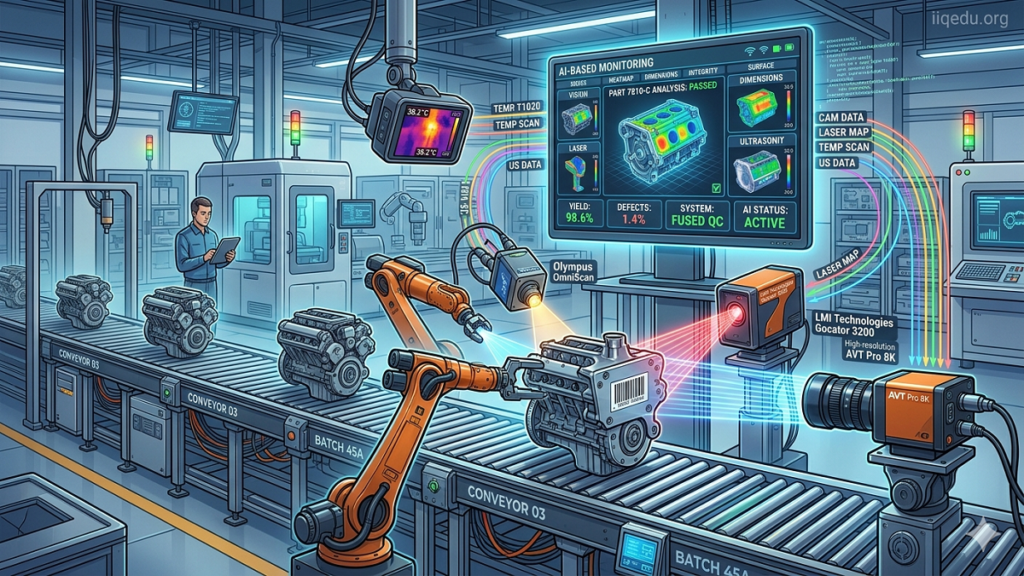
Multi-sensor fusion in Quality Control (QC) is a technique that combines data from multiple sensors—such as cameras, laser scanners, temperature sensors, and pressure sensors—to improve the accuracy, reliability, and efficiency of product inspection and monitoring during manufacturing.
Instead of relying on a single sensor, this method integrates information from several sources to create a more complete and accurate understanding of the product or process.
How Multi-Sensor Fusion Works
- Data Collection
Different sensors collect data simultaneously from the product or production environment. - Data Integration
The system combines data from all sensors into a single dataset. - Data Processing
Software algorithms analyze the combined data to identify patterns, defects, or irregularities. - Decision Making
The system determines whether the product meets quality standards or needs to be rejected.
Sensors Commonly Used
- Vision cameras – Detect shape, color, and surface defects
- Laser sensors – Measure dimensions and alignment
- Thermal sensors – Monitor temperature variations
- Pressure sensors – Check structural integrity or sealing
- Ultrasonic sensors – Detect internal defects
Applications in Industry
- Automotive manufacturing: Inspecting engine parts and body panels
- Electronics production: Checking circuit boards for missing components
- Food processing: Detecting contamination and packaging errors
- Pharmaceuticals: Ensuring correct tablet shape, size, and packaging
Advantages
- Higher inspection accuracy
- Improved defect detection
- Reduced false alarms
- Better process monitoring
- Increased production efficiency
Challenges
- Complex system integration
- Higher implementation cost
- Large data processing requirements
- Need for advanced algorithms
Conclusion
Multi-sensor fusion enhances quality control systems by combining multiple sources of information, making inspections more accurate and reliable. As industries move toward smart manufacturing and Industry 4.0, multi-sensor fusion is becoming an essential technology for advanced automated quality assurance.
What is Multi-sensor Fusion in QC?
Multi-Sensor Fusion in Quality Control (QC) is a technique where data from multiple sensors is combined and analyzed together to inspect products and monitor manufacturing processes more accurately.
Instead of relying on a single sensor, this method uses different types of sensors—such as cameras, laser scanners, temperature sensors, and pressure sensors—to gather more complete information about a product. The collected data is then processed by software or algorithms to detect defects, measure dimensions, and ensure that the product meets quality standards.
Example
In a manufacturing plant:
- A camera checks the product’s surface for scratches or color defects.
- A laser sensor measures the product’s size and shape.
- A temperature sensor monitors heat levels during production.
All this data is combined and analyzed together, allowing the system to make a more accurate decision about whether the product is acceptable or defective.
In Simple Terms
Multi-sensor fusion in QC means using multiple sensors together to improve the accuracy, reliability, and efficiency of quality inspection in industrial processes.
Who is Multi-sensor Fusion in QC required?
Multi-sensor Fusion in Quality Control (QC) is required or used by industries, engineers, and quality control teams that need highly accurate inspection and monitoring of products during manufacturing.
1. Manufacturing Companies
Factories use multi-sensor fusion systems to check product quality and detect defects during production.
2. Quality Control Engineers
QC engineers rely on multi-sensor fusion to analyze data from different sensors and ensure products meet quality standards.
3. Automation and Robotics Engineers
They use it to guide automated machines and robots for precise inspection and production processes.
4. Industrial Automation Systems
Smart factories and automated inspection systems use multi-sensor fusion to improve reliability and reduce errors.
5. Research and Development Teams
R&D teams use this technology to develop advanced inspection systems and improve manufacturing techniques.
In Simple Words
Multi-sensor fusion in QC is required by industries and professionals who need accurate, reliable, and automated quality inspection systems.
When is Multi-sensor Fusion in QC required?
Multi-sensor fusion in Quality Control (QC) is required when a single sensor is not enough to provide accurate or complete information about a product or manufacturing process. It is used to improve inspection accuracy, reliability, and efficiency.
1. When High Accuracy is Needed
It is required when products must meet strict quality standards and very small defects need to be detected.
2. When Multiple Product Features Must Be Checked
If different characteristics such as size, shape, temperature, and surface quality need to be inspected at the same time, multiple sensors are used together.
3. In Complex Manufacturing Processes
Industries with complex production lines require multi-sensor fusion to monitor different conditions simultaneously.
4. When One Sensor Cannot Detect All Defects
Some defects may not be visible to a single sensor. Combining sensors helps detect both surface and internal defects.
5. In Automated and Smart Factories
In modern Industry 4.0 environments, multi-sensor fusion is required to support automated inspection and real-time quality monitoring.
6. When Reducing Errors is Important
Using multiple sensors reduces the chance of false detections and improves the reliability of quality control systems.
In Simple Words
Multi-sensor fusion in QC is required when accurate, reliable, and comprehensive product inspection is needed in modern manufacturing systems.
How is Multi-sensor Fusion in QC required?
Multi-sensor fusion in Quality Control (QC) is required by combining data from different sensors to improve the accuracy and reliability of product inspection during manufacturing. It works through several important steps.
1. Collecting Data from Multiple Sensors
Different sensors are used to gather information about a product. For example:
- Cameras detect surface defects and color.
- Laser sensors measure size and shape.
- Temperature sensors monitor heat during production.
2. Integrating the Sensor Data
The data collected from all sensors is combined into one system. This allows the system to compare and analyze different types of information together.
3. Processing and Analysis
Special software or algorithms process the combined data to detect defects, measure dimensions, and identify irregularities in the product.
4. Making Quality Decisions
Based on the analysis, the system decides whether the product meets quality standards or if it should be rejected or corrected.
5. Improving Accuracy and Efficiency
By using multiple sensors together, the system reduces errors, improves inspection speed, and ensures better product quality.
In Simple Words
Multi-sensor fusion in QC is required by combining data from several sensors, analyzing it with software, and using the results to improve quality inspection and decision-making in manufacturing.
case study of Multi-sensor Fusion in QC
Background
A large automotive manufacturing company faced challenges in maintaining consistent quality while producing engine components. Traditional inspection methods using a single sensor could not detect all types of defects, which sometimes led to faulty parts passing through quality checks.
To solve this problem, the company implemented a Multi-Sensor Fusion Quality Control System.
Problem
The company experienced several issues:
- Surface defects like scratches were sometimes missed.
- Dimensional errors in parts were not always detected.
- Some internal defects could not be identified with visual inspection alone.
- Manual inspection slowed down production.
Solution
The company introduced a multi-sensor fusion system that combined several sensors in the inspection process:
- Vision Cameras: Detected surface defects such as scratches, dents, and discoloration.
- Laser Sensors: Measured the exact dimensions and alignment of engine parts.
- Ultrasonic Sensors: Identified internal cracks or structural defects.
- Temperature Sensors: Monitored heat levels during the manufacturing process.
All sensor data was integrated into a central software system that analyzed the information in real time.
Implementation Process
- Sensors were installed along the production line.
- Each sensor collected specific types of data from the engine components.
- The system fused the sensor data using advanced algorithms.
- If a defect was detected, the part was automatically removed from the production line.
Results
After implementing the multi-sensor fusion system, the company achieved:
- Higher inspection accuracy in detecting defects.
- Reduced product rejection rates due to early detection of issues.
- Faster inspection speed, improving production efficiency.
- Better data analysis for improving manufacturing processes.
Conclusion
The case study shows that Multi-Sensor Fusion in Quality Control significantly improves product inspection by combining information from multiple sensors. This approach helps industries achieve better quality, higher efficiency, and more reliable manufacturing processes.
Source: MATLAB
White paper of Multi-sensor Fusion in QC
1. Executive Summary
Multi-sensor fusion in Quality Control (QC) is an advanced technology that combines data from multiple sensors to improve inspection accuracy, reliability, and efficiency in industrial processes. Instead of relying on a single sensor, this approach integrates information from different sensing devices such as cameras, vibration sensors, acoustic sensors, and thermal sensors to obtain a more comprehensive understanding of product quality. By analyzing multiple data sources simultaneously, manufacturers can detect defects earlier, reduce production errors, and optimize manufacturing performance.
2. Introduction
Quality control is a critical component of modern manufacturing. Traditional QC methods often rely on manual inspection or single-sensor measurements, which may miss certain defects or produce inaccurate results. Multi-sensor fusion addresses these limitations by integrating data from multiple sensors and analyzing it through advanced algorithms or artificial intelligence systems.
This technology has become increasingly important in smart manufacturing and Industry 4.0, where automated systems continuously monitor production processes and product quality.
3. Concept of Multi-Sensor Fusion
Multi-sensor fusion refers to the combined use of information from multiple sensors to improve the reliability, accuracy, and effectiveness of a monitoring or decision-making system.
Each sensor provides partial information about a process or product. When these data streams are integrated and analyzed together, they provide a more accurate representation of the system compared with using a single sensor alone.
Example
In a production line:
- A vision camera detects surface defects.
- A laser scanner measures product dimensions.
- A vibration sensor monitors machine conditions.
- A temperature sensor checks heat levels.
The combined data enables the system to make more reliable quality decisions.
4. Architecture of Multi-Sensor Fusion Systems
A typical multi-sensor fusion QC system consists of several components:
1. Sensors
Different sensors collect data related to product or process parameters.
Examples include:
- Vision cameras
- Laser scanners
- Acoustic sensors
- Temperature sensors
- Vibration sensors
2. Data Acquisition Layer
Sensor signals are captured and transmitted to a central processing unit.
3. Data Fusion Layer
Advanced algorithms combine and process the sensor data to extract meaningful information.
4. Decision-Making Layer
The system determines whether the product meets quality standards or should be rejected.
5. Actuation Layer
If defects are detected, the system may trigger actions such as alarms, robotic removal, or process adjustments.
5. Applications in Quality Control
Multi-sensor fusion is widely used across various industries.
Automotive Manufacturing
Detecting surface defects, dimensional errors, and structural faults in engine components.
Electronics Manufacturing
Inspecting printed circuit boards (PCBs) for missing components and solder defects.
Additive Manufacturing
Real-time monitoring of melt pools, heat distribution, and acoustic signals to detect defects during printing.
Food and Pharmaceutical Production
Ensuring product quality by combining visual inspection with temperature and packaging sensors.
6. Benefits of Multi-Sensor Fusion in QC
1. Improved Accuracy
Combining multiple data sources reduces uncertainty and improves defect detection.
2. Higher Reliability
If one sensor fails or provides inaccurate data, other sensors can compensate.
3. Real-Time Monitoring
Sensor fusion enables continuous monitoring of manufacturing processes.
4. Reduced Production Costs
Early defect detection minimizes waste and reduces rework.
5. Enhanced Automation
Multi-sensor systems enable fully automated inspection processes.
Studies have shown that combining sensor signals such as cutting force, vibration, and acoustic emissions can significantly improve real-time monitoring of surface quality in machining processes.
7. Challenges
Despite its advantages, multi-sensor fusion systems face several challenges:
- Complex system integration
- Large data processing requirements
- Sensor calibration and synchronization
- High implementation cost
- Requirement for advanced machine learning algorithms
8. Future Trends
Several emerging technologies are shaping the future of multi-sensor fusion in QC:
- Artificial Intelligence and Deep Learning for defect detection
- Digital twin technology for predictive monitoring
- Edge computing for real-time analysis
- Integration with Industrial Internet of Things (IIoT)
These technologies will enable smarter and more adaptive manufacturing systems.
9. Conclusion
Multi-sensor fusion is a powerful approach for modern quality control systems. By combining information from multiple sensors, manufacturers can achieve higher inspection accuracy, improved reliability, and better production efficiency. As industries continue to adopt smart manufacturing technologies, multi-sensor fusion will play a crucial role in building intelligent and autonomous quality control systems.
Industry application of Multi-Sensor Fusion in QC
Multi-Sensor Fusion in Quality Control (QC) is widely used in different industries to improve product inspection, detect defects, and ensure consistent quality by combining data from multiple sensors.
1. Automotive Industry
In automotive manufacturing, multi-sensor fusion is used to inspect engine parts, car body panels, and assemblies. Vision cameras detect surface defects, laser sensors measure dimensions, and ultrasonic sensors identify internal cracks.
2. Electronics and Semiconductor Industry
Electronics manufacturers use multi-sensor fusion to inspect printed circuit boards (PCBs). Cameras check component placement, while thermal sensors detect overheating and electrical faults.
3. Aerospace Industry
Aircraft components require extremely high precision. Multi-sensor systems combine laser scanning, ultrasonic testing, and vibration monitoring to detect structural defects in aircraft parts.
4. Food and Beverage Industry
Food processing companies use multi-sensor fusion for quality and safety inspection. Vision systems detect packaging defects, while weight and temperature sensors ensure correct product quantity and storage conditions.
5. Pharmaceutical Industry
In pharmaceutical production, multi-sensor fusion ensures tablets and capsules meet strict quality standards. Cameras check shape and color, while weight sensors verify dosage accuracy.
6. Manufacturing and Smart Factories
In modern smart factories, multi-sensor fusion monitors machines, detects production errors, and improves automated quality inspection across assembly lines.
7. Agriculture and Food Sorting
Agricultural industries use multi-sensor systems to sort fruits and vegetables by size, color, ripeness, and internal quality using cameras, infrared sensors, and weight sensors.
8. Robotics and Automation
Robotic systems use multi-sensor fusion to perform precise quality inspection and automated assembly tasks, improving production efficiency.
Conclusion
Multi-Sensor Fusion in QC is becoming essential across industries because it provides higher inspection accuracy, faster defect detection, and improved manufacturing efficiency, making it a key technology in modern automated production systems.
What is Multi-Sensor Fusion in Quality Control (QC)?
Multi-sensor fusion in QC is a technology that combines data from multiple sensors—such as cameras, laser sensors, temperature sensors, and vibration sensors—to improve the accuracy and reliability of product inspection during manufacturing
Why is Multi-Sensor Fusion important in quality control?
It is important because it improves defect detection, reduces inspection errors, and provides more reliable quality analysis by using information from several sensors instead of relying on a single sensor.
Where is Multi-Sensor Fusion used in industries?
Multi-sensor fusion is used in industries such as automotive, electronics, aerospace, pharmaceuticals, food processing, and smart manufacturing to monitor production processes and ensure product quality.
What types of sensors are commonly used in Multi-Sensor Fusion systems?
Common sensors include vision cameras, laser scanners, ultrasonic sensors, temperature sensors, pressure sensors, and vibration sensors.
What are the benefits of Multi-Sensor Fusion in QC?
The main benefits include improved inspection accuracy, faster defect detection, reduced production errors, better process monitoring, and enhanced automation in manufacturing systems.
Source: Air and Space Power Centre
Table of Contents
Disclaimer:
The information provided about Multi-Sensor Fusion in Quality Control (QC) is for general educational and informational purposes only. It may not cover all technical aspects, and professional guidance should be considered before implementing such systems in industrial environments.