Smart Sensors for In-Line Inspection
Smart sensors for in-line inspection are advanced sensing devices used in manufacturing systems to monitor, inspect, and analyze products directly on the production line in real time. These sensors have built-in processing capabilities that allow them to collect data, analyze it, and provide immediate feedback without stopping the production process.
Unlike traditional sensors, smart sensors can communicate with machines, control systems, and software platforms, making them essential components of automated quality control and Industry 4.0 manufacturing environments.
How Smart Sensors Work in In-Line Inspection
- Data Detection
Smart sensors detect specific product characteristics such as size, shape, color, temperature, or defects. - Data Processing
The sensor processes the data internally using built-in microprocessors or embedded software. - Real-Time Monitoring
Inspection happens while the product moves along the production line. - Decision Making
If the product does not meet quality standards, the system can automatically trigger actions such as alerts or product rejection.
Types of Smart Sensors Used
- Vision sensors – detect surface defects and visual patterns
- Laser sensors – measure dimensions and alignment
- Temperature sensors – monitor heat levels during production
- Pressure sensors – check sealing and structural integrity
- Ultrasonic sensors – detect internal defects
Industry Applications
Manufacturing
Inspecting products on assembly lines for defects and dimensional accuracy.
Automotive
Checking engine parts, welding quality, and component alignment.
Electronics
Inspecting circuit boards and electronic components.
Food and Beverage
Detecting packaging defects and ensuring product quality.
Pharmaceutical
Verifying tablet size, shape, and packaging accuracy.
Advantages of Smart Sensors in In-Line Inspection
- Real-time quality monitoring
- Higher inspection accuracy
- Faster production processes
- Reduced human error
- Improved automation in manufacturing
Conclusion
Smart sensors play a crucial role in modern in-line inspection systems by enabling continuous monitoring and automatic quality control during production. As industries move toward smart factories and Industry 4.0, the use of intelligent sensors will continue to grow, helping manufacturers improve efficiency, reliability, and product quality.
What are Smart Sensors for In-Line Inspection?
Smart Sensors for In-Line Inspection are advanced, intelligent devices specifically designed to operate directly within a production or manufacturing line to continuously monitor, evaluate, and analyze products as they move through the production process. Unlike traditional sensors, which typically only detect raw signals or simple measurements, smart sensors combine sensing, data processing, and communication capabilities in a single unit. This allows them not only to capture data—such as size, shape, color, temperature, pressure, or surface defects—but also to process the information in real time, compare it against pre-defined quality standards, and provide instant feedback to automated systems or operators.
These sensors are often integrated with advanced technologies such as machine vision, laser scanning, ultrasonic measurement, and AI-based analytics, enabling them to detect subtle defects, deviations, or inconsistencies that may be difficult or impossible for human inspectors to identify. By doing so, they enhance accuracy, reliability, and efficiency in quality control, reduce human error, and minimize production downtime.
Smart sensors can also communicate with other machines and control systems through industrial networks or IoT platforms, making them an essential part of modern Industry 4.0 manufacturing environments. They enable automated decision-making, such as rejecting defective products, adjusting machine parameters, or sending alerts to supervisors, all in real time.
In essence, smart sensors for in-line inspection are intelligent, self-contained devices that provide continuous, automated, and high-precision quality monitoring during production, helping manufacturers maintain consistent product standards, improve efficiency, and reduce costs associated with defects or rework.
What are Smart Sensors for In-Line Inspection required?
Smart Sensors for In-Line Inspection are required in modern manufacturing because they ensure accurate, real-time quality control without slowing down production. They are essential wherever high precision, efficiency, and automation are needed.
Key Reasons They Are Required
- Real-Time Quality Monitoring
- Products need to be inspected as they move along the production line. Smart sensors provide instant detection of defects, preventing faulty items from continuing down the line.
- High Accuracy and Consistency
- Human inspection can be inconsistent and prone to error, especially for small or subtle defects. Smart sensors maintain consistent accuracy and reliability across thousands of items.
- Faster Production
- By inspecting products in-line without stopping the conveyor, production speed is maintained while quality is assured.
- Automation and Integration
- Smart sensors can communicate with robots, control systems, and software, enabling automatic actions such as rejecting defective products or adjusting machinery.
- Cost Reduction and Waste Minimization
- Early detection of defects reduces scrap, rework, and recalls, saving both time and money.
- Support for Industry 4.0
- Smart sensors provide data for analytics and predictive maintenance, helping manufacturers optimize processes and move toward fully automated smart factories.
In simple terms:
Smart sensors for in-line inspection are required anywhere manufacturers need fast, accurate, and automated quality control, ensuring products meet standards without slowing down production.
When are Smart Sensors for In-Line Inspection required?
Smart Sensors for In-Line Inspection are required in manufacturing processes whenever there is a need for real-time, accurate, and automated quality monitoring. They are especially critical in situations where human inspection is insufficient, slow, or unreliable.
Key Situations Where They Are Required
- High-Speed Production Lines
- When products move quickly along a conveyor belt, manual inspection cannot keep up. Smart sensors provide instant inspection without slowing down production.
- Precision-Critical Manufacturing
- Industries like automotive, electronics, aerospace, and pharmaceuticals require extremely precise measurements and defect detection, which smart sensors provide.
- Complex or Multi-Parameter Inspections
- When multiple product attributes need to be checked simultaneously, such as size, shape, color, temperature, and alignment, smart sensors can handle multiple parameters at once.
- Hazardous or Difficult Environments
- In environments where humans cannot safely inspect products—like high temperatures, chemicals, or automated robotic lines—smart sensors are essential.
- Automation and Industry 4.0 Integration
- In smart factories, where machines communicate and make automated decisions, smart sensors are required to provide real-time data for analytics and control systems.
- Defect Prevention and Waste Reduction
- When early detection of defective products is critical to minimize scrap, reduce rework, and avoid recalls, smart sensors ensure immediate identification and removal.
In simple terms:
Smart sensors for in-line inspection are required whenever accurate, fast, and automated quality checks are essential to maintain product standards, efficiency, and safety in modern manufacturing.
Where are Smart Sensors for In-Line Inspection required?
Smart Sensors for In-Line Inspection are required directly on production or assembly lines where products need to be monitored continuously for quality, accuracy, or safety. They are widely used across multiple industries to ensure real-time inspection without interrupting the manufacturing process.
Key Locations and Applications
- Manufacturing Assembly Lines
- Used to inspect parts, components, or finished products as they move through the production process.
- Example: Detecting misaligned or missing components on an automotive assembly line.
- Packaging Lines
- Ensure products are properly packaged, labeled, sealed, and free from defects.
- Example: Verifying correct labels on bottles or boxes in food and beverage production.
- High-Speed Conveyor Systems
- Required where products move too fast for human inspection.
- Example: Electronics manufacturing where circuit boards pass rapidly through inspection stations.
- Hazardous or Extreme Environments
- Used in areas where manual inspection is unsafe or impractical.
- Example: Hot metal processing, chemical production, or radiation-exposed areas.
- Automated Smart Factories
- Required in Industry 4.0 environments for integration with AI, IoT, and robotics to monitor production and make real-time quality decisions.
- Critical Quality Applications
- Where defects could lead to safety risks, product recalls, or regulatory issues.
- Example: Pharmaceutical tablet inspection, aerospace components, or automotive engine parts.
In simple words:
Smart sensors for in-line inspection are required on any production line or automated process where continuous, precise, and real-time quality monitoring is necessary to ensure high standards and reduce errors.
How are Smart Sensors for In-Line Inspection required?
Smart Sensors for In-Line Inspection are required by integrating them directly into production lines to continuously monitor, measure, and evaluate products in real time. They are essential wherever automated, accurate, and efficient quality control is needed.
How They Are Implemented
- Installation on Production Lines
- Smart sensors are mounted at strategic points along a conveyor or assembly line where inspection is necessary.
- Example: A vision sensor positioned to check product labels as bottles move down the line.
- Data Collection
- Sensors detect relevant product attributes such as size, shape, color, surface defects, temperature, pressure, or alignment.
- On-Sensor Data Processing
- Built-in microprocessors or embedded software analyze the sensor data instantly, eliminating the need for external computing in many cases.
- Integration with Automation Systems
- The sensors communicate with robotic arms, reject stations, or central monitoring systems to take immediate action if defects are detected.
- Example: Removing defective products automatically from the production line.
- Continuous Monitoring and Feedback
- Smart sensors provide real-time quality feedback, enabling process adjustments to prevent defects, optimize production, and maintain standards.
- Support for Data Analytics and Industry 4.0
- Sensor data is often fed into centralized systems or cloud platforms for predictive maintenance, trend analysis, and overall process improvement.
In simple terms:
Smart sensors for in-line inspection are required by placing them directly on production lines where they can continuously detect defects, process the data instantly, and interact with automated systems to maintain product quality efficiently.
Source: ROSEN Group
Case study of Smart Sensors for In-Line Inspection
Background
A large beverage company faced challenges in maintaining consistent quality on its high-speed bottling lines. Issues included:
- Misaligned labels
- Improper fill levels
- Cap sealing defects
Manual inspection was too slow and inconsistent, leading to customer complaints and product recalls.
Objective
- Implement an automated in-line inspection system
- Detect labeling, fill, and cap defects in real-time
- Reduce production downtime and waste
Solution
The company integrated smart sensors directly into the bottling line:
- Vision Cameras – Checked labels for correct placement, completeness, and legibility.
- Laser Sensors – Measured fill levels of bottles to ensure accuracy.
- Pressure Sensors – Verified that caps were properly sealed.
- AI-Based Processing System – Combined sensor data to identify defective bottles immediately.
The system was integrated with robotic reject stations, so defective bottles were automatically removed from the line.
Implementation Process
- Sensors installed at key inspection points along the conveyor.
- Data collected and analyzed in real time using smart sensor processing.
- Defective products automatically removed without stopping production.
- Data logged for quality control reports and process improvement.
Results
- Inspection Accuracy: Increased to 99.5%, reducing human error.
- Production Efficiency: Maintained high line speed without interruptions.
- Waste Reduction: Fewer defective products reached packaging or shipping.
- Process Insights: Data analytics identified recurring issues, allowing proactive maintenance and adjustments.
Conclusion
This case study demonstrates that smart sensors for in-line inspection can:
- Ensure real-time quality control
- Increase inspection accuracy
- Reduce labor costs and human error
- Provide valuable production data for continuous improvement
By implementing smart sensors, the beverage company improved product quality, efficiency, and customer satisfaction.
White paper of Smart Sensors for In-Line Inspection
1. Executive Summary
Smart sensors for in-line inspection are advanced devices integrated into production lines to monitor, measure, and analyze products in real time. By combining sensing, processing, and communication capabilities, these sensors provide automated, accurate, and efficient quality control without interrupting production. This white paper explores the technology, applications, benefits, challenges, and future trends of smart sensors in industrial inspection.
2. Introduction
In modern manufacturing, maintaining product quality while meeting high-speed production targets is challenging. Traditional manual inspection is often slow, inconsistent, and prone to error. Smart sensors address these issues by providing real-time monitoring and automated decision-making, ensuring that defects are detected and addressed immediately.
Smart sensors are a core component of Industry 4.0 and smart factories, enabling data-driven quality control, predictive maintenance, and continuous process improvement.
3. What Are Smart Sensors for In-Line Inspection?
Smart sensors for in-line inspection are intelligent devices that can detect product parameters such as size, shape, color, temperature, pressure, or surface defects directly on the production line.
Key features include:
- Built-in processing: Analyze data locally without needing external computers.
- Real-time inspection: Monitor products as they move through the line.
- Automation integration: Communicate with robotic systems, reject stations, or control software.
- Data logging and analytics: Provide insights for process optimization.
4. Types of Smart Sensors
- Vision Sensors: Detect visual defects, misalignment, or color variations.
- Laser Sensors: Measure dimensions, alignment, and distances.
- Temperature Sensors: Monitor heat-sensitive processes.
- Pressure Sensors: Ensure proper sealing or structural integrity.
- Ultrasonic Sensors: Detect internal defects or material inconsistencies.
5. Applications in Industry
Automotive
- Inspect engine components, weld quality, and assembly accuracy.
Food & Beverage
- Detect packaging defects, verify fill levels, and ensure labeling accuracy.
Pharmaceuticals
- Inspect tablets and capsules for shape, size, and packaging integrity.
Electronics
- Check circuit boards for missing components or soldering defects.
General Manufacturing
- Monitor production lines in real time, reducing defects and improving efficiency.
6. Advantages of Smart Sensors
- Real-Time Quality Monitoring: Immediate defect detection.
- High Accuracy and Reliability: Reduces human error.
- Faster Production: No need to stop the line for inspection.
- Automation Support: Integrates seamlessly with Industry 4.0 systems.
- Data Collection: Provides insights for continuous improvement.
7. Challenges
- High initial setup cost.
- Complex integration with existing production lines.
- Calibration and maintenance of multiple sensors.
- Requires skilled personnel for data analysis and system management.
8. Future Trends
- AI and Machine Learning: Smarter detection and predictive insights.
- IoT Integration: Real-time connectivity with cloud platforms.
- Miniaturization: Smaller sensors for more flexible installation.
- Enhanced Data Analytics: Advanced dashboards and decision-making tools.
9. Conclusion
Smart sensors for in-line inspection are essential for modern manufacturing, enabling continuous quality monitoring, automated defect detection, and integration with smart factory systems. By adopting smart sensor technology, industries can enhance product quality, reduce waste, improve efficiency, and gain valuable production insights.
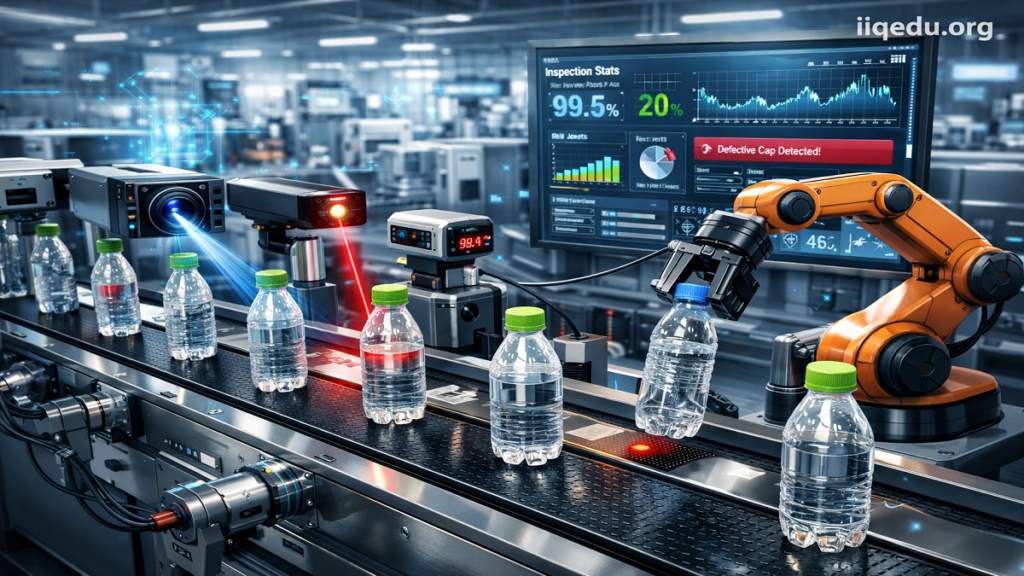
Industry Application of Smart Sensors for In-Line Inspection
Smart Sensors for In-Line Inspection are widely used across industries to monitor, inspect, and maintain product quality in real time. Their ability to combine sensing, processing, and communication makes them essential for modern automated manufacturing and quality control systems.
1. Automotive Industry
- Application: Inspect engine parts, welds, and assembly components.
- Purpose: Detect defects such as misalignments, cracks, or missing components in real time to ensure vehicle safety and performance.
2. Electronics and Semiconductor Industry
- Application: Inspect printed circuit boards (PCBs) and electronic assemblies.
- Purpose: Detect missing or misaligned components, soldering defects, and surface anomalies to maintain high-quality electronics production.
3. Food & Beverage Industry
- Application: Inspect bottles, cans, packaging, and labeling.
- Purpose: Ensure correct fill levels, proper sealing, accurate labeling, and detect foreign objects or contamination on the production line.
4. Pharmaceutical Industry
- Application: Inspect tablets, capsules, and packaging.
- Purpose: Verify correct shape, size, color, and packaging integrity to meet strict regulatory standards and maintain patient safety.
5. General Manufacturing
- Application: Monitor products on high-speed assembly and production lines.
- Purpose: Detect surface defects, dimensional errors, or misalignments without stopping the production process, improving throughput and reducing waste.
6. Aerospace Industry
- Application: Inspect critical aircraft components during production.
- Purpose: Detect structural defects, alignment issues, or surface flaws that could affect safety and performance.
7. Agriculture and Food Sorting
- Application: Sort fruits, vegetables, and processed foods.
- Purpose: Automatically select produce based on size, color, ripeness, and quality using vision and laser sensors.
8. Robotics and Automation Systems
- Application: Integrate sensors into robotic inspection and pick-and-place systems.
- Purpose: Provide real-time feedback to robots for accurate handling, assembly, or defect removal.
Conclusion:
Smart sensors for in-line inspection are essential wherever high-speed, accurate, and automated quality control is needed. They improve inspection accuracy, reduce errors, enhance efficiency, and support Industry 4.0 initiatives across automotive, electronics, pharmaceuticals, food & beverage, and other manufacturing sectors.
What are Smart Sensors for In-Line Inspection?
Smart sensors for in-line inspection are intelligent devices installed on production lines to monitor, measure, and inspect products in real time. They combine sensing, data processing, and communication to detect defects or deviations without stopping the production process.
Why are Smart Sensors required in manufacturing?
They are required to ensure consistent product quality, reduce human error, and maintain high production speed. Smart sensors detect defects immediately, enable automated rejection of faulty products, and provide data for process optimization.
Where are Smart Sensors for in-line inspection used?
They are widely used in industries such as automotive, electronics, pharmaceuticals, food & beverage, aerospace, and general manufacturing. They inspect assembly lines, packaging, labeling, and critical components for defects.
What types of smart sensors are used for in-line inspection?
Common types include:
Vision sensors – detect surface defects, labels, and color errors
Laser sensors – measure dimensions and alignment
Ultrasonic sensors – detect internal defects
Temperature sensors – monitor heat-sensitive processes
Pressure sensors – check sealing or structural integrity
What are the benefits of using Smart Sensors for In-Line Inspection?
Real-time defect detection and monitoring
Higher inspection accuracy and consistency
Faster production without stopping lines
Integration with automation and robotic systems
Data collection for analytics, predictive maintenance, and process optimization
Source: RealPars
Table of Contents
Disclaimer:
The information on Smart Sensors for In-Line Inspection is for general educational purposes only. Implementation in industrial settings should be guided by qualified professionals.