Toy Safety Standards (EN71, ASTM F963)
1. What are Toy Safety Standards?
Toy safety standards are regulations and guidelines designed to ensure that toys are safe for children to use. They address hazards like choking, chemical exposure, sharp edges, flammability, and mechanical risks.
2. EN71 (European Standard)
- Scope: Applies to toys sold in the European Union.
- Components: EN71 is divided into several parts, including:
- EN71-1: Mechanical and physical properties (sharp edges, small parts)
- EN71-2: Flammability
- EN71-3: Migration of certain chemicals and heavy metals
- Purpose: Ensures toys meet strict EU safety requirements to prevent accidents and chemical exposure.
- Compliance: Toys must carry the CE marking to show conformity with EN71.
3. ASTM F963 (American Standard)
- Scope: Applies to toys sold in the United States.
- Issued by: ASTM International, a globally recognized standards organization.
- Requirements: Covers mechanical hazards, labeling, chemical testing, flammability, and electrical toys.
- Enforcement: The Consumer Product Safety Commission (CPSC) enforces ASTM F963 compliance in the U.S. market.
4. Why These Standards Are Important
- Child Safety: Prevent injuries from choking, sharp edges, toxic chemicals, or flammable materials.
- Legal Compliance: Non-compliance can lead to recalls, fines, and legal liability.
- Market Access: EN71 is required for EU sales; ASTM F963 is required for the U.S.
- Consumer Confidence: Certified toys reassure parents that products are safe for children.
5. Industry Application
- Toy Manufacturers: Must design and test products to meet EN71 or ASTM F963 before launch.
- Importers & Distributors: Verify compliance documentation for safety and regulatory adherence.
- Retailers: Ensure toys sold are certified and labeled according to applicable standards.
- Testing Labs: Conduct mechanical, chemical, and flammability testing to confirm compliance.
6. Key Takeaways
- EN71 is mandatory for Europe, ASTM F963 is mandatory for the U.S.
- Toys must be tested for mechanical, chemical, flammability, and labeling hazards
- Compliance ensures safety, legal adherence, and consumer trust
Who is Toy Safety Standards (EN71, ASTM F963) required?
1. Toy Manufacturers
- Companies that design and produce toys must comply with these standards before products reach the market.
- Ensures toys are safe for children, reducing the risk of mechanical injuries, chemical hazards, or choking.
- Both EN71 and ASTM F963 set guidelines for materials, construction, labeling, and chemical content.
2. Importers and Distributors
- Businesses that import or distribute toys into the EU or U.S. markets must ensure that the toys meet the applicable standard.
- Non-compliance can result in confiscation, recalls, fines, or bans.
3. Retailers
- Retail stores, online shops, and marketplaces must sell toys that carry proper certification:
- EN71 → CE marking for EU sales
- ASTM F963 → compliance documentation for U.S. sales
- Protects consumers and prevents legal liability.
4. Testing Laboratories
- Certified labs performing mechanical, chemical, flammability, or labeling tests must use EN71 or ASTM F963 standards to verify compliance.
5. Regulatory Authorities
- Consumer Product Safety Commission (CPSC) in the U.S. enforces ASTM F963.
- European regulatory bodies enforce EN71, ensuring toys in the EU meet safety requirements.
In short:
Toy safety standards are required for any entity involved in making, importing, distributing, or selling toys in regulated markets Toy Safety Standards (EU for EN71, U.S. for ASTM F963), as well as testing and regulatory authorities ensuring compliance.
When is Toy Safety Standards (EN71, ASTM F963) required?
1. Before Manufacturing
- Toy manufacturers must consider EN71 or ASTM F963 during the design and material selection phase.
- Ensures that toys are safe from the start and that materials, mechanical design, and chemicals meet the regulatory requirements.
2. Before Market Launch
- Toys cannot be sold in the EU without EN71 compliance (CE marking) or in the U.S. without ASTM F963 compliance.
- Testing and certification must be completed before the product enters the market, to ensure legal compliance and child safety.
3. During Import/Distribution
- Importers and distributors must verify that all toys meet the applicable standard before bringing them into the market.
- Regulatory authorities may request proof of compliance at any time.
4. When Products Are Updated or Modified
- If a toy is redesigned, new materials are used, or manufacturing processes change, retesting for EN71/ASTM F963 compliance is required.
- Ensures ongoing compliance with safety standards and consumer protection.
5. During Recalls or Safety Investigations
- If there are reports of defects, injuries, or recalls, compliance testing may be required to verify whether toys meet EN71 or ASTM F963 standards.
In short:
Toy safety standards are required before manufacturing, before market release, during import/distribution, after product changes, and whenever safety verification is needed. Compliance ensures that toys are safe for children and meet legal requirements in the EU and U.S. markets.
Where is Toy Safety Standards (EN71, ASTM F963) required?
1. European Union (EN71)
- EN71 is mandatory for all toys sold in the European Union.
- Applies to physical retail stores, e-commerce platforms, wholesalers, and importers operating in the EU.
- Toys must carry the CE marking to show compliance before being sold in the EU market.
2. United States (ASTM F963)
- ASTM F963 compliance is required for toys sold in the U.S.
- Applies to manufacturers, importers, distributors, and retailers.
- Enforcement is done by the Consumer Product Safety Commission (CPSC).
- Applies to both physical retail stores and online marketplaces.
3. Global Markets
- Many other countries either adopt EN71/ASTM F963 directly or use them as reference standards for local toy safety regulations.
- Countries like Canada, Australia, and Japan often require imported toys to meet equivalent safety standards before sale.
4. Testing and Certification Facilities
- Toy testing laboratories use EN71 or ASTM F963 as mandatory reference standards for mechanical, chemical, flammability, and labeling tests.
- This ensures that toys are safe before reaching the consumer.
5. Trade Shows and Exhibitions
- When showcasing toys internationally, compliance with EN71 or ASTM F963 is often required to demonstrate safety standards to potential distributors or buyers.
In short:
Toy safety standards are required wherever toys are manufactured, imported, sold, or tested, especially in the EU (EN71) and U.S. (ASTM F963), as well as in global markets that adopt these standards as benchmarks for safety.
How is Toy Safety Standards (EN71, ASTM F963) required?
1. Through Product Design and Material Selection
- Manufacturers must design toys according to safety standards.
- Materials must comply with limits on toxic chemicals, heavy metals, and flammability as specified in EN71 (Europe) or ASTM F963 (U.S.).
- Mechanical design must prevent hazards like choking, sharp edges, or breakage.
2. Through Testing and Certification
- Toys must undergo mechanical, chemical, flammability, and labeling tests in certified laboratories.
- EN71 and ASTM F963 provide the specific test methods and requirements.
- Passing tests is mandatory before toys are sold in the EU or U.S.
3. Through Labeling and Documentation
- Compliance must be clearly documented:
- EN71 → CE marking on the product and packaging
- ASTM F963 → Certificate of compliance provided to distributors and retailers
- Labels may also include age recommendations, warnings, and batch information.
4. Through Regulatory Enforcement
- Regulatory bodies monitor compliance:
- EU authorities check CE marking and safety documentation for EN71.
- CPSC in the U.S. enforces ASTM F963 compliance and can issue recalls or fines for non-compliance.
5. Through Ongoing Quality Control
- Manufacturers must retest toys whenever materials, designs, or suppliers change.
- Return or incident reports can trigger additional testing to verify continued compliance.
In short:
Toy safety standards are required by designing safe products, testing them according to EN71/ASTM F963 methods, labeling and documenting compliance, and following regulatory enforcement and quality control processes. This ensures toys are safe for children and legally marketable in regulated regions.
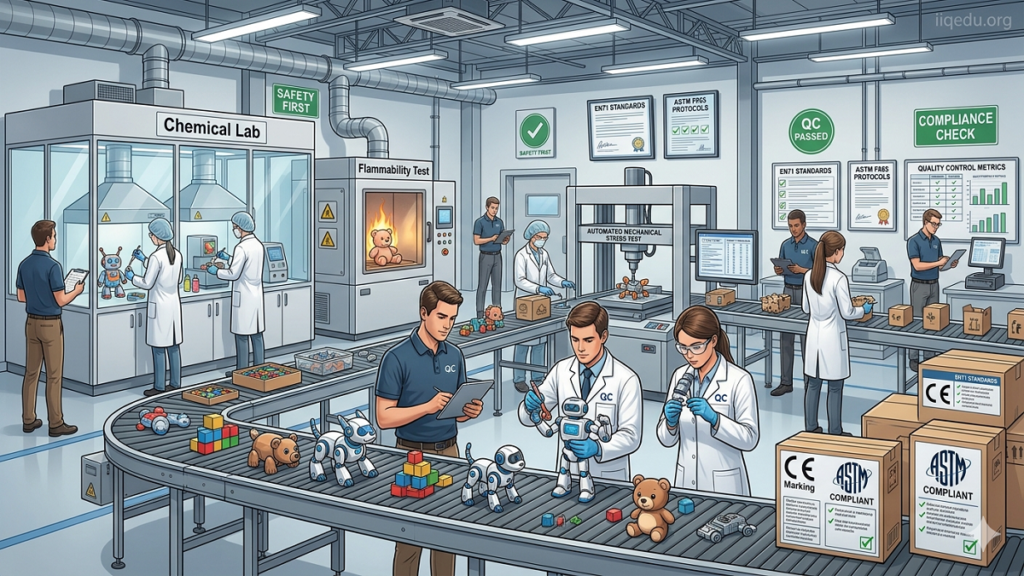
Case Study of Toy Safety Standards (EN71, ASTM F963)
Background
FunPlay Toys is a medium‑sized toy manufacturer that designs and sells children’s toys internationally. The company aims to enter both the European Union (EU) and United States (US) markets. These regions have strict toy safety regulations:
- EN71 for the EU
- ASTM F963 for the US
FunPlay’s flagship product is a set of interactive educational building blocks designed for ages 3–7.
Challenge
FunPlay must ensure its toy complies with both EN71 and ASTM F963 standards, which cover multiple safety areas such as:
- Mechanical and physical safety
- Flammability
- Chemical content
- Labeling and age warnings
Failure to comply could:
- Prevent entry into key markets
- Lead to product recalls
- Harm brand reputation
- Expose the company to fines or legal action
Steps Taken to Achieve Compliance
1. Design Phase
FunPlay’s product team incorporates safety requirements from the start:
- Rounded edges and no small detachable parts to prevent choking hazards
- Non‑toxic, phthalate‑free plastics suitable for young children
- Clear and durable labels with age recommendations
These design decisions align with fundamental clauses in both EN71 and ASTM F963.
2. Material Selection and Documentation
FunPlay tightly controls its supply chain by:
- Specifying chemical limits for dyes and plasticizers according to EN71‑3 and ASTM F963.
- Requesting material safety data sheets (MSDS) from all suppliers.
- Maintaining documentation for traceability and auditing.
These records are essential when submitting products for regulatory review.
3. Pre‑Compliance Testing
FunPlay submits prototype samples to accredited third‑party testing laboratories for:
- EN71 Part 1, 2, 3 Testing (EU)
– Physical/mechanical tests
– Flammability tests
– Chemical migration tests - ASTM F963 Testing (US)
– Impact resistance
– Heavy metal screening
– Label and packaging checks
– Flammability assessment
Testing labs generate compliance reports that FunPlay must retain for authorities and customers.
4. Certifications and Marking
After passing all required tests:
- For EU Sales:
– FunPlay affixes the CE mark and prepares the EU Declaration of Conformity based on EN71 test reports. - For US Sales:
– FunPlay obtains a Certificate of Compliance under ASTM F963, as required by the US Consumer Product Safety Commission (CPSC).
These documents travel with each shipment and are available for audits.
Results
1. Expanded Market Access
FunPlay successfully launched in both EU and US markets. Products appeared in major retail chains and online marketplaces.
2. Reduced Risk and Liability
Comprehensive compliance minimized the risk of customer injuries, legal action, and costly recalls.
3. Brand Credibility
Retailers and consumers perceived FunPlay as a trustworthy, safety‑focused brand, leading to stronger sales and repeat business.
4. Continuous Improvement
Return and incident data showed very few safety issues. FunPlay used this feedback to refine future designs and update internal quality checks.
Lessons Learned
- Early Integration of Standards Saves Time and Money
Integrating EN71/ASTM F963 requirements during product design reduces costly rework later. - Documentation is Critical
Detailed records of materials, tests, and compliance certificates are essential for audits and customs checks. - Third‑Party Testing Is an Investment, Not a Cost
Independently validated safety reports build trust with regulators, retailers, and parents. - Safety Standards Boost Brand Value
Customers value transparency and safety assurance, driving competitive advantage.
Conclusion
For FunPlay Toys, implementing toy safety standards like EN71 and ASTM F963 was a strategic necessity—not just a legal requirement. By thoroughly addressing mechanical, chemical, and labeling safety, FunPlay ensured compliance, enhanced consumer confidence, and secured access to major global markets.
White paper of Toy Safety Standards (EN71, ASTM F963)
Executive Summary
Ensuring the safety of toys is a critical responsibility for manufacturers, importers, and retailers. Global standards such as EN71 in the European Union and ASTM F963 in the United States provide comprehensive guidelines to protect children from mechanical, chemical, and flammability hazards. Compliance with these standards is essential not only for legal market access but also for building consumer trust and maintaining brand reputation.
1. Introduction
Toy safety standards establish rules for the design, materials, labeling, and testing of toys. They are intended to prevent injuries, poisoning, or other hazards that could affect children. With global markets increasingly interconnected, understanding and complying with EN71 and ASTM F963 is critical for companies aiming to sell products internationally.
2. Overview of EN71
- Region: European Union
- Purpose: Ensures toys meet safety requirements for mechanical, chemical, and flammability hazards.
- Key Parts:
- EN71-1: Mechanical and physical properties
- EN71-2: Flammability
- EN71-3: Migration of certain chemicals (heavy metals, toxic substances)
- Compliance: Toys must carry the CE marking, indicating conformity with EN71 and EU legislation.
3. Overview of ASTM F963
- Region: United States
- Purpose: Provides safety requirements for toys sold in the U.S., covering mechanical, chemical, flammability, and labeling hazards.
- Enforcement: Regulated by the Consumer Product Safety Commission (CPSC)
- Key Areas:
- Mechanical hazards (choking, sharp edges)
- Chemical content (heavy metals, phthalates)
- Flammability testing
- Labeling and age recommendations
4. Importance of Toy Safety Standards
- Child Protection: Prevent injuries, poisoning, and accidents.
- Legal Compliance: Mandatory for entry into the EU and U.S. markets.
- Consumer Confidence: Certified toys build trust among parents and caregivers.
- Risk Management: Reduces liability for manufacturers, importers, and retailers.
5. Industry Application
- Manufacturers: Design and test toys to meet EN71 and ASTM F963.
- Importers & Distributors: Verify compliance documentation before products enter the market.
- Retailers: Ensure all toys sold are certified and labeled according to applicable standards.
- Testing Laboratories: Conduct mechanical, chemical, and flammability tests to confirm compliance.
6. Compliance Process
- Product Design: Integrate safety standards from the design phase.
- Material Selection: Use non-toxic, approved materials.
- Third-Party Testing: Conduct EN71 or ASTM F963 tests at certified laboratories.
- Documentation: Maintain certificates, test reports, and declarations of conformity.
- Labeling: Apply CE marking for EU, and provide compliance certificates for U.S. sales.
- Ongoing Quality Control: Retest toys whenever designs, materials, or suppliers change.
7. Case Example
- Company: FunPlay Toys
- Action: Designed building blocks for ages 3–7 according to EN71 & ASTM F963
- Result: Passed all mechanical, chemical, and flammability tests; obtained CE mark and ASTM compliance certification; launched successfully in both EU and U.S. markets.
8. Challenges
- Cost of Testing: Accredited lab testing can be expensive for small manufacturers.
- Material Sourcing: Ensuring suppliers meet chemical safety requirements.
- Regulatory Updates: Standards evolve, requiring continuous monitoring and adaptation.
9. Conclusion
Compliance with EN71 and ASTM F963 is more than a legal requirement—it is a strategic approach to protecting children, building brand credibility, and accessing global markets. Companies that integrate these standards from design through distribution gain competitive advantage while reducing risk and promoting safety.
10. Recommendations
- Begin compliance planning during the product design phase.
- Work with certified testing labs early in development.
- Maintain thorough documentation for audits and market entry.
- Monitor changes in regulations to ensure ongoing compliance.
- Treat toy safety as a core part of corporate responsibility and brand reputation.

Industry Application of Toy Safety Standards (EN71, ASTM F963)
Toy safety standards like EN71 and ASTM F963 are applied across multiple industries involved in designing, producing, distributing, and selling toys. These standards ensure that products are safe for children and compliant with legal regulations in different markets.
1. Toy Manufacturing Industry
- Application: Incorporating EN71 or ASTM F963 requirements during product design and material selection.
- Focus Areas: Mechanical safety, chemical safety, flammability, labeling, and age-appropriate design.
- Example: A manufacturer of building blocks ensures rounded edges, non-toxic plastics, and proper labeling for age recommendations.
Impact: Reduces product defects, prevents injuries, and ensures regulatory compliance before market release.
2. Import and Export Industry
- Application: Verifying that imported or exported toys meet EN71 or ASTM F963 standards.
- Focus Areas: Documentation, certification checks, and testing reports.
- Example: A distributor importing toys from Asia for sale in the EU must verify CE marking and EN71 compliance.
Impact: Avoids customs delays, fines, and product recalls; ensures smooth international trade.
3. Retail Industry
- Application: Selling only certified toys that comply with safety standards.
- Focus Areas: Displaying proper labeling, age recommendations, and CE or ASTM compliance information.
- Example: A retail chain like Toys “R” Us or an e-commerce platform like Amazon ensures every toy listing shows CE marking (EU) or ASTM F963 compliance (US).
Impact: Builds consumer trust, minimizes liability, and strengthens brand reputation.
4. Testing and Certification Industry
- Application: Conducting third-party testing for compliance with EN71 or ASTM F963.
- Focus Areas: Mechanical testing, chemical analysis, flammability tests, and labeling verification.
- Example: Accredited labs test educational toys for small parts, chemical migration, and fire resistance.
Impact: Provides manufacturers and retailers with verified proof of compliance; essential for legal market access.
5. E-Commerce and Online Marketplaces
- Application: Verifying compliance for sellers offering toys internationally.
- Focus Areas: Digital labeling, documentation checks, and consumer safety information.
- Example: Amazon requires sellers to provide safety certificates before listing toys in the EU or US marketplaces.
Impact: Protects children, reduces liability, and ensures regulatory adherence across global digital markets.
6. Regulatory and Government Agencies
- Application: Enforcement and auditing of toy safety compliance.
- Focus Areas: Monitoring CE marking (EU) and ASTM F963 documentation (US) for market surveillance.
- Example: CPSC in the US and national authorities in the EU inspect toys and initiate recalls if safety standards are violated.
Impact: Ensures public safety, enforces laws, and maintains trust in the toy industry.
Conclusion
Toy safety standards like EN71 and ASTM F963 are critical across multiple industries—from manufacturing and retail to testing and regulation. Compliance ensures:
- Safety of children
- Legal market access
- Consumer confidence
- Reduced liability and brand risk
These standards serve as the backbone of safe, reliable, and globally acceptable toys.
#bestinstituteintheworld #bestinstituteinmumbai #bestinstituteinvasai #bestinstituteinindia #toysafetystandardsinvasai #toysafetystandardsinmumbai #toysafetystandardsinindia #toysafetystandardsinpatna #toysafetystandardsinuttrakhand #toysafetystandardsingujrat #toysafetystandardsinkolkata #toysafetystandardsindelhi #toysafetystandardsinnepal #toysafetystandardsinjaipur #toysafetystandardsinratnagiri #toysafetystandardsinraipur
Ask FAQs
What are EN71 and ASTM F963 standards?
EN71 (Europe) and ASTM F963 (United States) are regulations that define safety requirements for toys. They cover mechanical hazards, chemical content, flammability, labeling, and age-appropriate design to ensure children’s safety.
Who must comply with these toy safety standards?
Manufacturers, importers, distributors, retailers, and testing labs must comply. Any entity involved in designing, producing, selling, or certifying toys in the EU or US markets must meet EN71 or ASTM F963 requirements.
Why are these standards important?
Compliance prevents injuries, chemical exposure, and accidents among children. It also ensures legal market access, reduces liability for companies, and builds consumer trust in toy brands.
How do manufacturers ensure compliance with EN71 or ASTM F963?
Manufacturers design toys according to the standards, select safe materials, conduct third-party testing, maintain documentation (CE marking for EU, compliance certificates for US), and continuously monitor quality control.
Are these standards required for online toy sales?
Yes. Toys sold through e-commerce platforms in the EU must comply with EN71, and toys sold in the US must meet ASTM F963. Online marketplaces often require sellers to provide proof of compliance before listing produc
Source: QIMA Marketing
Table of Contents
Disclaimer:
“The information provided on EN71 and ASTM F963 toy safety standards is for general guidance only. Always refer to official regulations and certified testing for compliance and legal requirements.”