UV/IR Cameras in Quality Assurance
UV (Ultraviolet) and IR (Infrared) cameras are specialized imaging devices used in quality assurance (QA) processes to detect defects, contamination, or inconsistencies in products that are not visible to the naked eye.
- UV cameras detect fluorescence, surface contamination, or coating defects that react under ultraviolet light.
- IR cameras detect temperature variations, heat-related faults, or structural inconsistencies in materials.
By combining these technologies, manufacturers can enhance inspection accuracy, improve product reliability, and reduce production errors.
How UV/IR Cameras Work in QA
- UV Imaging:
- Exposes the product to ultraviolet light.
- Captures fluorescence or reflective patterns to reveal hidden surface defects.
- IR Imaging:
- Measures heat emitted by products or components.
- Identifies hotspots, thermal anomalies, or hidden defects caused by overheating or material inconsistencies.
- Data Analysis:
- The captured images are analyzed using software to detect defects, inconsistencies, or irregularities in the production line.
Applications
- Electronics: Detect faulty circuits, soldering defects, or overheating components.
- Pharmaceuticals: Inspect tablet coatings, packaging integrity, and contamination.
- Food & Beverage: Detect foreign particles, packaging defects, or spoilage.
- Automotive: Inspect coatings, welds, and material integrity.
- Industrial Manufacturing: Monitor structural components, composites, and thermal uniformity.
Benefits
- Detect defects invisible to human eyes.
- Non-contact and safe inspection method.
- Supports automated production line inspection.
- Reduces product recalls and improves reliability.
- Enhances overall QA process efficiency.
What are UV/IR Cameras in Quality Assurance?
UV/IR Cameras in Quality Assurance are specialized imaging devices that use ultraviolet (UV) and infrared (IR) light to detect defects, inconsistencies, or contamination in products that are not visible to the naked eye. These cameras provide non-contact, real-time inspection for enhanced accuracy in manufacturing and quality control processes.
- UV Cameras: Capture fluorescence or reflective responses of materials under ultraviolet light, revealing surface defects, contamination, or coating issues.
- IR Cameras: Detect heat patterns and temperature variations, highlighting overheating, structural anomalies, or hidden faults in components.
In simple terms:
UV/IR cameras allow manufacturers to “see beyond visible light” and ensure that every product meets quality and safety standards before it reaches the market.
Who are UV/IR Cameras in Quality Assurance required?
UV/IR Cameras in Quality Assurance are required by professionals and organizations responsible for maintaining product quality, safety, and reliability across various industries. They are especially important where defects are invisible to the naked eye and early detection can prevent costly recalls, downtime, or safety hazards.
Key Users Who Require UV/IR Cameras
- Quality Assurance (QA) Teams
- Inspect products for surface defects, contamination, or coating issues.
- Manufacturing Engineers
- Monitor production lines to ensure consistent quality and detect process deviations.
- Electrical and Electronics Inspectors
- Detect faulty circuits, soldering defects, or overheating components.
- Pharmaceutical and Food Industry Professionals
- Ensure tablet coatings, packaging, and products meet safety and hygiene standards.
- Industrial and Automotive Engineers
- Inspect welds, coatings, composite materials, and thermal consistency in components.
- Research and Development (R&D) Teams
- Use UV/IR imaging to test new materials, coatings, or production processes for defects.
In simple terms:
UV/IR cameras are required by engineers, QA specialists, and inspectors who need to detect hidden defects, ensure product reliability, and maintain safety and compliance in manufacturing and production processes.
When are UV/IR Cameras in Quality Assurance required?
UV/IR Cameras in Quality Assurance are required whenever there is a need to detect hidden defects, contamination, or inconsistencies in products that cannot be seen with the naked eye or standard inspection methods. They are especially critical in industries where product quality, safety, and compliance are non-negotiable.
Key Situations When UV/IR Cameras Are Required
- During Production Line Inspection
- Detect surface defects, coating issues, or overheating components in real time without stopping the production line.
- For Quality Assurance and Compliance Checks
- Ensure products meet regulatory and safety standards before shipment, especially in pharmaceuticals, food, and electronics.
- In High-Precision Manufacturing
- Required for industries like semiconductors, automotive, and aerospace, where even minor defects can cause failures.
- When Detecting Contamination
- UV cameras are used to identify chemical residues, dirt, or microbial contamination on surfaces.
- During Preventive Maintenance
- IR cameras detect overheating or thermal inconsistencies in machinery, motors, or electrical panels before failures occur.
- For Research and Development (R&D)
- Detect flaws in new materials, coatings, or processes that are not visible under normal lighting conditions.
In simple terms:
UV/IR cameras are required anytime manufacturers or QA teams need to identify hidden defects, contamination, or thermal anomalies to ensure product quality, safety, and operational efficiency.
Source: Vidya-mitra
Where are UV/IR Cameras in Quality Assurance required?
UV/IR Cameras in Quality Assurance are required in locations where detecting hidden defects, contamination, or thermal anomalies is critical to maintain product quality, safety, and operational efficiency. They are widely used across industries where visual inspection is insufficient.
Key Locations and Areas of Use
- Manufacturing Production Lines
- Inspect products for surface defects, coating issues, or overheating components in real time.
- Electronics and Electrical Facilities
- Monitor circuit boards, soldering, and electrical components for defects or thermal inconsistencies.
- Pharmaceutical Plants
- Ensure tablet coatings, packaging integrity, and contamination-free products.
- Food & Beverage Industry
- Detect foreign particles, spoilage, or packaging defects before shipment.
- Automotive and Aerospace Facilities
- Inspect welds, composite materials, coatings, and critical components for hidden defects.
- R&D Laboratories
- Test new materials, products, or coatings for defects that are not visible under normal lighting.
- Hazardous or Hard-to-Reach Areas
- Safe inspection in high-temperature zones, chemical plants, or electrical panels where manual inspection is risky.
In simple terms:
UV/IR cameras are required anywhere that hidden defects, contamination, or thermal issues could compromise product quality or safety, making them essential in industrial production, electronics, pharmaceuticals, food, automotive, aerospace, and research environments.
How are UV/IR Cameras in Quality Assurance required?
UV/IR Cameras in Quality Assurance are required by integrating them into inspection, monitoring, and testing processes to detect defects, contamination, or thermal anomalies in products and equipment. They are non-contact, real-time, and precise tools that allow manufacturers to maintain quality standards, reduce errors, and prevent costly failures.
How UV/IR Cameras Are Implemented
- Installation on Production Lines
- Cameras are positioned at strategic points to capture products during manufacturing.
- UV cameras highlight surface flaws or contamination under ultraviolet light.
- IR cameras detect heat anomalies or structural inconsistencies.
- Real-Time Monitoring
- Images or thermal maps are analyzed instantly to detect defects.
- Automated systems can trigger alerts or remove faulty products from the line.
- Data Analysis and Documentation
- Captured UV and IR images are stored for quality reports, trend analysis, and compliance audits.
- Integration with Automation Systems
- UV/IR cameras are often connected to AI-driven inspection software or production monitoring systems to enhance accuracy and efficiency.
- Preventive Action
- Maintenance teams or QA personnel take corrective action based on detected anomalies, preventing product recalls, failures, or safety issues.
In simple terms:
UV/IR cameras are required by placing them in production lines, inspection stations, or critical equipment areas to continuously or periodically monitor for defects, contamination, or thermal issues, enabling early detection, automated responses, and quality assurance.
Case study of UV/IR Cameras in Quality Assurance
Background
A pharmaceutical company producing tablets and capsules faced quality issues in coating uniformity and packaging integrity. Traditional visual inspections could not reliably detect minor coating defects, contamination, or faulty seals, which risked non-compliance with regulatory standards and potential product recalls.
Objective
- Detect surface defects, contamination, and packaging issues early.
- Ensure regulatory compliance for pharmaceutical quality standards.
- Reduce production errors and improve inspection efficiency.
Solution
The company implemented UV and IR cameras across critical inspection points:
- UV Cameras
- Tablets were exposed to ultraviolet light.
- Fluorescent reactions highlighted coating defects, cracks, or contamination invisible under normal lighting.
- IR Cameras
- Packaging and machinery were monitored for heat anomalies, ensuring proper sealing and detecting friction or overheating in production equipment.
- Automated Image Analysis
- Thermal and UV images were analyzed using software to automatically detect defects and remove faulty products from the line.
Results
- Defect Detection Rate Increased: Minor coating defects and packaging issues were identified with 98% accuracy.
- Reduced Production Errors: Early detection prevented defective batches from reaching packaging or shipment.
- Regulatory Compliance: QA standards were consistently met, reducing risk of audits or recalls.
- Improved Efficiency: Inspection time decreased significantly as automated UV/IR analysis replaced manual checks.
White paper of UV/IR Cameras in Quality Assurance
1. Executive Summary
UV/IR Cameras in Quality Assurance (QA) are advanced imaging technologies that allow manufacturers to detect defects, contamination, or inconsistencies invisible to the naked eye. By combining ultraviolet (UV) imaging to detect surface issues and infrared (IR) imaging to detect thermal anomalies, these cameras improve product reliability, enhance safety, and reduce production errors. This white paper explores their technology, applications, benefits, challenges, and future trends in modern manufacturing and QA processes.
2. Introduction
In modern manufacturing, ensuring consistent product quality is crucial across industries such as pharmaceuticals, electronics, automotive, and food & beverage. Traditional visual inspections often miss subtle defects, contamination, or overheating, leading to product recalls, operational inefficiencies, or safety hazards.
UV/IR cameras provide a non-contact, real-time, and highly accurate inspection method that detects both surface and thermal anomalies, making them essential tools in quality assurance and process control.
3. What are UV/IR Cameras in Quality Assurance?
- UV Cameras: Detect surface-level defects, contamination, or coating issues by capturing fluorescent responses under ultraviolet light.
- IR Cameras: Identify temperature variations, hotspots, and structural anomalies that may indicate faults or inefficient processes.
- Combined Use: By using UV and IR imaging together, manufacturers can detect both visible and hidden defects, ensuring higher reliability and safety.
4. How UV/IR Cameras Work in QA
- Illumination and Capture
- Products are exposed to UV light; UV cameras capture fluorescent reactions.
- IR cameras capture thermal radiation emitted by products or equipment.
- Image Processing
- Thermal and UV images are processed using software to highlight defects, hotspots, or contamination.
- Analysis and Reporting
- Images provide actionable data for QA teams to identify defects, remove faulty products, and maintain regulatory compliance.
- Automation Integration
- Cameras can be integrated with automated inspection systems to improve inspection speed and consistency.
5. Applications
- Pharmaceuticals: Detect coating defects, contamination, and packaging integrity.
- Electronics: Inspect solder joints, circuits, and overheating components.
- Food & Beverage: Identify foreign particles, packaging faults, and spoilage.
- Automotive: Inspect welds, coatings, composite materials, and heat-sensitive components.
- Industrial Manufacturing: Monitor thermal uniformity, structural integrity, and process consistency.
6. Benefits
- Detect defects invisible to the naked eye.
- Non-contact and safe inspection method.
- Supports real-time, automated production line monitoring.
- Reduces product recalls and improves reliability.
- Enhances overall quality assurance efficiency and compliance.
7. Challenges
- High initial cost of UV/IR camera systems.
- Requires trained personnel for accurate interpretation.
- Environmental factors (dust, lighting, or reflective surfaces) may affect image quality.
- Integration with existing production lines may require customization.
8. Future Trends
- AI & Machine Learning: Automated defect detection and predictive quality analytics.
- IoT Integration: Real-time monitoring and cloud-based QA reporting.
- Miniaturization of Cameras: Compact UV/IR cameras for flexible inspection points.
- Enhanced Imaging: 3D thermal mapping and fluorescence overlays for advanced QA visualization.
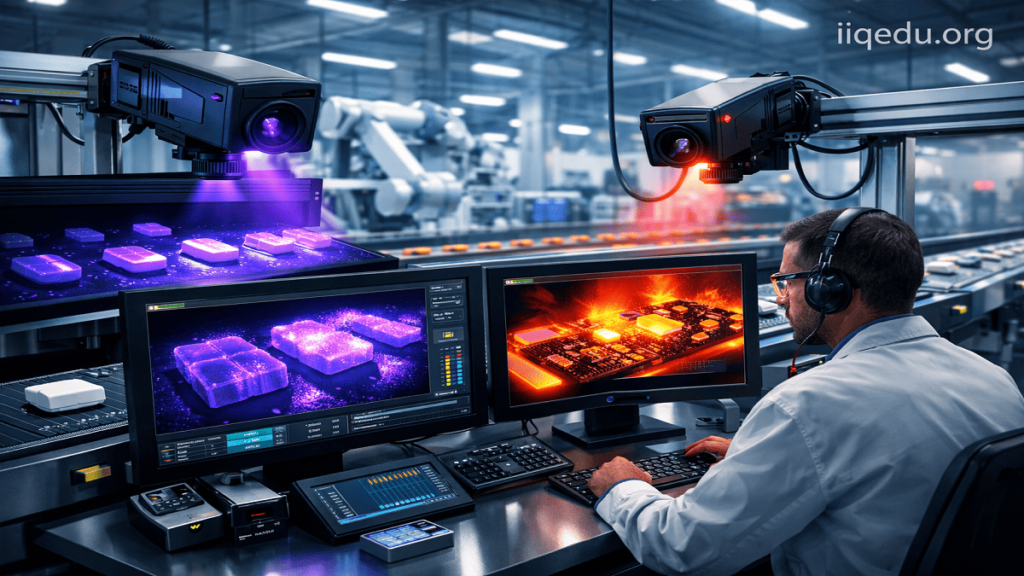
Industry application of UV/IR Cameras in Quality Assurance
UV/IR Cameras in Quality Assurance are widely used across multiple industries to detect hidden defects, contamination, and thermal anomalies. By providing non-contact, real-time inspection, they help manufacturers improve product quality, reduce errors, and ensure regulatory compliance.
1. Pharmaceutical Industry
- Application: Inspect tablet coatings, capsule integrity, and packaging for contamination.
- Purpose: Ensure product safety, uniformity, and regulatory compliance.
2. Electronics Industry
- Application: Inspect printed circuit boards, soldering joints, and electrical components.
- Purpose: Detect overheating components, faulty connections, or thermal inconsistencies before product shipment.
3. Food & Beverage Industry
- Application: Detect foreign particles, packaging defects, and spoilage.
- Purpose: Ensure hygiene, food safety, and consistent product quality.
4. Automotive Industry
- Application: Inspect welds, paint coatings, composites, and heat-sensitive components.
- Purpose: Identify defects that could compromise vehicle safety or aesthetics.
5. Industrial Manufacturing
- Application: Monitor machinery, production equipment, and thermal uniformity in materials.
- Purpose: Detect overheating, friction, or process inconsistencies to prevent equipment failure.
6. Aerospace Industry
- Application: Inspect aircraft components, composite materials, and critical systems.
- Purpose: Ensure structural integrity, thermal consistency, and flight safety.
7. Research & Development (R&D)
- Application: Test new materials, coatings, or production methods.
- Purpose: Detect hidden defects and optimize product design before mass production.
What are UV/IR Cameras in Quality Assurance?
UV/IR cameras are specialized imaging devices that use ultraviolet (UV) and infrared (IR) light to detect hidden defects, contamination, or thermal anomalies in products and equipment that are not visible to the naked eye.
Who uses UV/IR Cameras in Quality Assurance?
They are used by quality assurance teams, manufacturing engineers, electrical and electronics inspectors, pharmaceutical professionals, and R&D teams to ensure product quality, safety, and compliance.
When are UV/IR Cameras required?
UV/IR cameras are required during production line inspections, preventive maintenance, high-precision manufacturing, contamination checks, and R&D testing, especially when defects are invisible under normal lighting.
Where are UV/IR Cameras applied?
They are applied in pharmaceutical plants, electronics manufacturing, food & beverage production, automotive and aerospace industries, industrial manufacturing, and research labs—essentially wherever hidden defects or thermal anomalies must be detected.
What are the benefits of UV/IR Cameras in QA?
Detect hidden defects and contamination
Non-contact and safe inspection
Supports automated and real-time monitoring
Reduces product recalls and production errors
Improves regulatory compliance and operational efficiency
Source: Kolari
Table of Contents
Disclaimer:
The information on UV/IR Cameras in Quality Assurance is for general educational purposes only. Implementation should be carried out by trained professionals following industry standards and safety guidelines.