X-ray CT Scanning in Defect Detection
X-ray Computed Tomography (CT) Scanning is a non-destructive inspection technology that uses X-rays to create detailed 3D images of a product or component. It allows engineers and quality assurance teams to detect internal defects, cracks, voids, or structural inconsistencies that are invisible to the naked eye.
Unlike traditional X-ray imaging, CT scanning provides a complete volumetric view, enabling precise detection of hidden flaws and ensuring high product reliability.
How X-ray CT Scanning Works
- X-ray Generation: X-rays pass through the object being inspected.
- Image Capture: Sensors detect X-ray absorption differences to produce cross-sectional images.
- 3D Reconstruction: Specialized software combines multiple 2D slices to create a full 3D model of the internal structure.
- Defect Analysis: Engineers analyze the 3D images to identify cracks, voids, porosity, misalignments, or material inconsistencies.
Applications
- Aerospace: Inspect turbine blades, composite materials, and critical structural components.
- Automotive: Detect internal defects in engine parts, gears, and welds.
- Electronics: Check circuit boards, soldering joints, and battery packs for hidden faults.
- Medical Devices: Ensure structural integrity of implants and prosthetics.
- Industrial Manufacturing: Detect voids, porosity, or internal cracks in castings, 3D-printed components, and complex assemblies.
Benefits
- Non-destructive testing preserves the product.
- Detects internal defects invisible to visual inspection.
- Provides high-resolution 3D imaging for precise analysis.
- Improves product quality, safety, and reliability.
- Supports failure analysis and R&D testing.
What is X-ray CT Scanning in Defect Detection?
X-ray Computed Tomography (CT) Scanning in Defect Detection is a non-destructive inspection method that uses X-rays to create high-resolution 3D images of a product’s internal structure. It allows engineers and quality assurance teams to detect hidden defects such as cracks, voids, porosity, misalignments, or structural inconsistencies that are impossible to see with the naked eye or standard visual inspection.
Unlike conventional X-rays, CT scanning produces a volumetric 3D view, giving a complete and precise representation of internal components. This enables:
- Early detection of flaws in critical parts
- Accurate failure analysis
- Quality assurance for high-precision manufacturing
In simple terms:
X-ray CT scanning lets manufacturers “see inside” a product in 3D, ensuring reliability, safety, and defect-free production.
Who is X-ray CT Scanning in Defect Detection required?
X-ray CT Scanning in Defect Detection is required by professionals and organizations responsible for ensuring the integrity, safety, and reliability of critical components. It is especially important in industries where internal defects can lead to product failure, safety hazards, or costly recalls.
Key Users Who Require X-ray CT Scanning
- Quality Assurance (QA) Teams
- Inspect components for internal defects, voids, cracks, and porosity.
- Manufacturing Engineers
- Ensure precision and consistency in production lines, especially for complex or high-value parts.
- Aerospace and Automotive Inspectors
- Check critical engine parts, turbine blades, or safety components for hidden flaws.
- Electronics and Battery Inspectors
- Detect internal defects in circuit boards, soldering joints, and battery cells.
- Medical Device Manufacturers
- Verify structural integrity of implants, prosthetics, or surgical instruments.
- R&D Teams
- Analyze new materials, 3D-printed parts, or prototypes to identify defects before mass production.
In simple terms:
X-ray CT scanning is required by engineers, QA specialists, and inspectors who need to analyze the internal structure of products, detect hidden flaws, and ensure high reliability and safety in critical applications.
When is X-ray CT Scanning in Defect Detection required?
X-ray CT Scanning in Defect Detection is required whenever internal defects, structural inconsistencies, or hidden flaws could compromise product quality, safety, or performance. It is particularly essential in industries where precision and reliability are critical.
Key Situations When X-ray CT Scanning is Required
- During Production of High-Precision Components
- For aerospace, automotive, and medical devices where even minor internal defects can cause failures.
- For Quality Assurance and Compliance
- Ensures products meet regulatory standards and customer specifications.
- When Inspecting Complex or Internal Structures
- Parts like turbine blades, engine components, castings, or 3D-printed objects that cannot be fully examined visually.
- For Failure Analysis
- Investigate causes of malfunction or structural failures in products already in use or during testing.
- During Research & Development (R&D)
- Test prototypes or new materials for internal defects before mass production.
- For Safety-Critical Products
- Detect hidden voids, cracks, or misalignments in components where failure could be catastrophic.
In simple terms:
X-ray CT scanning is required anytime a product’s internal structure must be inspected for defects, voids, cracks, or inconsistencies—especially in high-value, high-precision, or safety-critical applications.
Where is X-ray CT Scanning in Defect Detection required?
X-ray CT Scanning in Defect Detection is required in locations or industries where internal defects, structural flaws, or hidden inconsistencies can affect product quality, safety, or functionality. It is widely applied wherever precise, non-destructive inspection of complex components is necessary.
Key Locations and Industries
- Aerospace Industry
- Inspect turbine blades, engine components, and composite materials for hidden cracks or voids.
- Automotive Industry
- Detect internal defects in engine parts, gears, welds, and 3D-printed components.
- Electronics Industry
- Examine PCBs, solder joints, and battery cells for structural defects or thermal inconsistencies.
- Medical Device Manufacturing
- Inspect implants, prosthetics, and surgical instruments for internal flaws.
- Industrial Manufacturing & 3D Printing
- Detect porosity, voids, and misalignments in castings, complex assemblies, and additive-manufactured parts.
- Research & Development Laboratories
- Test new materials, prototypes, and experimental components for defects before production.
- Safety-Critical Facilities
- Evaluate components in nuclear, chemical, or energy sectors where failure can have severe consequences.
In simple terms:
X-ray CT scanning is required wherever high-value, complex, or safety-critical components need non-destructive internal inspection, ensuring that hidden defects do not compromise product performance, reliability, or safety.
How is X-ray CT Scanning in Defect Detection required?
X-ray CT Scanning in Defect Detection is required by integrating it into quality control, inspection, and testing processes to non-destructively examine the internal structure of products and components. It is a precise, high-resolution method that allows engineers and QA teams to identify defects that could affect performance, safety, or reliability.
How X-ray CT Scanning Is Implemented
- Setup of the CT Scanner
- Place the product or component inside the X-ray CT machine.
- Configure scanning parameters based on the material type, size, and required resolution.
- X-ray Scanning Process
- X-rays pass through the object while detectors record absorption differences to create cross-sectional 2D images (slices).
- 3D Reconstruction
- Specialized software reconstructs the 2D slices into a 3D volumetric model, revealing the internal structure of the component.
- Defect Analysis
- Engineers or automated software analyze the 3D model to identify voids, cracks, porosity, misalignments, or other hidden defects.
- Integration with QA Processes
- Results are used for quality assurance, production validation, failure analysis, or R&D testing.
- Can be connected to automated inspection systems to flag defective components or guide corrective actions.
In simple terms:
X-ray CT scanning is required by placing products in a CT scanner, generating detailed 3D images, and analyzing them for internal defects. This method ensures precise defect detection, non-destructive inspection, and reliable quality assurance in critical applications.
Case study of X-ray CT Scanning in Defect Detection
Background
An aerospace manufacturer producing turbine blades and high-performance engine components faced challenges in detecting internal cracks, voids, and porosity in precision parts. Traditional inspection methods, like visual or standard X-ray imaging, were unable to reliably identify these hidden defects, which posed a risk to safety and component reliability.
Objective
- Detect internal defects in critical components before assembly.
- Ensure structural integrity and compliance with aerospace standards.
- Reduce the risk of component failure during operation.
Solution
The company implemented X-ray CT scanning at key inspection points:
- 3D Imaging of Components
- Turbine blades and engine parts were scanned using high-resolution X-ray CT.
- Multiple 2D slices were captured and reconstructed into a detailed 3D volumetric model.
- Defect Detection
- Engineers analyzed the 3D models to identify cracks, voids, porosity, and material inconsistencies.
- Automated software flagged areas that exceeded tolerance limits.
- Quality Control Integration
- Results were integrated into the QA process to reject defective components and guide corrective manufacturing adjustments.
Results
- Improved Defect Detection: Internal flaws that were previously undetectable were now identified with over 98% accuracy.
- Enhanced Product Reliability: Only defect-free components advanced to assembly, reducing the risk of failure.
- Reduced Waste and Rework: Early detection allowed targeted corrective actions, reducing material waste.
- Regulatory Compliance: Components consistently met aerospace safety and quality standards.
Source: NIBIB
White paper of X-ray CT Scanning in Defect Detection
1. Executive Summary
X-ray CT Scanning is a non-destructive inspection technology that provides high-resolution 3D imaging of components and products to detect internal defects, voids, cracks, and structural inconsistencies. This technology is critical in industries where precision, safety, and reliability are paramount, such as aerospace, automotive, electronics, and medical device manufacturing.
This white paper explores the technology, applications, benefits, challenges, and future trends of X-ray CT scanning in defect detection, highlighting how it improves quality assurance, reduces risk, and supports innovation.
2. Introduction
In modern manufacturing, ensuring consistent product quality and safety is crucial. Internal defects in high-precision or safety-critical components can result in catastrophic failures, recalls, or costly rework.
X-ray CT scanning overcomes the limitations of visual inspection and conventional X-ray imaging by providing volumetric 3D images of a component’s internal structure, enabling precise detection of hidden defects and supporting predictive quality control.
3. What is X-ray CT Scanning in Defect Detection?
- Uses X-rays to scan objects and generate multiple 2D cross-sectional images (slices).
- 3D reconstruction software creates a volumetric model for detailed internal inspection.
- Detects voids, cracks, porosity, misalignments, and structural anomalies non-destructively.
- Applicable for quality assurance, failure analysis, R&D, and compliance testing.
4. How X-ray CT Scanning Works
- Preparation and Setup
- Components are placed inside the CT scanner.
- Scan parameters are configured based on material type, size, and desired resolution.
- X-ray Scanning
- X-rays pass through the object; detectors measure absorption differences to produce 2D slices.
- 3D Reconstruction
- Specialized software combines slices into a 3D volumetric model, revealing internal defects.
- Defect Analysis
- Engineers or automated software identify cracks, voids, porosity, and misalignments.
- Integration with QA Processes
- Results inform production decisions, defect removal, and corrective measures.
5. Applications
- Aerospace: Turbine blades, structural components, and composite materials.
- Automotive: Engine parts, gears, welds, and 3D-printed components.
- Electronics: Circuit boards, soldering joints, battery cells.
- Medical Devices: Implants, prosthetics, surgical instruments.
- Industrial Manufacturing: Castings, complex assemblies, additive-manufactured parts.
6. Benefits
- Non-destructive inspection preserves components.
- Detects internal defects invisible to visual inspection.
- Provides high-resolution 3D imaging for accurate analysis.
- Supports failure analysis, predictive maintenance, and R&D testing.
- Enhances product reliability, safety, and regulatory compliance.
7. Challenges
- High initial investment for equipment.
- Requires trained personnel for operation and analysis.
- Environmental factors (e.g., vibration, temperature) may affect scan quality.
- Integration with existing production lines may need customization.
8. Future Trends
- AI & Machine Learning: Automated defect detection and predictive analysis.
- IoT & Cloud Integration: Real-time monitoring and remote QA reporting.
- Miniaturization & Mobility: Compact CT scanners for flexible inspection points.
- Enhanced Imaging: 3D volumetric models with AI-assisted anomaly detection.
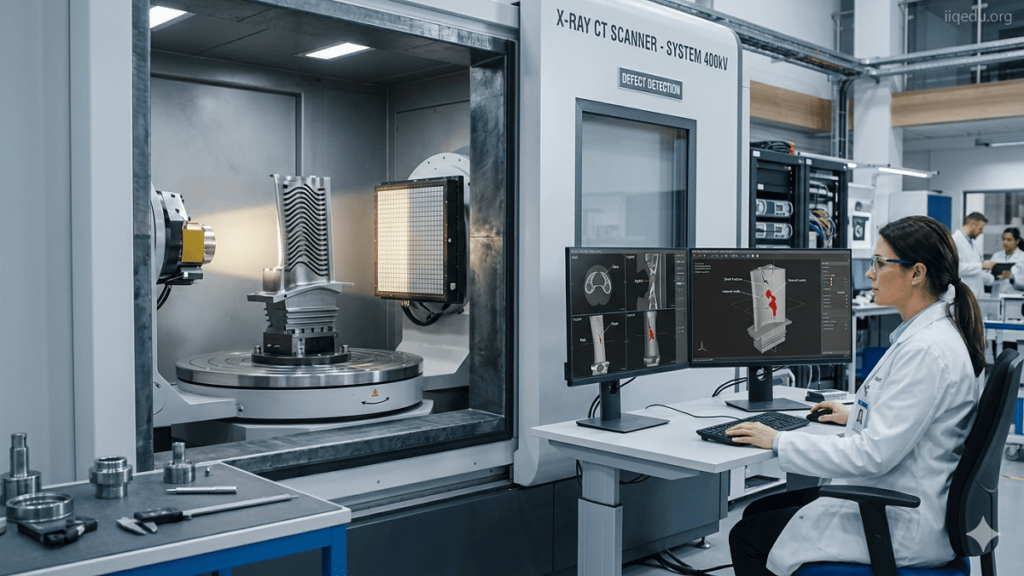
Industry applicfation of X-ray CT Scanning in Defect Detection
X-ray CT Scanning in Defect Detection is widely applied across industries where internal defects, hidden cracks, porosity, or structural inconsistencies can compromise product quality, safety, or functionality. By providing non-destructive, high-resolution 3D imaging, it allows manufacturers to detect flaws before products reach the market.
1. Aerospace Industry
- Application: Inspect turbine blades, engine components, composite materials, and structural parts.
- Purpose: Detect internal cracks, voids, or misalignments to prevent catastrophic failures and ensure flight safety.
2. Automotive Industry
- Application: Examine engine blocks, gears, welds, and 3D-printed components.
- Purpose: Ensure structural integrity, detect hidden defects, and improve vehicle reliability.
3. Electronics Industry
- Application: Inspect printed circuit boards (PCBs), soldering joints, and battery packs.
- Purpose: Identify voids, misalignments, or overheating risks in critical electronic components.
4. Medical Device Manufacturing
- Application: Examine implants, prosthetics, surgical instruments, and other critical medical devices.
- Purpose: Ensure internal structural integrity and compliance with safety standards.
5. Industrial Manufacturing
- Application: Check castings, complex assemblies, and additive-manufactured (3D-printed) parts.
- Purpose: Detect porosity, internal cracks, or misalignments to ensure product quality and reduce rework.
6. Research & Development (R&D)
- Application: Test prototypes, new materials, and experimental components.
- Purpose: Detect defects early, optimize designs, and validate materials before mass production.
7. Safety-Critical Facilities
- Application: Inspect components used in nuclear, chemical, or energy sectors.
- Purpose: Prevent failures in high-risk environments where defects can have severe consequences.
Ask FAQs
What is X-ray CT Scanning in Defect Detection?
X-ray CT scanning is a non-destructive inspection method that uses X-rays to create high-resolution 3D images of a component’s internal structure. It detects hidden defects, cracks, voids, or structural inconsistencies that are not visible to the naked eye.
Who uses X-ray CT Scanning for defect detection?
It is used by quality assurance teams, manufacturing engineers, aerospace and automotive inspectors, electronics manufacturers, medical device producers, and R&D teams to ensure product integrity, safety, and compliance.
When is X-ray CT Scanning required?
X-ray CT scanning is required during production of high-precision components, failure analysis, quality assurance checks, R&D testing, and in safety-critical applications where internal defects can impact reliability or safety.
Where is X-ray CT Scanning applied?
It is applied in aerospace, automotive, electronics, medical devices, industrial manufacturing, 3D printing, and safety-critical facilities to inspect internal structures for hidden defects and ensure high-quality standards.
What are the benefits of X-ray CT Scanning in defect detection?
Detects internal defects invisible to visual inspection
Non-destructive and safe
Provides high-resolution 3D imaging
Supports failure analysis, predictive maintenance, and R&D testing
Improves product reliability, safety, and regulatory compliance
Source: Dr. Abhishek Goyal
Table of Contents
Disclaimer:
The information on X-ray CT Scanning in Defect Detection is for general educational purposes only. Implementation should be carried out by trained professionals following industry standards and safety guidelines.