Augmented Reality for QC Training
1. What is AR for QC Training?
Augmented Reality (AR) for Quality Control training uses digital overlays, 3D models, and interactive simulations to train employees in QC processes. AR allows learners to visualize defects, follow inspection procedures, and interact with virtual tools in a safe and controlled environment, improving learning retention and skill application.
2. Benefits of AR in QC Training
- Interactive Learning: Hands-on training without disrupting production.
- Error Reduction: Employees learn correct procedures before handling real products.
- Faster Onboarding: Shortens training time for new employees.
- Consistent Standards: Ensures uniform understanding of QC procedures across teams.
- Remote Training: Enables training across multiple locations without physical presence.
3. How AR is Used in QC Training
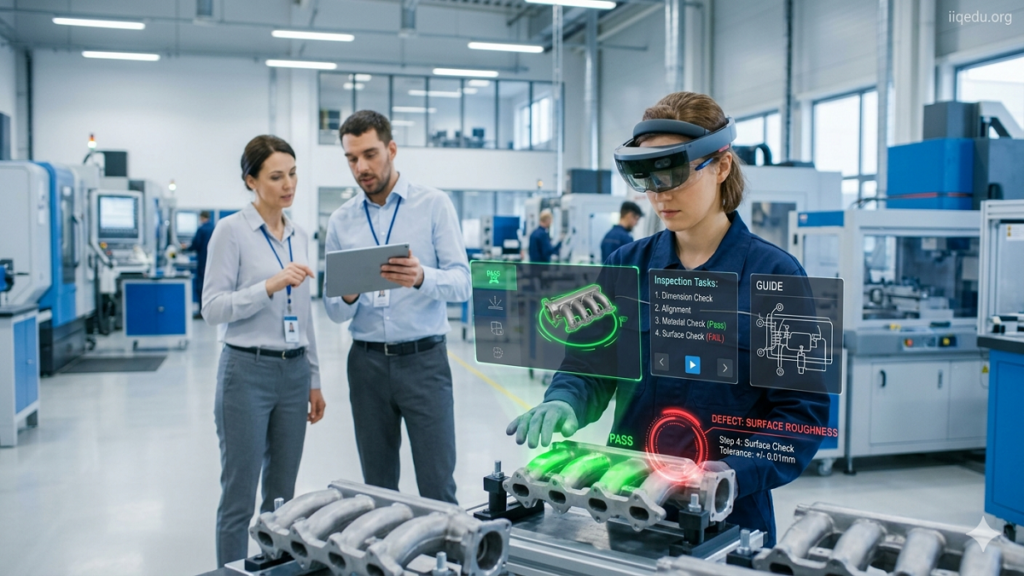
- Overlaying inspection guidelines directly onto physical parts.
- Simulating defect detection and corrective actions in virtual environments.
- Using AR headsets or mobile devices to guide step-by-step procedures.
- Integrating with real-time feedback systems to track trainee performance.
4. Industry Applications
- Manufacturing: Inspecting assembly lines, detecting defects, and learning calibration procedures.
- Pharmaceuticals: Training on packaging, labeling, and regulatory compliance.
- Automotive: Simulating safety inspections and component quality checks.
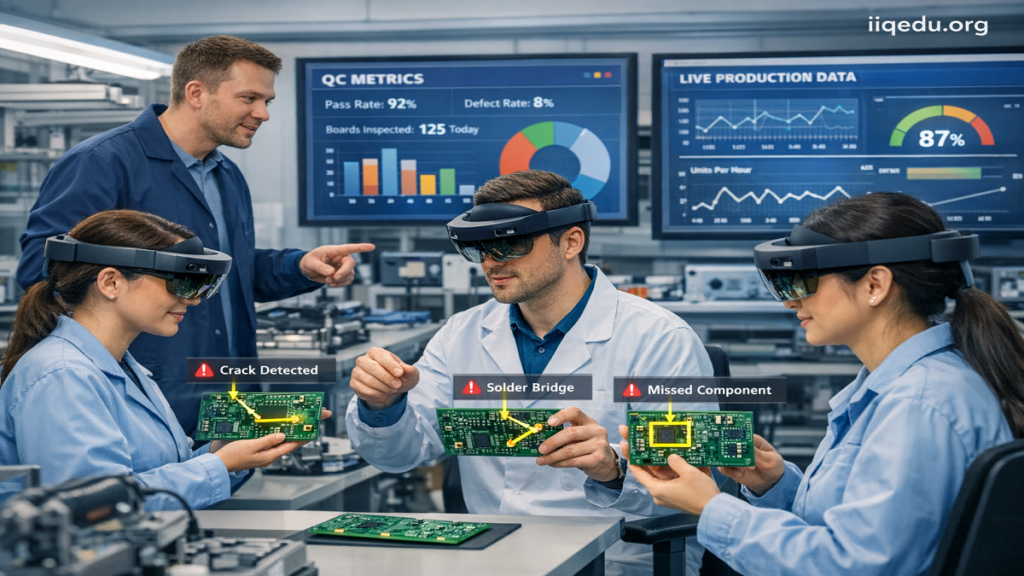
- Electronics: Handling delicate circuits and testing procedures safely.
5. Key Takeaways
AR-based QC training enhances efficiency, accuracy, and safety while reducing errors and training costs. It is especially effective in industries where precision and compliance are critical.
Who is Augmented Reality for QC Training required?
Augmented Reality (AR) for QC Training is required by organizations and stakeholders responsible for ensuring product quality, employee competence, Augmented Reality for QC Training and operational efficiency. Specifically:
1. Quality Control Teams
- QC inspectors and supervisors use AR to learn and standardize inspection procedures, identify defects accurately, and ensure compliance with quality standards.
2. Manufacturing & Production Employees
- Operators and assembly line staff benefit from AR training to understand proper handling, assembly, and inspection techniques, reducing errors.
3. Training & Learning & Development (L&D) Teams
- L&D teams implement AR programs to streamline onboarding and continuous training, making learning interactive and consistent across locations.
4. Operations & Production Managers
- Managers require AR training to monitor workforce competency, ensure adherence to QC standards, and improve overall production efficiency.
5. Remote Teams and Multi-Location Plants
- Organizations with distributed teams use AR to train employees in different locations simultaneously, maintaining consistent quality practices globally.
6. Regulatory & Compliance Officers
- Ensure that employees are trained on industry-specific regulations and QC procedures, reducing risks of non-compliance.
In short:
AR for QC Training is required by QC teams, production staff, L&D teams, operations managers, remote employees, and compliance officers to improve training effectiveness, Augmented Reality for QC Training maintain high-quality standards, and reduce errors in production.
When is Augmented Reality for QC Training required?
Augmented Reality (AR) for QC Training is required whenever organizations aim to improve quality, reduce errors, and enhance employee learning efficiency in quality control processes. Key situations include:
1. Onboarding New Employees
- When new hires need hands-on QC training, AR allows them to learn procedures safely and interactively without disrupting production.
2. Introducing New Products or Processes
- When new equipment, components, or inspection protocols are introduced, AR helps employees quickly understand complex procedures.
3. Correcting Quality Issues
- When recurring defects or errors are detected, AR training can reinforce proper QC methods and prevent mistakes.
4. Multi-Location or Remote Training
- When employees work across multiple plants or locations, AR enables consistent training without travel, maintaining uniform quality standards.
5. Compliance and Regulatory Updates
- When QC procedures are updated to meet industry standards or regulations, AR ensures employees learn and adhere to new compliance requirements effectively.
In short:
AR for QC Training is required during onboarding, process changes, quality issue correction, remote training, and compliance updates, helping organizations improve accuracy, efficiency, and consistency in quality control.
Where is Augmented Reality for QC Training required?
Augmented Reality (AR) for QC Training is required wherever quality control processes are critical and accurate employee training is essential. Specifically:
1. Manufacturing & Production Floors
- On assembly lines, machine operation areas, and inspection stations to train employees on defect detection, assembly checks, Augmented Reality for QC Training and process standards.
2. Pharmaceutical & Chemical Plants
- In laboratories, packaging, and quality inspection areas to ensure compliance with safety and regulatory standards.
3. Automotive Industry
- In vehicle assembly, component testing, and safety inspections for accurate defect identification and process adherence.
4. Electronics & High-Precision Industries
- In cleanrooms, circuit board assembly, or device testing areas where precision and error-free handling are critical.
5. Remote or Multi-Location Facilities
- In distributed plants, warehouses, or training centers to standardize QC training across locations without physical presence.
6. Research & Development (R&D) Labs
- For training employees on new testing protocols, prototypes, or experimental QC processes safely.
In short:
AR for QC Training is required on production floors, labs, automotive plants, electronics assembly areas, remote facilities, and R&D labs, enabling organizations to train employees effectively, maintain consistent quality, and reduce operational errors.
How is Augmented Reality for QC Training required?
Augmented Reality (AR) for QC Training is required through the integration of interactive, digital, and immersive learning tools into quality control processes to enhance skill development, Augmented Reality for QC Training reduce errors, and ensure consistent standards. Here’s how it is applied:
1. Interactive Learning Modules
- AR overlays step-by-step inspection instructions, 3D models, and visual guides onto physical components or equipment.
- Trainees can practice defect detection and quality checks without affecting real production.
2. Real-Time Guidance & Feedback
- AR headsets or tablets provide instant feedback on performance, highlighting mistakes or missed steps.
- Enables continuous correction during the training process, reinforcing correct procedures.
3. Remote and Multi-Site Training
- Employees across different locations can access the same AR training program, ensuring uniform QC knowledge and standards.
4. Simulation of Complex Scenarios
- AR can simulate rare or critical defects, emergency procedures, or new product inspections, allowing trainees to gain experience safely.
5. Integration with Performance Tracking
- AR platforms can track trainee progress, performance metrics, and assessment results to identify skill gaps and improvement areas.
6. Continuous Updates and Compliance
- New QC procedures, regulatory updates, or product changes can be digitally integrated into AR modules for quick, efficient training.
In short:
AR for QC Training is required through interactive modules, real-time feedback, remote accessibility, simulated scenarios, performance tracking, and continuous updates, enabling organizations to train employees effectively, improve accuracy, reduce errors, and maintain high-quality standards.
Case Study of Augmented Reality for QC Training
Background
A global electronics manufacturer faced challenges with high defect rates and inconsistent quality inspections across multiple production lines. Traditional training methods were time-consuming, costly, and did not ensure uniform understanding of quality control procedures. To address this, the company adopted Augmented Reality (AR) for QC training, aiming to improve accuracy, speed, and employee engagement.
Step 1: Planning & Technology Selection
- Selected AR headsets and mobile devices for training modules.
- Developed interactive AR simulations of assembly components, defect scenarios, and inspection protocols.
- Integrated step-by-step guides and real-time feedback into the AR system.
Step 2: Implementation
- Conducted pilot training sessions on high-priority production lines.
- Employees used AR to inspect products virtually, identify defects, and follow QC procedures before applying them to real production.
- Multi-location teams accessed the same AR modules remotely, ensuring standardized training globally.
Step 3: Performance Tracking & Feedback
- AR system tracked trainee performance, highlighted mistakes, and provided corrective guidance.
- Trainers could analyze data to identify skill gaps and focus on improvement areas.
Results
- Defect rates reduced by 35% within the first six months.
- Training time for new employees cut by 40%.
- Uniform QC standards were achieved across all production facilities.
- Increased employee engagement and confidence in performing quality inspections.
Key Takeaways
- AR provides interactive, hands-on QC training without disrupting production.
- Real-time feedback and simulations enhance accuracy, efficiency, and retention.
- Multi-location access ensures consistent quality standards globally.
White Paper of Augmented Reality for QC Training
1. Executive Summary
Augmented Reality (AR) is revolutionizing Quality Control (QC) training by enabling interactive, immersive, and safe learning environments. By overlaying digital information on physical components, AR allows employees to practice inspection procedures, identify defects, and follow compliance protocols without disrupting production. This white paper explores the benefits, implementation strategies, industry applications, and best practices for AR in QC training.
2. Introduction
Traditional QC training often involves on-the-job learning, manuals, or classroom sessions, which can be time-consuming, inconsistent, and error-prone. AR provides a digital overlay of instructions, 3D models, and simulations, allowing employees to experience real-life scenarios safely. This technology is particularly valuable in industries where precision, compliance, and efficiency are critical.
3. Key Benefits
- Interactive Learning: Hands-on training without affecting production.
- Error Reduction: Correct procedures learned before handling real products.
- Faster Onboarding: Accelerates training for new employees.
- Consistent Quality Standards: Uniform understanding of QC processes across teams.
- Remote Training: Enables distributed teams to access the same AR content.
4. Implementation Strategies
- Deploy AR headsets or tablets for interactive training.
- Develop step-by-step digital guides and 3D simulations for inspection tasks.
- Integrate performance tracking and feedback to measure competency.
- Update AR modules continuously for new products, processes, or compliance requirements.
5. Industry Applications
- Manufacturing: Inspecting assembly lines and product quality.
- Automotive: Component safety checks and assembly inspections.
- Pharmaceuticals: Packaging, labeling, and regulatory compliance.
- Electronics: Circuit board inspection and defect detection.
6. Best Practices
- Align AR training with business and QC objectives.
- Provide hands-on support and guidance alongside AR modules.
- Use data analytics from AR training to identify skill gaps.
- Ensure scalable deployment for multi-location operations.
7. Conclusion
AR for QC training enhances accuracy, efficiency, and employee engagement while reducing errors and training costs. Organizations that adopt AR can achieve consistent quality standards, faster onboarding, and improved operational performance, making it a critical tool for modern QC processes.
Indusrty Application of Augmented Reality for QC Training
Augmented Reality (AR) is transforming Quality Control (QC) training across multiple industries by providing interactive, immersive, and safe learning environments. AR allows employees to visualize defects, follow inspection protocols, and interact with virtual tools, improving accuracy, consistency, and efficiency.
1. Manufacturing & Production
- Application: Inspect assembly lines, machinery, and finished products using AR overlays.
- Impact: Reduces defects, ensures consistent QC standards, and accelerates employee training.
2. Automotive Industry
- Application: Train employees on vehicle assembly, safety inspections, and component quality checks.
- Impact: Improves precision, reduces assembly errors, and enhances compliance with safety standards.
3. Electronics & High-Precision Components
- Application: Simulate inspection of delicate circuits, PCBs, and devices.
- Impact: Minimizes risk of damage, improves accuracy, and accelerates onboarding.
4. Pharmaceutical & Chemical Industry
- Application: Training on packaging, labeling, regulatory compliance, and lab procedures.
- Impact: Ensures adherence to safety and quality standards while reducing operational errors.
5. Aerospace & Defense
- Application: Inspection of aircraft components, engines, and complex assemblies.
- Impact: Enhances safety, reduces maintenance errors, and standardizes inspection procedures.
6. Remote or Multi-Location Operations
- Application: Provide consistent AR-based QC training to employees across plants or locations.
- Impact: Maintains uniform quality standards globally, reducing training costs and travel.
In short:
AR for QC Training is applied in manufacturing, automotive, electronics, pharmaceuticals, aerospace, and remote operations, enabling organizations to train employees efficiently, improve accuracy, ensure compliance, and maintain consistent quality standards across all locations.
#augmentedrealityforqctraininginindia #augmentedrealityforqctraininginmumbai #augmentedrealityforqctraininginroha #augmentedrealityforqctraininginkochi #augmentedrealityforqctraininginvaranasi #augmentedrealityforqctraininginkedarnath #augmentedrealityforqctraininginpunjab #augmentedrealityforqctraininginsindhi #augmentedrealityforqctraininginkolkata #augmentedrealityforqctraininginnoida #augmentedrealityforqctraininginbangalore #augmentedrealityforqctrainingingujarat #augmentedrealityforqctraininginkashmir #bestinstituteinindia #bestinstituteinmumbai #bestinstituteinkochi #bestinstituteinvaranasi #bestinstituteinshimla #bestinstituteingujrat #bestinstituteinkanpur
Ask FAQs
Ask FAQs
What is AR for QC Training?
AR for QC Training uses digital overlays, 3D models, and interactive simulations to teach employees how to inspect products, detect defects, and follow quality control procedures safely and effectively.
Why is AR important in QC Training?
It reduces errors, accelerates onboarding, ensures consistent quality standards, and provides interactive, hands-on learning without disrupting actual production processes.
Who uses AR for QC Training?
AR training is used by QC inspectors, production staff, training teams, operations managers, and remote employees to standardize quality control procedures across locations.
How is AR applied in QC Training?
AR guides employees through step-by-step inspection procedures, simulates defect detection, provides real-time feedback, and allows practice in safe virtual environments before handling real products.
Which industries benefit from AR QC Training?
Industries such as manufacturing, automotive, electronics, pharmaceuticals, aerospace, and multi-location operations benefit by improving accuracy, compliance, efficiency, and employee engagement.
Source: Vuforia, a PTC Technology
Table of Contents
Summary
Augmented Reality (AR) for Quality Control (QC) Training is transforming how organizations train employees to maintain high-quality standards. By overlaying digital information, 3D models, and interactive simulations onto physical products, AR provides hands-on, immersive learning experiences without disrupting production. Employees can practice inspection procedures, identify defects, and follow standardized QC protocols in a safe, controlled environment.
AR-based QC training significantly reduces errors by allowing learners to understand processes before handling real components. It accelerates onboarding, enabling new employees to grasp complex inspection tasks more quickly than traditional training methods. Additionally, AR ensures consistent quality standards across all teams and locations, as training modules can be standardized and accessed remotely. This is particularly beneficial for multi-location organizations, where maintaining uniform QC practices is critical.
Industries adopting AR for QC training include manufacturing, automotive, electronics, pharmaceuticals, aerospace, and high-precision components. In manufacturing, AR helps employees inspect assembly lines and machinery accurately. Automotive and aerospace industries use it for component inspections and safety checks, reducing defects and improving compliance. Electronics and pharmaceutical companies apply AR to simulate inspections of delicate circuits, packaging, and labeling processes, ensuring adherence to regulatory standards.
AR also provides real-time feedback and performance tracking, enabling trainers to identify skill gaps, monitor progress, and optimize training programs. Simulating complex or rare defects allows employees to gain practical experience without risk to actual products.
In conclusion, AR for QC training enhances efficiency, accuracy, safety, and employee engagement, while reducing errors and training costs. By combining immersive technology with standardized procedures, organizations can achieve higher quality standards, improved operational performance, and consistent training outcomes across locations, making it a critical tool for modern quality control programs.
Disclaimer:
The information on Augmented Reality (AR) for QC Training is for general informational purposes only. Results may vary by organization, industry, and technology used, and this content does not constitute professional, legal, or regulatory advice.