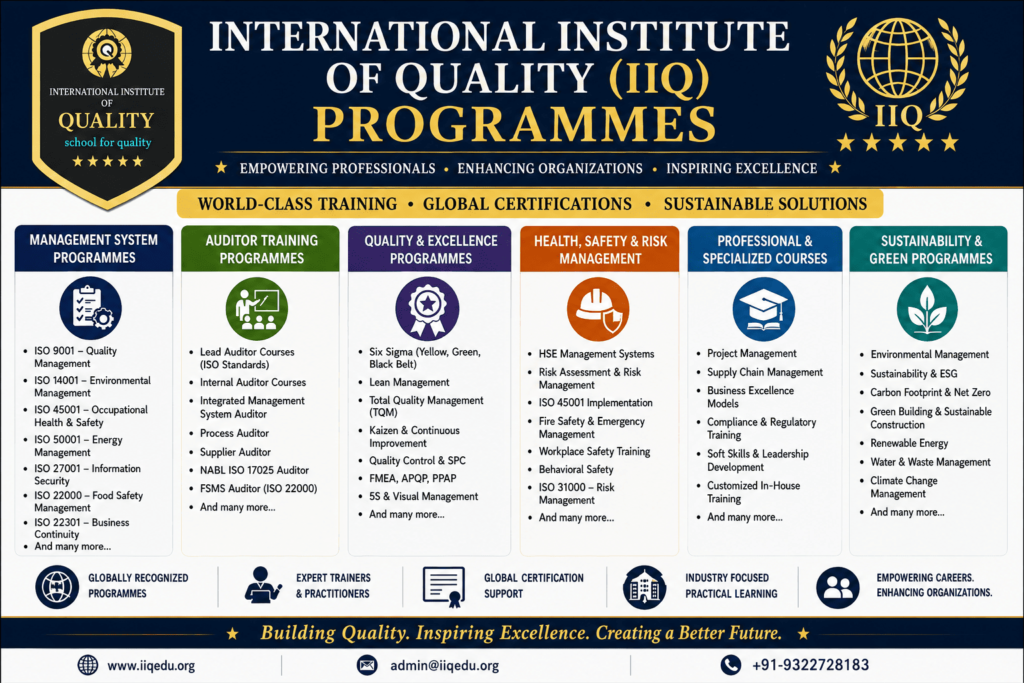
Programmes
- 1 Day Awareness Training Program IIQ Download
- 2 Days Advance Training on Quality IIQ Download
- 4 Days Advance Course on Quality IIQ Download
- 7 Days Quality Boot Stamp Camp IIQ Download
- 14 Days Practical Quality Workshop IIQ Download
- 06 Month Diploma in Quality IIQ Download
- 01 Year Post Graduate Diploma in Quality IIQ Download
What is Required at the International Institute of Quality (IIQ) Programmes?
The International Institute of Quality (IIQ) programmes are designed to develop professionals who can contribute effectively to quality management, process improvement, organizational excellence, and customer satisfaction. To participate successfully in IIQ programmes, certain academic, professional, technical, and personal requirements are generally expected from candidates.
First, educational qualification is an important requirement. Most IIQ programmes expect applicants to have completed at least a higher secondary education (12th standard) or an undergraduate degree, depending on the level of the programme. Advanced diplomas, postgraduate programmes, or specialized certifications may require a bachelor’s degree in engineering, management, science, commerce, or a related field. The educational background ensures that participants possess the basic analytical and communication skills necessary for understanding quality concepts.
Second, professional interest or experience in quality-related activities is highly beneficial. While some entry-level programmes may accept fresh students, many IIQ courses are intended for working professionals involved in manufacturing, services, healthcare, education, construction, information technology, or other sectors where quality management is essential. Experience in operations, production, auditing, compliance, or process improvement helps participants relate theoretical concepts to practical situations.
Third, participants should have basic computer and digital literacy. Since many IIQ programmes use online learning platforms, digital assessments, electronic study materials, and virtual discussions, candidates are expected to know how to use computers, email, web browsers, and common office software. Reliable internet access is also necessary for online or blended learning programmes.
Another key requirement is understanding and commitment to quality principles. IIQ programmes emphasize concepts such as continuous improvement, customer focus, teamwork, leadership, data-based decision making, and adherence to standards. Participants should be willing to learn international quality frameworks such as ISO standards, Total Quality Management (TQM), Six Sigma, Lean principles, and auditing practices. A positive attitude toward improvement and organizational excellence is essential.
Communication skills are also important. Participants are often required to read technical materials, prepare assignments, participate in discussions, and present case studies or project work. Therefore, the ability to communicate clearly in the language of instruction, usually English, helps in achieving better learning outcomes.
In addition, IIQ programmes generally require regular participation and completion of academic activities. This includes attending classes or webinars, submitting assignments on time, participating in practical exercises, completing projects, and appearing for examinations or assessments. Consistent engagement is necessary because quality management is a skill-oriented discipline that requires application, not only theoretical study.
Who is Required at the International Institute of Quality (IIQ) Programmes?
The International Institute of Quality (IIQ) programmes are intended for a wide range of individuals who are interested in developing knowledge and skills related to quality management, process improvement, organizational excellence, and professional growth. Rather than being limited to one profession, IIQ programmes are suitable for students, working professionals, managers, entrepreneurs, and anyone who wishes to contribute to quality enhancement in any sector.
One important group is students and fresh graduates. Individuals who have completed higher secondary education, diploma courses, or undergraduate studies often join IIQ programmes to strengthen their career prospects. The knowledge of quality tools, ISO standards, Lean, Six Sigma, and continuous improvement gives them an advantage when applying for jobs in manufacturing, service industries, healthcare, information technology, education, logistics, and other sectors. For fresh graduates, IIQ programmes provide practical exposure that complements academic learning.
Working professionals are another major category. Employees involved in production, operations, maintenance, customer service, procurement, supply chain, administration, or technical functions can benefit significantly from these programmes. Organizations increasingly expect employees to understand quality systems and contribute to reducing errors, improving efficiency, and enhancing customer satisfaction. IIQ training helps professionals perform their responsibilities more effectively and prepare for higher positions.
Quality executives, inspectors, and auditors are specifically suited for IIQ programmes. These individuals are directly responsible for maintaining quality standards, conducting inspections, identifying non-conformities, preparing reports, and supporting compliance with national and international standards. Advanced IIQ courses can deepen their expertise in auditing techniques, statistical quality control, risk management, corrective actions, and continual improvement methodologies.
The programmes are also valuable for supervisors, team leaders, and middle-level managers. Such professionals coordinate teams and processes and therefore need the ability to monitor performance, solve problems, analyze data, and implement improvement initiatives. IIQ programmes strengthen leadership capabilities by integrating quality thinking with decision-making and process management.
Senior managers and organizational leaders can also benefit. For them, quality is not only a technical activity but a strategic function that influences customer loyalty, operational excellence, competitiveness, and long-term sustainability. IIQ programmes help leaders understand how quality culture, policy deployment, performance measurement, and continuous improvement can support organizational success.
Another important group is entrepreneurs and business owners. Small and medium enterprises often face challenges related to consistency, customer complaints, waste, and compliance. By participating in IIQ programmes, entrepreneurs can learn how to establish quality systems, standardize processes, improve productivity, and build customer confidence. This can lead to better business performance and market reputation.
In addition, professionals from non-manufacturing sectors are increasingly required in IIQ programmes. Healthcare staff, educators, hospitality professionals, bankers, software engineers, and government employees all work in environments where service quality and process reliability are critical. Quality management principles are applicable to both products and services.
When is Required at the International Institute of Quality (IIQ) Programmes?
The International Institute of Quality (IIQ) programmes are required at different stages of education, professional development, and organizational growth. The question “When is required at the International Institute of Quality (IIQ) programmes?” can be understood as identifying the situations and periods in which individuals or organizations need IIQ programmes the most. These programmes become important whenever there is a need to improve quality, increase efficiency, meet standards, enhance career opportunities, or support continuous improvement.
For students and fresh graduates, IIQ programmes are required during the transition from education to employment. At this stage, many candidates possess theoretical knowledge but may lack practical understanding of quality systems, auditing, process control, and improvement techniques. Joining an IIQ programme before applying for jobs can strengthen employability and provide industry-relevant skills that are valued by employers.
For working professionals, IIQ programmes are required when they take on new responsibilities or seek career advancement. Employees who are promoted to supervisory, quality assurance, operations, or managerial roles often need additional knowledge of quality management tools, ISO standards, Lean practices, Six Sigma methodologies, and problem-solving techniques. The training helps them perform their duties more effectively and contribute to organizational goals.
IIQ programmes are also required when an organization is implementing or upgrading a quality management system. Companies pursuing certifications such as ISO 9001, ISO 14001, ISO 45001, or other international standards need trained personnel who understand documentation, auditing, corrective actions, risk management, and continual improvement. During such implementation phases, quality education becomes essential for successful compliance and certification.
Another important time is when quality problems arise. Increasing customer complaints, product defects, service errors, process delays, waste, rework, or non-conformities indicate the need for systematic quality improvement. IIQ programmes provide the knowledge and tools required to identify root causes, analyze data, improve processes, and prevent recurring problems. In such situations, the programmes support both immediate corrective actions and long-term improvement.
These programmes are further required during periods of organizational change. Expansion, digital transformation, automation, mergers, new product launches, or entry into international markets often demand stronger quality systems and better process control. Employees and managers need updated competencies to maintain consistency and customer satisfaction during change.
For quality professionals and auditors, IIQ programmes are required as part of continuous professional development. Quality standards, auditing practices, regulatory requirements, and improvement methodologies evolve over time. Regular participation in advanced programmes, workshops, and certification courses helps professionals remain current and maintain their competence in a competitive environment.
IIQ programmes are also required when organizations aim to improve performance and competitiveness. Even if no major quality problem exists, companies may seek higher productivity, lower costs, better customer experience, and operational excellence. In such cases, quality training becomes a proactive investment rather than a corrective measure.
In conclusion, International Institute of Quality programmes are required at multiple points in academic and professional life: before entering the workforce, during career progression, when implementing quality systems, when addressing quality problems, during organizational change, and as part of continuous professional development. They are needed whenever individuals or organizations seek improvement, compliance, efficiency, customer satisfaction, and long-term excellence. Therefore, the requirement for IIQ programmes is not limited to a single time; it is closely connected to the ongoing pursuit of quality and continuous improvement in both careers and organizations.
Where is Required at the International Institute of Quality (IIQ) Programmes?
The International Institute of Quality (IIQ) programmes are required in a wide variety of places and sectors where quality, efficiency, customer satisfaction, and continuous improvement are important. The question “Where is required at the International Institute of Quality (IIQ) programmes?” refers to the environments and industries in which the knowledge and skills gained from IIQ programmes are needed and applied. In today’s competitive world, quality management is not limited to factories; it is required in almost every organization and workplace.
One of the primary places where IIQ programmes are required is the manufacturing industry. Factories producing automobiles, electronics, pharmaceuticals, textiles, food products, chemicals, and engineering goods depend heavily on quality systems. Trained quality professionals are needed to conduct inspections, monitor processes, reduce defects, ensure compliance with standards, and improve productivity. IIQ programmes help employees apply quality tools and international standards effectively in these settings.
IIQ programmes are also required in the service sector. Banks, insurance companies, telecommunications organizations, retail businesses, hospitality establishments, and customer support centers must deliver consistent and reliable services. Quality management helps these organizations reduce errors, improve response time, increase customer satisfaction, and maintain a strong reputation. Employees trained through IIQ programmes can support service excellence and process improvement.
Another important area is healthcare. Hospitals, clinics, diagnostic laboratories, pharmacies, and healthcare administration require high standards of quality and patient safety. Quality professionals are needed to maintain documentation, monitor procedures, manage risks, support accreditation requirements, and improve healthcare services. IIQ programmes provide useful knowledge for healthcare personnel involved in quality assurance and compliance activities.
The programmes are equally required in educational institutions. Schools, colleges, universities, and training centers increasingly focus on quality assurance, academic improvement, institutional accreditation, and stakeholder satisfaction. Administrators and educators can use quality management principles to improve teaching processes, student services, documentation, and overall institutional performance.
In the field of information technology and software development, IIQ programmes are required to ensure process consistency, defect prevention, testing effectiveness, data quality, and project reliability. Software companies often adopt quality frameworks and continuous improvement practices, making quality training valuable for engineers, testers, analysts, and project managers.
IIQ programmes are also needed in construction and infrastructure projects. Quality control is essential in building construction, roads, bridges, utilities, and industrial projects. Engineers, supervisors, contractors, and inspectors use quality procedures to ensure safety, compliance, durability, and proper execution of work.
Another significant place is government and public-sector organizations. Departments involved in transportation, municipal services, public health, education, utilities, and administration are increasingly adopting quality management practices to improve efficiency, transparency, and citizen satisfaction. IIQ-trained professionals can contribute to better governance and service delivery.
In addition, IIQ programmes are required in small and medium enterprises (SMEs) as well as large multinational companies. Smaller businesses use quality systems to reduce waste, improve consistency, and compete effectively, while large organizations require structured quality management across multiple departments and locations.
How is Required at the International Institute of Quality (IIQ) Programmes?
The International Institute of Quality (IIQ) programmes are required through a systematic and practical approach that helps individuals and organizations develop competence in quality management, process improvement, and organizational excellence. The question “How is required at the International Institute of Quality (IIQ) programmes?” can be understood as explaining the manner in which these programmes are needed, implemented, and applied to achieve effective learning and professional results.
IIQ programmes are required through structured education and training. The institute typically organizes its programmes in levels such as foundation, diploma, advanced diploma, postgraduate, or professional certification courses. Each level is designed to build knowledge gradually, beginning with basic quality concepts and progressing toward advanced tools, auditing techniques, statistical methods, Lean practices, Six Sigma, and international standards. This step-by-step structure ensures that participants can learn and apply quality principles effectively.
They are also required through practical and industry-oriented learning. Quality management is not only theoretical; it involves solving real workplace problems. Therefore, IIQ programmes emphasize case studies, assignments, projects, process analysis, root-cause analysis, corrective actions, and continuous improvement activities. Participants learn how to identify defects, reduce waste, improve efficiency, and enhance customer satisfaction. The practical orientation makes the programmes useful across different industries.
Another important aspect is that IIQ programmes are required through compliance with international standards. Organizations seeking certifications such as ISO 9001, ISO 14001, ISO 45001, or other management system standards need trained personnel who understand documentation, auditing, risk management, and continual improvement. IIQ programmes provide the knowledge and competence required to support these standards and maintain compliance in professional environments.
The programmes are further required through continuous professional development. Quality practices and industry requirements change over time due to technological advancement, globalization, customer expectations, and regulatory updates. Professionals therefore need ongoing learning rather than one-time training. IIQ programmes help participants update their skills, remain competitive, and adapt to new quality methodologies and management approaches.
IIQ programmes are also required through active participation and assessment. Learning is achieved by attending classes or webinars, studying learning materials, participating in discussions, completing assignments, carrying out project work, and appearing for examinations or evaluations. These activities ensure that participants not only receive information but also demonstrate understanding and application of quality concepts.
Another way in which these programmes are required is through organizational implementation. Companies often nominate employees from production, operations, quality assurance, maintenance, supply chain, healthcare, education, or service departments. After training, participants apply the acquired knowledge in their workplaces by improving processes, conducting audits, analyzing data, standardizing procedures, and supporting improvement initiatives. Thus, the value of the programme is realized through workplace application.
In addition, IIQ programmes are required through the development of professional attitudes and skills. Participants are encouraged to develop analytical thinking, attention to detail, ethical behavior, teamwork, leadership, communication, and problem-solving abilities. These qualities are essential for effective quality professionals and managers.
In conclusion, International Institute of Quality programmes are required through a structured, practical, standards-based, and continuously evolving learning process. They are implemented through education, training, participation, assessment, and workplace application. By combining theoretical knowledge with practical improvement activities, IIQ programmes help individuals and organizations achieve higher quality, better performance, regulatory compliance, customer satisfaction, and long-term professional and organizational excellence.
Case Study on at the International Institute of Quality (IIQ) Programmes?
Impact of International Institute of Quality (IIQ) Programmes on Organizational Performance
Background
A medium-sized manufacturing company, Precision Auto Components Pvt. Ltd., located in Maharashtra, India, was facing increasing customer complaints, production defects, and delivery delays. The company supplied components to automotive manufacturers and employed around 250 workers. Although it had experienced technical staff, it lacked a structured quality management system and employees had limited knowledge of modern quality practices.
Problem
During the financial year 2025–26, the company observed several issues:
- Defect rate increased from 2.5% to 5.8%.
- Customer complaints rose by 40%.
- Rework and scrap costs increased significantly.
- Internal audits were inconsistent.
- Supervisors lacked problem-solving and data-analysis skills.
Management realized that improving machinery alone would not solve the problem. Employee competence in quality management had to be strengthened.
Intervention through IIQ Programmes
The company collaborated with the International Institute of Quality (IIQ) and enrolled 25 employees in different programmes:
- Quality Management System (QMS) Foundation Programme
- ISO 9001 Internal Auditor Programme
- Lean and Continuous Improvement Programme
- Statistical Quality Control (SQC) Workshop
Participants included production supervisors, quality inspectors, maintenance engineers, and store personnel. The training was conducted in a blended mode combining classroom sessions, online learning, case studies, and workplace projects.
Implementation
After completing the programmes, employees formed cross-functional improvement teams. They applied the tools learned during the training:
- Cause-and-effect diagrams for defect analysis.
- Pareto charts to identify major sources of complaints.
- 5S practices for workplace organization.
- Control charts for monitoring critical dimensions.
- Corrective and preventive action (CAPA) procedures.
The internal auditor team also standardized audit checklists and conducted monthly process audits.
Results
Within six months, the company recorded measurable improvements.
Performance Indicator
After IIQ
Defect rate
5.8% → 2.1%
Customer complaints
-40%
Rework cost
-32%
On-time delivery
88% → 96%
Audit compliance
72% → 95%
In addition, employee involvement improved noticeably. Supervisors began using data for decision-making, operators participated in improvement suggestions, and communication between departments became more effective.
Key Learning
The case demonstrated that IIQ programmes were not merely academic courses; they created practical capability within the organization. The most important success factors were:
- Management support.
- Selection of employees from different departments.
- Application of learning to real workplace problems.
- Regular follow-up and performance measurement.
Conclusion
This case study shows how the International Institute of Quality (IIQ) programmes can contribute directly to organizational excellence. By developing employee knowledge in quality systems, auditing, Lean practices, and statistical control, the company achieved lower defects, reduced costs, improved customer satisfaction, and better operational performance. The study highlights that investment in quality education and continuous improvement can produce significant business benefits and strengthen long-term competitiveness in the manufacturing sector.
White Paper on at the International Institute of Quality (IIQ) Programmes?
Introduction
In an increasingly competitive and quality-driven global economy, organizations are expected to deliver products and services that consistently meet customer expectations, regulatory requirements, and international standards. The International Institute of Quality (IIQ) plays an important role in addressing this need by offering professional programmes focused on quality management, continuous improvement, auditing, and organizational excellence. This white paper outlines the purpose, structure, benefits, and strategic value of IIQ programmes for individuals and organizations.
The Need for Quality Education
Industries across manufacturing, healthcare, information technology, education, construction, and services face challenges such as process variation, customer complaints, operational inefficiencies, compliance risks, and increasing competition. Traditional technical education often does not provide sufficient practical training in quality systems and improvement methodologies. IIQ programmes are designed to bridge this gap by combining theoretical knowledge with workplace application.
Programme Structure
IIQ programmes typically include foundation, diploma, advanced diploma, and professional certification levels. The curriculum is aligned with internationally recognized quality principles and may include:
- Quality Management Systems (QMS)
- ISO 9001 and other management standards
- Internal and lead auditing techniques
- Lean and continuous improvement
- Six Sigma concepts
- Statistical Quality Control (SQC)
- Root-cause analysis and corrective actions
- Risk-based thinking and performance measurement
The programmes are delivered through classroom sessions, online learning, workshops, case studies, projects, and assessments, enabling flexible participation for students and working professionals.
Target Participants
IIQ programmes are suitable for:
- Students and fresh graduates
- Quality inspectors and auditors
- Production and operations personnel
- Engineers and technicians
- Supervisors and managers
- Healthcare and service professionals
- Entrepreneurs and business owners
This broad applicability reflects the fact that quality management is a cross-functional discipline relevant to all sectors.
Organizational Benefits
Organizations that support employee participation in IIQ programmes can achieve several measurable benefits:
- Reduction in defects and rework
- Improved process consistency
- Better compliance with ISO and regulatory requirements
- Enhanced customer satisfaction
- Increased productivity and cost efficiency
- Stronger internal audit systems
- Improved employee involvement in continuous improvement
Quality-trained employees are better equipped to analyze data, solve problems systematically, and implement sustainable improvements.
Professional Benefits
For individuals, IIQ programmes provide industry-recognized knowledge and practical skills that enhance employability and career growth. Participants gain competence in auditing, process analysis, documentation, and improvement methodologies. The programmes also strengthen communication, leadership, teamwork, and analytical thinking, which are essential for modern quality professionals.
Strategic Importance
Quality is no longer a departmental activity; it is a strategic business function. Organizations seeking operational excellence, digital transformation, global market access, and long-term sustainability require a culture of continuous improvement. IIQ programmes contribute to this culture by developing capable professionals who can align quality objectives with organizational strategy.
Conclusion
The International Institute of Quality programmes represent a structured and practical approach to developing quality competence in both individuals and organizations. By integrating international standards, improvement tools, auditing practices, and performance-focused learning, these programmes support operational excellence and professional advancement. As industries continue to evolve, investment in quality education through IIQ programmes can serve as a critical enabler of competitiveness, customer trust, regulatory compliance, and sustainable organizational success.
Industrial Application of at the International Institute of Quality (IIQ) Programmes?
The International Institute of Quality (IIQ) programmes have significant industrial applications across manufacturing, service, healthcare, information technology, construction, and logistics sectors. These programmes are designed to develop practical competence in quality management, process improvement, auditing, and organizational excellence. In modern industries, where customer expectations and regulatory requirements are continuously increasing, IIQ programmes provide the knowledge and tools needed to achieve consistent performance and continuous improvement.
One of the most important industrial applications is in manufacturing operations. Industries such as automotive, pharmaceuticals, food processing, electronics, textiles, and engineering require strict quality control to ensure that products meet specifications. Employees trained through IIQ programmes can use quality tools such as Pareto analysis, cause-and-effect diagrams, control charts, and process capability studies to identify defects and reduce variation. This leads to lower scrap, less rework, improved productivity, and higher customer satisfaction.
IIQ programmes are also widely applied in Quality Management System (QMS) implementation. Organizations seeking ISO 9001 certification need trained personnel who understand documentation, process mapping, internal auditing, corrective actions, risk-based thinking, and continual improvement. IIQ-trained professionals help establish, maintain, and improve QMS frameworks, ensuring compliance with international standards and enhancing organizational credibility.
In the area of Lean and continuous improvement, IIQ programmes support industries in eliminating waste and improving efficiency. Trained employees can implement 5S, Kaizen, visual management, standard work, and other Lean practices. These applications reduce unnecessary movement, waiting time, excess inventory, and process delays, resulting in better resource utilization and lower operating costs.
Another major application is in Six Sigma and problem-solving projects. Industrial organizations often face recurring quality issues, machine downtime, customer complaints, and process instability. IIQ programmes teach structured problem-solving approaches using data analysis and root-cause identification. Improvement teams can apply these methods to achieve measurable gains in quality, delivery, and cost performance.
IIQ programmes also have strong applications in supply chain and vendor management. Companies depend on suppliers for raw materials, components, and services. Quality-trained professionals can conduct supplier audits, evaluate vendor performance, define acceptance criteria, and monitor incoming quality. This helps organizations reduce supplier-related defects and improve overall supply chain reliability.
In the healthcare industry, IIQ programmes support patient safety, documentation control, process standardization, infection-control procedures, and accreditation requirements. Hospitals and diagnostic centers can use quality tools to reduce errors, improve service delivery, and enhance patient satisfaction.
In information technology and software industries, the programmes contribute to process consistency, defect prevention, testing quality, documentation management, and project control. Quality practices help software organizations improve reliability and customer confidence.
The construction and infrastructure sector also benefits from IIQ programmes. Engineers and supervisors apply quality procedures for material inspection, process control, safety compliance, and project documentation, ensuring that structures meet required standards and specifications.
Furthermore, IIQ programmes encourage the development of a quality culture within organizations. Employees become more aware of customer requirements, teamwork, data-based decision making, and continuous improvement. This cultural transformation is often as valuable as the technical tools themselves.
In conclusion, the industrial application of International Institute of Quality programmes extends across production, quality assurance, auditing, Lean implementation, Six Sigma projects, supply chain management, healthcare, IT, and construction. By combining practical skills with international quality principles, IIQ programmes help organizations improve efficiency, reduce costs, ensure compliance, enhance customer satisfaction, and achieve sustainable industrial excellence.