Interoperability Frameworks
1. Definition
An interoperability framework is a set of rules, standards, and guidelines that ensures different software, hardware, or organizational systems can interact reliably. It defines how data is formatted, transmitted, and interpreted across systems.
2. Types of Interoperability
- Technical Interoperability:
Ensures that systems can connect and exchange data (e.g., APIs, communication protocols). - Semantic Interoperability:
Ensures that the exchanged data is meaningful and understood consistently across systems. - Organizational Interoperability:
Aligns policies, processes, and business rules so organizations can collaborate efficiently.
3. Components of an Interoperability Framework
- Standards and Protocols: Define how systems exchange data (e.g., HL7 in healthcare, OPC UA in industrial automation).
- Data Models and Ontologies: Ensure shared understanding of the data structure and meaning.
- Governance Policies: Define roles, responsibilities, and compliance rules.
- Integration Tools: Middleware, APIs, or adapters that connect systems.
4. Applications
- Healthcare: Sharing patient data across hospitals and labs securely using HL7 or FHIR standards.
- Smart Cities: Integrating traffic, energy, and environmental monitoring systems.
- Industry 4.0: Connecting factory machines, sensors, and ERP systems for seamless automation.
- Government Services: Sharing citizen data across departments securely and efficiently.
5. Benefits
- Enhanced Collaboration: Systems and organizations can work together effectively.
- Data Consistency: Reduces errors caused by misinterpretation of data.
- Cost Efficiency: Avoids redundant infrastructure and improves resource utilization.
- Scalability: New systems or partners can integrate more easily.
6. Challenges
- Complexity: Integrating heterogeneous systems can be technically and organizationally challenging.
- Compliance: Ensuring legal, privacy, and security standards are met.
- Standardization: Different industries may have competing or incompatible standards.
- Maintenance: Continuous updates and alignment are required as systems evolve.
What is Interoperability Frameworks?
Interoperability Frameworks are structured sets of standards, guidelines, and protocols that enable different systems, applications, or organizations to communicate, exchange data, and work together effectively.
In simpler terms, it’s a blueprint that ensures diverse technologies or organizations can “understand” each other and operate cohesively, even if they were designed independently.
Key Features
- Technical Interoperability – Ensures systems can connect and exchange data using compatible technologies (e.g., APIs, communication protocols).
- Semantic Interoperability – Ensures the meaning of exchanged data is preserved so all systems interpret it correctly.
- Organizational Interoperability – Aligns processes, policies, and governance so different entities can collaborate efficiently.
Why It’s Important
- Allows seamless integration across heterogeneous systems.
- Reduces errors and miscommunication in data exchange.
- Supports scalable, efficient, and secure operations in industries like healthcare, smart cities, government, and Industry 4.0.
Examples
- Healthcare: HL7 or FHIR frameworks allow hospitals, labs, and clinics to share patient data reliably.
- Smart Cities: Frameworks that integrate traffic, energy, and environmental monitoring systems.
- Industry 4.0: Standards like OPC UA enable machines, sensors, and ERP systems to communicate in manufacturing plants.
In essence, an interoperability framework is the backbone of connected systems, making sure that diverse technologies or organizations can exchange information meaningfully and work together seamlessly.
Who is Interoperability Frameworks required?
Interoperability Frameworks are required by any organization, industry, or system that needs multiple technologies or entities to work together seamlessly. Essentially, they are crucial wherever data sharing, system integration, or cross-organizational collaboration is needed.
Here’s a detailed breakdown:
1. Healthcare Providers
- Why required: Hospitals, clinics, and labs use different software and devices to manage patient records.
- Benefit: Frameworks like HL7 or FHIR ensure patient data can be shared securely and interpreted correctly across systems.
2. Government Agencies
- Why required: Different departments need to exchange citizen data, policy information, or service records.
- Benefit: Enables coordinated services, reduces redundancy, and ensures compliance with data privacy regulations.
3. Smart City Planners
- Why required: Traffic, energy, water, and environmental systems often run on separate platforms.
- Benefit: Interoperability frameworks allow these systems to communicate and optimize resources efficiently.
4. Industrial and Manufacturing Companies
- Why required: Factories use multiple machines, sensors, and ERP systems from different vendors.
- Benefit: Frameworks like OPC UA ensure machines and software can exchange data for real-time monitoring and automation.
5. Logistics and Supply Chain Operators
- Why required: Different partners, warehouses, and transport systems need to share inventory and shipment data.
- Benefit: Ensures smooth operations, accurate tracking, and reduces operational delays.
6. IT and Software Companies
- Why required: Products and platforms often need to integrate with third-party services or legacy systems.
- Benefit: Frameworks make integration easier, faster, and more reliable while reducing technical conflicts.
In short: Interoperability frameworks are required anywhere multiple systems, technologies, or organizations need to exchange data, collaborate, or operate together efficiently. They are critical for industries where accuracy, efficiency, and coordination are key.
When is Interoperability Frameworks required?
Interoperability Frameworks are required whenever multiple systems, technologies, or organizations need to exchange information, collaborate, or work together efficiently. They are especially important in complex environments where miscommunication or incompatible systems can cause errors, delays, or inefficiencies.
1. When Systems Need to Communicate
- Situation: Two or more software platforms, machines, or devices must share data.
- Example: A hospital’s lab system sending test results to the patient management system.
- Why Required: Ensures accurate, timely, and meaningful data exchange.
2. When Multiple Organizations Collaborate
- Situation: Different organizations or departments need to work together using separate systems.
- Example: Government agencies sharing citizen data for public services.
- Why Required: Aligns policies, processes, and data standards to enable smooth collaboration.
3. When Data Must Be Standardized
- Situation: Data from diverse sources must be interpreted consistently.
- Example: IoT devices in a smart city sending traffic, energy, and environmental data.
- Why Required: Semantic interoperability ensures all systems “understand” the data correctly.
4. When Systems Are Upgraded or Expanded
- Situation: New software, devices, or partners are added to an existing ecosystem.
- Example: Adding a new ERP system in a factory or integrating new medical devices in a hospital.
- Why Required: Prevents integration issues and ensures new systems work seamlessly with existing ones.
5. When Compliance and Security Are Critical
- Situation: Sensitive data needs secure sharing across systems while meeting regulatory standards.
- Example: Patient health records or financial data exchanged between institutions.
- Why Required: Frameworks provide governance, security protocols, and standardization to maintain compliance.
In short: Interoperability frameworks are required anytime systems, devices, or organizations must exchange data reliably, efficiently, and securely, especially in complex, regulated, or collaborative environments.
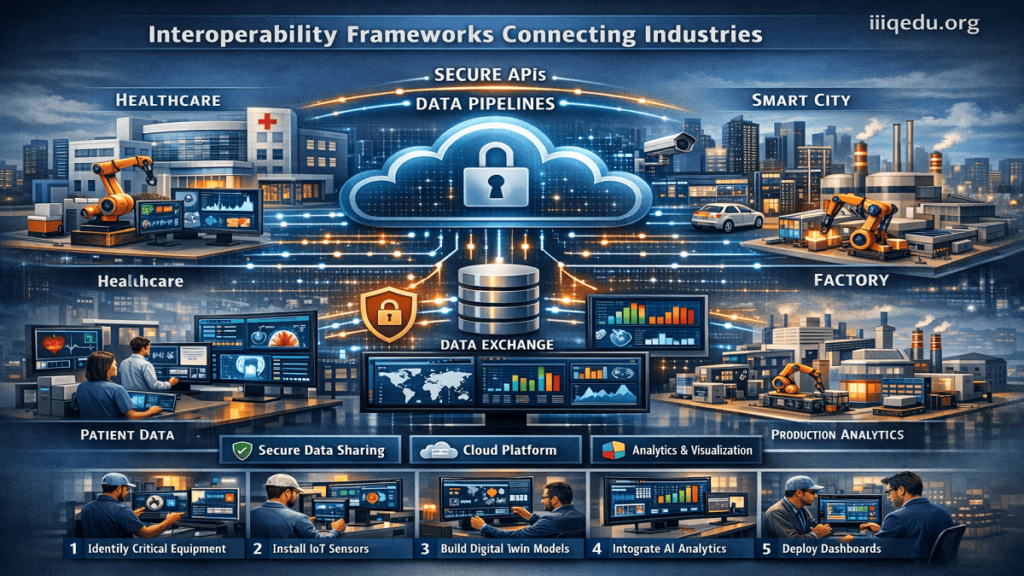
Where is Interoperability Frameworks required?
Interoperability Frameworks are required wherever multiple systems, technologies, or organizations need to communicate, share data, or operate together efficiently. They are critical in environments that rely on complex integrations and real-time information exchange.
Here’s a breakdown of where they are commonly required:
1. Healthcare Systems
- Why: Hospitals, clinics, labs, and pharmacies often use different software and devices.
- Example: Sharing electronic health records (EHRs) across hospitals using HL7 or FHIR standards.
- Benefit: Ensures patient data is accurate, secure, and accessible across care providers.
2. Government and Public Services
- Why: Multiple departments need to exchange data for public administration and citizen services.
- Example: Tax, social services, and healthcare agencies collaborating on citizen programs.
- Benefit: Enables coordinated services and reduces redundant processes.
3. Smart Cities
- Why: Cities use multiple systems for traffic, energy, water, and environmental monitoring.
- Example: Integrating IoT sensors across utilities, transport networks, and public safety systems.
- Benefit: Facilitates efficient resource management, real-time monitoring, and data-driven planning.
4. Manufacturing and Industry 4.0
- Why: Factories use machines, robotics, and ERP systems from different vendors.
- Example: Connecting production machines to central monitoring platforms using OPC UA standards.
- Benefit: Ensures real-time monitoring, predictive maintenance, and streamlined operations.
5. Logistics and Supply Chain
- Why: Multiple partners, warehouses, and transportation systems need to coordinate.
- Example: Sharing shipment and inventory data across e-commerce platforms and delivery partners.
- Benefit: Reduces delays, improves accuracy, and enhances supply chain efficiency.
6. IT and Software Systems
- Why: Organizations often integrate legacy systems with modern applications.
- Example: Connecting CRM, ERP, and analytics platforms across departments.
- Benefit: Prevents integration conflicts and ensures smooth operations across systems.
In short: Interoperability frameworks are required in healthcare, government, smart cities, manufacturing, logistics, and IT systems—anywhere that multiple systems or organizations must exchange data reliably, securely, and meaningfully.
How is Interoperability Frameworks required?
Interoperability Frameworks are required by being implemented as structured systems, standards, and protocols that allow diverse technologies, organizations, or processes to work together seamlessly. In other words, they are required through practical integration and governance mechanisms that ensure reliable communication and collaboration.
Here’s a detailed breakdown:
1. Through Standardized Communication
- How: Systems use agreed-upon protocols, APIs, or messaging standards to exchange data.
- Why Required: Ensures that devices, software, or organizations “speak the same language.”
- Example: Hospitals sending patient data between different EHR systems using HL7 or FHIR standards.
2. Through Data Consistency and Semantic Alignment
- How: Frameworks define data models, ontologies, or rules to interpret data consistently across systems.
- Why Required: Prevents misinterpretation of data and ensures that all parties understand it correctly.
- Example: IoT sensors in smart cities reporting energy or traffic data using a standardized format.
3. Through Process and Policy Integration
- How: Organizational workflows, governance policies, and compliance rules are aligned.
- Why Required: Enables smooth collaboration across departments or organizations.
- Example: Government agencies coordinating citizen services while following shared privacy and security policies.
4. Through Middleware and Integration Tools
- How: Software platforms, connectors, or adapters link heterogeneous systems.
- Why Required: Bridges gaps between legacy systems and modern applications without disrupting operations.
- Example: Manufacturing plants connecting robotic machinery, sensors, and ERP systems via OPC UA standards.
5. Through Security and Compliance Measures
- How: Frameworks define encryption, access control, and auditing standards for data exchange.
- Why Required: Protects sensitive information and ensures regulatory compliance.
- Example: Financial institutions securely sharing transaction data across different platforms.
In short: Interoperability frameworks are required by implementing standardized communication protocols, semantic data models, aligned organizational processes, integration tools, and security measures. They make collaboration between different systems, technologies, and organizations practical, secure, and efficient.
Case Study of Interoperability Frameworks
Background
In healthcare, sharing electronic medical records (EMRs) across different hospitals and clinics often fails due to incompatible systems and data formats. To overcome this, the TASIPPS interoperability framework was developed to enable secure, standardized data exchange between disparate EMR systems.
Implementation
- Two healthcare institutions with completely different EMR prototypes were connected using the TASIPPS framework.
- A central interoperability platform became the intermediary for exchanging medical records.
- A semantic interoperability module ensured that medical terms and data formats matched across systems so that patient histories could be understood correctly by both hospitals.
- Privacy and security were embedded into the framework using AES‑256 encryption and role‑based access control. A consent management system allowed patients to approve or deny access to their records before data was shared.
Outcome
- Doctors at one hospital could successfully access and interpret patient histories stored at the other hospital in real time.
- Security measures ensured that only authorized personnel could view sensitive data.
- The framework demonstrated that heterogeneous healthcare systems can be integrated without replacing existing EMR software, reducing disruption and cost.
- This validation showed interoperability frameworks can improve data sharing, protect privacy, and comply with legal requirements.
Key Takeaways
- Semantic interoperability (shared meaning of data) is essential for accurate record interpretation.
- Embedding security and consent management builds trust among stakeholders and patients.
- Interoperability frameworks can enable collaboration across systems without requiring complete software replacement.
White paper of Interoperability Frameworks
1. Executive Summary
An Interoperability Framework is a structured set of standards, protocols, policies, and guidelines designed to enable different systems, applications, and organizations to communicate, exchange data, and operate together effectively. In today’s interconnected world—spanning healthcare, government services, smart cities, industrial systems, and digital ecosystems—interoperability frameworks are critical for unlocking value, driving efficiency, and enabling secure, consistent data exchange.
This white paper examines the concept, architecture, business value, implementation strategies, industry use cases, challenges, and future outlook of interoperability frameworks.
2. Introduction
As enterprises and public services grow increasingly digital, disparate technologies and platforms must work in harmony to support real‑time decision‑making, cross‑organizational workflows, and data‑driven innovation. Without a coherent interoperability strategy, systems remain siloed, data remains fragmented, and collaboration becomes costly or impractical. Interoperability frameworks address this by offering a blueprint that balances technical connectivity with semantic understanding and organizational alignment.
3. What Is an Interoperability Framework?
An Interoperability Framework is not a single technology; it is a composite architecture that combines:
- Standards and Protocols: Rules governing how systems exchange data (e.g., APIs, messaging formats).
- Data Models and Ontologies: Structured definitions that ensure consistent interpretation of data semantics.
- Governance Policies: Organizational and legal rules that guide data use, privacy, and compliance.
- Integration Tools: Middleware, adapters, and APIs that enable technical integration across systems.
Interoperability frameworks ensure that systems do more than just connect technically; they ensure that data has the same meaning, that policies are respected, and that workflows are coordinated.
4. Architecture of Interoperability Frameworks
Interoperability frameworks generally include the following layers:
4.1 Technical Layer
Focuses on communication mechanisms such as network protocols, APIs, and transport standards that enable data exchange.
4.2 Semantic Layer
Defines shared data models, vocabularies, and ontologies so that meaning is preserved across systems.
4.3 Organizational Layer
Aligns business processes, governance structures, and compliance rules to support cross‑entity collaboration and decision‑making.
4.4 Security and Compliance Layer
Includes authentication, encryption, access control, audit trails, and regulatory adherence.
5. Business Value and Benefits
5.1 Enhanced Collaboration
Interoperability enables systems within and across organizations to function cohesively, improving cooperation and reducing redundancy.
5.2 Data Consistency
Standardized data models reduce errors caused by misinterpretation of information and improve accuracy for analytics and decision‑making.
5.3 Cost Efficiency
By eliminating manual data reconciliation and siloed workflows, organizations reduce operational costs and accelerate processes.
5.4 Scalability
New systems and partners can be integrated more easily, supporting growth and evolving business needs.
5.5 Regulatory Compliance
Frameworks embed compliance and privacy standards into data exchange mechanisms, reducing risk and enhancing governance.
6. Key Industry Use Cases
6.1 Healthcare
Hospitals, clinics, and labs use interoperability frameworks to share electronic health records (EHRs), ensuring continuity of care while preserving data security and patient privacy.
6.2 Government Services
Public agencies coordinate services like taxation, social welfare, and licensing by sharing citizen data securely, improving service delivery and transparency.
6.3 Smart Cities
Traffic systems, public utilities, safety networks, and environmental sensors integrate through interoperability frameworks to enable efficient urban management and resource allocation.
6.4 Manufacturing and Industry 4.0
Factory machines, robotics, and enterprise systems communicate seamlessly, enabling real‑time monitoring, predictive analytics, and automation.
6.5 Supply Chain and Logistics
Partners across transport, warehousing, and distribution networks share shipment, inventory, and status data in real time for optimized logistics operations.
7. Implementation Strategy
Successful interoperability framework deployment involves:
7.1 Strategic Assessment
Define business objectives and identify systems that require integration.
7.2 Standard Selection
Choose appropriate data standards, APIs, and messaging protocols based on industry and technology landscape.
7.3 Data Modeling
Develop shared data models and semantic rules to harmonize information exchange.
7.4 Integration and Middleware
Implement middleware, connectors, or APIs that bridge legacy and modern systems.
7.5 Governance and Security
Establish data governance policies, privacy safeguards, and security protocols.
7.6 Testing and Validation
Conduct rigorous interoperability testing across all participating systems.
8. Challenges and Considerations
8.1 Complexity of Diverse Systems
Integrating systems with different platforms, versions, and data formats is technically challenging.
8.2 Standard Alignment
Competing or divergent standards may exist, requiring consensus and adaptation.
8.3 Organizational Resistance
Cross‑department or cross‑entity alignment requires cultural change, governance agreements, and stakeholder buy‑in.
8.4 Security Risks
Data exchange increases the attack surface, necessitating strong encryption, access controls, and monitoring.
9. Future Trends
9.1 AI‑Enhanced Semantic Interoperability
Machine learning will automate semantic translation and alignment, reducing manual data modeling.
9.2 Cross‑Domain Frameworks
Interoperability will expand beyond individual sectors to integrate ecosystems such as healthcare with social services or urban mobility with energy networks.
9.3 Real‑Time, Event‑Driven Interoperability
Event streaming and real‑time APIs will power responsive systems for agile decision‑making.
9.4 Policy‑Driven Automation
Frameworks will embed compliance and legal frameworks into integration logic, reducing governance bottlenecks.
10. Conclusion
Interoperability frameworks are foundational to the modern digital ecosystem. By enabling disparate technologies and organizations to communicate meaningfully, they unlock collaboration, reduce costs, and drive innovation. Whether in healthcare, government, smart cities, industry, or logistics, interoperability frameworks empower stakeholders to move beyond data silos toward connected, efficient, and secure systems.
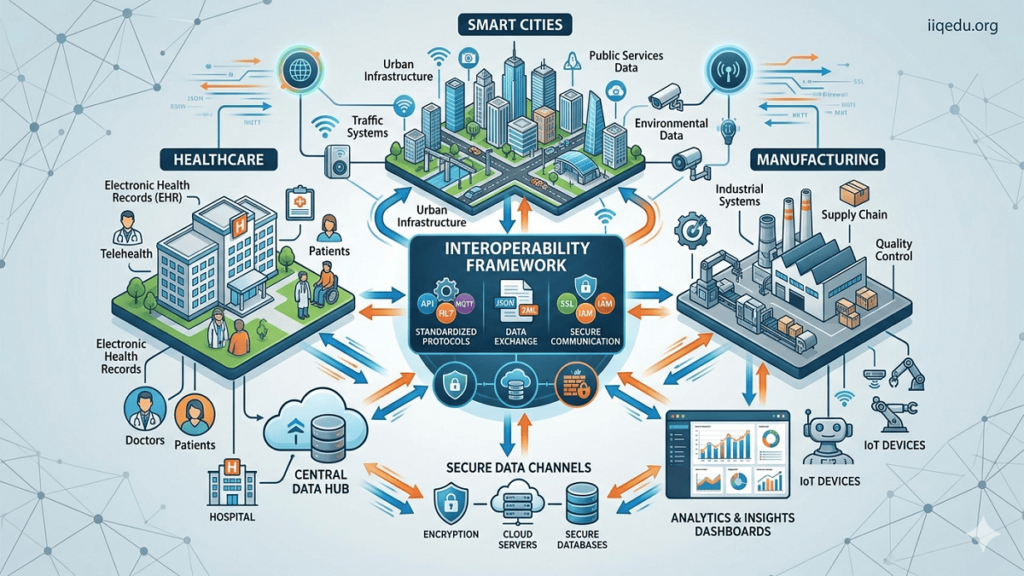
Industry Appliaction of Interoperability Frameworks
Interoperability Frameworks have wide-ranging applications across industries where multiple systems, technologies, or organizations need to work together efficiently and share data seamlessly. Here’s a structured overview of key industry applications:
1. Healthcare
- Application: Sharing electronic health records (EHRs) between hospitals, labs, clinics, and pharmacies.
- Benefit: Ensures accurate, secure, and timely access to patient information, improving patient care and reducing medical errors.
- Example: Using HL7 or FHIR standards for cross-hospital data exchange.
2. Government and Public Services
- Application: Integrating services across departments such as taxation, social welfare, and licensing.
- Benefit: Enables coordinated service delivery, reduces duplication, and ensures regulatory compliance.
- Example: Citizen data shared between municipal, state, and federal agencies.
3. Smart Cities
- Application: Connecting traffic management, energy grids, water systems, and environmental sensors.
- Benefit: Optimizes urban resources, reduces congestion, and supports real-time monitoring and planning.
- Example: IoT-enabled city platforms where multiple municipal systems communicate seamlessly.
4. Manufacturing and Industry 4.0
- Application: Linking factory machines, robotics, ERP systems, and supply chain platforms.
- Benefit: Enables real-time monitoring, predictive maintenance, and automation, improving productivity and reducing downtime.
- Example: OPC UA standards connecting machines from different vendors on a factory floor.
5. Logistics and Supply Chain
- Application: Coordinating inventory, warehouses, shipping, and partner platforms.
- Benefit: Reduces delays, improves tracking, and enhances overall operational efficiency.
- Example: Integrating e-commerce order systems with third-party logistics providers.
6. Energy and Utilities
- Application: Integrating smart grids, renewable energy sources, and utility management platforms.
- Benefit: Improves energy distribution, optimizes consumption, and supports predictive maintenance.
- Example: Real-time monitoring of power lines and substations across regions.
7. Information Technology
- Application: Connecting legacy systems with modern applications, cloud services, and APIs.
- Benefit: Ensures seamless workflow, reduces integration issues, and allows scalable IT infrastructure.
- Example: Enterprise software platforms communicating across departments using middleware and standardized protocols.
In summary: Interoperability frameworks are essential in any sector where multiple systems, organizations, or technologies must collaborate or share data effectively. They help industries improve efficiency, reduce errors, ensure compliance, and enable data-driven decision-making.
#introperabilityinindia #introperabilityinmaharashtra #introperabilityinvasai #introperabilityingorakhpur #introperabilityinkerala #introperabilityinkochi #introperabilityinuttarpradesh #introperabilityinjaipur #introperabilityinraipur #introperabilityinranchi #introperabilityinlakhnav #introperabilityinratnagiri #introperabilityindelhi #introperabilityinbadodara #bestinstituteintheworld #bestinstituteinmaharashtra #bestinstituteinindia #bestinstituteinvasai #bestinstituteinmumbai
Ask FAQs
What is an Interoperability Framework?
An interoperability framework is a structured set of standards, protocols, and policies that enables different systems, applications, or organizations to communicate and work together seamlessly. It ensures data is shared accurately, securely, and meaningfully.
Why are Interoperability Frameworks important?
They are important because they break down system silos, improve collaboration across organizations, ensure data consistency, reduce errors, and enable scalable, secure operations across industries.
Which industries use Interoperability Frameworks?
Key industries include healthcare, government, smart cities, manufacturing, logistics, energy, and IT systems. Any sector with multiple systems or organizations that need to exchange data efficiently benefits from them.
How do Interoperability Frameworks work?
They work by defining technical protocols, data models, semantic rules, and governance policies. Middleware, APIs, and integration tools connect systems, while security and compliance measures ensure safe and authorized data exchange.
What are the main challenges of implementing Interoperability Frameworks?
Challenges include technical complexity, integrating heterogeneous systems, aligning standards, maintaining security, and achieving organizational cooperation. Proper planning, governance, and adherence to standards are required to overcome these challenges.
Source: Real-Time Innovations
Table of Contents
Disclaimer: The information provided on Interoperability Frameworks is for general informational purposes only. While we strive for accuracy, results may vary by industry and organization. Users should conduct their own research or consult professionals before making implementation decisions.