Low-Code/No-Code Testing Platforms
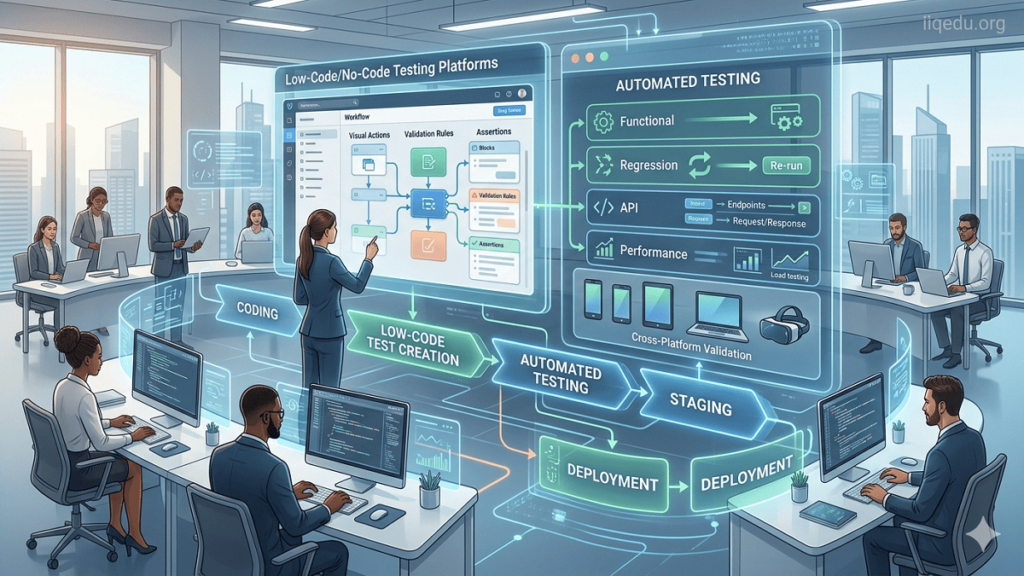
Low-code/no-code testing platforms are software solutions that enable teams to design, execute, and manage automated tests with minimal or no programming knowledge. These platforms have gained prominence in modern software development and DevOps practices due to the increasing demand for faster release cycles, agile methodologies, and cross-functional collaboration. They empower quality assurance (QA) teams, business analysts, and even non-technical stakeholders to participate in testing without writing complex scripts.
Key Features
- Visual Test Design: Users can create test cases using drag-and-drop interfaces, flowcharts, or pre-built templates, significantly reducing the dependency on coding expertise.
- Cross-Platform Support: These platforms support testing across web, mobile, API, and desktop applications, ensuring comprehensive coverage with minimal setup.
- Integration with CI/CD Pipelines: Many low-code/no-code platforms integrate seamlessly with CI/CD tools such as Jenkins, GitLab, and Azure DevOps, enabling continuous testing in automated DevOps workflows.
- Reusable Components: Test steps, actions, and workflows can be reused across multiple test scenarios, increasing efficiency and reducing duplication of effort.
- AI/ML Assistance: Advanced platforms leverage AI for test generation, maintenance, and defect prediction, helping to optimize testing efforts and reduce flaky tests.
Benefits
- Faster Test Creation and Execution: Teams can design and run automated tests without deep programming knowledge, reducing time-to-market.
- Broader Collaboration: Business users and QA engineers can contribute directly to test case creation, enhancing communication and coverage.
- Cost Efficiency: Reduces dependency on highly skilled test automation engineers, lowering operational costs.
- Scalability: Supports enterprise-wide automated testing initiatives without proportionally increasing the development or QA workforce.
- Continuous Testing Enablement: Simplifies embedding tests into CI/CD pipelines, supporting DevOps practices and early defect detection.
Use Cases
- Regression testing of web and mobile applications
- API testing and validation in complex microservices architectures
- Cross-browser and cross-device compatibility testing
- Functional and user-acceptance testing with minimal coding
- Supporting DevSecOps by integrating security checks into automated workflows
Examples of Popular Platforms
- Katalon Studio: Combines low-code design with AI-driven test execution.
- Testim: Uses AI to simplify test maintenance and improve stability.
- Leapwork: Offers a visual flow-based approach for test automation across multiple platforms.
- Tricentis Tosca: Enterprise-grade solution for model-based testing with minimal scripting.
Conclusion
Low-code/no-code testing platforms democratize test automation, making it accessible to non-developers while still supporting advanced DevOps workflows. By reducing the technical barrier and enabling rapid test creation, these platforms accelerate delivery, enhance collaboration, and improve overall software quality.
References:
- Katalon: https://www.katalon.com
- Tricentis Tosca: https://www.tricentis.com/products/automated-testing/
- Testim: https://www.testim.io
- Leapwork: https://www.leapwork.com
#Low-Code/No-Code Testing Platforms in India
What is Low-Code/No-Code Testing Platforms?
A Low-Code/No-Code Testing Platform is a software tool that allows users to create, execute, and manage automated tests for applications without requiring extensive programming knowledge. These platforms use visual interfaces, drag-and-drop workflows, and pre-built templates to simplify the creation of test cases. They are designed to enable QA engineers, business analysts, and even non-technical team members to participate in test automation, reducing reliance on skilled developers or test automation specialists.
The main goal of low-code/no-code testing platforms is to accelerate software testing and make automation accessible across the organization. They support a range of testing types, including:
- Functional Testing: Verifying that application features work as intended.
- Regression Testing: Ensuring new code changes do not break existing functionality.
- API Testing: Validating communication and data exchange between services.
- Cross-Platform Testing: Testing web, mobile, and desktop applications across different devices and browsers.
- Security and Compliance Testing: Integrating automated security checks into workflows.
These platforms often integrate seamlessly with CI/CD pipelines in DevOps environments, enabling continuous testing and early defect detection. Advanced solutions may leverage AI and machine learning to optimize test maintenance, reduce flaky tests, and even generate test cases automatically.
Benefits include:
- Faster test creation and execution
- Broader collaboration among developers, QA, and business teams
- Reduced dependency on specialized coding skills
- Lower costs and increased efficiency in test automation
- Scalability for enterprise-wide testing initiatives
Popular examples include:
- Katalon Studio – AI-powered, low-code testing for web, mobile, and API applications
- Testim – AI-driven automation for fast test creation and maintenance
- Leapwork – Flow-based visual automation for multiple platforms
- Tricentis Tosca – Model-based enterprise testing with minimal scripting
In summary, low-code/no-code testing platforms democratize automation, allowing organizations to implement effective, scalable, and continuous testing strategies without requiring deep programming expertise.
References:
- Katalon: https://www.katalon.com
- Tricentis Tosca: https://www.tricentis.com/products/automated-testing/
- Testim: https://www.testim.io
- Leapwork: https://www.leapwork.com
#Low-Code/No-Code Testing Platforms in Maharashtra
Who is Low-Code/No-Code Testing Platforms required?
Low-Code/No-Code Testing Platforms are required by organizations and teams that need to accelerate test automation, reduce technical barriers, and ensure consistent software quality without relying solely on highly skilled developers or test automation engineers. They are particularly valuable in fast-paced, Agile, and DevOps environments where continuous delivery and rapid releases are critical.
Key Users and Stakeholders:
- QA Teams and Test Engineers:
Traditional test automation requires programming expertise. Low-code/no-code platforms allow QA teams to create automated test cases visually, speeding up test development, reducing maintenance effort, and enabling broader participation in automation. - Business Analysts and Functional Experts:
Non-technical stakeholders who understand application workflows can design test scenarios using drag-and-drop interfaces. This ensures that business-critical functionality is accurately tested without translating requirements into code manually. - DevOps Teams:
DevOps emphasizes continuous integration and continuous delivery (CI/CD), requiring automated tests throughout the pipeline. Low-code/no-code platforms integrate with CI/CD tools like Jenkins, GitLab, and Azure DevOps, enabling developers and operations teams to validate functionality and performance continuously. - Organizations with Rapid Release Cycles:
Companies that release updates frequently (daily or weekly) need fast, scalable testing solutions. Low-code/no-code platforms allow organizations to implement robust automated testing without increasing team size, supporting speed without compromising quality. - Enterprises with Complex Applications:
Businesses operating in finance, healthcare, retail, and SaaS often manage complex, multi-platform applications. These platforms simplify testing across web, mobile, API, and desktop applications, providing broad coverage without deep technical coding skills. - Teams Needing Cost-Efficient Testing Solutions:
Organizations aiming to reduce dependency on specialized automation engineers can leverage these platforms to lower operational costs while maintaining or improving software quality.
In summary:
Low-Code/No-Code Testing Platforms are required wherever organizations want to democratize automation, speed up test creation, improve collaboration, and maintain software quality across complex applications without relying entirely on coding expertise. They are particularly suited for QA teams, business users, DevOps teams, and enterprises with fast-paced or large-scale software delivery requirements.
References:
- Katalon: https://www.katalon.com
- Tricentis Tosca: https://www.tricentis.com/products/automated-testing/
- Testim: https://www.testim.io
- Leapwork: https://www.leapwork.com
#Low-Code/No-Code Testing Platforms in Ahemdabad
When is Low-Code/No-Code Testing Platforms required?
Low-Code/No-Code Testing Platforms are required whenever organizations need to accelerate software testing, reduce reliance on coding expertise, and maintain high quality in fast-paced or complex development environments. These platforms are especially valuable in Agile and DevOps workflows, where continuous delivery, rapid iteration, and automated validation are critical.
Key Scenarios for Use:
- During Rapid Development Cycles:
When teams release features or updates frequently—such as daily, weekly, or sprint-based releases—manual testing becomes too slow and error-prone. Low-code/no-code platforms allow automated tests to be created and executed quickly, supporting fast release cycles without sacrificing quality. - For Regression Testing:
Whenever a new feature, bug fix, or enhancement is introduced, regression testing is required to ensure existing functionality remains unaffected. Low-code/no-code platforms simplify the creation and maintenance of automated regression test suites, reducing the time and effort required compared to traditional scripting. - When Involving Non-Technical Stakeholders:
Business analysts, functional experts, or QA professionals who may not have programming skills can design, execute, and validate test cases using visual workflows. This is particularly useful for business-critical processes where domain expertise is more important than coding ability. - In DevOps and CI/CD Pipelines:
Low-code/no-code testing platforms are required when testing needs to be integrated into continuous integration and continuous delivery pipelines. Automated tests validate each commit, merge, or deployment, enabling continuous testing without slowing the delivery process. - For Cross-Platform or Multi-Environment Testing:
Applications today often span web, mobile, desktop, and APIs. Low-code/no-code platforms are needed when teams must ensure consistent functionality and performance across multiple platforms and environments without writing separate test scripts for each. - When Reducing Cost and Resource Dependencies:
Organizations that want to minimize dependency on specialized test automation engineers or reduce operational costs benefit from these platforms. They allow teams to maintain automated testing at scale with fewer technical resources.
In summary:
Low-Code/No-Code Testing Platforms are required whenever fast, reliable, and scalable automated testing is needed, particularly in Agile, DevOps, or CI/CD contexts. They are essential during rapid development cycles, regression testing, cross-platform validation, and for teams that include non-technical stakeholders, helping organizations deliver high-quality software efficiently.
References:
- Katalon: https://www.katalon.com
- Tricentis Tosca: https://www.tricentis.com/products/automated-testing/
- Testim: https://www.testim.io
- Leapwork: https://www.leapwork.com
#Low-Code/No-Code Testing Platforms in Kolkata
Where is Low-Code/No-Code Testing Platforms required?
Low-Code/No-Code Testing Platforms are required across various environments, stages, and teams in the software development lifecycle to ensure automated, scalable, and reliable testing. They are particularly valuable in DevOps, Agile, and CI/CD workflows, where speed, collaboration, and quality are critical.
1. Development Environments:
In the development phase, low-code/no-code platforms allow developers and QA engineers to create and validate unit tests, integration tests, and functional scenarios without extensive scripting. Visual interfaces make it easy to build test cases while developers are actively coding, ensuring early defect detection.
2. Continuous Integration (CI) Pipelines:
These platforms are required in CI pipelines where automated tests must run every time code is committed or merged. Integration with tools like Jenkins, GitLab CI, or Azure DevOps allows immediate verification of new code changes, regression testing, and early identification of potential issues.
3. Staging or Pre-Production Environments:
Before deployment to production, testing is required in staging environments that replicate production conditions. Low-code/no-code platforms enable automated functional, regression, and performance testing across multiple platforms, browsers, or devices, reducing risks during deployment.
4. Production Monitoring and Post-Deployment Validation:
Even after deployment, low-code/no-code platforms can execute automated smoke tests, sanity checks, or monitoring scripts to ensure that the application continues to function correctly under live conditions. This supports continuous testing in production for high-availability applications.
5. Cross-Platform and Multi-Device Testing:
Applications today often span web, mobile, APIs, and desktop. Low-code/no-code platforms are required in environments where tests need to be executed across multiple devices, operating systems, or browsers without maintaining separate test scripts for each platform.
6. Teams and Collaboration Scenarios:
These platforms are also required where business analysts, QA teams, and non-technical stakeholders need to participate in test creation. By providing visual, low-code workflows, they facilitate collaboration across functional and technical teams while maintaining consistent test coverage.
In summary:
Low-Code/No-Code Testing Platforms are required across the entire software delivery pipeline: in development, CI/CD pipelines, staging, production, and cross-platform testing environments. They enable organizations to implement continuous, automated testing with broad collaboration, faster release cycles, and reduced dependency on coding expertise.
References:
- Katalon: https://www.katalon.com
- Tricentis Tosca: https://www.tricentis.com/products/automated-testing/
- Testim: https://www.testim.io
- Leapwork: https://www.leapwork.com
#Low-Code/No-Code Testing Platforms in Chennai
How is Low-Code/No-Code Testing Platforms required?
Low-Code/No-Code Testing Platforms are required by organizations to streamline test automation, enable faster software delivery, and reduce dependency on coding expertise. The “how” refers to the ways these platforms are implemented and leveraged in software development and DevOps practices.
1. Visual Test Creation and Automation:
These platforms allow users to design test cases using drag-and-drop interfaces, flowcharts, or templates instead of writing code. QA engineers, business analysts, or non-technical stakeholders can create automated tests for functional, regression, API, and performance scenarios without scripting knowledge. This simplifies test creation and reduces development bottlenecks.
2. Integration with CI/CD Pipelines:
Low-code/no-code platforms are implemented within Continuous Integration and Continuous Delivery workflows. Whenever code is committed or merged, automated tests execute automatically to validate functionality, performance, and security. This ensures early detection of defects and maintains high-quality releases. Integration is typically done through tools such as Jenkins, GitLab CI, or Azure DevOps.
3. Cross-Platform and Multi-Environment Testing:
Applications often run across multiple browsers, devices, operating systems, or API endpoints. Low-code/no-code platforms enable the same test workflows to be executed across these environments with minimal effort, ensuring broad test coverage and consistent application behavior.
4. Reusable Test Components:
Test steps, workflows, and actions can be reused across multiple scenarios or projects, reducing maintenance effort. Teams can implement modular test design, which increases efficiency and reduces duplication of work.
5. AI/ML Assisted Testing:
Many modern platforms provide AI or machine learning features to optimize test execution, predict flaky tests, or even generate test cases automatically. This ensures that tests remain reliable, reduces manual maintenance, and accelerates the automation process.
6. Collaboration Across Teams:
Low-code/no-code testing platforms are implemented to foster collaboration between development, QA, and business teams. Non-technical stakeholders can contribute to test design, provide functional validation, and participate in quality assurance without learning complex scripting languages.
In summary:
Low-Code/No-Code Testing Platforms are required by implementing automated, visual, and reusable testing workflows integrated into CI/CD pipelines, supporting cross-platform validation, enabling collaboration, and leveraging AI to optimize efficiency. They allow organizations to maintain high-quality software releases while reducing technical barriers, resource dependency, and test maintenance effort.
References:
- Katalon: https://www.katalon.com
- Tricentis Tosca: https://www.tricentis.com/products/automated-testing/
- Testim: https://www.testim.io
- Leapwork: https://www.leapwork.com
#Low-Code/No-Code Testing Platforms in Hyderabad

Case Study of Low-Code/No-Code Testing Platforms
Low‑code/no‑code testing platforms have increasingly been adopted by organizations looking to modernize test automation, reduce manual effort, and accelerate release cycles without requiring deep scripting expertise. Real‑world case examples demonstrate measurable improvements in QA productivity, speed of delivery, and test coverage, especially in DevOps‑oriented environments.
1. Revwit Enhances QA Reliability with No‑Code Automation
Revwit, a sales platform company, adopted a no‑code test automation tool to strengthen the reliability of critical sales flows. By enabling QA and product teams to build and maintain automated test suites without writing code, the platform improved confidence in product quality and reduced regression risk on frequent releases. This approach empowered team members beyond traditional developers to participate in test creation, making automation accessible across the organization. The success story highlights how no‑code tools can democratize test automation and enhance product stability.
2. Cashwise Accelerates Product Quality in Fintech
Cashwise, a fintech startup, leveraged no‑code automated testing to enhance product quality and speed. Prior to adopting the platform, testing was more manual and resource‑intensive. After implementing the no‑code solution, Cashwise scaled its QA processes rapidly, ensuring that functional and regression testing could keep pace with agile delivery cycles. The result was improved release confidence and reduced time spent on test design and execution.
3. Curacel Scales Across Insurance Products
Curacel, operating in the insurance technology space, used a no‑code testing platform to extend automated test coverage across its full suite of products. The platform’s visual test creation and maintenance tools enabled cross‑functional teams—including product owners and QA engineers—to contribute directly to building robust automated tests. This cross‑team collaboration reduced bottlenecks and ensured a continuous quality focus as the product portfolio grew.
4. DevAssure Case Examples: Boosted Velocity and Reduced Cycle Times
Several companies using DevAssure’s low‑code, AI‑assisted test automation reported substantial gains. One OKR platform achieved a 5× increase in automation velocity and improved release quality through visual regression testing and CI/CD integration. Another client in the accounting workflow domain reduced complex testing time by over 50 percent, accelerating sprint completion and improving overall team throughput. These results illustrate how low‑code automation can significantly optimize testing processes in diverse business contexts.
5. Banking Success Story with Low‑Code/No‑Code Frameworks
A U.S. wholesale bank facing inefficiencies with legacy test frameworks transitioned to a low‑code/no‑code automation solution. The legacy system suffered from prolonged testing cycles and high maintenance costs due to complex test scripts. By modernizing with a visual automation framework, the bank aimed to streamline test creation, reduce the maintenance burden, and accelerate delivery while improving team productivity and system reliability.
Key Outcomes Observed Across Cases:
- Faster test development and reduced bottlenecks in QA processes.
- Broader participation from non‑technical roles in test design and maintenance.
- Improved regression and release quality through scalable automated tests.
- Alignment with CI/CD and DevOps pipelines, enabling continuous validation.
Conclusion:
These examples illustrate that low‑code/no‑code testing platforms are not just theoretical tools but practical solutions driving tangible business value. Organizations across fintech, insurance, SaaS, and enterprise banking are seeing measurable improvements in testing velocity, quality assurance, and team collaboration by adopting these platforms.
For more on how these platforms support broader test automation goals, see professional guides on low‑code automation testing:
- Katalon: https://katalon.com/resources‑center/blog/low‑code‑automation‑testing
- Practical insights into no‑code testing: https://katalon.com/resources‑center/blog/no‑code‑automation‑testing
#Low-Code/No-Code Testing Platforms in Patna
White Paper of Low-Code/No-Code Testing Platforms
Executive Summary
Low‑Code/No‑Code Testing Platforms represent a transformative shift in software quality assurance by enabling automated testing with minimal or no programming knowledge. As organizations accelerate digital delivery through Agile and DevOps methodologies, these platforms democratize test automation, reduce dependency on specialized scripting skills, and support continuous validation across complex application ecosystems. This white paper examines the purpose, architecture, implementation strategies, benefits, and challenges associated with low‑code/no‑code testing platforms.
Introduction
Traditional test automation often requires deep coding expertise, extensive framework setup, and ongoing maintenance. In fast‑paced environments, this creates bottlenecks, increases costs, and limits collaboration between technical and non‑technical team members. Low‑code/no‑code testing platforms address these challenges by offering visual interfaces, reusable components, and integration capabilities that accelerate test creation and execution without heavy scripting.
Definition and Scope
A low‑code/no‑code testing platform enables teams to define, execute, and manage automated tests using visual workflows, drag‑and‑drop actions, and pre‑built templates. These platforms support a range of test types including functional, regression, API, performance, and cross‑platform validation. They are designed to integrate with continuous integration/continuous delivery (CI/CD) pipelines, bridging the gap between development, QA, and operations teams to support DevOps practices.
Core Principles
- Visual Test Design: Users construct test cases through intuitive interfaces rather than writing code, significantly lowering the technical barrier to automation.
- Reusable Components: Test steps and workflows are modular and reusable across multiple scenarios, reducing redundancy and maintenance overhead.
- Pipeline Integration: Platforms integrate with tools such as Jenkins, GitLab CI, and Azure DevOps to enable automated execution within CI/CD workflows.
- Cross‑Environment Support: Support for web, mobile, desktop, and API testing ensures broad application coverage with consistent results.
- AI‑Assisted Testing: Advanced platforms leverage artificial intelligence and machine learning to optimize test case generation, maintenance, and execution reliability.
Implementation Strategies
Successful adoption begins with identifying priority areas where automation yields the greatest impact—such as regression testing, user acceptance scenarios, or critical business flows. Teams should define test objectives, select tools aligned with existing CI/CD workflows, and invest in training to ensure seamless collaboration across roles. A phased rollout—starting with a pilot project followed by broader integration—helps validate effectiveness and refine best practices.
Challenges and Mitigation
- Test Reliability: Visual tests can become unstable with UI changes. Mitigation includes using object repositories and AI‑assisted selectors to reduce flakiness.
- Scalability: Without proper governance, test suites can grow unwieldy. Establishing standards for reuse and modular design helps maintain scalable test portfolios.
- Integration Complexity: Integrating with legacy systems may require adapters or custom plugins. Choosing platforms with wide ecosystem support reduces integration friction.
Benefits
- Accelerated Test Development: Visual design significantly shortens test creation time compared to script‑based approaches.
- Broad Participation: Business analysts, QA, and non‑technical stakeholders can actively contribute to automation.
- Cost Efficiency: Reduced dependence on specialized scripting resources lowers operational costs.
- Improved Quality: Continuous automated validation enhances defect detection early in the lifecycle.
Conclusion
Low‑Code/No‑Code Testing Platforms are essential enablers of modern software delivery, especially in environments demanding speed, adaptability, and cross‑functional collaboration. When implemented strategically, they empower organizations to deliver high‑quality software efficiently and sustainably.
References:
- Katalon: https://www.katalon.com
- Tricentis Tosca: https://www.tricentis.com/products/automated-testing/
- Testim: https://www.testim.io
- Leapwork: https://www.leapwork.com
#Low-Code/No-Code Testing Platforms in Pune
Industry Application of Low-Code/No-Code Testing Platforms
Low-Code/No-Code Testing Platforms are increasingly adopted across industries to accelerate test automation, improve software quality, and enable broad collaboration without relying solely on coding expertise. Their visual interfaces, reusable components, and CI/CD integration capabilities make them suitable for complex, fast-paced development environments.
1. Financial Services and Banking
Banks and fintech organizations require rigorous functional, security, and compliance testing for applications such as online banking, payment gateways, and trading platforms. Low-code/no-code testing platforms enable QA teams to automate regression, API, and security testing efficiently. By reducing dependence on coding skills, these platforms allow business analysts and functional experts to validate critical workflows, ensuring compliance with PCI DSS and other regulatory standards.
2. Healthcare and Life Sciences
Healthcare applications must comply with HIPAA, FDA, and GDPR standards. Low-code/no-code platforms allow cross-functional teams to automate testing for electronic health records (EHRs), telemedicine portals, and clinical trial management systems. Automated validation reduces risk, improves accuracy, and allows frequent releases while maintaining regulatory compliance.
3. E-Commerce and Retail
Retail platforms and online marketplaces require rapid updates for customer-facing features such as product catalogs, payment systems, and recommendation engines. Low-code/no-code testing platforms accelerate UI, regression, and API testing across multiple devices and browsers. This ensures consistent customer experience and minimizes downtime during seasonal spikes or promotional campaigns.
4. Telecommunications
Telecom providers manage distributed networks, customer portals, and billing platforms. Low-code/no-code platforms enable automated testing of web, mobile, and API-based services. Integration with CI/CD pipelines ensures continuous validation of network orchestration and customer-facing applications, reducing service outages and enhancing user satisfaction.
5. Media and Entertainment
Streaming services and content platforms frequently deploy new features and UI improvements. Low-code/no-code platforms allow QA and product teams to automate cross-platform functional and regression testing efficiently. Automated testing ensures that new releases do not disrupt content delivery, user experience, or system performance.
6. Software as a Service (SaaS)
SaaS companies rely on continuous delivery for frequent product updates. Low-code/no-code platforms enable automated testing of multi-tenant applications, API integrations, and cross-browser compatibility. Teams can scale test automation quickly without hiring large numbers of test automation engineers.
Conclusion
Low-Code/No-Code Testing Platforms are valuable across industries where speed, collaboration, and software quality are critical. They democratize test automation, allowing technical and non-technical stakeholders to contribute, while supporting continuous testing and CI/CD workflows. Organizations in finance, healthcare, retail, telecom, media, and SaaS are leveraging these platforms to deliver high-quality software faster and more efficiently.
References:
- Katalon: https://www.katalon.com
- Tricentis Tosca: https://www.tricentis.com/products/automated-testing/
- Testim: https://www.testim.io
- Leapwork: https://www.leapwork.com
#Low-Code/No-Code Testing Platforms in Mumbai
Ask FAQs
What is a Low-Code/No-Code Testing Platform?
A Low-Code/No-Code Testing Platform is a software tool that allows users to create, execute, and manage automated tests without requiring extensive programming skills. These platforms use visual workflows, drag-and-drop interfaces, and pre-built templates to simplify test automation for QA engineers, business analysts, and non-technical stakeholders.
Why should organizations use Low-Code/No-Code Testing Platforms?
Organizations use these platforms to accelerate test automation, reduce dependency on specialized coding skills, and enable faster software delivery. They also foster collaboration between development, QA, and business teams, ensuring comprehensive test coverage and higher software quality.
When are Low-Code/No-Code Testing Platforms required?
These platforms are required during rapid development cycles, regression testing, cross-platform testing, and CI/CD integration. They are particularly useful when teams need scalable, repeatable, and continuous automated testing without relying on manual scripting.
What types of testing can be performed with Low-Code/No-Code Platforms?
Low-Code/No-Code Platforms support a wide range of testing types, including functional, regression, UI, API, performance, security, and cross-browser/device testing. Advanced platforms may also offer AI-assisted test generation and maintenance for optimized test coverage.
Who can use Low-Code/No-Code Testing Platforms?
These platforms are designed for QA engineers, business analysts, functional experts, and non-technical stakeholders. They allow cross-functional teams to contribute to test design, execution, and maintenance, reducing bottlenecks and improving collaboration across the software delivery lifecycle.
Source: Call for Data
Table of Contents
Disclaimer:
The information provided about Low-Code/No-Code Testing Platforms is for general educational and informational purposes only. While efforts have been made to ensure accuracy, the content may not reflect the latest industry practices or specific organizational requirements. Readers should independently verify details and consult professional guidance before implementing any testing strategies or tools.