Continuous Testing in DevOps
Continuous Testing is a core practice within DevOps that aims to evaluate software quality at every stage of the development lifecycle. Unlike traditional testing approaches that occur at defined phases, continuous testing integrates testing activities into the continuous integration and continuous delivery (CI/CD) pipeline. The goal is to detect defects earlier, reduce feedback cycles, and ensure that code changes do not introduce regressions or quality risks.
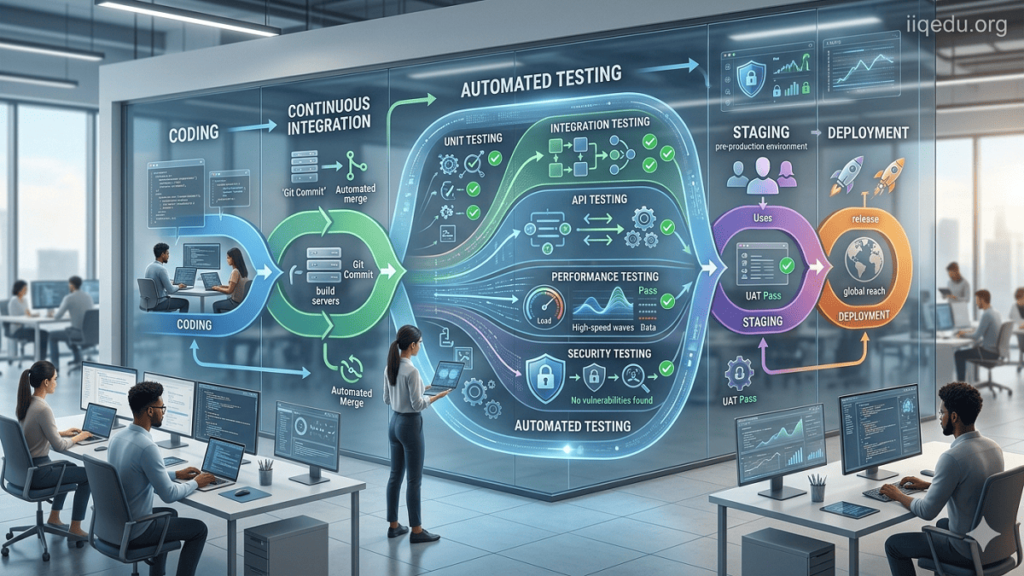
In a DevOps environment, development, testing, and operations teams collaborate to deliver software at a high velocity. Continuous Testing supports this by automating the execution of tests—unit, integration, API, performance, security, and usability—to provide rapid feedback to developers. This allows teams to make informed decisions about code quality before changes are merged or deployed.
The key principles of Continuous Testing include automation, early testing, testing across environments, and ongoing feedback. Automated test suites are designed to run with every code commit, pull request, or build. Tools such as Jenkins, GitLab CI, CircleCI, and Azure DevOps orchestrate these automated tests within pipelines. Test automation frameworks like Selenium (for UI), JUnit/TestNG (for unit tests), and Postman or RestAssured (for API tests) are commonly used to implement consistent and repeatable testing processes.
Continuous Testing also emphasizes shift-left testing, where testing activities are performed as early as possible in the software delivery lifecycle. This contrasts with traditional quality assurance approaches that defer testing until after development is complete. Shift-left testing helps identify defects early, significantly reducing the cost and complexity of fixing issues later in the process.
Another important aspect is test environment management. To be effective, continuous tests should run in environments that closely resemble production. This includes staging environments that mirror infrastructure configurations, data schemas, and network conditions. Containerization technologies like Docker and orchestration platforms such as Kubernetes facilitate environment consistency and scalability for testing.
Security testing is integrated into the Continuous Testing strategy through practices often referred to as DevSecOps. Security tools like Snyk, OWASP ZAP, and Fortify can be incorporated into pipelines to perform vulnerability scanning and compliance checks as part of automated tests.
The benefits of Continuous Testing include increased confidence in code quality, accelerated release cycles, early detection of defects, improved collaboration among teams, and reduced technical debt. However, challenges include maintaining test suites, managing flakiness in automated tests, and ensuring that tests provide meaningful coverage without slowing down the pipeline.
For further reading on Continuous Testing and DevOps best practices, the following resources are recommended:
- Continuous Testing overview by SmartBear: https://smartbear.com/learn/continuous-testing/what-is-continuous-testing/
- DevOps Continuous Testing practices (Atlassian): https://www.atlassian.com/continuous-delivery/continuous-testing
- Continuous Testing in CI/CD (IBM): https://www.ibm.com/topics/continuous-testing
#Continuous Testing in DevOps in India
What is Continuous Testing in DevOps?
Continuous Testing in DevOps is a methodology that integrates automated testing into the software development and delivery pipeline, ensuring that code is continuously validated for quality, functionality, and performance throughout the development lifecycle. Unlike traditional testing approaches, which often occur at specific stages near the end of development, continuous testing operates in real-time alongside continuous integration (CI) and continuous delivery (CD) processes, enabling immediate feedback on code changes.
The primary objective of continuous testing is to detect defects early, reduce the risk of failures in production, and accelerate software delivery. By embedding testing into every stage of the pipeline—from code commit to deployment—teams can maintain high-quality standards while achieving faster release cycles. This practice aligns closely with the DevOps philosophy of collaboration, automation, and continuous improvement between development, operations, and quality assurance teams.
Key components of continuous testing include:
- Automation: Automated test execution is essential for continuous testing. This includes unit tests, integration tests, API tests, performance tests, and security tests. Tools like Selenium (UI testing), JUnit/TestNG (unit testing), and Postman/RestAssured (API testing) are widely used. Automation ensures that tests run consistently and without manual intervention, supporting frequent deployments.
- Shift-Left Testing: Continuous testing encourages “shift-left” practices, meaning testing occurs as early as possible in the software development lifecycle. Early detection of defects reduces the cost and effort required to fix issues and improves overall software reliability.
- Pipeline Integration: Continuous testing is tightly integrated with CI/CD pipelines. Tools like Jenkins, GitLab CI, CircleCI, and Azure DevOps orchestrate the testing processes, ensuring that tests are triggered automatically on code commits, merges, or builds.
- Test Environment Management: To produce reliable results, tests should run in environments that closely mirror production. Containerization technologies such as Docker and orchestration tools like Kubernetes allow teams to create consistent, scalable testing environments.
- Security and Compliance: Modern continuous testing also incorporates security testing (DevSecOps) to identify vulnerabilities and compliance issues early using tools like Snyk and OWASP ZAP.
Benefits of continuous testing in DevOps include faster feedback loops, higher code quality, reduced risk of production failures, improved collaboration across teams, and accelerated software delivery. Despite its advantages, challenges include maintaining automated test suites, managing test reliability, and balancing test coverage with execution speed.
For further insights, see:
- SmartBear: What is Continuous Testing?
- Atlassian: Continuous Testing in DevOps
- IBM: Continuous Testing Overview
#Continuous Testing in DevOps in Maharashtra
Who is Continuous Testing in DevOps required?
Continuous Testing is a critical requirement in DevOps because modern software development demands faster delivery cycles, higher quality, and seamless integration between development and operations. Traditional testing approaches, which are often performed at the end of the development lifecycle, are insufficient in a DevOps environment, where code changes occur frequently and deployments are continuous. Continuous Testing addresses this gap by embedding testing throughout the software delivery pipeline.
The need for Continuous Testing in DevOps arises from several key factors:
- Accelerated Release Cycles: DevOps emphasizes rapid and frequent software releases through Continuous Integration (CI) and Continuous Delivery (CD). Without Continuous Testing, defects may go undetected until deployment, increasing the risk of production failures and rollback. Continuous Testing ensures that every code change is validated automatically, enabling faster and safer releases.
- Early Defect Detection (Shift-Left Testing): By testing code as early as possible, Continuous Testing helps identify functional, performance, and security issues before they escalate. Early detection reduces the cost and effort required to fix defects compared to identifying them late in the development process.
- Enhanced Software Quality: Continuous Testing enforces rigorous quality checks at every stage of development. Automated unit tests, integration tests, API tests, and performance tests collectively ensure that the software meets functional, performance, and reliability standards before deployment.
- Seamless Collaboration Across Teams: DevOps promotes collaboration between development, QA, and operations teams. Continuous Testing provides immediate feedback on code quality, enabling developers and QA engineers to work together proactively to resolve issues, rather than addressing defects post-deployment.
- Risk Reduction in Production: Continuous Testing integrates security and compliance checks into the pipeline, commonly referred to as DevSecOps. Automated vulnerability scanning and compliance testing ensure that new code adheres to security and regulatory standards, reducing the risk of production outages, breaches, and compliance violations.
- Scalability and Consistency: With large codebases and distributed teams, manual testing becomes impractical. Continuous Testing leverages automation and environment consistency (via containers or virtual environments) to ensure tests are repeatable, reliable, and scalable across multiple builds and pipelines.
In summary, Continuous Testing is required in DevOps to maintain software quality, accelerate delivery, reduce costs associated with late defect detection, enhance collaboration, and mitigate risks in production. Organizations that implement Continuous Testing effectively achieve a balance between speed and reliability, enabling them to deliver value to users continuously while maintaining confidence in software stability.
For further reading:
- SmartBear: What is Continuous Testing?
- Atlassian: Continuous Testing in DevOps
- IBM: Continuous Testing Overview
#Continuous Testing in DevOps in Pune
When is Continuous Testing in DevOps required?
Continuous Testing in DevOps is required throughout the entire software development lifecycle (SDLC) to ensure that quality, functionality, performance, and security are maintained at every stage. Unlike traditional testing, which occurs at specific phases—often toward the end of development—continuous testing is integrated into every step of the DevOps pipeline, providing immediate feedback and reducing the risk of production failures.
Here are the key situations when Continuous Testing is required:
- During Code Development and Commit: Continuous Testing should begin as soon as developers write and commit code. Unit tests, static code analysis, and linting checks are performed at this stage to identify syntax errors, coding standard violations, or logic defects immediately. Early testing reduces the cost and effort needed to fix defects and prevents flawed code from entering the main codebase.
- During Continuous Integration (CI): Whenever code is merged into shared repositories, automated integration tests and regression tests are required to verify that new changes do not break existing functionality. Continuous Testing at this stage ensures that the application remains stable, and it validates interoperability between modules. Tools like Jenkins, GitLab CI, and CircleCI are commonly used to automate this process.
- Before Deployment to Staging or Production: Prior to deploying new features or updates, Continuous Testing validates the build in environments that closely mimic production. This includes functional, performance, load, and security testing. Running tests in a staging environment ensures that the application behaves as expected under realistic conditions, reducing deployment risks.
- During Continuous Delivery (CD) Pipelines: Continuous Testing is required as part of the automated deployment pipeline to verify that each stage—from build to staging to production—is error-free. Smoke tests and sanity checks confirm that critical features work correctly after each deployment, enabling faster release cycles without compromising quality.
- When Implementing DevSecOps Practices: Security testing is required continuously to detect vulnerabilities and compliance violations. Integrating tools such as Snyk, OWASP ZAP, or Fortify into the pipeline ensures that security checks are automated and executed alongside functional testing.
- For Regression and Performance Validation: Continuous Testing is essential whenever new features, bug fixes, or updates are introduced. Regression tests confirm that existing functionality remains unaffected, while performance tests verify scalability, responsiveness, and stability under expected load conditions.
In essence, Continuous Testing is required throughout the entire DevOps lifecycle—from development, integration, and staging, to deployment and post-release monitoring. Its goal is to ensure that quality, security, and performance are continuously verified, enabling organizations to deliver reliable software rapidly.
For further reference:
- SmartBear: Continuous Testing Overview
- Atlassian: Continuous Testing in DevOps
- IBM: Continuous Testing Best Practices
#Continuous Testing in DevOps in Banglore
Where is Continuous Testing in DevOps required?
Continuous Testing in DevOps is required at multiple points throughout the software development and delivery lifecycle to ensure quality, reliability, and security of applications. Unlike traditional testing approaches, which often occur late in the development process, Continuous Testing is embedded across environments, pipelines, and stages to provide immediate feedback on code changes. Its requirement is determined by where risk, complexity, or integration challenges exist in the DevOps workflow.
- Development Environments: Continuous Testing begins in the development environment, where individual developers write and commit code. Unit tests, static code analysis, and linting checks are essential here to detect errors early, enforce coding standards, and reduce defects before code reaches shared repositories. Automated tests executed in development environments allow developers to fix issues immediately, aligning with the shift-left testing principle.
- Version Control Systems and CI Pipelines: Continuous Testing is required whenever code is committed or merged into a central repository. In Continuous Integration (CI) pipelines, automated tests—including integration tests, regression tests, and API tests—ensure that new changes do not break existing functionality. This step is critical in DevOps because multiple developers may be contributing concurrently, increasing the risk of conflicts and defects. CI tools such as Jenkins, GitLab CI, and CircleCI orchestrate these tests.
- Staging and Pre-Production Environments: Testing is required in staging environments that closely replicate production infrastructure. Functional testing, performance testing, load testing, and security testing validate the application under realistic conditions. This ensures that features operate as expected, performance standards are met, and vulnerabilities are mitigated before deployment to production. Containerized environments using Docker and orchestration platforms like Kubernetes help maintain consistency between staging and production.
- Production Environments: While Continuous Testing primarily focuses on pre-release verification, it is also required in production through practices such as monitoring, canary testing, and automated smoke tests. This ensures that deployed applications continue to function correctly and that any post-deployment issues are detected quickly.
- Security and Compliance Checks (DevSecOps): Continuous Testing is required across all environments for security and compliance validation. Tools like Snyk, OWASP ZAP, and Fortify automate vulnerability scanning and regulatory compliance testing, making security an integral part of every stage rather than a separate process.
- Cross-Platform and Distributed Environments: For applications with multiple clients, APIs, or microservices, Continuous Testing is required across platforms, devices, and services to ensure interoperability and consistent behavior.
In summary, Continuous Testing is required everywhere in the DevOps lifecycle: in development, CI/CD pipelines, staging, production, and across all platforms where the application operates. Its purpose is to detect defects early, validate functionality, enforce security, and ensure reliability, supporting the DevOps goals of speed, quality, and continuous delivery.
For more detailed guidance:
- SmartBear: Continuous Testing Overview
- Atlassian: Continuous Testing in DevOps
- IBM: Continuous Testing Best Practices
#Continuous Testing in DevOps in Delhi
How is Continuous Testing in DevOps required?
Continuous Testing in DevOps is implemented through the integration of automated testing processes into the software development and delivery lifecycle. Its purpose is to validate code quality, performance, security, and compliance continuously, providing immediate feedback to developers and ensuring that applications remain reliable during rapid releases. The “how” of Continuous Testing involves a combination of automation, pipeline integration, environment management, and testing best practices.
- Integration with CI/CD Pipelines: Continuous Testing is implemented directly within Continuous Integration (CI) and Continuous Delivery (CD) pipelines. Whenever code is committed or merged, automated tests—unit, integration, regression, API, and performance tests—are triggered automatically. Tools like Jenkins, GitLab CI, CircleCI, and Azure DevOps orchestrate the execution of these tests, ensuring that every change is verified before moving forward in the pipeline.
- Automation of Test Suites: Manual testing is insufficient in a DevOps environment due to rapid release cycles. Continuous Testing requires comprehensive automated test suites for different test types:
- Unit Tests: Validate individual components of code using frameworks like JUnit or TestNG.
- Integration Tests: Ensure that different modules or services interact correctly.
- API Tests: Verify API endpoints using tools like Postman or RestAssured.
- UI Tests: Test front-end functionality with tools such as Selenium or Cypress.
- Performance and Load Tests: Validate scalability and responsiveness under realistic workloads.
- Shift-Left Testing: Continuous Testing is implemented early in the development process to detect defects sooner. By applying the shift-left approach, testing starts at the code level, preventing errors from propagating and reducing the cost of fixing defects later.
- Test Environment Management: Tests must run in environments that mirror production as closely as possible. Continuous Testing is supported by containerized environments (Docker) and orchestration tools (Kubernetes) to ensure consistency, scalability, and repeatability across different stages.
- Security and Compliance Integration: In DevOps, security is integrated into testing processes (DevSecOps). Automated tools like Snyk, OWASP ZAP, and Fortify perform vulnerability scanning and compliance checks as part of Continuous Testing. This ensures that security issues are detected continuously rather than at the end of development.
- Continuous Monitoring and Feedback: Continuous Testing requires constant monitoring of test results. Teams use dashboards and reporting tools to track defects, test coverage, and performance metrics. Immediate feedback loops allow developers to address issues quickly, maintaining code quality throughout development and deployment.
In summary, Continuous Testing in DevOps is required through automation, integration with CI/CD pipelines, early testing (shift-left), environment consistency, security integration, and continuous monitoring. By embedding testing into every stage of the pipeline, organizations ensure high-quality, reliable software while maintaining rapid release cycles.
Further reading:
- SmartBear: Continuous Testing Overview
- Atlassian: Continuous Testing in DevOps
- IBM: Continuous Testing Practices
#Continuous Testing in DevOps in Chennai

Case Study of Continuous Testing in DevOps
Continuous Testing is a critical ingredient of DevOps success, enabling organizations to achieve rapid delivery without compromising quality. Real‑world case studies demonstrate how integrating automated testing into CI/CD pipelines transforms software delivery by reducing defects, improving release velocity, and fostering collaboration.
1. Netflix – Streaming Service Reliability at Scale
Netflix is widely recognized for its advanced DevOps culture and continuous delivery model. To support frequent deployments and maintain high service reliability, Netflix embedded continuous testing into its CI/CD pipeline. Automated unit tests, integration tests, and chaos engineering exercises run continuously as code changes are committed. This testing approach ensures that new features and bug fixes do not degrade system performance or user experience. By running tests automatically and validating functionality at every step, Netflix can safely deploy hundreds of changes per day while maintaining high availability.
2. Etsy – Faster Feature Releases with Confidence
Etsy, an online marketplace, adopted continuous testing as part of a broader DevOps transformation to improve deployment frequency and reduce cycle time. Prior to this, Etsy’s release process was slower and risk‑prone, with defects often discovered late in the cycle. By integrating continuous testing into its CI/CD pipeline, Etsy automated most of its testing workflows, including regression and integration tests. This enabled the team to catch defects early, reduce manual effort, and push new features more aggressively. The result was shorter release cycles, higher code quality, and better collaboration between development and quality assurance teams. Etsy’s implementation shows how continuous testing can support both speed and stability in a high‑change environment.
3. Target – Retail Software Delivery Optimization
Target, a major retail organization, adopted continuous testing to enhance its DevOps practices and respond more rapidly to market demands. With multiple teams working on different aspects of the business application ecosystem, manual testing processes were slow and error‑prone. By automating test execution and integrating it into CI/CD pipelines, Target improved visibility into test outcomes and reduced release cycle times. This shift also improved collaboration between developers and testers, as automated tests provided immediate feedback and reduced dependency on manual test runs. Continuous testing became a quality enabler that supported Target’s broader digital transformation goals, including faster MVP delivery and improved operational efficiency.
4. Enterprise Adoption Patterns
Beyond specific companies, industry reports and success stories highlight broader trends where continuous testing reduced regression hours, enhanced test coverage, and enabled quality gates within DevOps pipelines. For example, a templated approach to continuous testing in cloud environments reduced regression test durations from over 150 hours to under 15 hours, illustrating the dramatic efficiency gains possible with automation and parallel execution. These improvements were coupled with more comprehensive test matrices covering device, OS, and browser combinations, reflecting real‑world complexity in modern applications.
Key Takeaways:
- Continuous Testing transforms quality assurance from a final phase into an ongoing, automated process integrated into the CI/CD pipeline.
- Automated testing increases deployment frequency while maintaining or improving quality.
- Organizations like Netflix, Etsy, and Target demonstrate that continuous testing supports rapid innovation, early defect detection, and operational flexibility.
For deeper insights into how Continuous Testing operates within DevOps pipelines and its benefits, refer to resources such as SmartBear’s overview on continuous testing, Atlassian’s DevOps practices, and IBM’s continuous testing documentation:
- SmartBear: https://smartbear.com/learn/continuous-testing/what-is-continuous-testing/
- Atlassian: https://www.atlassian.com/continuous-delivery/continuous-testing
- IBM: https://www.ibm.com/topics/continuous-testing
#Continuous Testing in DevOps in Ahemdabad
White Paper of Continuous Testing in DevOps
Executive Summary
Continuous Testing (CT) is a strategic practice within DevOps that ensures software quality, reliability, and performance throughout the delivery lifecycle. As organizations adopt DevOps to accelerate release cycles and respond to market demands, traditional phase‑based testing proves inadequate. Continuous Testing embeds automated validation into Continuous Integration/Continuous Delivery (CI/CD) pipelines to deliver rapid feedback, reduce defects, and support high‑velocity deployments. This white paper outlines the rationale, practices, challenges, tooling considerations, and measurable outcomes associated with Continuous Testing in DevOps.
Introduction and Context
DevOps emphasizes collaboration, automation, and end‑to‑end responsibility for delivering software. Central to this is CI/CD: developers integrate code frequently, and delivery pipelines promote changes rapidly into production. However, without integrated testing, frequent builds can compound quality risks and elevate production failures. Continuous Testing closes this gap by automating and executing tests at every stage of the DevOps workflow, ensuring confidence in code quality without impeding velocity.
Definition
Continuous Testing is the process of executing automated tests early, often, and across the software delivery pipeline. It includes unit testing, integration testing, API testing, performance testing, security testing, and regression testing. Its primary objective is to identify defects and risks as soon as they are introduced, enabling fast feedback loops and preventing defect accumulation.
Core Principles
- Shift‑Left Testing: Testing occurs early in the development lifecycle to detect defects at the source, reducing cost and remediation effort.
- Pipeline Integration: Tests are orchestrated as part of CI/CD workflows so that every commit triggers a suite of validations.
- Automation by Default: Manual testing is supplemented—and progressively replaced—by automated execution to support scale and frequency.
- Environment Consistency: Tests run in environments that mirror production using containerization (e.g., Docker) and orchestration (e.g., Kubernetes).
- Continuous Feedback: Results are reported in real time to developers and stakeholders to enable rapid corrective action.
Implementation Practices
- Automated Test Suites: Develop modular test suites covering unit, integration, API, UI, and performance layers. Tools include JUnit/TestNG for unit tests, Selenium/Cypress for UI, and Postman/RestAssured for API testing.
- Orchestration within Pipelines: Use CI/CD tools such as Jenkins, GitLab CI, CircleCI, or Azure DevOps to execute tests automatically on commits and merges.
- Security and Compliance: Integrate security tools like Snyk, OWASP ZAP, and Fortify to automate vulnerability scanning and compliance checks (DevSecOps).
- Test Environment Management: Employ containerized, ephemeral environments to mimic production and reduce environmental discrepancies.
Challenges and Mitigation
- Test Maintenance: Test suites require continuous updates as the application evolves. Adopting service virtualization and test data management can stabilize dependencies.
- Flaky Tests: Intermittent failures erode trust. Practices like test isolation and parallel execution improve reliability.
- Balancing Speed with Coverage: Running comprehensive tests must be balanced against pipeline throughput. Prioritization and risk‑based test selection are recommended.
Benefits and Measurable Outcomes
Organizations that adopt Continuous Testing report:
- Reduced defect leakage into production
- Shortened cycle times and higher deployment frequency
- Improved cross‑team collaboration and shared ownership
- Enhanced visibility into quality metrics
Conclusion
Continuous Testing is foundational to effective DevOps transformation. By integrating automated, environment‑consistent testing into CI/CD pipelines, organizations achieve reliability without sacrificing delivery speed. As quality becomes a continuous activity rather than a gated phase, teams unlock accelerated innovation with reduced risk.
References
- SmartBear: What is Continuous Testing? https://smartbear.com/learn/continuous-testing/what-is-continuous-testing/
- Atlassian: Continuous Testing in DevOps https://www.atlassian.com/continuous-delivery/continuous-testing
- IBM: Continuous Testing Overview https://www.ibm.com/topics/continuous-testing
#Continuous Testing in DevOps in Hyderabad
Industry Application of Continuous Testing in DevOps
Continuous Testing (CT) has become a pivotal practice in modern DevOps, enabling industries to achieve high software quality, faster release cycles, and operational resilience. By integrating automated testing into Continuous Integration and Continuous Delivery (CI/CD) pipelines, organizations across sectors can reduce defects, detect issues early, and ensure compliance with regulatory and security standards. This section highlights key industry applications of Continuous Testing in DevOps.
1. Financial Services and Banking
Financial institutions handle complex systems with high regulatory and security requirements. Continuous Testing is used to ensure that transaction processing, payment gateways, and mobile banking applications are robust and secure. Automated regression testing, security scanning, and API validation help banks deploy updates frequently while maintaining compliance with standards like PCI DSS. For example, automated testing allows banks to validate thousands of transaction scenarios without manual intervention, reducing operational risk and improving customer trust.
2. E-commerce and Retail
Retail and e-commerce companies operate in highly dynamic environments where customer experience is critical. Continuous Testing is applied to ensure website functionality, checkout processes, recommendation engines, and API integrations work seamlessly during frequent feature releases. Companies like Etsy and Target have implemented continuous testing within DevOps pipelines to detect issues before production deployment, reducing downtime and ensuring uninterrupted customer experience. Performance and load testing also ensure applications can handle seasonal traffic spikes efficiently.
3. Healthcare and Life Sciences
Healthcare applications must adhere to strict regulatory standards such as HIPAA, FDA guidelines, and GDPR. Continuous Testing ensures that electronic health records (EHRs), telemedicine platforms, and clinical applications meet both functional and compliance requirements. Automated regression, security, and integration testing prevent defects that could affect patient safety or data privacy. By embedding testing into CI/CD pipelines, healthcare providers can release updates faster while maintaining rigorous quality standards.
4. Media and Entertainment
Streaming platforms and content providers rely on continuous delivery to release new features, content recommendations, and UI improvements. Continuous Testing ensures that services remain stable, performant, and resilient under variable loads. Netflix, for example, integrates automated unit, integration, and chaos engineering tests into its DevOps pipeline, validating system reliability and enabling rapid innovation without impacting user experience.
5. Telecommunications
Telecom providers manage complex distributed systems including network management, billing, and customer portals. Continuous Testing is critical for ensuring software updates do not disrupt service availability. Automated testing frameworks validate network orchestration, API communication, and mobile applications to reduce service outages, minimize downtime, and improve customer satisfaction.
6. Software as a Service (SaaS)
SaaS companies deploy frequent updates across cloud-based applications. Continuous Testing supports rapid iteration by automatically validating multi-tenant environments, API integrations, and UI functionality. This allows SaaS providers to maintain service reliability, optimize performance, and ensure cross-platform compatibility without delaying releases.
Conclusion
Continuous Testing in DevOps is applicable across industries where software quality, reliability, security, and speed of delivery are critical. Its adoption allows organizations to reduce risk, accelerate innovation, and maintain operational excellence. By integrating automated testing into CI/CD pipelines, industries such as finance, healthcare, retail, media, telecom, and SaaS can deliver consistent, high-quality software to meet market and customer demands.
References:
- SmartBear: Continuous Testing Overview
- Atlassian: Continuous Testing in DevOps
- IBM: Continuous Testing in CI/CD
#Continuous Testing in DevOps in Mumbai
Ask FAQs
What is Continuous Testing in DevOps?
Continuous Testing (CT) is the practice of integrating automated tests throughout the software development lifecycle. In DevOps, CT ensures that code changes are validated immediately, reducing defects, enabling faster releases, and maintaining software quality. It includes unit testing, integration testing, API testing, performance testing, and security testing, all executed within CI/CD pipelines.
Why is Continuous Testing important in DevOps?
Continuous Testing is crucial because DevOps emphasizes frequent code commits, rapid releases, and collaboration between development and operations teams. CT detects defects early, provides real-time feedback, enforces quality standards, and reduces the risk of production failures, enabling organizations to deliver reliable software at high velocity.
When should Continuous Testing be performed?
Continuous Testing should be performed throughout the entire software lifecycle: during code development, in Continuous Integration (CI) pipelines, before deployment to staging or production, and even post-deployment for monitoring and validation. It ensures that every change—feature, bug fix, or update—is continuously verified.
What tools are commonly used for Continuous Testing?
Common tools for Continuous Testing include:
CI/CD orchestration: Jenkins, GitLab CI, CircleCI, Azure DevOps
Unit testing: JUnit, TestNG
UI testing: Selenium, Cypress
API testing: Postman, RestAssured
Security testing: Snyk, OWASP ZAP, Fortify
Performance testing: JMeter, Gatling
What are the benefits of Continuous Testing in DevOps?
Benefits include early defect detection, improved code quality, reduced risk of production failures, faster release cycles, better collaboration between teams, and compliance with security and regulatory standards. Organizations can achieve higher confidence in their releases while maintaining development velocity.
Source: IBM Technology
Table of Contents
Disclaimer:
The information provided in this document is for general informational and educational purposes only. While every effort has been made to ensure accuracy, the content may not reflect the most current industry practices or regulatory requirements. Readers should verify details independently and consult professional guidance before implementing any DevOps or Continuous Testing practices.