Material & Surface Quality Testing
What is Material & Surface Quality Testing?
Material & Surface Quality Testing is the process of evaluating the physical, chemical, and mechanical properties of materials and their surfaces to ensure they meet the required specifications, performance standards, and regulatory compliance. It is a critical component of Quality Assurance (QA) in manufacturing, construction, aerospace, electronics, and other high-precision industries.
Testing focuses on attributes such as:
- Surface roughness, texture, and finish
- Hardness, tensile strength, and elasticity
- Corrosion and wear resistance
- Coating adhesion and uniformity
- Dimensional accuracy and flatness
Why is Material & Surface Quality Testing Important?
Material and surface quality directly affect:
- Product performance and durability – Poor material quality can lead to failure or reduced lifespan.
- Safety compliance – Critical in aerospace, automotive, and medical devices.
- Regulatory adherence – Many industries must comply with ISO, ASTM, or FDA standards.
- Process optimization – Identifying defects early reduces scrap, rework, and operational costs.
Where is Material & Surface Quality Testing Applied?
- Manufacturing industries: Automotive, electronics, machinery, and precision engineering.
- Construction: Concrete, steel, and composite material testing for structural integrity.
- Aerospace & Defense: Aircraft components, engines, and high-stress parts.
- Energy & Power: Turbine blades, pipelines, and renewable energy equipment.
- Medical Devices: Surgical tools, implants, and equipment surfaces requiring sterility and smoothness.
How is Material & Surface Quality Testing Performed?
Testing can be destructive or non-destructive, depending on requirements:
Non-Destructive Testing (NDT) Methods:
- Ultrasonic Testing (UT): Detects internal defects and material thickness.
- X-ray / Radiographic Testing (RT): Identifies internal voids and inclusions.
- Eddy Current Testing: Measures conductivity and surface defects in metals.
- Magnetic Particle Testing: Detects cracks on ferromagnetic surfaces.
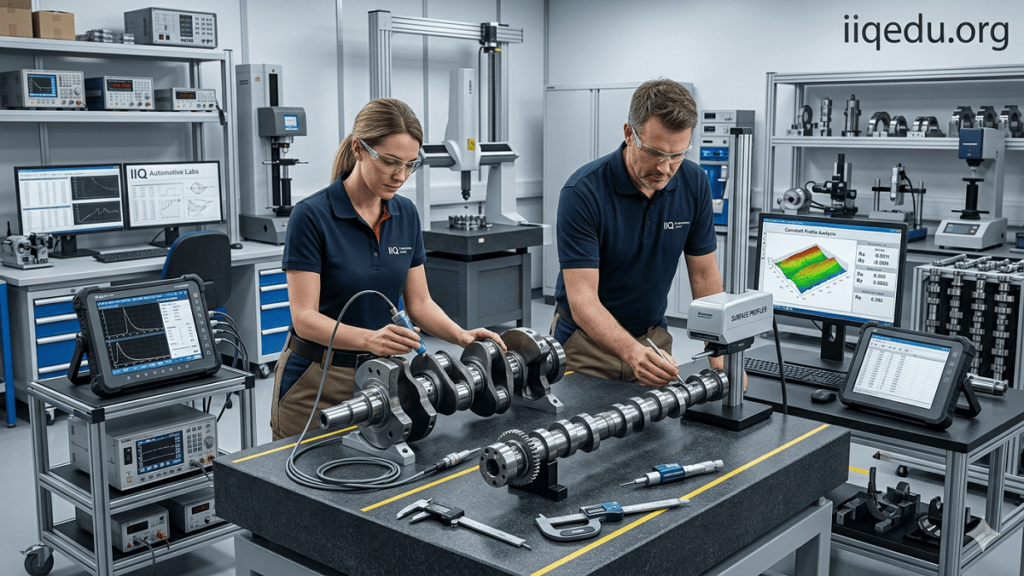
- Surface Profilometry: Measures roughness, flatness, and texture.
Destructive Testing Methods:
- Tensile & Compression Tests: Evaluate strength and elasticity.
- Hardness Testing (Rockwell, Brinell, Vickers): Determines resistance to indentation.
- Fatigue and Impact Tests: Assesses durability under cyclic or sudden loads.
Benefits of Material & Surface Quality Testing
- Early defect detection to reduce production losses.
- Assurance of compliance with quality standards.
- Improved product longevity and performance.
- Support for innovation in materials and surface coatings.
- Enhanced customer trust and brand reputation.
References for Further Reading
- ASTM International – Standards for Material Testing: https://www.astm.org
- Callister, W. D., & Rethwisch, D. G. (2020). Materials Science and Engineering: An Introduction.
- ISO 4287 / ISO 4288 – Surface Texture Standards: https://www.iso.org/standard/4287.html
- Hellier, C. (2012). Handbook of Nondestructive Evaluation. McGraw-Hill.
#Material & Surface Quality Testing in India
Who is Material & Surface Quality Testing required?
1. Manufacturers and Industrial Engineers
- Companies producing metal parts, machinery, electronics, or automotive components require material and surface testing to ensure products are defect-free and meet design specifications.
- Industrial engineers use testing to validate process quality, optimize production parameters, and reduce scrap or rework.
2. Quality Assurance and Compliance Teams
- QA departments rely on testing to verify that materials and finished products comply with internal quality standards and external regulations, such as ISO, ASTM, or FDA standards.
- This ensures traceability and audit readiness, particularly in regulated industries like aerospace, pharmaceuticals, and medical devices.
3. Research and Development Teams
- Material scientists and R&D engineers require surface and material testing when developing new materials, coatings, or treatments.
- Testing helps predict performance, durability, and failure points before scaling up production.
4. Construction and Civil Engineering Firms
- Structural engineers use material testing to confirm the strength, composition, and durability of steel, concrete, and composites for buildings, bridges, and infrastructure projects.
- Surface testing ensures that finishing layers meet performance requirements like adhesion, smoothness, and corrosion resistance.
5. Aerospace, Automotive, and Defense Industries
- Critical components in aircraft, vehicles, and defense equipment undergo stringent material and surface testing to prevent failure under high stress, temperature extremes, or harsh environmental conditions.
6. Energy and Power Sector
- Turbine blades, pipelines, and power plant equipment require surface and material testing to ensure they can withstand operational stress, corrosion, and fatigue.
In summary: Material & Surface Quality Testing is required by anyone responsible for product integrity, safety, compliance, or performance, from manufacturers and QA teams to engineers and R&D professionals across multiple industries.
#Material & Surface Quality Testing in Kolkata

When is Material & Surface Quality Testing required?
1. During Raw Material Inspection
- When: At the arrival of raw materials or components from suppliers.
- Purpose: To ensure that the incoming materials meet required specifications for chemical composition, strength, and surface condition before entering production.
- Example: Checking steel sheets for hardness and surface defects before using them in automotive panels.
2. During Manufacturing and Production
- When: During intermediate stages of production or assembly.
- Purpose: To monitor process quality, detect defects early, and prevent defective products from progressing further.
- Example: Surface roughness measurements on machined parts to ensure proper fit and function.
3. Post-Production / Final Inspection
- When: After the product is completed but before it is shipped or installed.
- Purpose: To confirm that the finished product meets all mechanical, chemical, and surface quality requirements.
- Example: Testing hardness, coating adhesion, or corrosion resistance of aerospace components before delivery.
4. Before Critical Use or Installation
- When: Prior to installation or operational use of critical components in safety-sensitive applications.
- Purpose: To ensure that materials will withstand operational loads, environmental conditions, and stress over time.
- Example: Inspecting turbine blades or pipeline sections for surface cracks or fatigue before deployment.
5. During R&D and Material Development
- When: During the development of new materials, coatings, or treatments.
- Purpose: To evaluate material performance under expected operational conditions and optimize processes.
- Example: Testing new alloy formulations for strength, fatigue resistance, and surface finish.
6. Periodic Maintenance and Quality Audits
- When: At scheduled intervals during service or as part of quality audits.
- Purpose: To detect wear, corrosion, or degradation over time and prevent failure.
- Example: Checking metal surfaces in power plants or machinery for fatigue cracks or surface corrosion.
Summary: Material & Surface Quality Testing is required before, during, and after production, as well as during research, critical deployment, and periodic maintenance, whenever the integrity, safety, and compliance of materials and surfaces are essential.
#Material & Surface Quality Testing in Delhi
Where is Material & Surface Quality Testing required?
1. Manufacturing Plants
- Where: Factories producing automotive parts, electronics, machinery, or precision equipment.
- Purpose: To ensure that manufactured components meet design specifications and surface finish requirements.
- Examples: Machined metal components, PCB boards, industrial machinery parts.
2. Construction Sites
- Where: On-site concrete, steel, or composite structures.
- Purpose: To validate that building materials meet strength, durability, and surface finish standards for safety and regulatory compliance.
- Examples: Structural steel beams, concrete slabs, coatings on bridges and infrastructure.
3. Aerospace and Defense Facilities
- Where: Aircraft, spacecraft, and defense equipment production and assembly areas.
- Purpose: To ensure materials and surfaces can withstand extreme loads, temperature variations, and environmental stresses.
- Examples: Aircraft turbine blades, fuselage components, military-grade metal alloys.
4. Energy and Power Plants
- Where: Turbines, pipelines, and power generation equipment areas.
- Purpose: To monitor surface wear, corrosion, and material degradation for operational reliability.
- Examples: Gas and steam turbines, hydroelectric components, pipeline joints.
5. Pharmaceutical and Food Industries
- Where: Laboratories and production facilities where hygiene and surface smoothness are critical.
- Purpose: To ensure surfaces are free of contamination and meet cleanability and regulatory standards.
- Examples: Stainless steel equipment, coating surfaces, storage containers.
6. Research and Development Laboratories
- Where: Material science and engineering labs.
- Purpose: To evaluate new materials, coatings, and surface treatments under controlled conditions.
- Examples: Alloy development, nanocoatings, polymer surface testing.
7. Warehouses and Logistics Hubs
- Where: Storage and transport environments where materials are sensitive to damage or environmental conditions.
- Purpose: To check for surface defects, corrosion, or degradation during storage and transportation.
- Examples: Cold storage for pharmaceuticals, metal storage facilities, sensitive electronics.
Summary: Material & Surface Quality Testing is required in manufacturing, construction, aerospace, energy, pharmaceutical, research, and logistics environments wherever material performance, safety, durability, or regulatory compliance is critical.
#Material & Surface Quality Testing in Ahemdabad
How is Material & Surface Quality Testing required?
1. Defining Quality and Testing Requirements
- Identify critical material properties (strength, hardness, elasticity) and surface parameters (roughness, smoothness, coating adhesion).
- Set acceptance criteria based on industry standards (ISO, ASTM, FDA) and design specifications.
- Determine testing frequency, whether for incoming materials, in-process inspections, or final product verification.
2. Selecting Appropriate Testing Methods
- Non-Destructive Testing (NDT):
Used when material integrity must be verified without damaging the part. Examples include:- Ultrasonic Testing (UT): Detects internal flaws or thickness variations.
- X-ray / Radiographic Testing (RT): Finds internal voids or inclusions.
- Magnetic Particle or Dye Penetrant Testing: Detects surface cracks.
- Surface Profilometry: Measures roughness and texture.
- Destructive Testing:
Applied when sample sacrifice is acceptable to evaluate strength or durability. Examples include:- Tensile and Compression Tests – evaluate mechanical strength.
- Hardness Tests (Rockwell, Brinell, Vickers) – measure resistance to indentation.
- Fatigue and Impact Tests – assess durability under cyclic or sudden loads.
3. Preparing Samples and Surfaces
- Clean and condition the material or component to remove contaminants.
- Cut, shape, or polish samples as required for testing instruments.
- Ensure environmental conditions (temperature, humidity) are controlled during testing to maintain consistency.
4. Conducting Tests Using Standardized Procedures
- Follow industry standards for each testing method (ISO, ASTM, or company QA protocols).
- Record measurements systematically, including material ID, testing conditions, and results.
- Use calibrated and certified instruments to ensure accuracy.
5. Data Analysis and Quality Assessment
- Compare results against predefined thresholds or tolerances.
- Identify defects, surface irregularities, or material deviations.
- Generate reports with pass/fail results, measurements, and observations.
- Use statistical analysis for trends, predictive insights, and process improvements.
6. Integration with QA and Compliance Systems
- Feed testing data into Quality Management Systems (QMS) for traceability and audit readiness.
- Implement corrective actions if deviations are detected, such as process adjustments or rejection of defective materials.
- Maintain records for regulatory compliance (ISO 9001, ISO 13485, ASTM, FDA, etc.).
7. Continuous Monitoring and Improvement
- For critical applications, implement in-process or real-time monitoring using sensors and automated inspection systems.
- Review testing results periodically to improve material selection, production processes, and surface finishing techniques.
Summary: Material & Surface Quality Testing is required through standardized, methodical, and repeatable procedures that include preparation, measurement, analysis, reporting, and integration with QA systems. This ensures materials and surfaces meet required specifications, maintain safety, and comply with regulatory standards.
#Material & Surface Quality Testing in Hyderabad
Case Study of Material & Surface Quality Testing
1. Background
An automotive manufacturer producing high-performance engine components, such as crankshafts and camshafts, faced recurring issues with premature wear and surface defects in their engines. These defects resulted in increased warranty claims, customer dissatisfaction, and costly rework. The company decided to implement a comprehensive Material & Surface Quality Testing program to ensure component durability and compliance with ISO 9001 standards.
2. Objectives
- Ensure mechanical integrity and surface finish quality of engine components.
- Detect micro-cracks, surface irregularities, and material inconsistencies early in production.
- Reduce defective parts, rework, and warranty claims.
- Establish traceable QA records for internal audits and regulatory compliance.
3. Implementation Strategy
The company deployed a combination of non-destructive and destructive testing methods:
Non-Destructive Testing (NDT)
- Ultrasonic Testing (UT): Detected internal voids or micro-cracks in crankshafts.
- Magnetic Particle Testing: Identified surface cracks and inclusions in steel components.
- Surface Profilometry: Measured surface roughness to ensure proper lubrication performance.
Destructive Testing
- Hardness Testing (Rockwell and Vickers): Verified hardness of metal alloys for wear resistance.
- Tensile and Fatigue Testing: Evaluated component strength under simulated engine conditions.
Integration and QA Workflow
- Testing results were logged in the Quality Management System (QMS).
- Deviations triggered automated alerts for corrective actions in the production line.
- Statistical Process Control (SPC) was applied to monitor trends and optimize machining parameters.
4. Results
- Reduction in Defective Parts: Surface defects dropped by 35% within six months.
- Improved Product Durability: Fatigue life of components increased, leading to fewer warranty claims.
- Operational Efficiency: Early detection of material inconsistencies reduced rework and scrap by 20%.
- Regulatory Compliance: All tested components met ISO 9001 and OEM standards, ensuring traceable QA documentation.
5. Key Learnings
- Combining NDT and destructive testing provides comprehensive assurance of material and surface quality.
- Integration with digital QA systems enables real-time monitoring and faster corrective actions.
- Continuous statistical analysis of testing data improves manufacturing processes and reduces defects over time.
- Investing in QA testing upfront reduces long-term operational costs and protects brand reputation.
6. Conclusion
This case study demonstrates that Material & Surface Quality Testing is crucial for industries where component integrity, safety, and performance are critical. By adopting systematic testing protocols, integrating data into QA systems, and combining multiple testing methods, the automotive manufacturer successfully improved product quality, reduced failures, and ensured compliance with industry standards.
References
- ASTM International. Standards for Material and Surface Testing. https://www.astm.org
- Callister, W. D., & Rethwisch, D. G. (2020). Materials Science and Engineering: An Introduction.
- ISO 9001:2015 – Quality Management Systems. https://www.iso.org/iso-9001-quality-management.html
- Hellier, C. (2012). Handbook of Nondestructive Evaluation. McGraw-Hill.
#Material & Surface Quality Testing in Chennai
White Paper of Material & Surface Quality Testing
Executive Summary
Material & Surface Quality Testing (MSQT) is critical for ensuring that components and products meet required specifications for strength, durability, safety, and regulatory compliance. Industries ranging from automotive and aerospace to pharmaceuticals and energy depend on precise material characterization and surface evaluation to reduce defects, optimize processes, and maintain operational efficiency. This white paper explores testing methods, applications, benefits, and implementation strategies for MSQT.
1. Introduction
The performance and longevity of a product often depend on the materials used and the quality of their surfaces. Surface defects, micro-cracks, improper hardness, or poor coating adhesion can lead to product failure, safety risks, or regulatory non-compliance. MSQT ensures reliability, efficiency, and traceability across the product lifecycle.
Scope of this paper:
- Overview of MSQT concepts
- Testing methods (destructive and non-destructive)
- Industry applications
- Benefits and ROI
- Implementation strategies
2. Importance of Material & Surface Quality Testing
- Product Reliability: Ensures materials meet mechanical, chemical, and thermal specifications.
- Safety Assurance: Detects defects that may compromise structural integrity.
- Regulatory Compliance: Supports adherence to ISO, ASTM, FDA, and other industry standards.
- Process Optimization: Reduces scrap, rework, and operational costs.
- Innovation Enablement: Facilitates R&D for new materials and coatings.
3. Testing Methods
3.1 Non-Destructive Testing (NDT)
- Ultrasonic Testing (UT): Internal flaw detection and thickness measurement
- X-ray / Radiographic Testing (RT): Detects voids and inclusions
- Magnetic Particle & Dye Penetrant Testing: Surface crack detection
- Surface Profilometry: Measures roughness, flatness, and texture
3.2 Destructive Testing
- Tensile and Compression Tests: Evaluates strength and elasticity
- Hardness Tests (Rockwell, Brinell, Vickers): Measures resistance to indentation
- Fatigue and Impact Tests: Assesses durability under repeated or sudden loads
4. Industry Applications
- Automotive: Engine components, chassis, and safety-critical parts
- Aerospace & Defense: Aircraft structures, turbine blades, defense equipment
- Energy & Utilities: Pipelines, turbines, and high-stress components
- Construction: Steel beams, concrete structures, and surface coatings
- Pharmaceutical & Food Processing: Stainless steel equipment and cleanroom surfaces
- Electronics & Semiconductors: PCBs, microchips, and precision components
5. Implementation Strategy
- Define QA Objectives: Identify critical material and surface properties
- Select Appropriate Testing Methods: Based on material type and application
- Prepare Samples & Surfaces: Ensure consistency and eliminate contamination
- Conduct Testing: Follow ISO, ASTM, or internal protocols
- Analyze Data & Generate Reports: Use statistical analysis to identify trends
- Integrate into QA Systems: Implement corrective actions and maintain traceable records
6. Benefits of MSQT
- Early detection of defects reduces production costs
- Enhanced product reliability and durability
- Compliance with regulatory and safety standards
- Supports continuous process improvement
- Increases customer trust and brand reputation
7. Case Study
Automotive Manufacturing Example:
A manufacturer implemented a combination of NDT and destructive testing for engine components. This resulted in:
- 35% reduction in surface defects
- 20% reduction in rework and scrap
- Improved fatigue life of components
- Compliance with ISO 9001 standards
(Detailed case study available in Section 8 of this white paper.)
8. Conclusion
Material & Surface Quality Testing is essential for industrial quality assurance. By combining advanced testing methods, data-driven analysis, and integration with QA systems, organizations can improve product performance, reduce operational risks, and maintain compliance across industries. MSQT is a strategic investment for any company aiming for excellence in product quality and safety.
9. References
- ASTM International. Standards for Material and Surface Testing. https://www.astm.org
- ISO 4287 / ISO 4288 – Surface Texture Standards. https://www.iso.org/standard/4287.html
- Callister, W. D., & Rethwisch, D. G. (2020). Materials Science and Engineering: An Introduction.
- Hellier, C. (2012). Handbook of Nondestructive Evaluation. McGraw-Hill.
#Material & Surface Quality Testing in Banglore
Industry Application of Material & Surface Quality Testing
Material & Surface Quality Testing is critical across industries where product integrity, safety, durability, and regulatory compliance are essential. Testing ensures that materials meet required standards and surfaces are free from defects that could compromise performance. Below are key industry applications:
1. Automotive Industry
Applications:
- Engine components (crankshafts, camshafts)
- Body panels and chassis for surface finish and corrosion resistance
- Brake systems and transmission parts
Purpose:
- Detect micro-cracks, surface irregularities, or material inconsistencies
- Ensure components meet mechanical and safety standards
Benefits:
- Reduces defective parts and warranty claims
- Increases component life and operational reliability
2. Aerospace & Defense
Applications:
- Aircraft structural components (wings, fuselage panels, turbine blades)
- Defense equipment and critical machinery parts
Purpose:
- Verify material strength and fatigue resistance under extreme conditions
- Detect surface defects that could lead to catastrophic failure
Benefits:
- Enhances safety and operational reliability
- Supports strict regulatory compliance and traceability
3. Energy & Power Generation
Applications:
- Turbines, pipelines, and pressure vessels
- Renewable energy components (wind turbine blades, solar frame structures)
Purpose:
- Monitor material degradation, corrosion, and surface wear
- Ensure long-term performance under high stress or harsh environmental conditions
Benefits:
- Prevents downtime and operational failures
- Increases efficiency and equipment lifespan
4. Construction and Civil Engineering
Applications:
- Steel beams, concrete structures, and composite materials
- Surface coatings and protective layers
Purpose:
- Ensure structural integrity and proper surface finish
- Confirm adherence to building codes and safety standards
Benefits:
- Reduces structural failure risks
- Ensures durability and longevity of infrastructure projects
5. Pharmaceuticals and Food Processing
Applications:
- Stainless steel equipment, pipelines, and storage containers
- Surface finish in cleanrooms and processing lines
Purpose:
- Detect surface imperfections that could harbor contaminants
- Ensure compliance with hygiene and safety regulations (GMP, HACCP)
Benefits:
- Maintains product safety and quality
- Supports regulatory compliance and traceable records
6. Electronics & Semiconductor Industry
Applications:
- Printed circuit boards (PCBs), microchips, and semiconductor wafers
- Surface coatings and solder joints
Purpose:
- Monitor micro-level surface quality for electrical and thermal performance
- Detect surface defects that could impact functionality
Benefits:
- Improves yield and reliability of high-precision components
- Reduces product failures and rework
7. Research & Development
Applications:
- Development of new alloys, polymers, and coatings
- Testing novel surface treatments and material composites
Purpose:
- Validate material properties before mass production
- Optimize materials and surfaces for enhanced performance
Benefits:
- Facilitates innovation and advanced material solutions
- Reduces risk in scaling new materials to production
Summary:
Material & Surface Quality Testing is vital across industries to ensure components and products are reliable, safe, and compliant. Its applications span automotive, aerospace, energy, construction, pharmaceuticals, electronics, and R&D, offering measurable benefits in durability, performance, and operational efficiency.
References
- ASTM International. Standards for Material and Surface Testing. https://www.astm.org
- ISO 4287 / ISO 4288 – Surface Texture Standards. https://www.iso.org/standard/4287.html
- Callister, W. D., & Rethwisch, D. G. (2020). Materials Science and Engineering: An Introduction.
- Hellier, C. (2012). Handbook of Nondestructive Evaluation. McGraw-Hill.
#Material & Surface Quality Testing in Mumbai
Ask FAQs
What is Material & Surface Quality Testing?
Material & Surface Quality Testing (MSQT) is the process of evaluating the physical, mechanical, and chemical properties of materials and their surfaces to ensure they meet required specifications. This includes checking for hardness, tensile strength, surface roughness, corrosion resistance, and coating adhesion. It is essential for maintaining product quality, safety, and compliance with industry standards.
Which industries require Material & Surface Quality Testing?
MSQT is critical in industries where material integrity and surface quality affect performance and safety, including:
Automotive and aerospace
Energy and power generation
Construction and civil engineering
Pharmaceuticals and food processing
Electronics and semiconductors
When is Material & Surface Quality Testing performed?
Testing is performed at multiple stages, including:
Incoming raw materials inspection – to verify material quality before production.
During production – to monitor surface finish and material consistency.
Post-production/final inspection – to ensure components meet specifications.
R&D and development – for new materials or coatings.
Periodic maintenance and audits – for long-term performance monitoring.
How is Material & Surface Quality Testing conducted?
MSQT uses both destructive and non-destructive testing methods:
Non-Destructive Testing (NDT): Ultrasonic, X-ray, magnetic particle, dye penetrant, and surface profilometry.
Destructive Testing: Tensile, compression, hardness, fatigue, and impact tests.
Data from these tests are analyzed and integrated into Quality Management Systems to trigger corrective actions if defects are detected.
What are the benefits of Material & Surface Quality Testing?
Ensures product reliability and durability.
Reduces scrap, rework, and operational costs.
Supports compliance with industry regulations and standards.
Enables early detection of defects and surface irregularities.
Enhances customer confidence and protects brand reputation.
Source: Magic Marks
Table of Contents
Disclaimer:
The information provided is for general educational and informational purposes only. While care has been taken to ensure accuracy, the authors and publishers make no warranties regarding completeness or suitability for specific applications. Users should verify all information and consult qualified professionals before implementing any testing procedures or making business decisions.