Atomic Force Microscopy (AFM)
What is Atomic Force Microscopy (AFM)?
Atomic Force Microscopy (AFM) is a high-resolution imaging technique that allows scientists and engineers to visualize and measure surface topography at the nanometer scale. It operates by scanning a sharp probe (cantilever tip) across a sample surface and measuring the forces between the tip and the sample, generating a detailed 3D map of surface features.
Unlike optical or electron microscopes, AFM does not require conductive coatings or vacuum conditions, making it versatile for a wide range of materials, including biological, polymeric, and semiconductor surfaces.
Key Principles of AFM
- A cantilever with a nanoscale tip interacts with the sample surface.
- Deflection of the cantilever is detected using a laser and photodiode system.
- Force interactions (van der Waals, electrostatic, or chemical) provide information about surface morphology, roughness, and mechanical properties.
- AFM can operate in contact, tapping, or non-contact modes, depending on sample sensitivity and desired measurements.
Why AFM is Important
- Provides nanometer to sub-nanometer resolution imaging.
- Measures surface roughness, texture, and mechanical properties such as adhesion and stiffness.
- Non-destructive for most samples, allowing repeated analysis.
- Supports research, quality assurance, and material development at micro- and nanoscale levels.
Where AFM is Used
- Material Science: Surface roughness, coatings, thin films, nanostructures.
- Semiconductors and Electronics: Nanostructure characterization, thin-film uniformity.
- Biology and Life Sciences: Imaging cells, proteins, DNA, and tissue surfaces.
- Polymers and Composites: Surface texture, elasticity, and adhesion measurements.
- Nanotechnology: Characterization of nanoparticles and nanodevices.
How AFM is Conducted
- Sample Preparation: Minimal preparation, often just cleaning or mounting.
- Cantilever Approach: AFM tip approaches the sample surface with precise control.
- Scanning: The tip scans across the sample in raster mode.
- Data Acquisition: Laser detects cantilever deflections; software converts them into topographical maps.
- Analysis: Surface roughness, mechanical properties, and other parameters are measured quantitatively.
Advantages of AFM
- High Resolution: Atomic or nanometer-level imaging.
- Versatility: Works with conductors, semiconductors, insulators, and biological samples.
- Non-destructive: Can image delicate samples without coating or vacuum.
- Quantitative Measurements: Provides topography, mechanical, and sometimes electrical properties.
Limitations
- Small scan size (typically microns) compared to SEM or optical microscopy.
- Slow scanning speed for high-resolution imaging.
- Sensitive to vibration and environmental noise, requiring controlled conditions.
- Limited depth information; primarily surface characterization.
References and Further Reading
- Binnig, G., Quate, C. F., & Gerber, C. (1986). Atomic Force Microscope. Physical Review Letters, 56(9), 930–933.
- Garcia, R., & Perez, R. (2002). Dynamic atomic force microscopy methods. Surface Science Reports, 47(6-8), 197–301.
- Meyer, E., Hug, H. J., & Bennewitz, R. (2004). Scanning Probe Microscopy: The Lab on a Tip. Springer.
- AFM Applications Overview – Bruker Instruments: https://www.bruker.com/en/products-and-solutions/microscopy/atomic-force-microscopy.html
#Atomic Force Microscopy (AFM) in India
Who is Atomic Force Microscopy (AFM) required?
1. Material Scientists and Nanotechnologists
- Purpose: To study surface topography, texture, and nanostructures of metals, polymers, composites, and thin films.
- Use: Characterizing coatings, detecting defects, and evaluating nanomaterial performance in research and development.
2. Semiconductor and Electronics Engineers
- Purpose: To ensure nanoscale precision and uniformity in semiconductor wafers, microchips, and electronic components.
- Use: Measuring surface roughness, thin-film uniformity, and detecting defects that could affect device performance.
3. Biologists and Life Science Researchers
- Purpose: To image cells, proteins, DNA, and tissues without staining or destructive preparation.
- Use: Studying cellular mechanics, protein interactions, or biological surface structures at nanometer resolution.
4. Quality Assurance and R&D Teams
- Purpose: To verify that materials and surfaces meet design specifications and regulatory requirements.
- Use: Ensuring consistency, reliability, and safety of high-precision components in aerospace, automotive, and medical devices.
5. Polymer and Coatings Specialists
- Purpose: To study adhesion, elasticity, and surface roughness of coatings, films, and composites.
- Use: Evaluating material performance, optimizing coating processes, and developing new surface treatments.
Summary
AFM is required by professionals who need nanometer-scale insight into surface structures, mechanical properties, or material behavior, especially in:
- Materials science and nanotechnology
- Semiconductor and electronics manufacturing
- Life sciences and biomedical research
- Industrial QA and R&D for high-performance products
#Atomic Force Microscopy (AFM) in Maharashtra
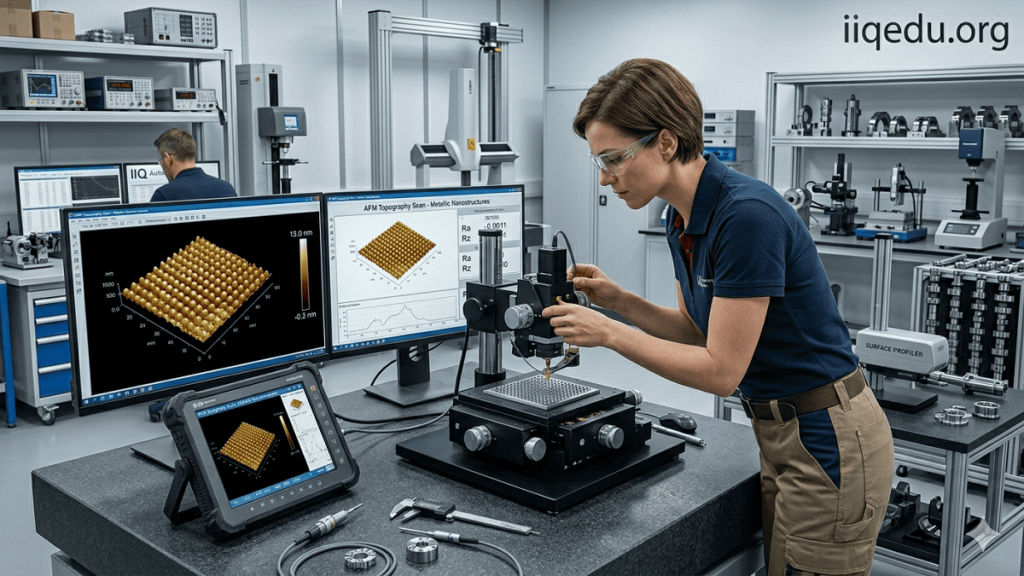
When is Atomic Force Microscopy (AFM) required?
1. During Research and Development
- When: In the early stages of material, nanostructure, or biological research.
- Purpose: To study surface morphology, texture, adhesion, and mechanical properties at the nanoscale.
- Example: Imaging protein interactions, analyzing nanoparticle surfaces, or testing novel polymer coatings.
2. During Material or Component Testing
- When: When validating the quality and surface characteristics of manufactured components.
- Purpose: To ensure materials meet specifications, detect defects, or evaluate thin-film uniformity.
- Example: Measuring roughness of semiconductor wafers or evaluating micro-scale coatings on aerospace parts.
3. Post-Production Quality Assurance
- When: After manufacturing, before product release.
- Purpose: To verify consistency and surface quality of critical components.
- Example: Inspecting turbine blade surfaces, microelectronic devices, or medical implants for nanoscale irregularities.
4. During Material Optimization
- When: While developing or improving materials, coatings, or surface treatments.
- Purpose: To assess performance improvements or detect nanoscale defects before scaling up production.
- Example: Testing new polymer coatings for adhesion and uniformity under different process conditions.
5. For Failure Analysis and Investigation
- When: After component failure or degradation in service.
- Purpose: To identify surface defects, wear patterns, or nanoscale damage causing failure.
- Example: Analyzing micro-cracks in electronics or wear on mechanical components in aerospace systems.
Summary
AFM is required at all stages where nanoscale surface information is critical—from research and development, through production, to failure analysis. Its use ensures accuracy, reliability, and performance of materials and components that depend on precise surface characteristics.
#Atomic Force Microscopy (AFM) in Kolkata
Where is Atomic Force Microscopy (AFM) required?
1. Research and Academic Laboratories
- Where: Universities, nanotechnology centers, and materials science labs.
- Purpose: To study surface topography, nanoscale structures, and biological samples.
- Examples: Imaging proteins, DNA, nanoparticles, or developing new nanomaterials.
2. Semiconductor and Electronics Facilities
- Where: Semiconductor fabs, microelectronics manufacturing plants, and MEMS production lines.
- Purpose: To monitor surface roughness, thin-film uniformity, and defects on microchips or wafers.
- Examples: Silicon wafer inspection, thin-film transistor analysis, microelectromechanical systems (MEMS) surfaces.
3. Materials Science and Nanotechnology Industries
- Where: Industrial R&D labs, nanomaterial manufacturing plants, and coatings facilities.
- Purpose: To analyze polymers, composites, metals, and coatings at nanometer resolution.
- Examples: Evaluating surface adhesion, roughness, or mechanical properties of advanced materials.
4. Aerospace and Automotive QA Facilities
- Where: Aerospace component testing labs, automotive R&D centers, and high-precision manufacturing QA labs.
- Purpose: To ensure surface integrity of high-stress or safety-critical parts.
- Examples: Inspecting turbine blades, engine components, or precision metal coatings.
5. Biomedical and Pharmaceutical Labs
- Where: Clinical research labs, pharmaceutical R&D centers, and medical device testing facilities.
- Purpose: To study biological samples, tissue surfaces, or implant materials.
- Examples: Imaging cell membranes, proteins, biomaterials, or nanoparticle drug delivery systems.
6. Failure Analysis and Industrial QA Labs
- Where: Facilities for post-production testing, defect analysis, or quality audits.
- Purpose: To identify nanoscale defects or surface degradation that could lead to failure.
- Examples: Wear analysis on mechanical parts, micro-cracks in electronics, or coating degradation.
Summary
AFM is required in any environment where precise nanoscale surface measurement is critical, including:
- Academic and research labs
- Industrial R&D and QA labs
- Semiconductor and electronics production
- Aerospace and automotive facilities
- Biomedical and pharmaceutical laboratories
#Atomic Force Microscopy (AFM) in Pune
How is Atomic Force Microscopy (AFM) required?
1. Defining Objectives
- Determine what properties or features need to be measured, such as:
- Surface roughness
- Nanostructure morphology
- Mechanical properties (stiffness, adhesion, elasticity)
- Coating uniformity or thin-film quality
- Identify the required resolution and scanning mode (contact, tapping, or non-contact) based on sample sensitivity.
2. Sample Preparation
- Clean and mount the sample on the AFM stage.
- Minimize contamination, dust, or vibration to prevent measurement errors.
- For biological samples, maintain hydration or physiological conditions if needed.
3. Selecting the AFM Mode
- Contact Mode: Tip stays in continuous contact with the surface; ideal for hard, stable materials.
- Tapping Mode: Tip intermittently contacts the surface; suitable for delicate or soft samples.
- Non-Contact Mode: Tip oscillates above the surface; used for ultra-sensitive or soft samples.
4. Scanning and Data Collection
- Raster-scan the AFM tip across the surface.
- Monitor cantilever deflection using a laser and photodetector system.
- Acquire high-resolution topographical maps and mechanical property data simultaneously.
5. Data Analysis
- Convert raw AFM signals into 3D surface topography maps.
- Calculate parameters such as roughness (Ra, RMS), feature dimensions, adhesion, and elasticity.
- Compare results to material specifications or research targets.
6. Integration with QA or R&D
- Incorporate AFM data into Quality Management Systems (QMS) for traceability in industrial environments.
- Use results to verify compliance with design or regulatory standards.
- Apply findings to optimize materials, coatings, or production processes.
7. Reporting and Documentation
- Prepare detailed reports with surface maps, quantitative measurements, and observations.
- Highlight areas of deviation or defects and recommend corrective actions if necessary.
- Maintain records for audits, regulatory compliance, or R&D validation.
Summary
AFM is required through a structured workflow that includes defining testing objectives, careful sample preparation, selecting the appropriate scanning mode, precise data acquisition, and thorough analysis. This ensures that materials and surfaces are evaluated accurately at the nanoscale, supporting research, industrial QA, and process optimization.
#Atomic Force Microscopy (AFM) in Banglore
Case Study of Atomic Force Microscopy (AFM)
1. Background
A leading nanotechnology research and manufacturing company faced challenges with surface uniformity and nanoscale defects in carbon-based nanomaterials intended for high-performance electronics. Traditional microscopy techniques were unable to detect defects below 50 nanometers, leading to inconsistencies in electrical performance and mechanical stability.
To address this, the company implemented Atomic Force Microscopy (AFM) for detailed nanoscale surface characterization and quality assurance.
2. Objectives
- Detect and analyze nanoscale surface defects such as roughness irregularities, cracks, or particle agglomeration.
- Measure mechanical properties of nanomaterials, including stiffness, elasticity, and adhesion.
- Optimize production processes to enhance material performance in electronic devices.
- Integrate findings into quality assurance workflows to ensure compliance with industry standards.
3. Implementation
3.1 Sample Preparation
- Nanomaterial samples were deposited on clean substrates and allowed to dry in a dust-free environment.
- Biological or polymeric coatings were maintained in hydrated conditions to preserve structure.
3.2 AFM Scanning
- Tapping mode AFM was used to minimize damage to delicate nanostructures.
- Cantilever tips scanned the surface to generate high-resolution 3D topography maps.
- Multiple regions of each sample were scanned to ensure representative data.
3.3 Data Analysis
- Surface roughness, particle size, and morphology were quantified.
- Mechanical properties, such as adhesion and stiffness, were measured using force spectroscopy.
- Data was compared against design specifications and prior batches to identify inconsistencies.
4. Results
- Surface Defects Reduced: AFM identified nanoscale irregularities that were invisible to optical microscopy, enabling corrective process adjustments.
- Enhanced Material Performance: Optimized production improved conductivity and mechanical stability of the nanomaterials.
- Quality Assurance Integration: AFM data became part of the standard QA protocol, ensuring batch-to-batch consistency.
- Cost Reduction: Early defect detection minimized waste and reduced costs associated with defective products.
5. Key Learnings
- AFM provides unparalleled nanoscale resolution for surface and mechanical characterization.
- Integration into production QA ensures consistent quality and supports regulatory compliance.
- Combining topography and force measurements enables simultaneous assessment of surface structure and material properties.
- Early detection of nanoscale defects prevents costly downstream failures in electronics and other high-performance applications.
6. Conclusion
This case demonstrates that Atomic Force Microscopy is an essential tool for industries and research areas requiring nanometer-level surface characterization and quality assurance. Its ability to detect minute defects, measure mechanical properties, and provide actionable insights allows organizations to optimize materials, enhance performance, and maintain rigorous quality standards.
References
- Binnig, G., Quate, C. F., & Gerber, C. (1986). Atomic Force Microscope. Physical Review Letters, 56(9), 930–933.
- Garcia, R., & Perez, R. (2002). Dynamic atomic force microscopy methods. Surface Science Reports, 47(6–8), 197–301.
- Bruker Instruments. AFM Applications Overview. https://www.bruker.com/en/products-and-solutions/microscopy/atomic-force-microscopy.html
- Meyer, E., Hug, H. J., & Bennewitz, R. (2004). Scanning Probe Microscopy: The Lab on a Tip. Springer.
#Atomic Force Microscopy (AFM) in Chennai
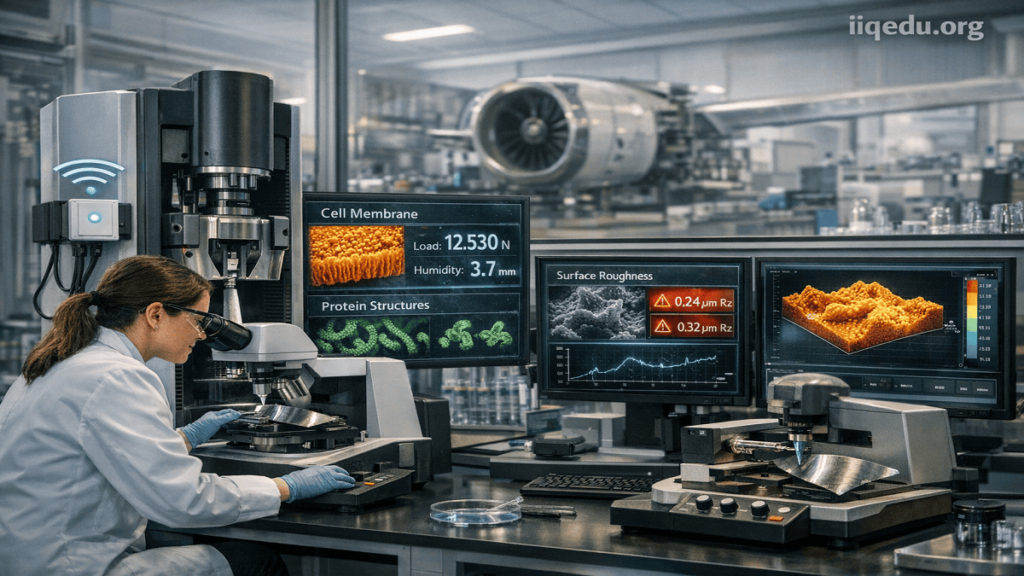
White Paper of Atomic Force Microscopy (AFM)
Executive Summary
Atomic Force Microscopy (AFM) is a critical technology for analyzing material surfaces at the nanometer scale. It provides high-resolution imaging and mechanical characterization of materials, enabling precise quality assurance, research, and development across industries. AFM is widely used in nanotechnology, electronics, materials science, and life sciences to optimize performance, detect defects, and ensure compliance with stringent quality standards.
1. Introduction
The increasing complexity of modern materials and devices demands nanoscale precision in surface and material analysis. Traditional microscopy techniques often fail to detect nanoscale defects or subtle surface variations that can impact product performance. AFM fills this gap by providing 3D surface topography, mechanical property mapping, and quantitative nanoscale analysis without requiring conductive coatings or vacuum conditions.
2. Principles of AFM
- Probe-Based Scanning: A cantilever with a nanoscale tip interacts with the surface.
- Detection: Laser deflection measures cantilever bending, producing detailed 3D maps.
- Force Measurement: Quantifies adhesion, stiffness, and elasticity through force spectroscopy.
- Modes of Operation: Contact, tapping, and non-contact modes allow adaptation to sample type and sensitivity.
3. Why AFM is Essential
- Enables nanometer-level imaging and measurement.
- Provides quantitative mechanical properties of surfaces.
- Non-destructive, suitable for delicate samples such as biomaterials or thin films.
- Supports research, industrial QA, and R&D across multiple sectors.
4. Industry Applications
- Nanotechnology and Materials Science: Surface roughness, coatings, thin films, and nanostructures.
- Semiconductors and Electronics: Wafer inspection, thin-film uniformity, and defect detection.
- Life Sciences and Biomedical Research: Imaging cells, proteins, DNA, and biomaterials.
- Aerospace and Automotive: QA of turbine blades, engine components, and high-precision materials.
- Polymers and Composites: Surface adhesion, elasticity, and coating performance assessment.
5. Implementation Strategy
- Define Objectives: Identify the nanoscale features or properties to measure.
- Sample Preparation: Clean, mount, and stabilize the sample to prevent measurement errors.
- Select AFM Mode: Choose contact, tapping, or non-contact depending on material sensitivity.
- Scanning and Data Acquisition: Raster-scan the tip across the surface to collect topographical and mechanical data.
- Analysis: Generate 3D maps, calculate roughness, adhesion, stiffness, and identify defects.
- QA Integration: Incorporate results into Quality Management Systems to improve production and compliance.
6. Case Study
Nanomaterial Quality Assurance:
A nanotechnology company used AFM to detect nanoscale defects and surface irregularities in carbon-based materials for electronic applications. AFM enabled:
- Detection of micro-defects invisible to optical microscopy
- Measurement of mechanical properties such as stiffness and adhesion
- Process optimization for improved conductivity and durability
- Integration into QA workflows, ensuring batch-to-batch consistency
7. Benefits
- High-Resolution Imaging: Atomic to nanometer-scale precision.
- Non-Destructive: Minimal sample preparation required.
- Quantitative Data: Surface roughness, adhesion, and elasticity measurements.
- Versatile Applications: Works with metals, polymers, semiconductors, and biological samples.
- Improved QA and R&D: Enables defect detection, process optimization, and regulatory compliance.
8. Limitations
- Limited scan area compared to SEM or optical microscopy.
- Slow scanning for high-resolution imaging over large surfaces.
- Sensitive to vibration and environmental conditions.
- Mainly surface characterization; depth information is limited.
9. Conclusion
Atomic Force Microscopy is a powerful tool for nanoscale material and surface analysis. Its ability to combine high-resolution imaging with quantitative mechanical measurement makes it essential in R&D, industrial QA, and advanced material development. Integrating AFM into workflows ensures superior quality, performance, and compliance in highly demanding industries.
References
- Binnig, G., Quate, C. F., & Gerber, C. (1986). Atomic Force Microscope. Physical Review Letters, 56(9), 930–933.
- Garcia, R., & Perez, R. (2002). Dynamic atomic force microscopy methods. Surface Science Reports, 47(6–8), 197–301.
- Bruker Instruments. AFM Applications Overview. https://www.bruker.com/en/products-and-solutions/microscopy/atomic-force-microscopy.html
- Meyer, E., Hug, H. J., & Bennewitz, R. (2004). Scanning Probe Microscopy: The Lab on a Tip. Springer.
#Atomic Force Microscopy (AFM) in Hyderabad
Industry Application of Atomic Force Microscopy (AFM)
Atomic Force Microscopy (AFM) provides nanoscale imaging and mechanical property analysis, making it indispensable in industries where surface quality, material integrity, and precision are critical. Below are the key industry applications:
1. Nanotechnology and Materials Science
Applications:
- Surface roughness measurement of thin films and coatings
- Nanostructure characterization, such as nanoparticles or nanotubes
- Analysis of composite materials
Benefits:
- Detects nanoscale defects that traditional microscopy cannot reveal
- Optimizes material properties for performance and durability
2. Semiconductor and Electronics Industry
Applications:
- Inspection of silicon wafers, microchips, and MEMS devices
- Measurement of thin-film uniformity and surface morphology
- Detection of micro- and nanoscale defects
Benefits:
- Improves yield and reliability of electronic components
- Ensures consistency in high-precision semiconductor manufacturing
3. Aerospace and Automotive Industries
Applications:
- Quality assessment of turbine blades, engine components, and metal coatings
- Analysis of surface wear, corrosion, and micro-cracks
Benefits:
- Enhances component longevity and safety
- Supports rigorous QA standards and regulatory compliance
4. Polymers and Coatings
Applications:
- Evaluation of polymer surface adhesion, elasticity, and roughness
- Characterization of protective coatings and films
Benefits:
- Optimizes coating processes
- Ensures performance under mechanical and environmental stress
5. Biomedical and Life Sciences
Applications:
- Imaging of cells, proteins, DNA, and tissue surfaces
- Study of biomaterial surface interactions and mechanical properties
Benefits:
- Supports drug delivery research and biomaterial development
- Enables non-destructive visualization at the nanoscale
6. Energy and Renewable Technology
Applications:
- Surface analysis of solar panels, battery electrodes, and fuel cell materials
- Characterization of nanostructured energy materials
Benefits:
- Improves efficiency and durability of energy devices
- Detects defects that can reduce performance or lifespan
7. Research and Development
Applications:
- Development of new materials, coatings, and nanostructures
- Surface property optimization for high-performance applications
Benefits:
- Enables innovation in advanced materials and devices
- Provides quantitative data to support product development and patent applications
Summary
AFM is applied across nanotechnology, electronics, aerospace, automotive, polymers, biomedical research, energy, and R&D. Its ability to provide high-resolution surface imaging, mechanical property mapping, and defect detection at the nanoscale makes it a crucial tool for quality assurance, innovation, and process optimization in advanced industries.
References:
- Binnig, G., Quate, C. F., & Gerber, C. (1986). Atomic Force Microscope. Physical Review Letters, 56(9), 930–933.
- Bruker Instruments. AFM Applications Overview. https://www.bruker.com/en/products-and-solutions/microscopy/atomic-force-microscopy.html
- Meyer, E., Hug, H. J., & Bennewitz, R. (2004). Scanning Probe Microscopy: The Lab on a Tip. Springer.
#Atomic Force Microscopy (AFM) in Mumbai
Ask FAQs
What is Atomic Force Microscopy (AFM)?
Atomic Force Microscopy (AFM) is a high-resolution scanning probe technique used to visualize and measure surface topography at the nanometer scale. It provides 3D surface mapping and mechanical property measurements such as stiffness, adhesion, and elasticity, making it crucial for material science, nanotechnology, and biomedical applications.
Who uses AFM and why?
AFM is used by researchers, quality assurance professionals, and engineers in fields such as:
Nanotechnology and materials science
Semiconductor and electronics manufacturing
Aerospace and automotive QA
Biomedical research
AFM helps these professionals detect nanoscale defects, optimize surfaces, and ensure material performance and compliance.
When is AFM required?
AFM is required during:
R&D and material development – to study surface structures and mechanical properties.
Quality assurance – to ensure nanoscale surface integrity in production.
Failure analysis – to identify defects or wear that cannot be seen with optical microscopy.
Process optimization – to refine coatings, thin films, and nanostructured materials.
How does AFM work?
AFM operates by scanning a nanoscale cantilever tip across a sample surface. The tip’s deflection is detected by a laser and converted into a 3D surface map. AFM can also measure mechanical properties through force spectroscopy, and it can operate in contact, tapping, or non-contact modes depending on sample sensitivity.
What are the benefits of using AFM?
Provides atomic- to nanometer-scale resolution imaging.
Allows quantitative surface and mechanical property measurements.
Non-destructive for delicate materials, including biological samples.
Detects defects and surface irregularities invisible to traditional microscopy.
Supports R&D, industrial QA, and regulatory compliance across multiple sectors.
Source: Park Systems
Table of Contents
Disclaimer:
The information provided is for educational and informational purposes only. While every effort has been made to ensure accuracy, the authors and publishers make no warranties regarding completeness or suitability for specific applications. Users should verify all information and consult qualified professionals before implementing AFM procedures or making decisions based on the data.