Non-Destructive Testing (NDT)
Introduction
Non-Destructive Testing (NDT) refers to a set of inspection techniques used to evaluate the properties of materials, components, or assemblies without causing damage. NDT is crucial in industries where structural integrity, safety, and reliability are critical, such as aerospace, automotive, oil & gas, power generation, and manufacturing.
The main purpose of NDT is to detect defects, measure material properties, and ensure compliance with industry standards without compromising the usability of the tested object.
Common NDT Methods
- Visual Testing (VT): Direct observation using the naked eye or magnification tools to detect surface defects.
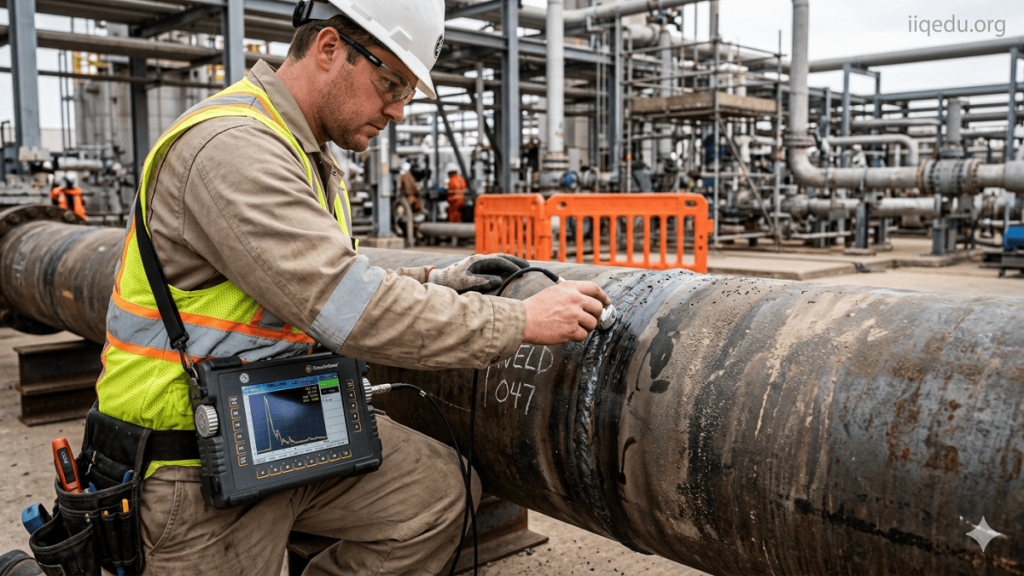
- Ultrasonic Testing (UT): High-frequency sound waves detect internal flaws or thickness variations.
- Radiographic Testing (RT): X-rays or gamma rays reveal internal defects in materials.
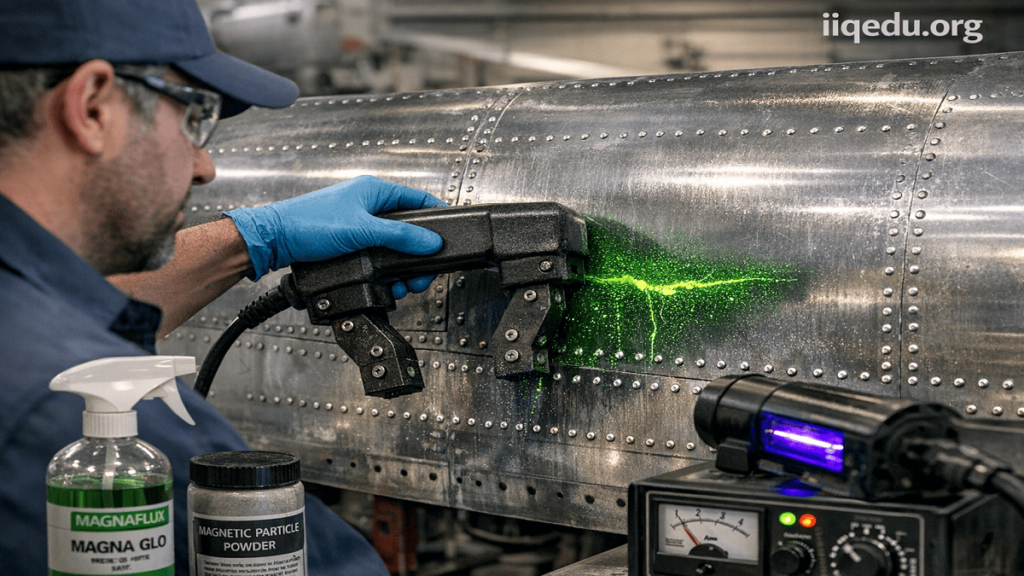
- Magnetic Particle Testing (MT/ MPI): Detects surface and near-surface defects in ferromagnetic materials.
- Liquid Penetrant Testing (PT): Uses a dye to reveal surface cracks in non-porous materials.
- Eddy Current Testing (ECT): Detects surface and subsurface defects in conductive materials.
- Acoustic Emission (AE) & Thermography: Advanced methods to monitor material stress or heat patterns.
Applications of NDT
- Aerospace: Inspect aircraft structures, engines, and landing gear for cracks or corrosion.
- Oil & Gas: Test pipelines, pressure vessels, and storage tanks for corrosion or leaks.
- Automotive: Evaluate components like chassis, engine parts, and welds for fatigue or cracks.
- Power Generation: Monitor boilers, turbines, and nuclear reactors for defects and wear.
- Construction & Infrastructure: Inspect bridges, pipelines, and steel structures for safety and compliance.
Advantages of NDT
- Preserves the integrity of the material or component.
- Enables early detection of defects to prevent failures.
- Reduces maintenance costs and downtime.
- Complies with regulatory and safety standards.
- Applicable across a wide range of materials and industries.
Standards & References
- ASTM International (ASTM E165, E1444, E1417)
- ISO 9712 – Qualification and certification of NDT personnel
- ASNT – American Society for Nondestructive Testing Guidelines
- NDT Overview – ASNT
Summary
Non-Destructive Testing (NDT) is a critical quality assurance process for detecting defects and measuring material properties without causing damage. By combining multiple techniques, industries can ensure safety, performance, and regulatory compliance while minimizing costs and operational risks.
#Non-Destructive Testing (NDT) in India
What is Non-Destructive Testing (NDT)?
Non-Destructive Testing (NDT) is a collection of inspection and evaluation techniques used to assess the properties, integrity, and quality of materials, components, or structures without causing damage. Unlike destructive testing, NDT allows the material or component to remain fully functional after inspection.
The primary objectives of NDT are to:
- Detect defects or discontinuities such as cracks, corrosion, voids, or inclusions.
- Measure material properties like thickness, hardness, or residual stress.
- Ensure safety, reliability, and regulatory compliance in critical applications.
Common NDT methods include visual testing (VT), ultrasonic testing (UT), radiographic testing (RT), magnetic particle inspection (MPI), liquid penetrant testing (PT), and eddy current testing (ECT). NDT is widely used in aerospace, automotive, power generation, construction, and oil & gas industries, where early detection of defects can prevent failures and reduce maintenance costs.
References:
- ASTM E165 – Standard Practice for Liquid Penetrant Examination
- ISO 9712 – Qualification and Certification of NDT Personnel
- ASNT – Non-Destructive Testing Overview
#Non-Destructive Testing (NDT) in Maharashtra
Who is Non-Destructive Testing (NDT) required?
Non-Destructive Testing (NDT) is required by engineers, quality assurance professionals, regulatory authorities, and industries that rely on structural integrity, safety, and reliability of their materials, components, and systems. Specifically, NDT is essential for:
1. Aerospace Industry Professionals
- Aircraft manufacturers, maintenance teams, and aerospace engineers use NDT to inspect airframes, engines, and critical components.
- Ensures compliance with strict safety and certification standards.
2. Oil, Gas, and Petrochemical Engineers
- Pipeline operators, refinery engineers, and pressure vessel inspectors use NDT to detect corrosion, cracks, or leaks.
- Helps prevent catastrophic failures and environmental hazards.
3. Automotive and Mechanical Engineers
- Used by automotive designers, quality engineers, and maintenance teams to inspect engine components, welds, and structural parts.
- Ensures durability and compliance with industry safety standards.
4. Construction and Infrastructure Inspectors
- Civil engineers and structural inspectors rely on NDT for bridges, buildings, pipelines, and steel frameworks.
- Detects hidden cracks, voids, or defects that could compromise structural safety.
5. Manufacturing and Materials Engineers
- Engineers developing new materials, alloys, composites, or coatings use NDT for quality assurance.
- Ensures products meet design specifications and performance requirements.
6. Regulatory and Certification Bodies
- Organizations and authorities that enforce safety and industrial standards require NDT as part of compliance verification.
- Example: Aviation authorities, nuclear regulatory commissions, and ISO/ASTM standards.
Summary:
Non-Destructive Testing is required by any professional or organization responsible for the safety, quality, and reliability of critical components and structures. Its use spans aerospace, automotive, oil & gas, construction, manufacturing, and regulatory compliance, making it a fundamental tool in modern engineering and industry.
References:
#Non-Destructive Testing (NDT) in Singapore
When is Non-Destructive Testing (NDT) required?
Non-Destructive Testing (NDT) is required whenever the integrity, reliability, or performance of a material, component, or structure must be verified without causing damage. It is especially critical in industries where failure can lead to safety hazards, financial losses, or regulatory non-compliance. Key situations include:
1. During Manufacturing and Fabrication
- NDT is applied to welds, castings, and machined parts to ensure they are defect-free before being installed or shipped.
- Examples: Ultrasonic testing on pressure vessels, radiographic inspection of welds, and magnetic particle testing on ferromagnetic parts.
2. During Maintenance and In-Service Inspection
- Periodic inspections of aircraft, pipelines, bridges, and industrial equipment use NDT to detect fatigue, cracks, corrosion, or wear.
- Ensures preventive maintenance and reduces the risk of catastrophic failure.
3. After Repair or Modification
- Components that have been repaired, refurbished, or modified are tested with NDT to ensure repairs meet safety and performance standards.
- Example: Post-weld heat treatment and subsequent ultrasonic testing of repaired turbine blades.
4. Before Critical Operations
- NDT is required for components before they are exposed to high stress, high pressure, or extreme environments.
- Example: Pressure vessel inspection before commissioning or pipeline inspection before gas or oil transport.
5. For Regulatory Compliance
- Many industries require NDT to meet national or international standards.
- Ensures adherence to safety regulations and certification requirements in aerospace, nuclear, automotive, and construction sectors.
Summary
NDT is required at all stages where failure could be dangerous or costly: during manufacturing, after repairs, during routine maintenance, before critical operations, and for regulatory compliance. It allows industries to detect defects early, maintain safety, and ensure product quality without damaging components.
References:
- ISO 9712 – Qualification and Certification of NDT Personnel
- ASNT – Non-Destructive Testing Overview
- ASTM E165 – Standard Practice for Liquid Penetrant Examination
#Non-Destructive Testing (NDT) in Pune
How is Non-Destructive Testing (NDT) required?
Yes, Non-Destructive Testing (NDT) is required whenever there is a need to verify the integrity, quality, and performance of materials, components, or structures without causing damage. Its use is essential in industries where failure can result in safety risks, operational downtime, financial loss, or regulatory non-compliance.
Situations Where NDT is Required
- Critical Components: Aircraft, nuclear reactors, pressure vessels, pipelines, and bridges require NDT to detect defects such as cracks, corrosion, or voids.
- During Manufacturing: To ensure welds, castings, and machined parts are free from flaws before use.
- After Repairs or Modifications: To confirm the safety and reliability of repaired or modified components.
- Routine Maintenance and Inspection: Periodic NDT ensures long-term integrity and prevents unexpected failures.
- Regulatory Compliance: Required by industry standards such as ISO, ASTM, and ASNT for certification and safety verification.
Summary:
Non-Destructive Testing is mandated whenever material reliability, operational safety, or regulatory compliance is critical. It allows industries to detect defects early, maintain safety standards, and optimize performance without damaging components.
References:
- ISO 9712 – Qualification and Certification of NDT Personnel
- ASNT – Non-Destructive Testing Overview
- ASTM E165 – Standard Practice for Liquid Penetrant Examination
#Non-Destructive Testing (NDT) in Kolkata
Case Study of Non-Destructive Testing (NDT)
Background
A major oil and gas company needed to ensure the structural integrity and leak-free performance of a newly installed high-pressure natural gas pipeline. The pipeline consisted of carbon steel segments joined by welded seams, which are common points for defects such as cracks, porosity, or incomplete fusion. Given the high-risk nature of pipeline failure, traditional destructive testing was not feasible.
Objective
- Detect surface and subsurface defects in welds.
- Verify the overall quality and compliance with regulatory standards (API 1104 and ASME Section VIII).
- Ensure pipeline safety and long-term reliability without damaging any welds.
Methodology
- Visual Testing (VT):
- Conducted initial inspection of weld surfaces for visible cracks, misalignment, or undercuts.
- Provided a preliminary assessment to prioritize detailed NDT.
- Radiographic Testing (RT):
- X-ray imaging of welds was performed to detect internal voids, inclusions, or incomplete penetration.
- Images were analyzed by certified NDT inspectors to identify defects.
- Ultrasonic Testing (UT):
- High-frequency sound waves were transmitted through the welds.
- Reflected waves indicated the presence of internal discontinuities, providing depth and size information for detected flaws.
- Magnetic Particle Testing (MT):
- Applied to ferromagnetic steel welds to detect surface and near-surface cracks.
Results
- Out of 120 welds inspected, 5 welds exhibited minor internal defects detected by RT and UT.
- MT confirmed no significant surface cracks.
- All defective welds were repaired and retested, ensuring compliance with safety standards.
- The combination of NDT methods provided comprehensive coverage of potential defect types.
Discussion
- NDT allowed the company to identify critical flaws without damaging any welds, preventing potential leaks or failures.
- The use of multiple NDT methods (VT, RT, UT, MT) provided a high level of confidence in the pipeline’s structural integrity.
- This approach saved time, cost, and resources compared to destructive testing.
Conclusion
Non-Destructive Testing was essential for ensuring the safety, reliability, and regulatory compliance of high-pressure pipeline welds. The case study demonstrates that NDT:
- Detects both surface and internal defects.
- Reduces risk of catastrophic failure.
- Optimizes maintenance and repair planning.
- Provides cost-effective quality assurance without damaging components.
#Non-Destructive Testing (NDT) in Banglore
White Paper of Non-Destructive Testing (NDT)
Executive Summary
Non-Destructive Testing (NDT) is a set of inspection techniques used to evaluate materials, components, and structures without causing damage. This white paper explores the principles, methods, applications, benefits, and industry relevance of NDT, highlighting its role in quality assurance, safety, and compliance across critical industries such as aerospace, oil & gas, automotive, and construction.
1. Introduction
Industrial components and structures are subject to stress, fatigue, corrosion, and wear, which can lead to failures. Traditional destructive testing is often impractical or uneconomical, especially for critical, expensive, or operationally essential assets.
NDT allows for early detection of defects and continuous monitoring of material properties while keeping components intact, thus ensuring operational safety, cost efficiency, and compliance with industry standards.
2. Principles of NDT
NDT relies on detecting physical anomalies in materials without altering their usability. Key principles include:
- Surface and Subsurface Evaluation: Identify cracks, voids, porosity, and inclusions.
- Material Property Measurement: Assess hardness, thickness, and residual stress.
- Data Interpretation: Convert detected signals (sound, radiation, magnetic flux, or dye penetration) into actionable information about material integrity.
3. Common NDT Methods
| Method | Principle | Application |
|---|---|---|
| Visual Testing (VT) | Direct observation | Surface defects, misalignments |
| Ultrasonic Testing (UT) | High-frequency sound waves | Internal cracks, weld inspections |
| Radiographic Testing (RT) | X-rays or gamma rays | Detects internal voids or inclusions |
| Magnetic Particle Testing (MT/MPI) | Magnetic field inspection | Surface and near-surface defects in ferromagnetic materials |
| Liquid Penetrant Testing (PT) | Dye penetration | Surface cracks in non-porous materials |
| Eddy Current Testing (ECT) | Electromagnetic induction | Surface and subsurface defects in conductive materials |
| Acoustic Emission & Thermography | Stress or heat detection | Monitoring ongoing stress or damage |
4. Industry Applications
- Aerospace: Aircraft fuselages, turbine blades, engines, and landing gear.
- Oil & Gas: Pipelines, pressure vessels, storage tanks, and offshore platforms.
- Automotive: Engine components, chassis, welds, and safety-critical parts.
- Construction: Bridges, steel frameworks, pipelines, and structural concrete.
- Manufacturing & R&D: Alloys, composites, thin films, and coatings.
5. Advantages of NDT
- Maintains component usability while testing.
- Detects defects early, preventing failures.
- Reduces maintenance costs and operational downtime.
- Ensures regulatory compliance and safety certification.
- Applicable to various materials and industrial applications.
6. Limitations
- Requires trained personnel and certification.
- Some methods are limited to specific materials (e.g., MT only works with ferromagnetic materials).
- Surface preparation and environmental factors can affect accuracy.
7. Case Study Example
Pipeline Weld Inspection: A high-pressure natural gas pipeline underwent NDT using VT, RT, UT, and MT. Out of 120 welds, 5 defects were identified and repaired, ensuring safe and reliable operation without damaging the pipeline. This demonstrates NDT’s effectiveness in high-stakes industrial applications.
8. Standards and References
- ISO 9712 – Qualification and Certification of NDT Personnel
- ASTM E165 – Standard Practice for Liquid Penetrant Examination
- ASNT – Nondestructive Testing Handbook, 3rd Edition
- API 1104 – Welding of Pipelines and Related Facilities
9. Conclusion
Non-Destructive Testing is an essential tool in modern industry, enabling detection of defects and measurement of material properties without compromising the component’s usability. By applying NDT across aerospace, oil & gas, automotive, and construction sectors, organizations enhance safety, reduce costs, and ensure regulatory compliance.
NDT is indispensable for preventive maintenance, quality assurance, and operational reliability, making it a cornerstone of modern engineering practices.
#Non-Destructive Testing (NDT) in Hyderabad
Industry Application of Non-Destructive Testing (NDT)
Non-Destructive Testing (NDT) is widely applied across industries where safety, reliability, and quality assurance are critical. Its ability to detect defects without damaging components makes it indispensable for modern engineering, manufacturing, and maintenance.
1. Aerospace Industry
- Applications: Inspecting aircraft fuselage, wings, turbine blades, landing gear, and engine components.
- Purpose: Detect surface cracks, corrosion, and fatigue before they compromise safety.
- Methods Used: Ultrasonic Testing (UT), Radiographic Testing (RT), Magnetic Particle Testing (MT), and Eddy Current Testing (ECT).
- Benefit: Ensures compliance with aviation safety regulations and reduces risk of catastrophic failures.
2. Oil & Gas Industry
- Applications: Pipelines, storage tanks, pressure vessels, and offshore rigs.
- Purpose: Detect corrosion, weld defects, leaks, and structural weaknesses.
- Methods Used: RT, UT, PT, MT, and Acoustic Emission (AE).
- Benefit: Prevents environmental hazards, ensures operational safety, and reduces unplanned downtime.
3. Automotive Industry
- Applications: Engine components, chassis structures, welds, and safety-critical parts.
- Purpose: Evaluate manufacturing quality, identify cracks or weak points, and ensure component durability.
- Methods Used: Eddy Current Testing (ECT), UT, PT, and Visual Testing (VT).
- Benefit: Enhances vehicle safety, optimizes maintenance, and supports product warranty compliance.
4. Construction and Infrastructure
- Applications: Bridges, pipelines, steel frameworks, reinforced concrete structures, and high-rise buildings.
- Purpose: Detect structural defects, corrosion, or cracks that could compromise stability.
- Methods Used: UT, RT, PT, Thermography, and Acoustic Emission.
- Benefit: Ensures long-term safety, compliance with building codes, and cost-effective maintenance.
5. Power Generation and Energy
- Applications: Boilers, turbines, nuclear reactors, wind turbines, and solar panels.
- Purpose: Ensure material integrity, detect micro-cracks or corrosion, and maintain operational efficiency.
- Methods Used: UT, RT, MT, PT, and Acoustic Emission.
- Benefit: Minimizes unplanned outages, reduces maintenance costs, and enhances reliability of energy systems.
6. Manufacturing and Materials R&D
- Applications: Testing new alloys, nanocomposites, coatings, and microstructured components.
- Purpose: Measure hardness, elasticity, and detect defects during R&D or production.
- Methods Used: UT, PT, MT, Eddy Current, and Nanoindentation in advanced applications.
- Benefit: Supports innovation, ensures quality, and validates material performance at small scales.
Summary
Non-Destructive Testing is applied across multiple industries where component integrity, operational safety, and compliance are paramount. By employing NDT methods such as ultrasonic, radiographic, magnetic particle, eddy current, and liquid penetrant testing, industries can:
- Detect surface and subsurface defects early.
- Reduce operational risk and maintenance costs.
- Ensure compliance with national and international standards.
- Extend the service life of critical components.
References:
- ISO 9712 – Qualification and Certification of NDT Personnel
- ASNT – Nondestructive Testing Overview
- API 1104 – Welding of Pipelines and Related Facilities
#Non-Destructive Testing (NDT) in Mumbai
Ask FAQs
What is Non-Destructive Testing (NDT)?
Non-Destructive Testing (NDT) is a set of inspection techniques used to evaluate the integrity, quality, and mechanical properties of materials, components, or structures without causing damage. It helps detect defects such as cracks, corrosion, voids, or inclusions while keeping the part fully operational.
Who requires NDT?
NDT is required by engineers, maintenance teams, quality assurance professionals, and regulatory authorities in industries like aerospace, automotive, oil & gas, construction, and manufacturing. Any industry where safety, reliability, and compliance are critical relies on NDT.
When is NDT required?
NDT is needed during:
Manufacturing: Inspect welds, castings, and machined parts before use.
Maintenance: Periodic inspection of pipelines, bridges, and equipment.
After repairs or modifications: To ensure the repaired part meets safety standards.
Before critical operations: To prevent catastrophic failures in high-risk applications.
What are the common methods of NDT?
The most common NDT methods include:
Visual Testing (VT) – Surface inspection.
Ultrasonic Testing (UT) – Detects internal flaws.
Radiographic Testing (RT) – Uses X-rays or gamma rays for internal defects.
Magnetic Particle Testing (MT) – Detects surface and near-surface defects in ferromagnetic materials.
Liquid Penetrant Testing (PT) – Reveals surface cracks in non-porous materials.
Eddy Current Testing (ECT) – Detects surface/subsurface defects in conductive materials.
Why is NDT important?
NDT is critical because it:
Preserves component usability while testing.
Detects defects early to prevent failures.
Reduces maintenance costs and downtime.
Ensures compliance with safety and industry regulations.
Supports quality assurance and operational reliability across industries.
Source: Limble
Table of Contents
Disclaimer:
The information provided is for educational and informational purposes only. While efforts have been made to ensure accuracy, the authors and publishers make no warranties regarding completeness or applicability. Users should consult relevant standards, manufacturer guidelines, and certified professionals before performing any NDT procedures.