Quality in Franchising
1. What is Quality in Franchising?
Quality in franchising refers to maintaining consistent standards across all franchise locations to ensure the same level of products, services, and customer experience as the parent brand. It covers operational processes, product/service delivery, employee performance, and customer satisfaction. Maintaining quality is critical because inconsistency can damage brand reputation and reduce customer trust.
2. Why Quality Matters in Franchising
- Brand Consistency: Ensures that every location represents the brand accurately
- Customer Satisfaction: High-quality service leads to loyal customers
- Operational Efficiency: Standardized processes reduce errors and inefficiencies
- Compliance: Ensures adherence to legal, safety, and industry regulations
- Competitive Advantage: Quality differentiates the franchise from competitors
3. Key Areas of Quality Management
- Product/Service Quality: Consistent taste, performance, or service delivery
- Operational Procedures: Standard operating procedures (SOPs) across all locations
- Employee Training: Uniform training to maintain skill and service levels
- Customer Experience: Ensuring uniform experience at every outlet
- Monitoring & Auditing: Regular inspections and audits to maintain standards
4. Strategies to Ensure Quality in Franchising
- Develop comprehensive SOPs and manuals
- Implement training programs for staff and franchisees
- Conduct regular audits and performance reviews
- Use customer feedback systems to identify gaps
- Apply quality improvement initiatives continuously
5. Industry Examples
- Fast Food: Brands like McDonald’s ensure consistent taste, service, and hygiene globally
- Retail: Stores maintain uniform product displays, inventory, and customer service
- Hospitality: Hotels guarantee standard room service, amenities, and cleanliness
In short:
Quality in franchising is essential to maintain brand integrity, customer satisfaction, and operational efficiency. Consistent standards across all locations help franchises grow sustainably while protecting the reputation of the parent brand.
Who is Quality in Franchising required?
1. Franchise Owners/Franchisees
- They must adhere to the franchisor’s quality standards to maintain brand consistency, operational efficiency, and customer trust.
2. Franchisors
- Responsible for setting quality benchmarks, creating standard operating procedures (SOPs), and monitoring compliance across all franchise locations.
3. Employees and Staff
- Ensuring high-quality service, proper execution of processes, and consistent customer experience.
4. Customers
- Indirectly require quality, as consistent products and services drive satisfaction, loyalty, and repeat business.
5. Regulatory Authorities and Industry Auditors
- Compliance with health, safety, and industry-specific quality regulations is mandatory in many sectors, such as food, hospitality, and retail.
In short:
Quality in franchising is required by franchisors, franchisees, employees, customers, and regulatory bodies to ensure consistent brand experience, operational excellence, and customer trust across all locations.
When is Quality in Franchising required?
1. During Franchise Launch
- When opening a new franchise location, quality standards must be implemented from day one to ensure the brand’s reputation is upheld.
2. During Daily Operations
- Continuous adherence to SOPs, product/service standards, and employee performance ensures consistent customer experience.
3. During Training and Onboarding
- Quality standards must be reinforced when training new employees or franchisees to maintain uniformity across all locations.
4. During Audits and Inspections
- Regular quality checks, audits, and performance reviews are required to identify gaps and ensure compliance with franchisor requirements and regulations.
5. During Customer Interactions
- Quality must be maintained at every customer touchpoint—product/service delivery, service speed, cleanliness, and overall experience.
In short:
Quality in franchising is required continuously, from opening a franchise and training staff to daily operations and customer interactions, to ensure consistent standards, compliance, and a positive brand reputation.
Where is Quality in Franchising required?
1. Franchise Outlets / Stores
- Physical locations where products or services are delivered must maintain the same quality standards, including product consistency, service, hygiene, and ambiance.
2. Corporate Offices / Support Centers
- Head offices and regional support centers enforce standard operating procedures, provide training, and monitor compliance with quality standards.
3. Supply Chain & Distribution
- Suppliers, warehouses, and logistics operations must meet quality benchmarks to ensure products are consistent and safe.
4. Online & Delivery Services
- Digital ordering platforms, delivery partners, and e-commerce systems must maintain service quality and timely fulfillment.
5. Customer Service Channels
- Call centers, social media support, and feedback systems must provide consistent service and resolve issues effectively.
In short:
Quality in franchising is required across all touchpoints—physical stores, corporate offices, supply chains, online platforms, and customer service channels—to ensure a consistent brand experience, operational efficiency, and customer satisfaction.
How is Quality in Franchising required?
1. Standard Operating Procedures (SOPs)
- Franchisors provide detailed manuals covering operations, service protocols, product preparation, hygiene, and customer interaction.
- Franchisees and employees are expected to follow these SOPs consistently.
2. Training and Development
- New franchisees and staff undergo structured training programs to understand brand standards, operational processes, and quality expectations.
- Continuous training updates ensure staff are aware of improvements and new procedures.
3. Audits and Inspections
- Regular inspections and audits are conducted by the franchisor to assess compliance with quality standards.
- Performance reviews and mystery shopper evaluations help identify gaps.
4. Feedback Systems
- Customer feedback mechanisms, surveys, and reviews are monitored to detect issues in product, service, or operations.
- Franchisees act on feedback to improve quality.
5. Continuous Improvement
- Franchisors and franchisees implement corrective actions based on audit results and customer feedback.
- Ongoing process improvement ensures standards evolve and are maintained across all locations.
In short:
Quality in franchising is required by establishing SOPs, training staff, monitoring compliance, gathering feedback, and continuously improving operations, ensuring that every franchise location consistently delivers the brand’s promise and a superior customer experience.
Case Study of Quality in Franchising
Background
A global fast-food franchise faced challenges maintaining consistent quality across its 200+ international outlets. Customers reported variations in food taste, service speed, and cleanliness, which began affecting brand reputation and customer loyalty. The franchisor decided to implement a comprehensive quality management program to standardize operations and enhance customer satisfaction.
Step 1: Define Quality Standards
- Established uniform standard operating procedures (SOPs) for food preparation, service, hygiene, and customer interaction.
- Set measurable quality benchmarks for product consistency, service time, and cleanliness.
Step 2: Training and Certification
- Conducted mandatory training programs for franchisees and employees on SOPs, safety standards, and customer service protocols.
- Certified outlets that met quality requirements before opening or during audits.
Step 3: Monitoring and Audits
- Implemented regular audits and mystery shopper programs to monitor adherence to quality standards.
- Used dashboards to track KPIs like order accuracy, service speed, and customer satisfaction scores.
Step 4: Feedback and Continuous Improvement
- Collected customer feedback via surveys, app ratings, and social media.
- Introduced corrective actions for outlets underperforming in audits or receiving negative feedback.
- Updated SOPs and training based on lessons learned to maintain continuous improvement.
Results
- Achieved 95% compliance with quality standards across all outlets within one year.
- Increased customer satisfaction scores by 30%.
- Reduced inconsistencies in food quality and service speed across locations.
- Strengthened brand loyalty and improved operational efficiency.
Key Takeaways
- Consistent quality is critical to maintaining brand reputation in franchising.
- SOPs, training, and regular audits are essential tools for standardization.
- Continuous feedback and improvement sustain quality across multiple locations.

White Paper of Quality in Franchising
1. Executive Summary
Maintaining consistent quality across franchise locations is critical for protecting brand reputation, ensuring customer satisfaction, and driving business growth. Quality in franchising covers products, services, operational procedures, and customer experience. This white paper explores the importance of quality management in franchising, strategies to maintain standards, industry applications, and measurable outcomes.
2. Introduction
Franchising allows businesses to expand rapidly, but it introduces challenges in maintaining consistent standards. Inconsistencies in product quality, service delivery, or hygiene can erode customer trust. Effective quality management ensures that every franchise location represents the brand accurately, delivering the same experience, product, and service.
3. Importance of Quality in Franchising
- Brand Consistency: Ensures uniform experience across locations
- Customer Satisfaction: High-quality products and services build loyalty
- Operational Efficiency: Standardized processes reduce errors and waste
- Regulatory Compliance: Meets legal, health, and industry standards
- Competitive Advantage: Distinguishes the franchise from competitors
4. Key Components of Quality Management
- Standard Operating Procedures (SOPs): Clear guidelines for operations, product preparation, and customer service
- Training and Certification: Employee and franchisee training to maintain skills and service quality
- Monitoring and Audits: Regular inspections, KPI tracking, and performance reviews
- Customer Feedback Systems: Collecting and analyzing feedback to identify improvement areas
- Continuous Improvement: Implementing corrective actions and refining processes to sustain quality
5. Strategies to Maintain Quality
- Develop comprehensive manuals and SOPs for all operations
- Conduct regular franchisee and staff training programs
- Use audit checklists, mystery shoppers, and performance dashboards
- Encourage continuous feedback loops and corrective actions
- Benchmark performance across outlets to identify and scale best practices
6. Industry Applications
- Fast Food & Restaurants: Consistent taste, service, and hygiene standards
- Retail: Uniform product presentation, inventory management, and customer service
- Hospitality: Standardized room service, cleanliness, and amenities
- Healthcare Clinics: Consistent patient care protocols, safety, and service delivery
7. Benefits of Maintaining Quality in Franchising
- Improved customer loyalty and satisfaction
- Strengthened brand reputation
- Reduced operational errors and inefficiencies
- Compliance with regulatory standards
- Scalable growth with consistent results
8. Conclusion
Quality in franchising is essential for sustaining brand integrity, customer trust, and operational efficiency. By implementing SOPs, continuous training, monitoring, and feedback systems, franchises can deliver a consistent, high-quality experience across all locations, driving long-term success and competitive advantage.
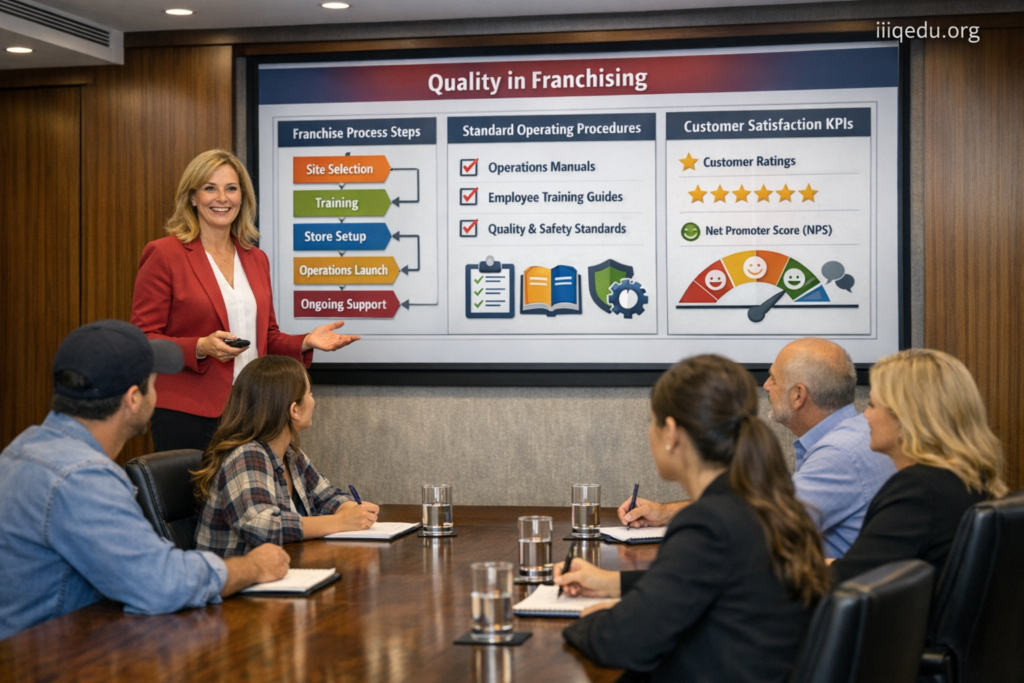
Industry Application of Quality in Franchising
Maintaining quality in franchising is critical across industries to ensure consistent products, services, and customer experiences. Effective quality management drives brand reputation, operational efficiency, and customer loyalty.
1. Fast Food & Restaurants
- Application: Standardizing recipes, portion sizes, cooking methods, and service protocols.
- Example: Global chains like McDonald’s and KFC maintain consistent taste, hygiene, and service standards across thousands of outlets.
- Benefits: Customer trust, repeat business, and brand loyalty.
2. Retail
- Application: Consistent product presentation, inventory management, and customer service.
- Example: Retail franchises ensure uniform store layouts, product quality, and checkout experiences across locations.
- Benefits: Stronger brand recognition, customer satisfaction, and operational efficiency.
3. Hospitality & Hotels
- Application: Standardizing room service, cleanliness, amenities, and staff behavior.
- Example: Hotel chains maintain uniform experiences globally, from check-in procedures to room standards.
- Benefits: High customer satisfaction, positive reviews, and repeat bookings.
4. Healthcare & Clinics
- Application: Maintaining consistent patient care, safety protocols, and administrative procedures.
- Example: Franchise-based healthcare clinics apply uniform processes for treatment, hygiene, and record keeping.
- Benefits: Improved patient outcomes, trust, and regulatory compliance.
5. Fitness & Wellness Centers
- Application: Consistent training programs, equipment maintenance, hygiene, and customer support.
- Example: Gym franchises implement SOPs for classes, personal training, and facility cleanliness.
- Benefits: Member retention, safety, and enhanced brand image.
6. Education & Training Franchises
- Application: Standardized curriculum, teaching methods, and assessment procedures.
- Example: Tutoring and skill-based franchises maintain consistent course quality across multiple locations.
- Benefits: Improved learning outcomes, credibility, and franchise scalability.
In short:
Quality in franchising is required across all industries where brand consistency, customer experience, and operational standards are critical. By implementing SOPs, training programs, monitoring, and feedback systems, franchises can deliver consistent, high-quality experiences across every location, driving growth and long-term success.
#qualityinfranchisinginmumbai #qualityinfranchisinginvasai #qualityinfranchisinginindia #qualityinfranchisinginbangalore #qualityinfranchisinginmaharashtra #qualityinfranchisinginjaipur #qualityinfranchisingingujrat #qualityinfranchisinginkolkata #qualityinfranchisingintheworld #qualityinfranchisinginkochi #qualityinfranchisinginjodhapur #bestinstituteinmumbai #bestinstituteinindia #bestinstituteintheworld
Ask FAQs
What is Quality in Franchising?
Quality in franchising refers to maintaining consistent products, services, and customer experiences across all franchise locations to protect the brand and ensure customer satisfaction.
Why is Quality important in Franchising?
It ensures brand consistency, customer loyalty, operational efficiency, and regulatory compliance, which are critical for long-term franchise success.
Who is responsible for maintaining Quality in Franchising?
Franchisors, franchisees, employees, and even supply chain partners are responsible for adhering to standard operating procedures (SOPs), training, and monitoring processes.
How is Quality maintained in Franchising?
Through SOPs, employee training, audits, customer feedback, and continuous improvement initiatives, franchises ensure all locations deliver a uniform brand experience.
Which industries benefit most from Quality in Franchising?
Industries like fast food, retail, hospitality, healthcare, fitness, and education benefit by maintaining consistent service, operational standards, and customer satisfaction across multiple locations.
Source: iFranchise Group
Table of Contents
Summary
Quality in Franchising is essential for maintaining consistent standards across all franchise locations to protect brand reputation, ensure customer satisfaction, and drive business growth. Franchises expand a brand rapidly, but without proper quality management, inconsistencies in products, services, or customer experience can harm the brand and reduce customer loyalty. Maintaining quality ensures that each location represents the parent brand accurately and delivers the same level of service and operational excellence.
Key components of quality management in franchising include standard operating procedures (SOPs), employee and franchisee training, audits and inspections, customer feedback systems, and continuous improvement initiatives. SOPs guide operations, product preparation, and service delivery, ensuring every location meets brand standards. Training programs help staff understand and implement these procedures effectively, while audits and performance reviews monitor compliance and identify areas for improvement. Customer feedback mechanisms allow franchises to address issues proactively, and continuous improvement ensures quality evolves with changing market needs.
Industry examples demonstrate the importance of quality management. In the fast-food sector, global chains maintain consistent taste, service, and hygiene across thousands of outlets. Retail franchises ensure uniform store layouts, product availability, and service standards. In hospitality, hotels maintain consistent room quality, amenities, and service procedures. Even in healthcare, fitness, and education franchises, standardized procedures and training help deliver consistent outcomes and experiences.
The benefits of maintaining quality in franchising are significant: improved customer satisfaction and loyalty, enhanced brand reputation, reduced operational errors, compliance with regulations, and the ability to scale efficiently.
In conclusion, quality in franchising is critical for sustaining operational excellence and customer trust. By implementing SOPs, training, monitoring, and continuous improvement processes, franchises can ensure that every location consistently delivers high-quality products, services, and experiences, driving long-term growth and success.
Disclaimer:
The information provided about Quality in Franchising is for general informational purposes only. Results may vary by franchise, location, or industry and do not constitute professional or legal advice.