Quantum Computing & Quality Frameworks
Introduction
Quantum computing is an advanced field of computation that leverages principles from Quantum Computing & Quality Frameworks mechanics to process information in fundamentally different ways than classical computers. Unlike classical bits, which exist as either 0 or 1, Quantum Computing & Quality Frameworks computers use qubits that can exist in multiple states simultaneously due to superposition.
Key Principles
1. Superposition
A qubit can exist in a combination of states (both 0 and 1 at the same time). This allows Quantum Computing & Quality Frameworks computers to process a vast number of possibilities simultaneously.
2. Entanglement
Qubits can become entangled, meaning the state of one qubit is directly related to another, regardless of distance. This enables highly correlated computations and faster problem-solving.
3. Quantum Interference
Quantum Computing & Quality Frameworks systems use interference to amplify correct solutions and cancel out incorrect ones during computation.
Quantum vs Classical Computing
| Feature | Classical Computing | Quantum Computing |
|---|---|---|
| Basic Unit | Bit (0 or 1) | Qubit (0, 1, or both) |
| Processing | Sequential/Parallel | Massive parallelism via superposition |
| Speed | Limited by transistor scaling | Exponential speedup for specific problems |
| Examples | Laptops, servers | Experimental quantum machines |
Applications
1. Cryptography
Quantum Computing & Quality Frameworks computing threatens traditional encryption (e.g., RSA) but also enables quantum-safe cryptography.
2. Drug Discovery
Simulating molecular structures becomes more accurate and efficient.
3. Optimization Problems
Used in logistics, supply chains, and financial modeling.
4. Artificial Intelligence
Potential to accelerate machine learning algorithms.
5. Material Science
Designing new materials with specific properties.
Challenges
- Decoherence: Loss of Quantum Computing & Quality Frameworks state due to environmental interference
- Error rates: High probability of computational errors
- Scalability: Building stable systems with many qubits is difficult
- Cost and infrastructure: Requires extreme conditions (e.g., near absolute zero)
Current State
Quantum Computing & Quality Frameworks computing is still in the Noisy Intermediate-Scale Quantum Computing & Quality Frameworks (NISQ) era, meaning systems are not yet fully fault-tolerant but are advancing rapidly.
Quality Frameworks
Introduction
Quality frameworks are structured methodologies used by organizations to ensure that products, services, and processes meet defined standards and continuously improve over time.
Key Objectives
- Ensure consistency and reliability
- Improve customer satisfaction
- Reduce defects and inefficiencies
- Enable continuous improvement
- Maintain compliance with standards
Major Quality Frameworks
1. ISO 9001
An internationally recognized standard for quality management systems (QMS). It focuses on:
- Customer focus
- Leadership
- Process approach
- Risk-based thinking
- Continuous improvement
2. Six Sigma
A data-driven methodology aimed at reducing defects and variability in processes.
- Uses DMAIC (Define, Measure, Analyze, Improve, Control)
- Targets near-perfect quality (3.4 defects per million)
3. Total Quality Management (TQM)
An organization-wide approach emphasizing long-term success through customer satisfaction and continuous improvement.
4. Lean
Focuses on eliminating waste and improving efficiency in processes.
- Identifies non-value-adding activities
- Enhances workflow and productivity
5. CMMI (Capability Maturity Model Integration)
Used primarily in software development to improve process maturity.
- Levels range from initial to optimizing
- Helps organizations standardize processes
Key Components of Quality Frameworks
1. Process Standardization
Defining consistent methods for performing tasks.
2. Performance Measurement
Using KPIs and metrics to evaluate quality.
3. Continuous Improvement
Applying iterative enhancements (e.g., PDCA cycle).
4. Customer Focus
Ensuring that outputs meet or exceed customer expectations.
5. Documentation and Compliance
Maintaining records for auditing and regulatory purposes.
Benefits
- Improved efficiency
- Reduced operational costs
- Higher customer satisfaction
- Better decision-making through data
- Enhanced competitive advantage
Challenges
- Resistance to change
- Implementation costs
- Complexity in large organizations
- Need for ongoing training and monitoring
Intersection of Quantum Computing & Quality Frameworks
Although seemingly unrelated, these fields intersect in emerging ways:
- Quality assurance for Quantum Computing & Quality Frameworks systems: Developing frameworks to test and validate quantum algorithms
- Error correction standards: Applying quality principles to Quantum Computing & Quality Frameworks error correction
- Process optimization: Quantum Computing & Quality Frameworks computing may enhance quality frameworks by solving complex optimization problems
- Standardization efforts: As Quantum Computing & Quality Frameworks technology matures, formal quality standards will be required
Conclusion
Quantum Computing & Quality Frameworks computing represents a transformative leap in computational capability, while quality frameworks ensure reliability and excellence in organizational processes. Together, they highlight the importance of both innovation and structured management in advancing technology and maintaining high standards in modern industries.
#Quantum Computing & Quality Frameworks in India
What is Quantum Computing & Quality Frameworks?
Definition
Quantum Computing & Quality Frameworks computing is a branch of computing that uses principles of Quantum Computing & Quality Frameworks mechanics to perform calculations. It operates using Quantum Computing & Quality Frameworks bits (qubits), which can exist in multiple states simultaneously, unlike classical bits that are strictly 0 or 1.
Explanation
Traditional computers process information sequentially or in limited parallel ways. In contrast, Quantum Computing & Quality Frameworks computers leverage:
- Superposition: A qubit can represent multiple states at once
- Entanglement: Qubits can be interconnected so that the state of one affects another
- Quantum interference: Helps in selecting correct computational paths
These properties allow Quantum Computing & Quality Frameworks computers to solve certain complex problems much faster than classical systems.
In Simple Terms
Quantum Computing & Quality Frameworks computing is a powerful computing approach that can process vast amounts of possibilities at the same time, making it suitable for highly complex and data-intensive problems.
Quality Frameworks
Definition
Quality frameworks are structured systems, models, or methodologies used by organizations to ensure that their products, services, and processes meet defined standards of quality and continuously improve over time.
Explanation
They provide guidelines for:
- Maintaining consistency in processes
- Measuring performance using defined metrics
- Improving efficiency and reducing errors
- Ensuring customer satisfaction
Examples include widely adopted frameworks such as:
- ISO-based Quality Management Systems
- Six Sigma methodologies
- Lean practices
In Simple Terms
A quality framework is a systematic way for organizations to maintain high standards, minimize mistakes, and continuously improve their work.
Combined Understanding
- Quantum Computing & Quality Frameworks Computing focuses on advanced computational capability using physics-based principles.
- Quality Frameworks focus on ensuring reliability, consistency, and improvement in processes and outputs.
Together, they represent two important dimensions of modern technology and management: innovation and structured quality control.
#Quantum Computing & Quality Frameworks in Banglore

When is Quantum Computing & Quality Frameworks required?
Quantum Computing & Quality Frameworks computing is not needed for all computational tasks—it is most relevant when classical computers struggle with complexity or scale. Key scenarios include:
1. Complex Problem Solving
- Situations involving exponential computational complexity, such as factoring large numbers in cryptography.
- Example: RSA encryption relies on the difficulty of factoring very large integers, which Quantum Computing & Quality Frameworks computers can potentially solve faster.
2. Optimization Problems
- Industries like logistics, supply chain, and finance face challenges in finding optimal solutions among vast possibilities.
- Example: Determining the most efficient delivery routes for thousands of trucks simultaneously.
3. Molecular and Material Simulations
- Simulating chemical reactions, new materials, or protein folding is computationally expensive for classical systems.
- Quantum Computing & Quality Frameworks computing can model these systems more efficiently and accurately.
4. Artificial Intelligence & Machine Learning
- Training certain AI models on extremely large datasets can benefit from Quantum Computing & Quality Frameworks acceleration.
5. Cryptography and Cybersecurity
- Quantum Computing & Quality Frameworks computing is needed both to break traditional cryptography and to develop quantum-safe encryption methods.
Summary: Quantum Computing & Quality Frameworks computing is required in fields where classical computing is too slow, inefficient, or incapable of handling exponential complexity.
When Quality Frameworks are Required
Quality frameworks are essential whenever an organization wants to ensure consistent, reliable, and high-standard outcomes. They are broadly applicable across industries. Key situations include:
1. Product Development
- Ensuring products meet customer requirements and regulatory standards.
- Example: Automotive or medical device manufacturing requires strict quality standards.
2. Process Standardization
- When multiple teams or departments must follow uniform procedures to reduce errors and increase efficiency.
3. Continuous Improvement
- Organizations aiming to improve operations iteratively benefit from quality frameworks such as ISO 9001 or Six Sigma.
4. Compliance and Regulatory Requirements
- Many industries have mandatory standards for safety, quality, or environmental compliance.
- Example: Pharmaceuticals must follow Good Manufacturing Practices (GMP), which are part of quality frameworks.
5. Customer Satisfaction & Risk Management
- Businesses that rely on high-quality services (e.g., IT services, finance) use quality frameworks to prevent defects and ensure trust.
Summary: Quality frameworks are required whenever consistency, reliability, compliance, or process improvement is critical to business success.
Combined Perspective
While quantum computing addresses computational limits and advanced problem-solving, quality frameworks address operational efficiency, process reliability, and continuous improvement. In future advanced technology fields:
- Quality frameworks may be applied to quantum computing projects to ensure algorithm validation, error correction, and reliable implementation.
- Organizations combining these approaches will manage both innovation and quality, reducing risks while leveraging cutting-edge computation.
#Quantum Computing & Quality Frameworks in Chennai
Where is Quantum Computing & Quality Frameworks required?
Quantum computing is applicable in industries and research areas that deal with highly complex, large-scale, or computationally intensive problems. Key domains include:
1. Pharmaceuticals and Healthcare
- Quantum computing can simulate molecular interactions, protein folding, and drug discovery with high accuracy.
- Example: Predicting the effectiveness of new compounds or designing personalized medicine.
2. Finance and Banking
- Used for portfolio optimization, risk analysis, fraud detection, and derivative pricing.
- Quantum algorithms can process large datasets faster than classical systems.
3. Logistics and Supply Chain
- Optimizing routes, delivery schedules, and inventory management in real time.
- Useful for companies with global supply chains and complex operations.
4. Material Science and Chemistry
- Modeling new materials, catalysts, or energy-efficient compounds.
- Example: Developing high-capacity batteries or superconductors.
5. Cryptography and Cybersecurity
- Both offensive (breaking classical encryption) and defensive (creating quantum-safe encryption) applications.
6. Artificial Intelligence and Machine Learning
- Quantum Computing & Quality Frameworks computing can accelerate training and optimization of complex AI models.
7. Government and Defense
- Used for cryptanalysis, secure communications, and advanced simulation tasks.
Summary: Quantum Computing & Quality Frameworks computing is required wherever traditional computing is too slow or incapable of solving complex mathematical, chemical, or optimization problems.
References:
Where Quality Frameworks are Required
Quality frameworks are required in any organization or sector that values consistency, reliability, compliance, and continuous improvement. Key domains include:
1. Manufacturing
- Automotive, aerospace, electronics, and consumer goods industries use frameworks like ISO 9001 or Six Sigma to maintain product quality and safety.
2. Healthcare
- Hospitals, medical device manufacturers, and pharmaceutical companies follow rigorous quality standards (e.g., GMP, ISO 13485) to ensure patient safety.
3. Software and IT Services
- Software companies implement frameworks like CMMI or ITIL for consistent development, maintenance, and service delivery.
4. Construction and Infrastructure
- Ensuring safety, compliance, and durability of buildings, bridges, and large infrastructure projects.
5. Finance and Banking
- Applying quality frameworks to ensure compliance, reduce operational errors, and enhance customer trust.
6. Government and Public Services
- Standardized processes improve efficiency, transparency, and accountability in public service delivery.
Summary: Quality frameworks are required anywhere consistency, regulatory compliance, process efficiency, and customer satisfaction are critical.
References:
Intersection: Where Both Are Relevant
As Quantum Computing & Quality Frameworks computing matures, quality frameworks will be essential in its deployment:
- Ensuring Quantum Computing & Quality Frameworks hardware reliability and algorithm validation
- Managing errors and decoherence with standardized processes
- Facilitating industry adoption through compliance and documentation
Example: A pharmaceutical company using Quantum Computing & Quality Frameworks computing for drug discovery would implement quality frameworks to validate results, ensure reproducibility, and maintain regulatory compliance.
#Quantum Computing & Quality Frameworks in Kolkata
How is Quantum Computing & Quality Frameworks required?
Quantum Computing & Quality Frameworks computing is required in situations where traditional computing struggles with efficiency, scale, or complexity. The “how” is mostly about leveraging Quantum Computing & Quality Frameworks principles to solve specific problems. Key points include:
1. Handling Complex Calculations
- Quantum Computing & Quality Frameworks computers use qubits in superposition, allowing them to process multiple possibilities simultaneously.
- Example: In cryptography, quantum computers can factor large integers much faster than classical computers.
2. Solving Optimization Problems
- Quantum computing can explore a massive number of solutions in parallel and select optimal ones using quantum interference.
- Example: Route optimization for logistics companies with thousands of delivery paths.
3. Simulating Molecular and Material Systems
- Quantum systems can accurately simulate molecules and chemical reactions, which is nearly impossible for classical computers at scale.
- Example: Drug discovery or designing high-performance materials.
4. Enhancing Machine Learning
- Quantum algorithms can accelerate certain AI models by efficiently searching large solution spaces.
- Example: Quantum-assisted neural network training for large datasets.
5. Cryptography and Security
- Quantum computing is used to both break classical encryption and create quantum-resistant encryption protocols, ensuring cybersecurity in the future.
In practice: Organizations access quantum computing through cloud platforms (IBM Quantum, Microsoft Azure Quantum, Google Quantum AI) and integrate it into specific problem-solving workflows where classical computing is insufficient.
Reference:
How Quality Frameworks are Required
Quality frameworks are required to ensure consistency, efficiency, and compliance across processes and products. They are applied through structured practices and standardized procedures:
1. Process Standardization
- Organizations define workflows, checklists, and protocols to minimize errors.
- Example: Manufacturing plants follow ISO 9001 standards to maintain consistent product quality.
2. Measurement and Monitoring
- Key Performance Indicators (KPIs), audits, and metrics track performance and defects.
- Example: A software company uses CMMI to monitor code quality, development efficiency, and defect rates.
3. Continuous Improvement
- Frameworks encourage iterative enhancements through cycles like PDCA (Plan-Do-Check-Act) or Six Sigma’s DMAIC.
- Example: A hospital improves patient safety by continuously refining clinical processes.
4. Compliance and Risk Management
- Ensures adherence to regulatory and safety standards, reducing legal and operational risks.
- Example: Pharmaceutical companies apply GMP and ISO 13485 standards to meet regulatory requirements.
5. Customer and Stakeholder Satisfaction
- Quality frameworks align processes with customer needs, ensuring consistent outcomes.
- Example: Lean principles eliminate waste and improve delivery speed, enhancing customer satisfaction.
In practice: Organizations implement quality frameworks through documented procedures, training, audits, and technology-enabled monitoring tools.
References:
Combined Perspective: How Both Are Required
In modern industries, quantum computing and quality frameworks intersect in these ways:
- Quantum Software Testing
- Applying quality frameworks to validate quantum algorithms ensures reliable results and reduces computational errors.
- Process Management in Quantum Labs
- Standardized procedures for qubit calibration, error correction, and algorithm deployment maintain consistency and efficiency.
- Regulatory Compliance
- As quantum technologies enter industries like pharmaceuticals or finance, quality frameworks ensure results are auditable and compliant with standards.
- Optimized Innovation
- Quantum computing accelerates problem-solving, while quality frameworks ensure the output is reliable, reproducible, and aligned with organizational goals.
Summary:
- Quantum computing is required to solve problems classical computers cannot handle efficiently.
- Quality frameworks are required to ensure reliability, compliance, and continuous improvement of processes, products, and outputs—including those powered by quantum technologies.
#Quantum Computing & Quality Frameworks in Surat
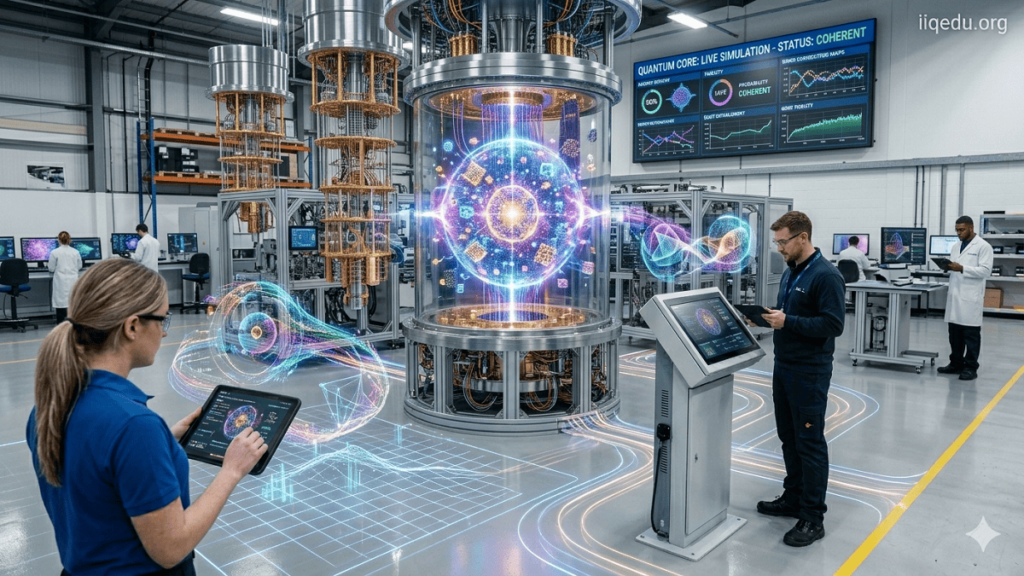
Case Study of Quantum Computing & Quality Frameworks
1. Cambridge Quantum Computing & Nippon Steel: Materials and Supply Chain Optimization
In a collaboration between Cambridge Quantum Computing (CQC) and Nippon Steel Corporation, quantum computing was applied to address complex challenges in steel manufacturing. The initiative focused on three core areas:
- Materials discovery: Quantum algorithms such as the Variational Quantum Eigensolver (VQE) were used to simulate electronic structures of novel steel alloy compositions that are computationally intensive for classical methods.
- Supply chain optimization: The team implemented quantum approximate optimization algorithms (QAOA) within a hybrid classical‑quantum framework to optimize distribution and production constraints across the supply network.
- Quality control: Quantum machine learning techniques were explored for detecting defect patterns in large sensor datasets from production lines.
Results:
- Materials prediction accuracy improved by 15–20% compared to classical computational chemistry methods, with a ~40% reduction in computation time for certain simulations.
- Supply chain solutions delivered 8–12% logistics cost savings, representing significant annual financial benefits.
- Machine learning models improved defect prediction accuracy by ~25%, contributing to reduced waste and improved product quality.
This case exemplifies how quantum computing workflows are engineered as hybrid systems (quantum + classical) and deployed in industrial environments to generate measurable business outcomes even with current quantum hardware limitations.
Reference: Cambridge Quantum Computing & Nippon Steel case study, OpenQase.
Link: https://www.openqase.com/case-study/cambridge-quantum-computing-nippon-steel-materials-science
2. Hybrid Quantum Computing Pipeline for Real‑World Drug Discovery
Scientific Reports published a case study on a hybrid quantum‑classical pipeline for tackling drug discovery problems, specifically computing reaction barriers and molecular dynamics—tasks that are extremely demanding for classical computation alone.
- The pipeline uses quantum computing to handle the storage and manipulation of molecular wave functions.
- Classical computing handles solvation energy and force calculations.
- The hybrid system enables complex simulations such as Gibbs free energy profiling for prodrug activation.
Impact:
- Demonstrated the feasibility of near‑term quantum computing contributions to drug design workflows.
- Provided a modular architecture that can be adapted to diverse molecular problems.
This example highlights how quantum computing is being integrated into industry‑relevant scientific workflows well before fully scalable quantum hardware becomes available.
Reference: A hybrid quantum computing pipeline for real world drug discovery, Scientific Reports.
Quality Frameworks: Case Studies
1. ISO 9001 Implementation at Welspun Corp. Ltd
Welspun Corp., a major Indian steel pipe manufacturer, implemented an ISO 9001 Quality Management System (QMS) to standardize and strengthen quality practices across global facilities.
Key outcomes included:
- Establishing a consistent quality system supporting operations in India, Saudi Arabia, and the USA.
- Improving product acceptance rates from international customers by meeting global quality standards.
- Strengthening integration of quality processes with other standards such as API Specification Q1 and ISO/IEC 17025 for testing.
ISO 9001 provided a structured framework for documenting processes, training staff, and embedding risk‑based thinking into quality practices, enabling the company to grow its global market presence.
Reference: Welspun Corp. Ltd case study — ISO 9001 Benefits, 9001 Council.
Link: https://www.9001council.org/iso-9001-benefits-case-studies.php
2. Lean Six Sigma Integrated with ISO 9001 at a Textile Mill
A research case study documented the integration of Lean Six Sigma practices with an ISO 9001‑based QMS in a textile manufacturing environment. The initiative focused on:
- Applying Lean Six Sigma tools (DMAIC methodology) to reduce defects and operational inefficiencies.
- Embedding these tools within a QMS framework compliant with ISO 9001 standards to ensure structured quality governance and sustained improvement.
Results:
- The integration delivered annual cost savings of approximately INR 2 million by reducing waste and improving process consistency.
- A combined framework helped institutionalize continuous improvement culture rather than sporadic project‑based interventions.
This demonstrates how quality frameworks can be coupled with operational improvement methodologies to realize sustained performance improvements.
Reference: Implementation of Lean Six Sigma through ISO 9001:2008 in a textile mill.
3. Case Study of QMS (ISO 9001:2015) in a Coachwork Manufacturing Company
This case documents how a coachwork manufacturing firm used the ISO 9001:2015 quality management model to standardize processes and improve product quality:
- Established process documentation and controls to standardize body manufacturing activities.
- Used PDCA (Plan‑Do‑Check‑Act) cycles to drive continuous improvement.
- Applied quality metrics to identify process weaknesses and implement corrective actions.
The QMS helped the company align operations with customer and regulatory requirements, enhancing both production consistency and competitive positioning in international markets.
Reference: Quality Management System based on ISO 9001:2015 — case study, ResearchGate.
Comparative Insights: Quantum Computing vs. Quality Frameworks
| Aspect | Quantum Computing Case Studies | Quality Framework Case Studies |
|---|---|---|
| Primary Focus | Solving complex computational challenges (materials simulation, optimization) using hybrid quantum classical systems | Improving process consistency, defect reduction, customer satisfaction, organizational efficiency |
| Typical Domains | Scientific R&D, pharmaceuticals, industrial optimization | Manufacturing, engineering, services, global supply |
| Outcome Measurement | Computational performance improvements, predictive accuracy enhancements | Quality improvements, cost savings, certification achievement |
| Implementation Approach | Hybrid algorithm design, benchmarking against classical systems | Standard compliance, continuous improvement cycles (e.g., PDCA, DMAIC) |
Conclusion
- Quantum computing case studies show that while quantum systems are still emerging, hybrid architectures can deliver measurable advantages in simulation accuracy, optimization, and predictive analytics in industrial contexts.
- Quality framework case studies demonstrate how structured quality systems such as ISO 9001 and Lean Six Sigma drive measurable operational improvements, defect reduction, and compliance across diverse industries.
These case studies reflect how both domains—one deeply technological and the other rooted in structured management practice—contribute unique value when applied to real‑world business and research challenges.
#Quantum Computing & Quality Frameworks in Ahemdabad
White Paper of Quantum Computing & Quality Frameworks
Executive Summary
Quantum computing represents a paradigm shift in computational capability, offering exponential improvements for specific classes of problems that are intractable for classical computing. Quality frameworks, on the other hand, are structured methodologies organizations employ to achieve consistent, reliable, and continuously improving outcomes. This white paper explores how quantum computing is emerging as a transformative technology and how quality frameworks can be applied to ensure its reliable, auditable, and disciplined adoption within enterprises.
1. Introduction
1.1. Purpose
The purpose of this white paper is to explain the roles, synergies, and implementation strategies of quantum computing and quality frameworks within modern enterprise environments. It targets technology leaders, quality assurance professionals, and strategic decision-makers.
1.2. Scope
- Core concepts of quantum computing
- Overview of quality frameworks
- Integration and governance models
- Case studies and implementation pathways
- Challenges and future directions
2. Quantum Computing
2.1. Definition
Quantum computing is a computational paradigm based on quantum mechanics principles such as superposition, entanglement, and quantum interference. These characteristics enable quantum processors to perform calculations in ways fundamentally different from classical processors.
2.2. Quantum Bits (Qubits)
Unlike classical bits that are either 0 or 1, qubits can exist in a combination of states simultaneously. This enables quantum parallelism, wherein large solution spaces can be explored simultaneously.
2.3. Computational Models
- Gate-based quantum computing (universal quantum computers)
- Quantum annealing (optimization-focused)
- Hybrid quantum-classical models
For industry use cases, hybrid pipelines are currently the most feasible given quantum hardware limitations.
2.4. Maturity and NISQ Era
Quantum computers remain in the Noisy Intermediate-Scale Quantum (NISQ) era, where error rates and qubit decoherence impose constraints on practical deployment. Hybrid models and error mitigation techniques are used to bridge this gap.
Reference: IBM Quantum Computing Overview
https://www.ibm.com/quantum-computing/what-is-quantum-computing/
3. Quality Frameworks
3.1. Definition
Quality frameworks are structured methodologies designed to ensure processes, products, and outcomes meet defined quality objectives, regulatory requirements, and stakeholder expectations.
3.2. Common Frameworks
| Framework | Focus |
|---|---|
| ISO 9001 | Quality management systems |
| Six Sigma | Defect reduction via data-driven methods |
| Lean | Waste elimination and process efficiency |
| CMMI | Software and process maturity |
3.3. Core Components
- Process Standardization
- Metrics and KPIs
- Continuous Improvement Cycles
- Compliance and Audit Mechanisms
- Risk Management
3.4. Value Proposition
Quality frameworks reduce defects, improve operational efficiency, support compliance, and increase customer satisfaction.
Reference: ISO 9001 Overview
https://www.iso.org/iso-9001-quality-management.html
4. Where Quantum Computing and Quality Frameworks Intersect
Quantum computing holds potential in areas like optimization, simulation, cryptography, and machine learning. However, adopting such disruptive technologies requires structured governance and quality assurance:
4.1. Governance and Validation
Quality frameworks define how quantum solutions should be validated, tested, and deployed to ensure reliable outcomes, especially in regulated industries.
4.2. Testing and Verification
Quantum outputs must be subjected to rigorous quality checks, reproducibility tests, and benchmark comparisons against classical baselines.
4.3. Compliance and Audit Trails
Frameworks such as ISO 9001 can be extended to quantum computing projects to ensure documentation, traceability, and accountability.
4.4. Continuous Improvement
A disciplined mechanism ensures performance monitoring, error diagnostics, and iterative enhancements to hybrid quantum workflows.
5. Implementation Strategy
5.1. Assessment and Use Case Identification
- Evaluate problem domains where quantum advantage is probable (e.g., optimization, material simulation)
- Quantify performance gaps between classical and quantum models
5.2. Quality Framework Alignment
- Integrate quality management plans (e.g., ISO 9001, CMMI) into quantum project governance
- Define quantum-specific metrics such as fidelity rates, error probabilities, and hybrid workflow performance
5.3. Hybrid Deployment Model
Many organizations adopt cloud-based quantum services to balance performance and practicality:
- IBM Quantum
- Microsoft Azure Quantum
- Google Quantum AI
5.4. Testing and Validation Processes
- Cross-validation of quantum and classical results
- Establish benchmarking standards
- Implement version control and reproducibility records
6. Challenges
6.1. Technological Constraints
Quantum hardware faces:
- High decoherence rates
- Limited qubit counts
- Error-prone computations
6.2. Skills and Talent Gap
Quantum computing expertise is scarce; integrating quality frameworks adds further training requirements.
6.3. Standards and Regulation
Global standards for quantum computing processes, validation, and quality compliance are still evolving.
7. Case Studies
7.1. Industrial Materials Optimization
Cambridge Quantum Computing collaborated with Nippon Steel to improve alloy simulation and supply chain optimization using hybrid quantum computing methods.
7.2. Pharmaceutical Simulations
Hybrid quantum-classical drug discovery pipelines reduced simulation time and increased prediction accuracy for reaction pathways.
7.3. ISO 9001 Deployment
Global manufacturers (e.g., Welspun Corp.) achieved consistent product quality and compliance across international operations.
https://www.9001council.org/iso-9001-benefits-case-studies.php?utm_source=chatgpt.com
8. Future Directions
8.1. Standardization Initiatives
Professional bodies are expected to publish quantum testing and quality standards over the next decade.
8.2. Embedded Quality for Quantum Workflows
Industry adopters will create quality templates specific to quantum algorithm design, verification, and operational integration.
8.3. Hybrid Optimization Engines
Quantum solutions will be embedded in enterprise applications for real-time optimization, validated through continuous quality metrics.
9. Conclusions
Quantum computing represents a transformative shift in computational capability with concrete value in specific use cases. However, to use it safely, reliably, and effectively at scale, organizations must complement quantum technologies with robust quality frameworks that enforce governance, validation, auditability, and continuous improvement.
This white paper positions quantum computing not only as a technological opportunity but as a discipline requiring structured quality assurance similar to traditional software and systems engineering.
References & External Links
- IBM — What is Quantum Computing?
https://www.ibm.com/quantum-computing/what-is-quantum-computing/ - Microsoft Azure Quantum Overview
https://learn.microsoft.com/en-us/azure/quantum/overview-what-is-quantum-computing - ISO 9001 — Quality Management Systems
https://www.iso.org/iso-9001-quality-management.html - OpenQase – CQC & Nippon Steel Case Study
https://www.openqase.com/case-study/cambridge-quantum-computing-nippon-steel-materials-science - Scientific Reports — Hybrid Quantum Computing Pipeline
https://www.nature.com/articles/s41598-024-67897-8 - ISO Council — ISO 9001 Case Studies
https://www.9001council.org/iso-9001-benefits-case-studies.php
#Quantum Computing & Quality Frameworks in Hyderabad
Industry Application of Quantum Computing & Quality Frameworks
Quantum computing is being explored and applied across multiple industries where complex computations, optimization, and large-scale simulations are required. Key applications include:
1. Pharmaceuticals and Healthcare
- Drug Discovery: Quantum computers simulate molecular interactions and protein folding far faster than classical computers, reducing time-to-market for new drugs.
- Personalized Medicine: Quantum algorithms help analyze complex genetic and biochemical datasets to tailor treatments for individual patients.
- Medical Imaging and Diagnostics: Optimizing image reconstruction and predictive models for better diagnosis.
Example: Hybrid quantum-classical pipelines have been used to simulate reaction pathways in drug molecules, improving predictive accuracy while reducing computation time.
References:
2. Finance and Banking
- Portfolio Optimization: Quantum computing solves complex multi-asset allocation problems more efficiently than classical methods.
- Risk Analysis: Quantum algorithms enable faster Monte Carlo simulations for market risk modeling.
- Fraud Detection: Large datasets can be analyzed with quantum-enhanced machine learning models to detect anomalies.
Example: Financial institutions like JPMorgan Chase are experimenting with quantum optimization for derivatives pricing and portfolio risk assessment.
Reference: IBM Quantum Finance Applications
3. Logistics and Supply Chain
- Route Optimization: Quantum algorithms solve the traveling salesman problem and vehicle routing problems for large fleets.
- Inventory Management: Predictive optimization of stock levels reduces storage costs and stockouts.
- Dynamic Scheduling: Real-time optimization of production schedules and shipment timing.
Example: Nippon Steel used quantum algorithms to optimize supply chain and material distribution.
Reference: OpenQase Case Study – Nippon Steel
4. Materials Science and Energy
- New Material Design: Quantum simulations help design superconductors, catalysts, and high-efficiency batteries.
- Energy Grid Optimization: Quantum computing can optimize energy distribution and load balancing in smart grids.
- Chemical Process Simulation: Reduces the need for expensive physical experiments by simulating reactions in silico.
Example: Companies use quantum computing to design high-capacity lithium-ion batteries with improved energy density.
5. Cybersecurity
- Quantum-Safe Cryptography: Development of encryption methods resistant to quantum attacks.
- Cryptanalysis: Testing existing cryptographic systems against quantum algorithms to identify vulnerabilities.
Example: Governments and defense organizations are investing in quantum-safe cryptography frameworks to protect sensitive communications.
Industry Applications of Quality Frameworks
Quality frameworks are applied across virtually all sectors to ensure compliance, efficiency, and consistent performance. Major applications include:
1. Manufacturing
- Process Standardization: ISO 9001 ensures consistent production processes.
- Defect Reduction: Six Sigma methodologies identify and eliminate sources of variation.
- Lean Manufacturing: Eliminates waste to improve efficiency and cost-effectiveness.
Example: Automotive and aerospace manufacturers use integrated QMS frameworks to comply with international standards while maintaining high product reliability.
Reference: ISO 9001 Case Studies
2. Healthcare
- Patient Safety: ISO 13485 and Lean Six Sigma frameworks are used to reduce errors in hospitals and medical device manufacturing.
- Regulatory Compliance: Ensures adherence to FDA, EMA, and other global healthcare standards.
- Process Efficiency: Improves hospital workflow and reduces wait times.
3. Information Technology & Software
- CMMI for Software: Ensures mature processes, quality assurance, and predictable delivery.
- ITIL for IT Services: Frameworks for managing IT operations and service quality.
- Agile Quality Integration: Embeds quality checkpoints into software development life cycles.
Example: Microsoft and other cloud providers integrate quality frameworks into their software development and deployment pipelines to reduce defects and enhance user experience.
4. Construction & Infrastructure
- Safety Compliance: ISO standards ensure safety protocols are followed.
- Project Efficiency: Lean principles minimize delays and waste in construction projects.
- Process Quality: Quality frameworks standardize procedures across multi-stakeholder projects.
5. Finance & Banking
- Operational Efficiency: Six Sigma identifies bottlenecks and reduces processing errors.
- Regulatory Compliance: Ensures adherence to global banking regulations (Basel III, SOX).
- Customer Satisfaction: Quality frameworks monitor service levels and complaint resolution.
Integration of Quantum Computing with Quality Frameworks
- Validation & Testing: Quantum algorithms require rigorous testing and reproducibility, which is supported by quality frameworks.
- Governance: ISO 9001-style documentation can be applied to quantum R&D labs to track processes, errors, and improvements.
- Hybrid Operational Models: Enterprises applying quantum computing for supply chain optimization or drug discovery integrate Lean and Six Sigma principles to ensure process reliability.
Example: Pharmaceutical companies using quantum computing for molecular simulations simultaneously apply quality management standards to maintain compliance and ensure auditability.
Conclusion
- Quantum computing is applied in industries requiring high computational power, optimization, and simulation capabilities.
- Quality frameworks ensure consistent outcomes, compliance, and continuous improvement across industries.
- Integration of both enables organizations to adopt cutting-edge technology without compromising process reliability, governance, or regulatory compliance.
References & External Links
- IBM Quantum — Industry Applications: https://www.ibm.com/quantum-computing/industries/
- OpenQase Case Study – Nippon Steel: https://www.openqase.com/case-study/cambridge-quantum-computing-nippon-steel-materials-science
- Nature — Hybrid Quantum Pipeline for Drug Discovery: https://www.nature.com/articles/s41598-024-67897-8
- ISO 9001 Case Studies: https://www.9001council.org/iso-9001-benefits-case-studies.php
#Quantum Computing & Quality Frameworks in Mumbai
Ask FAQs
What is Quantum Computing?
Quantum computing is a computational paradigm that leverages the principles of quantum mechanics, including superposition, entanglement, and quantum interference, to perform calculations. Unlike classical computers that use bits (0 or 1), quantum computers use qubits, which can exist in multiple states simultaneously, enabling them to solve certain complex problems much faster than classical systems.
Reference: IBM Quantum Computing Overview
What are Quality Frameworks and why are they important?
Quality frameworks are structured methodologies, such as ISO 9001, Six Sigma, Lean, and CMMI, that organizations use to ensure consistency, reliability, compliance, and continuous improvement in their processes, products, or services. They help reduce defects, improve operational efficiency, meet regulatory standards, and enhance customer satisfaction.
Reference: ISO 9001 Quality Management
Which industries benefit the most from Quantum Computing?
Industries that handle complex computations, simulations, or optimization problems benefit the most from quantum computing. Key sectors include:
Pharmaceuticals & Healthcare: Drug discovery, personalized medicine
Finance & Banking: Portfolio optimization, risk modeling, fraud detection
Logistics & Supply Chain: Route optimization, inventory management
Materials Science & Energy: New material and battery design
Cybersecurity: Quantum-safe encryption and cryptanalysis
Reference: IBM Quantum Industry Applications
How are Quality Frameworks applied in industries?
Quality frameworks are applied across multiple sectors to ensure process reliability, compliance, and efficiency. Examples include:
Manufacturing: ISO 9001 ensures standardization and defect reduction
Healthcare: ISO 13485 and Lean Six Sigma improve patient safety and operational efficiency
Software & IT Services: CMMI and ITIL enforce process maturity and service quality
Construction & Infrastructure: Lean and ISO frameworks maintain safety, reduce waste, and standardize procedures
Finance & Banking: Six Sigma improves operational accuracy and regulatory compliance
Reference: ISO 9001 Case Studies
How do Quantum Computing and Quality Frameworks work together?
While quantum computing focuses on solving high-complexity problems, quality frameworks ensure these solutions are reliable, auditable, and compliant. Integration occurs in areas such as:
Algorithm validation and reproducibility
Process governance in quantum labs
Benchmarking quantum outputs against classical systems
Regulatory compliance in industries like pharmaceuticals or finance
This combination ensures that cutting-edge technology can be adopted without compromising process reliability or quality standards.
Reference: OpenQase – Quantum & Industrial Applications
Source: TED
Table of Contents
Disclaimer:
The information provided in this document is for educational and informational purposes only. While every effort has been made to ensure accuracy, the content may not reflect the most current developments in quantum computing or quality frameworks. The author and publisher disclaim any liability for errors, omissions, or any actions taken based on this information. Readers should consult qualified professionals or authoritative sources before making business or technical decisions.