Synthetic Data for QA Environments
Overview
Synthetic data refers to artificially generated data that mimics the statistical properties, structure, and patterns of real production data without containing any actual sensitive information. In Quality Assurance (QA) environments, Synthetic Data for QA is increasingly used to test applications, validate workflows, and simulate complex scenarios while mitigating the risks associated with using real customer or operational data.
Importance in QA
QA teams often require large volumes of representative data to perform functional, performance, and regression testing. Using real production data can expose sensitive information, violate privacy regulations (such as GDPR or HIPAA), or introduce compliance risks. Synthetic Data for QA solves these problems by providing privacy-compliant, risk-free test datasets that are realistic enough to uncover defects and validate system behavior.
Key Benefits
- Data Privacy and Compliance
Synthetic data eliminates the need to use real customer information in test environments, reducing the risk of data breaches and ensuring compliance with privacy regulations. - Scalability
Synthetic Data for QA datasets can be generated in any volume, enabling QA teams to simulate high-load scenarios, test boundary conditions, and validate system performance under stress without exhausting production resources. - Consistency and Reproducibility
Because Synthetic Data for QA can be generated on demand and controlled programmatically, test cases can be reproduced consistently, which is critical for regression testing and automated QA pipelines. - Cost and Time Efficiency
Generating Synthetic Data for QA reduces dependency on production data extraction, masking, or transformation processes. This accelerates the setup of test environments and enables faster iteration cycles.
Implementation Approaches
- Rule-Based Generation: Data is created based on predefined rules and patterns, such as generating names, addresses, or numeric ranges consistent with application requirements.
- AI/ML-Based Generation: Machine learning models analyze production data patterns to generate Synthetic Data for QA datasets that statistically resemble real-world data while remaining anonymized.
- Hybrid Methods: Combines rule-based and AI approaches for high fidelity, supporting both structured and unstructured data requirements.
Challenges
- Ensuring the Synthetic Data for QA accurately represents edge cases and rare events can be complex.
- Overly simplistic data generation may fail to expose defects that occur in real-world conditions.
- Integration with existing QA automation pipelines requires planning and tooling support.
Use Cases
- Regression and functional testing for enterprise applications.
- Performance and load testing for high-traffic systems.
- Testing AI/ML models with realistic but privacy-compliant data.
- Simulating cross-system workflows where real data access is limited.
Conclusion
Synthetic data in QA environments is a strategic enabler for secure, scalable, and high-quality software testing. By mitigating privacy risks, enabling reproducible test scenarios, and supporting automated pipelines, Synthetic Data for QA empowers organizations to accelerate delivery while maintaining compliance and reliability.
References:
- Gartner: Synthetic Data for Testing and AI
- IBM: Synthetic Data in QA
- Forbes: The Role of Synthetic Data in QA
#Synthetic Data for QA Environments in India
What is Synthetic Data for QA Environments?
Synthetic data for QA (Quality Assurance) environments refers to artificially generated data that replicates the structure, patterns, and statistical characteristics of real production data without exposing any sensitive or personally identifiable information (PII). Unlike real data, synthetic data is fully anonymized and privacy-compliant, making it safe to use in development, testing, and QA processes.
Purpose in QA Environments
QA teams require representative datasets to perform functional, performance, and regression testing effectively. Using real production data in test environments poses significant risks, including:
- Exposure of sensitive customer information
- Non-compliance with regulations like GDPR or HIPAA
- Operational constraints due to limited access to production data
Synthetic Data for QA addresses these challenges by providing realistic test data at scale, enabling teams to validate software behavior under different conditions, simulate rare or edge cases, and run automated test pipelines without risking data privacy or security.
Key Characteristics of Synthetic Data for QA
- Privacy-Compliant: Contains no real user or customer information.
- Customizable: Can be generated to match specific scenarios, formats, or volumes needed for testing.
- Scalable: Supports large datasets for performance or load testing.
- Reproducible: Ensures consistent test results across multiple QA cycles.
Common Use Cases in QA
- Functional and regression testing
- Load and performance testing for high-traffic systems
- Testing AI/ML models with realistic datasets
- Simulating multi-system workflows or edge cases
Benefits
- Reduces risk of data breaches and regulatory violations
- Accelerates test environment setup
- Provides flexible and scalable testing data
- Enhances test coverage and reliability
Conclusion
Synthetic data allows QA teams to test software thoroughly and safely without relying on sensitive production data. By simulating real-world conditions in a controlled, privacy-compliant way, it improves the efficiency, accuracy, and speed of QA processes.
References:
- IBM: Synthetic Data for Testing
- Gartner: Synthetic Data in QA
- Forbes: Synthetic Data Applications
#Synthetic Data for QA Environments in Singapore

Who is Synthetic Data for QA Environments required?
Synthetic data for QA environments is required by organizations and teams that need secure, scalable, and realistic data for testing without exposing sensitive or production information. It is particularly relevant for industries and scenarios where data privacy, regulatory compliance, or complex testing conditions are critical. The key groups that require Synthetic Data for QA include:
1. QA and Software Testing Teams
Quality Assurance teams need large volumes of realistic test data to perform functional, regression, and performance testing. Synthetic data allows them to simulate real-world scenarios, including edge cases and rare conditions, without depending on production data that may be sensitive or incomplete.
2. Organizations in Regulated Industries
Industries such as finance, healthcare, insurance, and government are subject to strict regulations like GDPR, HIPAA, or PCI-DSS. Using real customer or patient data in QA environments could lead to compliance violations or data breaches. Synthetic data ensures that testing is fully privacy-compliant while still representative of real workflows.
3. DevOps and Agile Teams
Teams practicing DevOps or Agile require automated testing integrated into CI/CD pipelines. Synthetic data provides consistent and reproducible datasets for automated unit tests, integration tests, and performance tests, enabling continuous validation without risking production data.
4. AI/ML Development Teams
Machine learning and AI model developers require large, varied datasets for training and testing. Using real data can expose sensitive information, but synthetic data allows developers to create statistically accurate datasets for model training, testing, and validation while maintaining privacy.
5. Enterprises Needing Scalable Testing Environments
Organizations building high-traffic systems, e-commerce platforms, or SaaS applications often need massive datasets to simulate load and stress conditions. Synthetic data can be scaled to any volume, enabling realistic performance and stress testing without constraints from limited production data.
Conclusion
Synthetic data for QA environments is required by any organization or team that prioritizes data privacy, regulatory compliance, early defect detection, and scalable testing. Its use is essential for QA teams, regulated industries, DevOps workflows, AI/ML development, and high-traffic software systems, allowing teams to perform comprehensive testing safely and efficiently.
References:
- IBM: Synthetic Data for Testing
- Gartner: Synthetic Data in QA
- Forbes: Synthetic Data Applications
#Synthetic Data for QA Environments in Pune
When is Synthetic Data for QA Environments required?
Synthetic data for QA environments is required whenever testing needs cannot safely or practically rely on real production data. Its usage is driven by privacy concerns, regulatory compliance, scalability, and the need for realistic, reproducible test datasets. The following scenarios illustrate when synthetic data becomes essential:
1. Early-Stage Development and Testing
During the design and development phases, QA teams often need representative datasets to validate functionality, simulate workflows, and ensure that features meet business requirements. Synthetic data allows testing from the earliest stages without waiting for production data to become available.
2. Privacy and Regulatory Compliance Requirements
Industries such as healthcare, finance, insurance, and government must comply with regulations like GDPR, HIPAA, and PCI-DSS. Using real production data in QA environments could lead to privacy violations or regulatory penalties. Synthetic data ensures testing is compliant and safe, making it required whenever sensitive information is involved.
3. High-Volume or Performance Testing
When performing load, stress, or performance testing, large datasets are required to simulate real-world conditions. Production data is often insufficient or unavailable in the required scale. Synthetic data enables QA teams to generate arbitrary volumes of realistic data to evaluate system performance under peak loads.
4. Automated Testing in DevOps and CI/CD Pipelines
In Agile and DevOps environments, automated unit, integration, and regression tests run continuously. Synthetic data is required to provide consistent and reproducible datasets for these automated tests, ensuring that QA processes are reliable without exposing sensitive production data.
5. Testing Edge Cases and Rare Scenarios
Some defects only appear under unusual conditions or rare data combinations. Real production datasets may not cover these scenarios. Synthetic data allows testers to create specific conditions and edge cases, ensuring comprehensive coverage and higher quality assurance.
6. AI/ML Model Testing and Validation
For AI and machine learning applications, synthetic data is required when training or validating models without exposing real-world sensitive data. It enables teams to generate statistically accurate datasets that mimic real-world patterns while remaining privacy-compliant.
Conclusion
Synthetic data for QA environments is required anytime safe, scalable, and realistic test data is needed. It is particularly critical in early development, regulated industries, performance testing, automated DevOps pipelines, edge-case testing, and AI/ML validation. Its use ensures privacy compliance, reproducibility, and comprehensive testing coverage while accelerating development cycles.
References:
- IBM: Synthetic Data for Testing
- Gartner: Synthetic Data in QA
- Forbes: Synthetic Data Applications
#Synthetic Data for QA Environments in Ahemdabad
Where is Synthetic Data for QA Environments required?
Synthetic data for QA environments is required across multiple locations within the software development lifecycle (SDLC) and organizational infrastructure where testing, validation, and simulation of real-world conditions are needed without using production data. Its use is especially critical in environments handling sensitive information or large-scale systems.
1. Development Environments
Synthetic data is required in development and staging environments where developers and QA engineers perform unit testing, integration testing, and early functional validation. It provides realistic datasets that simulate production scenarios without risking exposure of real customer or operational data.
2. Test and QA Environments
Dedicated QA and testing servers need synthetic data for regression testing, system testing, and automated test pipelines. Using synthetic datasets ensures reproducibility and consistency for testing while enabling coverage of edge cases, unusual conditions, and high-volume scenarios that production data may not provide.
3. Performance and Load Testing Environments
High-traffic applications, such as e-commerce platforms, SaaS applications, and banking systems, require synthetic data to simulate large-scale user activity and stress test servers. These environments need datasets large enough to measure performance, scalability, and resilience under peak conditions.
4. Continuous Integration / Continuous Delivery (CI/CD) Pipelines
Synthetic data is essential in CI/CD environments where automated testing occurs continuously. Each code commit triggers unit tests, integration tests, and regression tests. Synthetic datasets provide consistent, safe, and reproducible data for automated pipelines without depending on production databases.
5. AI/ML Testing and Training Environments
For machine learning and AI model development, synthetic data is required to train, validate, and test algorithms without exposing real-world sensitive data. This ensures compliance, reproducibility, and the ability to simulate rare or complex scenarios that may not exist in production data.
6. Compliance and Regulatory Testing Environments
Organizations in healthcare, finance, insurance, and government need synthetic data wherever QA teams must validate workflows, systems, or applications under regulatory constraints. This ensures privacy compliance while enabling thorough testing of functional, integration, and security aspects.
Conclusion
Synthetic data for QA environments is required anywhere testing, validation, or simulation occurs within development, QA, CI/CD, performance, AI/ML, or regulatory-focused environments. Its use allows teams to achieve realistic, scalable, and reproducible testing while maintaining privacy, compliance, and operational efficiency.
References:
- IBM: Synthetic Data for Testing
- Gartner: Synthetic Data in QA
- Forbes: Synthetic Data Applications
#Synthetic Data for QA Environments in Hyderabad
How is Synthetic Data for QA Environments required?
Synthetic data is required in QA environments by integrating data generation, automation, and privacy-compliant practices into the software development lifecycle (SDLC). Its requirement arises from the need to test software effectively without using sensitive production data, while ensuring scalability, reproducibility, and compliance. The “how” involves strategic planning, tooling, and process adjustments:
1. Generating Realistic Test Data
Synthetic data is required by creating datasets that mimic real production data in structure, patterns, and variability. This can be done using:
- Rule-based generation, which follows predefined rules or constraints for generating names, addresses, numeric values, and transaction data.
- AI/ML-based generation, which analyzes production data patterns (without copying sensitive information) to produce statistically accurate synthetic datasets.
- Hybrid approaches, combining rules and AI to produce high-fidelity data suitable for both structured and unstructured scenarios.
2. Integrating with QA and Development Pipelines
Synthetic data is required by embedding it directly into development, testing, and CI/CD pipelines:
- Developers use synthetic data in unit tests and integration tests during coding.
- QA teams leverage synthetic datasets for regression, system, and performance testing.
- Automated pipelines continuously validate software using reproducible synthetic data, ensuring defects are caught early.
3. Ensuring Privacy and Compliance
Synthetic data is required to replace sensitive production data in QA environments, particularly in regulated industries (healthcare, finance, insurance). By removing personally identifiable information (PII) while retaining realistic behavior, synthetic data ensures testing is fully compliant with GDPR, HIPAA, PCI-DSS, and other regulations.
4. Scaling for Performance and Edge-Case Testing
Synthetic data is required to simulate high-volume traffic, stress conditions, and rare scenarios. QA teams can generate datasets of any size to test system performance, resilience, and scalability, which would be impractical using production data due to size limitations or privacy constraints.
5. Supporting AI/ML Model Development
For AI and machine learning applications, synthetic data is required to train, validate, and test models while avoiding exposure of sensitive production data. It enables teams to simulate rare or complex patterns that real data may not capture.
Conclusion
Synthetic data is required in QA environments by providing privacy-safe, realistic, scalable, and reproducible datasets that integrate into development, testing, and automated pipelines. Its use ensures early defect detection, compliance with privacy regulations, performance validation, and improved software quality without risking sensitive production data.
References:
- IBM: Synthetic Data for Testing
- Gartner: Synthetic Data in QA
- Forbes: Synthetic Data Applications
#Synthetic Data for QA Environments in Banglore
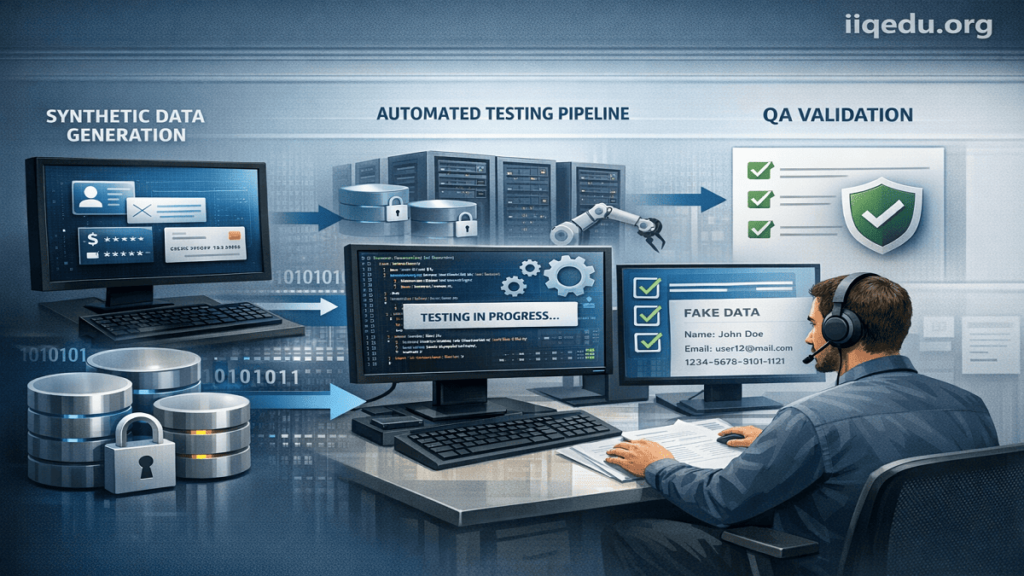
Case Study of Synthetic Data for QA Environments
A clear example of synthetic data use in QA environments comes from the education technology sector, where privacy and regulatory compliance are paramount. A school management platform that handled highly sensitive children’s data faced a critical challenge: development and testing teams could not use real student information such as home addresses, health records, and location data due to legal and ethical restrictions. Production data exposure could have resulted in significant GDPR violations and safety risks. To continue development without compromising security, the organization engaged a consultancy to implement synthetic data generation across its QA and test environments.
Prior to adopting synthetic data, testers struggled with limited test data, risking undetected defects and slowing development cycles because production data was off‑limits. The consultancy transformed the environment by replacing real data with fully synthetic datasets derived from artificial generation methods that preserved schema structure and data relationships without containing any actual personal information. This enabled testers to execute functional, integration, and performance tests on realistic yet safe data.
The result was a significant improvement in development velocity and QA effectiveness. By using synthetic data, the organization achieved zero compliance risk and avoided potential legal exposure tied to using real sensitive data. Teams could now run edge‑case scenarios, data‑intensive load tests, and automated regression tests—activities previously constrained by data availability and privacy concerns. Annual cycle tasks such as stakeholder demos and yearly rollovers were executed confidently with production‑like datasets that always maintained privacy protections.
In another real‑world application, a health and life insurer adopted synthetic data solutions to modernize its test data management across multiple systems. The company implemented dynamic synthetic data generation at runtime—injecting appropriate test datasets directly into microservices via APIs—so testers no longer needed to prepare or store persistent test data. This approach ensured that test data was context‑aware, compliant, and aligned with specific business logic and workflows, significantly streamlining test execution and reducing overhead.
The insurer’s shift to synthetic test data facilitated more comprehensive validation of functionalities across its platforms, especially for regulated processes involving sensitive financial and health data. By enabling more robust QA cycles without exposing confidential user records, the firm reduced compliance risk while maintaining high quality and stability across releases.
These case studies demonstrate that synthetic data is not only a privacy‑preserving alternative to production data but also a practical enabler for expansive and effective testing. It allows teams to overcome limitations associated with real data—such as restricted access, compliance barriers, and insufficient edge‑case coverage—thereby supporting more reliable and scalable QA environments.
#Synthetic Data for QA Environments in Chennai
White Paper of Synthetic Data for QA Environments
Executive Summary
Synthetic data has emerged as a foundational component in modern quality assurance (QA) practices. It refers to artificially generated datasets that imitate the structure and statistical attributes of real production data without containing any actual sensitive information. Synthetic data enables secure, scalable, and realistic testing across development, QA, and automation workflows, addressing the inherent limitations and risks of using real production data in test environments. This white paper outlines the concept, benefits, implementation strategies, challenges, and best practices for deploying synthetic data in QA environments.
Introduction
Quality Assurance (QA) teams face persistent obstacles when relying on real production data for software testing. Privacy restrictions, regulatory compliance requirements, lack of access to large volumes of representative data, and the need for comprehensive automated testing have prompted organizations to seek alternatives. Synthetic data is increasingly seen as a viable solution, allowing teams to simulate production‑like scenarios safely and efficiently. Synthetic data generation enables more extensive test coverage, supports privacy compliance, and accelerates QA processes.
What is Synthetic Data?
Synthetic data is artificially constructed information designed to resemble real data in structure, relationships, and variability but contains no real user information. It is produced through rule‑based methods, statistical models, or generative machine learning techniques that mimic the distribution of production datasets. This allows it to be used in testing scenarios without exposing sensitive customer or operational data.
Key Benefits
- Privacy and Compliance: Synthetic data eliminates the risk of exposing personally identifiable information (PII) in non‑prod environments, helping organizations comply with data protection regulations such as GDPR, HIPAA, and PCI‑DSS.
- Scalability: Test teams can generate large volumes of data to simulate real‑world loads for performance and stress testing, far beyond the constraints of sample production datasets.
- Reproducibility: Synthetic datasets can be created on demand or programmatically generated for automated test suites, ensuring identical conditions across test cycles.
- Enhanced Test Coverage: Teams can explicitly model edge cases, rare scenarios, and boundary conditions that may not exist in production data, helping uncover hidden defects.
Implementation Strategies
Organizations typically utilize a combination of methods to generate synthetic data:
- Rule‑Based Generation: Predefined business rules produce data that meets specific schema and format requirements.
- Statistical Modeling: Algorithms generate data samples that match the distributions and relationships of production data without copying real values.
- Generative AI Models: Machine learning techniques, including deep generative models, can create plausible synthetic datasets that reflect complex real‑world patterns.
Integration of synthetic data into QA workflows involves embedding data generation in automated test frameworks, ensuring that developers and testers have immediate access to relevant test datasets without manual provisioning.
Challenges and Considerations
While synthetic data offers many advantages, there are inherent limitations:
- Tooling and Expertise: Generation of high‑quality synthetic data requires specialized tools and expertise in data modeling and automation.
- Relevance and Fidelity: Poorly designed synthetic datasets may lack realistic anomalies or edge characteristics, potentially masking defects that only appear with complex real‑world data. Collaboration between data scientists and QA professionals is crucial to maintain quality.
- Test Suitability: Some testing types, particularly behavior‑driven analytics or real user behavior simulations, may require a mix of synthetic and sanitized real‑world data for optimal fidelity.
Best Practices
- Combine Synthetic and Masked Production Data: Use synthetic data for privacy‑preserving, scalable test scenarios and masked real production data when realistic behavior patterns are critical.
- Automate Data Generation: Integrate synthetic data generation into CI/CD pipelines to support continuous testing and early defect detection.
- Validate Data Quality: Establish validation metrics to ensure synthetic datasets accurately reflect intended use cases and test scenarios.
Conclusion
Synthetic data is a strategic enabler for modern QA environments, providing secure, scalable, and flexible test datasets that support extensive automated testing, comply with strict privacy regulations, and improve overall software reliability. When implemented alongside best practices and appropriate tooling, synthetic data enhances test coverage and accelerates development cycles, making it essential for organizations seeking high‑quality software delivery.
References:
- Guide to synthetic test data | TechTarget: https://www.techtarget.com/searchsoftwarequality/tip/Guide-to-synthetic-test-data
- Synthetic test data generation | DATPROF: https://www.datprof.com/solutions/synthetic-test-data-generation/
- Synthetic Test Data in Software Testing | VALA: https://www.valagroup.com/blog/synthetic-test-data-in-software-testing
#Synthetic Data for QA Environments in Kolkata
Industry Application of Synthetic Data for QA Environments
Synthetic data is increasingly adopted across industries to address challenges related to data privacy, regulatory compliance, testing scalability, and realistic scenario simulation. By replacing or supplementing production data with artificial datasets that replicate real-world patterns, organizations can perform effective QA testing without compromising sensitive information. Here’s how various industries are leveraging synthetic data in QA environments:
1. Financial Services
Banks, insurance companies, and fintech organizations handle highly sensitive financial data. QA teams in these sectors need realistic datasets to test transaction processing, fraud detection, and reporting workflows. Synthetic data enables:
- Regulatory compliance with GDPR, PCI-DSS, and other financial data protection laws
- Simulating rare fraud scenarios without exposing real customer accounts
- High-volume testing for performance and stress analysis of core banking systems
Example: A global bank uses synthetic transaction data to validate fraud detection algorithms while maintaining customer privacy.
2. Healthcare and Life Sciences
Healthcare applications must comply with HIPAA and other patient privacy regulations. Synthetic data allows QA teams to:
- Conduct functional testing on EHR (Electronic Health Records) and telemedicine platforms
- Simulate rare medical conditions or treatment scenarios
- Perform load and integration testing on healthcare management systems without risking patient data exposure
Example: Hospitals and healthtech companies use synthetic patient records to test software updates and new modules without using real patient data.
3. Automotive and Aerospace
These industries rely heavily on embedded systems and connected devices, where failure can be critical. QA teams require datasets that mimic sensor outputs, vehicle telemetry, and operational signals. Synthetic data supports:
- Early defect detection in control systems and safety-critical modules
- Simulation of extreme driving conditions or rare aerospace scenarios
- Integration testing of multiple interconnected subsystems
Example: Automotive manufacturers generate synthetic telemetry data to test autonomous driving software under extreme road and weather conditions.
4. E-Commerce and Retail
Retailers and e-commerce platforms require massive datasets to simulate customer behavior, inventory flows, and transactions. Synthetic data helps:
- Load and stress test online stores during peak traffic events
- Validate personalization engines and recommendation systems
- Ensure QA can cover edge cases like rare product combinations or purchase patterns
Example: An e-commerce giant uses synthetic user profiles and purchase histories to test recommendation algorithms without storing or exposing real user data.
5. Software-as-a-Service (SaaS) and Technology
SaaS providers require continuous integration and delivery (CI/CD), with automated testing pipelines running multiple scenarios daily. Synthetic data enables:
- Reproducible automated regression and integration testing
- Simulated multi-tenant environments without compromising client data
- Testing complex workflows and large datasets efficiently
Example: A SaaS CRM platform generates synthetic client accounts and interaction histories for testing new features before deploying to production.
Key Takeaways
- Synthetic data is vital in regulated, high-risk, and high-volume industries.
- It allows secure, scalable, and realistic testing without exposing sensitive information.
- Across industries, synthetic data improves QA efficiency, early defect detection, and compliance.
References:
- IBM: Synthetic Data in QA
- Datprof: Synthetic Test Data Generation
- Gartner: Synthetic Data in Testing
#Synthetic Data for QA Environments in Mumbai
Ask FAQs
What is Synthetic Data in QA Environments?
Synthetic data is artificially generated data that mimics the statistical patterns, structure, and relationships of real production data but contains no real sensitive information. In QA environments, it is used to test software functionality, performance, and edge cases without risking privacy or regulatory violations.
Why is Synthetic Data Required for QA Testing?
Synthetic data is required to ensure privacy, regulatory compliance, and safe testing. Real production data often contains sensitive information that cannot be exposed in non-production environments. Synthetic datasets allow QA teams to test realistic scenarios, run automated pipelines, and simulate rare edge cases safely.
Who Uses Synthetic Data in QA Environments?
Synthetic data is primarily used by QA teams, developers, DevOps engineers, and AI/ML teams. Industries such as finance, healthcare, insurance, e-commerce, and SaaS platforms rely on synthetic data for secure and scalable testing, early defect detection, and automated workflow validation.
How is Synthetic Data Generated for QA?
Synthetic data can be generated using:
Rule-based methods: Predefined rules create data that meets schema requirements.
Statistical modeling: Data is generated to match distributions and relationships of real datasets.
AI/ML approaches: Generative models create realistic data patterns while ensuring privacy.
This data can be directly integrated into test environments or automated pipelines for reproducible testing.
What Are the Benefits of Using Synthetic Data in QA?
The benefits include:
Privacy compliance: Eliminates exposure of sensitive or personally identifiable information (PII).
Scalability: Generates large volumes of data for performance and load testing.
Reproducibility: Ensures consistent results across multiple test cycles.
Enhanced coverage: Supports edge cases and rare scenarios often missing in production data.
Efficiency: Accelerates QA cycles and reduces dependency on production data access.
Source: IBM Technology
Table of Contents
Disclaimer:
The information provided here on synthetic data for QA environments is for educational and informational purposes only. While efforts have been made to ensure accuracy, the content may not reflect the latest industry standards or specific organizational practices. Users should independently verify details and consult experts before implementing synthetic data solutions. The authors and sources are not responsible for any outcomes, damages, or losses resulting from the use of this material.