Adaptive Control Systems
Adaptive Control Systems are advanced control systems that automatically adjust their parameters in real time to maintain optimal performance in dynamic or uncertain environments. Unlike traditional control systems, which operate based on fixed rules, adaptive systems can learn from changes in the process or environment and modify their behavior accordingly.
Purpose
- Maintain stable and efficient operations despite changing process conditions
- Compensate for uncertainties, disturbances, or system variations
- Optimize performance in real time
- Reduce human intervention in process control
Key Features
- Self-Tuning: Automatically adjusts control parameters to optimize system performance.
- Learning Capability: Uses feedback and historical data to improve control strategies over time.
- Disturbance Rejection: Responds effectively to external disturbances or changes in system dynamics.
- Real-Time Adaptation: Continuously monitors process variables and adapts control actions accordingly.
Applications Across Industries
- Manufacturing: Optimizing machine performance and minimizing defects in dynamic production lines.
- Automotive: Adaptive cruise control, engine control, and suspension systems.
- Aerospace: Flight control systems that adjust for changing aerodynamics and environmental conditions.
- Robotics: Robot manipulators and autonomous systems that adjust to varying payloads or environments.
- Energy Systems: Power plants and smart grids adjusting to changing loads or renewable energy inputs.
Benefits
- Improved process stability and efficiency
- Reduced energy consumption and waste
- Enhanced product quality and reliability
- Minimized manual tuning and human error
- Greater adaptability to complex or changing environments
Example Scenario
In an automotive engine system, an adaptive control system continuously adjusts fuel injection and air intake based on engine load, temperature, and driving conditions. This ensures optimal performance, lower emissions, and fuel efficiency, even as conditions vary.
In simple terms:
Adaptive Control Systems learn and adjust in real time, keeping processes stable and efficient even when conditions change.
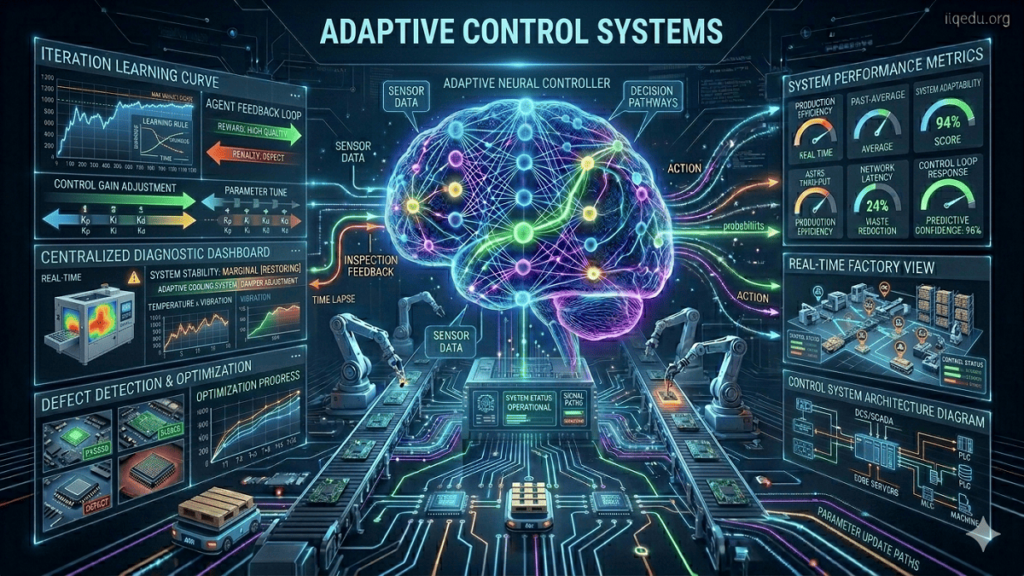
What is Adaptive Control Systems?
Adaptive Control Systems are advanced control systems that automatically adjust their behavior or parameters in real time to maintain optimal performance in changing or uncertain environments. Unlike traditional fixed-parameter controllers, adaptive systems learn from feedback and continuously adapt to variations in the process, disturbances, or operating conditions.
Key Features
- Self-Tuning: Automatically modifies control parameters to optimize system performance.
- Learning from Feedback: Uses data from the system to improve responses over time.
- Disturbance Handling: Reacts to unexpected changes or fluctuations in the environment.
- Real-Time Adaptation: Continuously monitors and adjusts system behavior for stability and efficiency.
Example
In automotive engine control, an adaptive control system adjusts fuel injection, air intake, and ignition timing in real time based on engine load, temperature, and driving conditions. This ensures optimal performance, fuel efficiency, and lower emissions even as conditions change.
In simple terms:
Adaptive Control Systems learn and adjust automatically, keeping processes or systems stable, efficient, and respon
Who are required Adaptive Control Systems?
Adaptive Control Systems (ACS) are required by organizations, engineers, and industries that operate complex processes or systems where conditions can change dynamically and precise control is critical. These systems are essential wherever traditional fixed-parameter control cannot maintain optimal performance.
Who Requires Adaptive Control Systems
- Manufacturing Engineers and Plant Operators
- To optimize machinery, minimize defects, and maintain consistent production quality in dynamic production lines.
- Automotive Industry Professionals
- For engine control, adaptive cruise control, and suspension systems that adjust to varying driving conditions.
- Aerospace and Aviation Engineers
- For flight control systems that adapt to changing aerodynamics, wind conditions, and payloads.
- Robotics and Automation Specialists
- For robots and autonomous systems that must adjust to varying loads, environments, or tasks.
- Energy System Operators
- In power plants or smart grids to adapt to fluctuating energy demands and renewable energy inputs.
In simple terms:
Adaptive Control Systems are required by any professional or organization managing processes or systems that must remain efficient, stable, and precise under changing conditions.
When are required Adaptive Control Systems?
Adaptive Control Systems (ACS) are required when processes, systems, or environments are dynamic, uncertain, or changing, and traditional fixed-parameter control cannot maintain optimal performance.
When Adaptive Control Systems Are Required
- Changing Process Conditions
- When system parameters like temperature, pressure, or load vary over time, ACS adjusts automatically to maintain stability.
- High-Precision Requirements
- When precise control is critical, such as in robotics, aerospace, or high-tech manufacturing.
- Dynamic or Complex Environments
- For systems exposed to unpredictable disturbances, like autonomous vehicles or power grids.
- Efficiency and Optimization Needs
- When minimizing waste, energy consumption, or operational costs is essential.
- Safety-Critical Operations
- In aerospace, automotive, or industrial automation, where failures can lead to hazards.
In simple terms:
Adaptive Control Systems are required whenever conditions change frequently or unpredictably, and maintaining optimal performance, safety, and efficiency is critical.
Where are required Adaptive Control Systems?
Adaptive Control Systems (ACS) are required in industries and environments where processes or systems experience changing conditions and require precise, real-time adjustments to maintain optimal performance.
Where Adaptive Control Systems Are Required
- Manufacturing Plants
- To optimize machine performance, maintain product quality, and adjust to variations in production processes.
- Automotive Industry
- Engine control, adaptive cruise control, and suspension systems that adjust to driving conditions.
- Aerospace and Aviation
- Flight control systems that adapt to changing aerodynamics, wind, and payload conditions.
- Robotics & Automation
- Industrial robots, autonomous vehicles, and manipulators that adjust to varying loads or environments.
- Energy & Utilities
- Power plants and smart grids that respond to fluctuating loads, renewable energy inputs, or changing demand.
- Process Industries
- Chemical, pharmaceutical, or food processing plants where temperature, pressure, or flow rates vary dynamically.
In simple terms:
Adaptive Control Systems are required wherever dynamic conditions or uncertainties exist, and systems need to continuously adjust to maintain efficiency, stability, and safety.
How are required Adaptive Control Systems?
Adaptive Control Systems (ACS) are required by implementing integrated control mechanisms that can automatically monitor, analyze, and adjust system parameters in real time. They are designed to respond to changing conditions, disturbances, or uncertainties in a process to maintain optimal performance.
How Adaptive Control Systems Are Implemented
- Real-Time Monitoring
- Sensors continuously measure key variables such as temperature, pressure, speed, or load.
- Data Analysis & Feedback
- Control algorithms analyze sensor data and compare it to desired performance targets.
- Automatic Parameter Adjustment
- The system adjusts control parameters (like valve positions, motor speed, or fuel injection) automatically based on feedback.
- Learning & Adaptation
- Some ACS use advanced algorithms, including AI or machine learning, to improve performance over time by learning from historical data and disturbances.
- Integration with Process Systems
- ACS is connected to production, robotic, or vehicle systems to implement real-time adjustments efficiently.
In simple terms:
Adaptive Control Systems are required by setting up a system that continuously monitors conditions, analyzes performance, and automatically adjusts parameters to maintain stability, efficiency, and safety in dynamic environments.
Case study of Adaptive Control Systems
1. Background
A leading automotive manufacturer was facing challenges with fuel efficiency, emission compliance, and performance consistency in their engines due to varying driving conditions, load, and environmental factors. Traditional fixed-parameter engine control systems could not optimize performance across all scenarios.
The company implemented an Adaptive Control System to continuously monitor and adjust engine parameters in real time.
2. Problem
- Variations in engine load, temperature, and driving conditions led to inconsistent performance.
- Fuel consumption was higher than optimal during dynamic driving scenarios.
- Emission levels occasionally exceeded regulatory limits.
- Manual tuning and fixed-parameter controls could not adapt to real-time changes efficiently.
3. Solution: Implementing Adaptive Control Systems
Step 1: Sensors & Data Collection
- Installed sensors to measure engine speed, temperature, air intake, exhaust composition, and load.
Step 2: Adaptive Controller Integration
- Deployed an adaptive engine control module that adjusts fuel injection, ignition timing, and air intake in real time.
Step 3: Real-Time Feedback & Learning
- The ACS continuously analyzes sensor data and adapts parameters based on driving conditions and engine behavior.
- Machine learning algorithms help the system learn over time for improved performance.
Step 4: Testing & Optimization
- Engineers tested the system under various driving conditions, ensuring optimal fuel efficiency, reduced emissions, and consistent power delivery.
4. Results
- Fuel efficiency improved by 12–15% across diverse driving conditions.
- Emissions reduced to consistently meet regulatory standards.
- Engine performance remained stable under varying loads and environmental conditions.
- Reduced manual calibration and maintenance requirements for engine control systems.
5. Key Benefits
| Benefit | Impact |
|---|---|
| Real-time adaptation | Optimized engine performance in all conditions |
| Reduced fuel consumption | Lower operating costs and improved efficiency |
| Lower emissions | Compliance with environmental regulations |
| Less manual intervention | Reduced maintenance and human error |
| Continuous learning | System improves over time for better results |
6. Conclusion
This case study demonstrates that Adaptive Control Systems are critical in dynamic and complex systems like automotive engines. By continuously monitoring and adjusting key parameters, ACS ensures optimal performance, efficiency, and regulatory compliance, while minimizing human intervention.
Key Takeaway:
Adaptive Control Systems enable organizations to handle uncertainty and variability in real-time operations, making processes more efficient, reliable, and sustainable.
White paper of Adaptive Control Systems
Executive Summary
Adaptive Control Systems (ACS) are advanced control technologies that adjust system parameters automatically in real time to maintain optimal performance under changing or uncertain conditions. Unlike traditional fixed-parameter controllers, ACS can learn from feedback, respond to disturbances, and optimize processes dynamically.
This white paper explores the components, applications, benefits, challenges, and future trends of ACS across industries, demonstrating their importance in modern manufacturing, automotive, aerospace, robotics, and energy systems.
1. Introduction
Traditional control systems are designed with fixed parameters, which can limit performance when operating conditions change. Adaptive Control Systems overcome this limitation by continuously adjusting their behavior based on real-time feedback.
Key characteristics of ACS:
- Self-tuning
- Real-time adaptation
- Feedback-based learning
- Disturbance rejection
2. Why Adaptive Control Systems Are Needed
Modern industrial and technological environments face challenges such as:
- Dynamic operating conditions: Load variations, temperature changes, and environmental disturbances
- High precision and efficiency requirements: Robotics, aerospace, and high-tech manufacturing
- Energy optimization: Reducing waste and maintaining sustainability
- Safety-critical operations: Automotive, aviation, and industrial automation
ACS enables stable, efficient, and reliable control, reducing reliance on human intervention and improving operational outcomes.
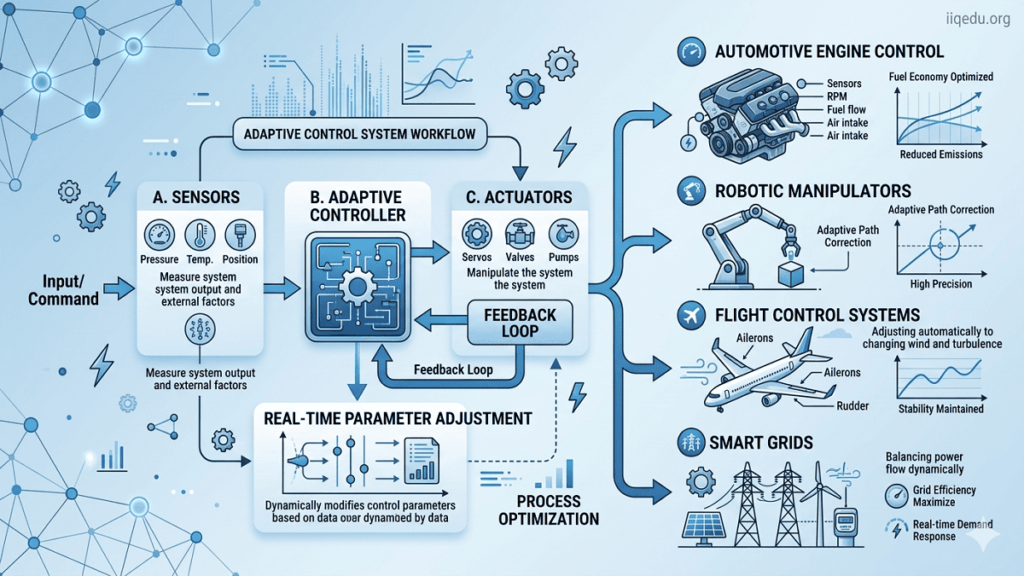
3. Components of Adaptive Control Systems
3.1 Sensors and Actuators
- Collect data from the process (temperature, pressure, speed, position)
- Actuators adjust system parameters based on control decisions
3.2 Adaptive Controller
- Processes real-time data to continuously tune control parameters
- Can incorporate AI or machine learning for improved performance
3.3 Feedback Mechanism
- Compares actual system performance with desired outcomes
- Adjusts control actions to minimize deviations
4. Industry Applications
| Industry | Application |
|---|---|
| Automotive | Engine control, adaptive cruise control, active suspension systems |
| Aerospace | Flight control systems, stability adjustments in varying conditions |
| Manufacturing | Optimizing machinery performance, reducing defects in dynamic production lines |
| Robotics & Automation | Adaptive robot manipulators, autonomous vehicle navigation |
| Energy Systems | Smart grids, power plants, renewable energy integration for load balancing |
5. Benefits of Adaptive Control Systems
| Benefit | Impact |
|---|---|
| Real-time adaptation | Maintains optimal performance under varying conditions |
| Improved efficiency | Reduces energy consumption and operational costs |
| Enhanced safety | Minimizes human error in critical systems |
| Continuous optimization | Learns from feedback to improve performance over time |
| Reduced manual intervention | Decreases maintenance and tuning requirements |
6. Challenges and Considerations
- Complexity: Design and implementation require skilled engineers and advanced algorithms
- Cost: Initial deployment can be expensive
- Integration: Must be compatible with existing systems and infrastructure
- Data Management: Requires robust data collection and processing for effective adaptation
7. Future Trends
- AI-Enhanced ACS: Integration with machine learning for predictive adjustments
- Industry 4.0 & Smart Factories: ACS enabling fully automated, adaptive production lines
- Digital Twins: Simulating systems to test and optimize adaptive control strategies before deployment
- Collaborative Systems: ACS working alongside human operators (cobots) for safe and efficient operations
8. Conclusion
Adaptive Control Systems are essential for modern industries where conditions are variable and precision is critical. By continuously monitoring, analyzing, and adjusting system parameters, ACS ensures stability, efficiency, safety, and continuous optimization.
Key Takeaway:
Organizations that implement ACS gain the ability to adapt to changing conditions in real time, reduce operational risks, improve quality, and achieve sustainable and reliable performance across dynamic environments.
Industry application of Adaptive Control Systems
Adaptive Control Systems (ACS) are widely used across industries where dynamic conditions, high precision, and process optimization are critical. By continuously adjusting control parameters in real time, ACS improves efficiency, stability, quality, and safety.
1. Automotive Industry
- Engine Control: Adjusts fuel injection, air intake, and ignition timing based on load, temperature, and driving conditions.
- Adaptive Cruise Control: Maintains safe speed and distance by adapting to traffic conditions.
- Active Suspension Systems: Optimizes ride comfort and handling by adjusting suspension settings dynamically.
2. Aerospace & Aviation
- Flight Control Systems: Continuously adjust control surfaces for stability under varying aerodynamic conditions.
- Autopilot Systems: Adapt to wind, turbulence, and changing flight paths.
- Unmanned Aerial Vehicles (UAVs): Adjust flight parameters in real time for stability and efficiency.
3. Manufacturing & Industrial Automation
- Machinery Optimization: Automatically adjusts machine settings for varying material properties or process loads.
- Robotic Manipulators: Adapt to changing payloads, positions, or environments.
- Process Control: Monitors temperature, pressure, and flow to maintain quality in dynamic production lines.
4. Energy & Utilities
- Smart Grids: Adjust energy distribution in real time based on demand fluctuations.
- Power Plants: Optimize turbine speeds, load distribution, and energy output for varying operational conditions.
- Renewable Energy Systems: Adapt to changing sunlight, wind, or environmental factors to maintain efficiency.
5. Robotics & Autonomous Systems
- Industrial Robots: Adjust grip, force, and motion paths for varying workpieces.
- Autonomous Vehicles: Continuously adapt speed, steering, and route planning to traffic and road conditions.
- Medical Robotics: Adaptive surgical robots adjust precision based on tissue feedback and surgical environment.
Key Takeaway
Adaptive Control Systems are required wherever processes or systems are dynamic, precision is critical, and optimal performance must be maintained despite changing conditions. They help industries reduce defects, improve efficiency, enhance safety, and maintain high-quality standards.
Ask FAQs
What are Adaptive Control Systems?
Adaptive Control Systems are advanced control systems that automatically adjust their parameters in real time to maintain optimal performance in dynamic or uncertain environments, unlike traditional fixed-parameter controllers.
Why are Adaptive Control Systems important?
They are important because they maintain stability, improve efficiency, reduce defects, and optimize performance even when operating conditions change or disturbances occur.
Who uses Adaptive Control Systems?
ACS is used by manufacturing engineers, automotive designers, aerospace engineers, robotics specialists, and energy system operators—any professional managing complex processes that require real-time adaptation.
When are Adaptive Control Systems required?
They are required when systems operate in dynamic, uncertain, or complex environments where traditional controllers cannot maintain performance, such as high-precision manufacturing, automotive engine control, or flight control systems.
What are the benefits of Adaptive Control Systems?
Key benefits include:
Real-time adjustment to changing conditions
Improved process stability and product quality
Reduced energy consumption and operational costs
Minimized human intervention and errors
Enhanced safety in hazardous or critical operations
Source: Radwell International
Table of Contents
Disclaimer:
The information provided about Adaptive Control Systems (ACS) is for educational and informational purposes only. Performance and results may vary depending on system design, industry application, and operating conditions. Organizations should assess their specific requirements before implementing ACS in real-world processes.