Automated Guided Vehicles (AGVs) for Inspection
Automated Guided Vehicles (AGVs) are self-operating mobile robots used in industrial and manufacturing environments to transport materials, perform inspections, and automate repetitive tasks without human intervention. When applied for inspection, AGVs can navigate facilities, collect data, and detect anomalies in real time, improving efficiency, safety, and accuracy.
Purpose of AGVs for Inspection
- Perform automated facility inspections in manufacturing plants, warehouses, or logistics centers
- Detect equipment malfunctions, process deviations, or safety hazards
- Reduce human exposure to hazardous environments
- Collect data for preventive maintenance and quality assurance
Key Features
- Autonomous Navigation: Uses sensors, LiDAR, or cameras to navigate predefined paths or dynamically plan routes.
- Data Collection: Equipped with cameras, sensors, and IoT devices to gather operational, environmental, or product data.
- Real-Time Monitoring: Transmits inspection data to central control systems for immediate analysis.
- Integration with Control Systems: Interfaces with Manufacturing Execution Systems (MES) or SCADA for process optimization.
Applications Across Industries
- Manufacturing Plants: Inspect assembly lines, detect defects, and monitor equipment health.
- Warehouses & Logistics: Scan inventory, detect misplaced items, and monitor storage conditions.
- Energy & Utilities: Inspect pipelines, tanks, or power equipment safely and continuously.
- Pharmaceuticals & Healthcare: Monitor cleanrooms, equipment status, and ensure compliance with hygiene standards.
- Automotive: Inspect vehicle assembly lines, parts, and process quality.
Benefits
- Improved Inspection Efficiency: Covers large areas faster than manual inspection
- Consistent Accuracy: Reduces human error in monitoring and data collection
- Safety: Minimizes human exposure to hazardous or difficult-to-reach areas
- Predictive Maintenance: Data collected can be used for early detection of equipment failures
- Cost Savings: Reduces labor costs and inspection downtime
Example Scenario
In a warehouse, AGVs equipped with cameras and sensors autonomously navigate aisles, scanning inventory and checking for damaged or misplaced items. Data is sent to the warehouse management system in real time, allowing staff to take corrective actions immediately, improving operational efficiency and accuracy.
What is Automated Guided Vehicles (AGVs) for Inspection?
Automated Guided Vehicles (AGVs) for Inspection are self-operating mobile robots designed to autonomously navigate industrial, manufacturing, or warehouse environments to perform inspection tasks. Unlike standard AGVs that primarily transport materials, inspection AGVs are equipped with sensors, cameras, and monitoring devices to detect anomalies, check equipment health, ensure quality, and collect real-time operational data.
Key Features
- Autonomous Navigation: Moves through predefined routes or dynamically navigates using sensors and LiDAR.
- Real-Time Monitoring: Captures inspection data such as equipment condition, process deviations, or product defects.
- Data Integration: Sends inspection results to control systems like SCADA, MES, or IoT platforms for analysis.
- Safety Enhancement: Reduces human exposure to hazardous or hard-to-reach areas.
Example
In a manufacturing plant, an AGV patrols the assembly line with sensors that detect equipment vibrations or temperature anomalies. It reports potential issues to maintenance teams before failures occur, ensuring continuous operation and minimal downtime.
In simple terms:
AGVs for Inspection are autonomous robots that inspect equipment, processes, or products, collect data, and help organizations maintain quality, efficiency, and safety without human intervention.
Who is required Automated Guided Vehicles (AGVs) for Inspection?
Automated Guided Vehicles (AGVs) for Inspection are required by organizations, engineers, and industries that need efficient, accurate, and safe monitoring of equipment, processes, or facilities. They are especially valuable in environments where manual inspection is slow, hazardous, or prone to error.
Who Requires AGVs for Inspection
- Manufacturing Companies
- To inspect assembly lines, detect equipment malfunctions, and monitor production quality.
- Warehouse & Logistics Operators
- To scan inventory, check storage conditions, and ensure proper placement of goods.
- Energy & Utilities Providers
- To inspect pipelines, tanks, or power equipment in hazardous or remote locations.
- Pharmaceutical & Healthcare Facilities
- To monitor cleanrooms, lab equipment, and ensure compliance with hygiene standards.
- Automotive Industry
- To perform inspections on vehicle assembly lines, parts, and process quality.
In simple terms:
AGVs for Inspection are required by any organization that needs automated, accurate, and safe inspection solutions to maintain quality, operational efficiency, and workplace safety.
When is required Automated Guided Vehicles (AGVs) for Inspection?
Automated Guided Vehicles (AGVs) for Inspection are required whenever organizations need continuous, accurate, and efficient monitoring of processes, equipment, or facilities, especially under conditions where manual inspection is slow, risky, or error-prone.
When AGVs for Inspection Are Required
- Hazardous Environments
- Areas with chemicals, high temperatures, or moving machinery where human inspection is dangerous.
- Large or Complex Facilities
- Warehouses, manufacturing plants, or power plants where manual inspection is time-consuming.
- High-Volume Production
- Assembly lines or production processes where frequent quality checks are needed.
- Critical Equipment Monitoring
- To detect early signs of failure in machinery, pipelines, or medical equipment.
- Data-Driven Maintenance & Compliance
- When real-time inspection data is required for preventive maintenance, regulatory compliance, or process optimization.
In simple terms:
AGVs for Inspection are required anytime inspections must be performed safely, quickly, and accurately, especially in high-risk, large-scale, or data-critical environments.
Where is required Automated Guided Vehicles (AGVs) for Inspection?
Automated Guided Vehicles (AGVs) for Inspection are required in industries and facilities where continuous monitoring, quality checks, and equipment inspections are critical, especially in large, complex, or hazardous environments.
Where AGVs for Inspection Are Required
- Manufacturing Plants
- Inspect assembly lines, machinery, and production processes to ensure quality and detect equipment malfunctions.
- Warehouses & Logistics Centers
- Scan inventory, check storage conditions, and monitor proper placement of goods.
- Energy & Utilities Facilities
- Inspect pipelines, tanks, power equipment, and other high-risk infrastructure.
- Pharmaceutical & Healthcare Facilities
- Monitor cleanrooms, lab equipment, and production processes for hygiene and compliance.
- Automotive Industry
- Inspect vehicle assembly lines, parts, and quality assurance processes.
In simple terms:
AGVs for Inspection are required anywhere automated, accurate, and safe inspection is needed to maintain operational efficiency, product quality, and workplace safety.
How is required Automated Guided Vehicles (AGVs) for Inspection?
Automated Guided Vehicles (AGVs) for Inspection are required by integrating autonomous navigation, sensor technology, and data analysis into inspection processes. They perform inspections by continuously monitoring equipment, processes, or facilities and automatically reporting anomalies, reducing the need for manual checks.
How AGVs for Inspection Are Implemented
- Autonomous Navigation
- AGVs are programmed to follow predefined routes or use sensors and LiDAR to dynamically navigate the facility.
- Sensor & Data Integration
- Equipped with cameras, temperature sensors, vibration sensors, and IoT devices to collect inspection data.
- Real-Time Monitoring & Alerts
- AGVs transmit collected data to control systems or dashboards for immediate analysis and alerts.
- Integration with Maintenance Systems
- Connects with MES, SCADA, or predictive maintenance platforms to prioritize actions based on inspection results.
- Safety & Efficiency Enhancements
- Reduces human exposure to hazardous areas while ensuring inspections are consistent, accurate, and efficient.
In simple terms:
AGVs for Inspection are required by deploying autonomous vehicles that monitor, collect, and report inspection data in real time, enabling safer, faster, and more accurate inspections across facilities.
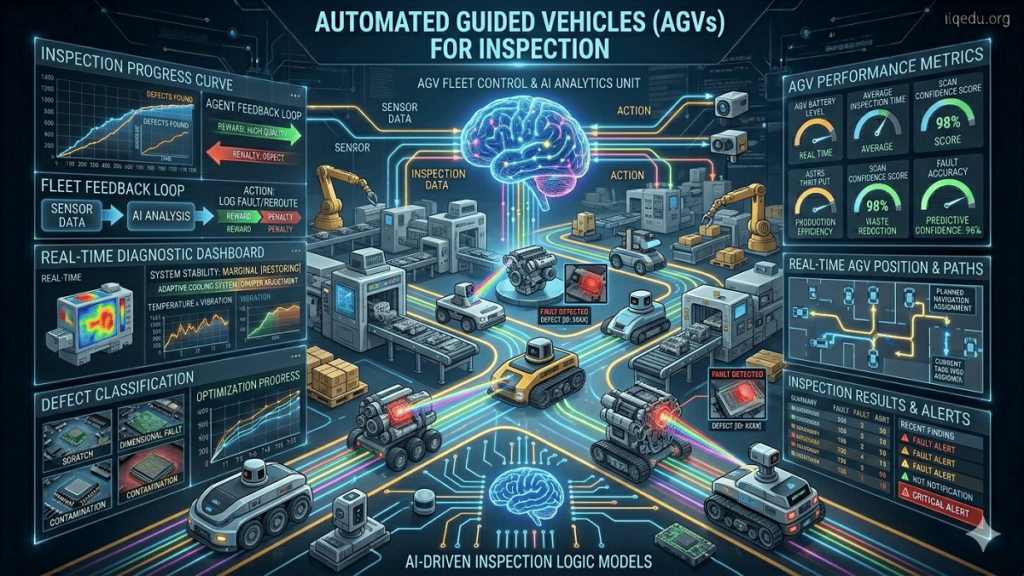
Case study of Automated Guided Vehicles (AGVs) for Inspection
1. Background
A leading electronics manufacturing company faced challenges in monitoring its large production floor. Manual inspection of assembly lines and equipment was:
- Time-consuming
- Prone to human error
- Difficult in hazardous or hard-to-reach areas
The company needed a solution to automate inspections, improve efficiency, and maintain high-quality standards.
2. Problem
- Manual inspections could not keep up with production speed, causing delays.
- Early detection of equipment faults was inconsistent, leading to unplanned downtime.
- Employees were exposed to hazardous areas, such as high-voltage zones and automated machinery.
- Data from inspections was not integrated, making predictive maintenance difficult.
3. Solution: Deployment of Inspection AGVs
Step 1: AGV Selection & Setup
- Selected AGVs equipped with LiDAR, cameras, and temperature/vibration sensors.
- Pre-programmed routes along critical inspection points in the facility.
Step 2: Integration with Data Systems
- AGVs connected to the Manufacturing Execution System (MES) and SCADA for real-time data transfer.
- Sensors collected equipment conditions, environmental parameters, and process deviations.
Step 3: Real-Time Monitoring & Alerts
- AGVs continuously monitored machinery and infrastructure, detecting vibrations, overheating, or misalignment.
- Alerts were sent to maintenance teams instantly, enabling prompt corrective actions.
Step 4: Optimization & Learning
- AI algorithms analyzed inspection data to predict potential equipment failures.
- AGVs’ routes and inspection schedules were optimized based on high-risk areas identified from historical data.
4. Results
| Metric | Improvement |
|---|---|
| Inspection Coverage | Increased from 60% to 100% of critical points |
| Equipment Downtime | Reduced by 25% due to early fault detection |
| Safety Incidents | Reduced by 40% by minimizing human exposure |
| Inspection Time | Cut by 50%, enabling continuous monitoring |
| Data Integration | Achieved real-time reporting for predictive maintenance |
5. Key Benefits
- Proactive Maintenance: Early detection of faults prevented costly downtime.
- Consistent Accuracy: AGVs collected precise and repeatable inspection data.
- Enhanced Safety: Reduced the need for humans to enter hazardous areas.
- Efficiency: Faster and more frequent inspections compared to manual methods.
- Data-Driven Insights: Facilitated predictive maintenance and process optimization.
6. Conclusion
This case study demonstrates that AGVs for Inspection are highly effective in automating inspection tasks, improving safety, and optimizing operational efficiency. By combining autonomous navigation, sensors, and real-time data integration, organizations can ensure consistent quality, proactive maintenance, and safer work environments.
Key Takeaway:
AGVs for Inspection enable industries to monitor, detect, and act on equipment and process issues automatically, transforming traditional inspection practices into efficient, safe, and data-driven operations.
White paper of Automated Guided Vehicles (AGVs) for Inspection
Automated Guided Vehicles (AGVs) for Inspection: Transforming Industrial Monitoring
Executive Summary
Automated Guided Vehicles (AGVs) for Inspection are autonomous mobile robots designed to perform inspection tasks in industrial, manufacturing, and logistics environments. By combining autonomous navigation, sensors, and real-time data integration, AGVs can monitor equipment, detect anomalies, and provide actionable insights without human intervention.
This white paper explores the purpose, components, applications, benefits, and future trends of AGVs for inspection, highlighting their role in improving efficiency, safety, and quality across industries.
1. Introduction
Traditional inspection methods in industries often rely on manual checks, which can be:
- Time-consuming
- Inconsistent
- Hazardous
AGVs for inspection automate these processes, enabling continuous, accurate, and safe monitoring. They integrate with industrial control systems, IoT platforms, and predictive maintenance tools to enhance operational efficiency.
2. Why AGVs for Inspection Are Needed
- Large Facilities: Manual inspection is inefficient for expansive warehouses or factories.
- High-Risk Environments: Hazardous areas such as chemical plants, power equipment, or automated machinery require reduced human exposure.
- Data-Driven Maintenance: Real-time monitoring allows predictive maintenance and early fault detection.
- Quality Assurance: Frequent inspections ensure consistent product quality.
3. Components of Inspection AGVs
| Component | Function |
|---|---|
| Autonomous Navigation System | Guides AGVs along pre-defined or dynamic routes using LiDAR, GPS, or cameras |
| Sensors & Cameras | Collects data on equipment condition, temperature, vibration, and other parameters |
| Control Software | Integrates data with MES, SCADA, or IoT platforms for monitoring and alerts |
| Feedback & Analytics | AI/ML algorithms analyze collected data for anomalies and predictive maintenance |
| Communication Modules | Real-time data transmission to central monitoring systems |
4. Industry Applications
| Industry | Application |
|---|---|
| Manufacturing | Inspect assembly lines, detect equipment malfunctions, monitor production quality |
| Warehousing & Logistics | Scan inventory, monitor storage conditions, identify misplaced goods |
| Energy & Utilities | Inspect pipelines, tanks, and power equipment safely |
| Pharmaceutical & Healthcare | Monitor cleanrooms, lab equipment, and production processes |
| Automotive | Inspect vehicle assembly lines and components for defects |
5. Benefits of AGVs for Inspection
| Benefit | Impact |
|---|---|
| Continuous Monitoring | 24/7 inspection coverage without human fatigue |
| Safety | Reduces human exposure to hazardous areas |
| Accuracy | Minimizes human errors in inspection and data collection |
| Predictive Maintenance | Early detection of potential failures reduces downtime |
| Operational Efficiency | Reduces inspection time and labor costs |
6. Challenges and Considerations
- Initial Cost: Investment in AGVs, sensors, and software integration.
- Complexity: Requires careful planning of navigation routes and sensor placement.
- Integration: Must work with existing MES, SCADA, or IoT systems.
- Maintenance: AGVs themselves require maintenance and software updates.
7. Future Trends
- AI-Enhanced AGVs: Using machine learning to improve inspection accuracy and predict failures.
- Collaborative AGVs (Cobots): Working alongside human operators safely.
- IoT & Digital Twins: Simulating AGV inspection routes and analyzing data before deployment.
- Autonomous Data Analytics: Automatic detection and reporting of anomalies without human intervention.
8. Conclusion
AGVs for inspection redefine industrial monitoring by providing autonomous, continuous, and accurate inspections. They enhance safety, improve operational efficiency, and support predictive maintenance, making them essential in modern manufacturing, logistics, and energy operations.
Key Takeaway:
Organizations deploying AGVs for inspection can reduce manual labor, enhance data-driven decision-making, maintain high quality, and improve workplace safety, ensuring consistent performance in dynamic industrial environments.
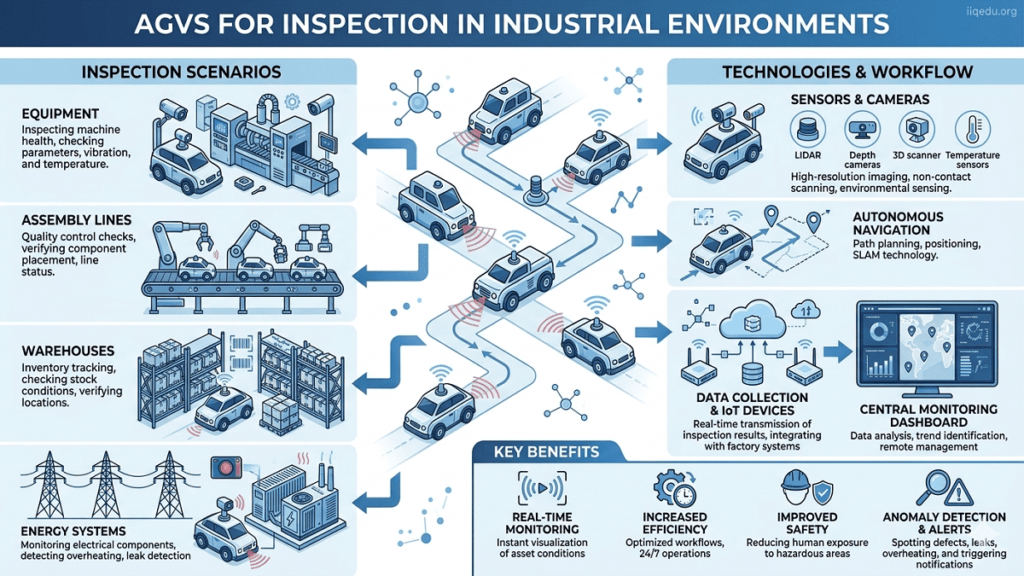
Industry application of Automated Guided Vehicles (AGVs) for Inspection
Automated Guided Vehicles (AGVs) for Inspection are widely used across industries to automate monitoring, detect anomalies, and ensure operational efficiency. By integrating autonomous navigation, sensors, and real-time data analysis, AGVs reduce human intervention while enhancing accuracy and safety.
1. Manufacturing Industry
- Assembly Line Monitoring: Inspect machinery, detect defects, and ensure process consistency.
- Equipment Health Checks: Measure temperature, vibration, and performance metrics for preventive maintenance.
- Quality Assurance: Frequent inspection of products without slowing production.
2. Warehousing & Logistics
- Inventory Scanning: Check stock levels, identify misplaced items, and monitor storage conditions.
- Safety Checks: Detect obstacles, hazards, or environmental issues in warehouse aisles.
- Operational Efficiency: Automate repetitive inspection tasks to free human labor for higher-level work.
3. Energy & Utilities
- Pipeline Inspection: Detect leaks, corrosion, or pressure anomalies in industrial pipelines.
- Power Plants & Substations: Monitor equipment, temperature, and operational performance safely.
- Renewable Energy Facilities: Inspect wind turbines, solar panels, and other critical infrastructure.
4. Pharmaceutical & Healthcare
- Cleanroom Monitoring: Ensure compliance with hygiene and contamination standards.
- Equipment Checks: Inspect laboratory machines, storage units, and critical devices for faults.
- Regulatory Compliance: Maintain documentation of inspections automatically.
5. Automotive Industry
- Vehicle Assembly Line Inspection: Check parts and assemblies for defects in real time.
- Robotics Monitoring: Inspect automated machinery and robotic arms for operational consistency.
- Preventive Maintenance: Early detection of failures in critical equipment.
Key Takeaway
AGVs for Inspection are essential wherever safety, accuracy, and efficiency are critical. They allow industries to monitor large areas, detect anomalies early, reduce manual labor, and improve overall operational performance.
Ask FAQs
What are AGVs for Inspection?
AGVs for Inspection are autonomous mobile robots equipped with sensors, cameras, and data collection tools to monitor equipment, processes, or facilities. They perform inspections automatically, reducing human intervention while ensuring accurate, real-time data.
Why are AGVs for Inspection important?
They improve inspection efficiency, safety, and accuracy. AGVs can monitor hazardous areas, detect equipment faults early, collect operational data for predictive maintenance, and ensure consistent quality across large facilities.
Who uses AGVs for Inspection?
AGVs for Inspection are used by manufacturing plants, warehouses, logistics operators, energy and utility companies, pharmaceutical labs, and automotive industries—any organization that requires automated, accurate, and safe inspection solutions.
When are AGVs for Inspection required?
They are required in large, complex, or hazardous environments, where manual inspection is slow, risky, or prone to error. They are especially useful for continuous monitoring, preventive maintenance, and quality assurance.
What are the benefits of using AGVs for Inspection?
Key benefits include:
Continuous monitoring without human fatigue
Early fault detection and predictive maintenance
Reduced safety risks in hazardous areas
Increased accuracy and data reliability
Operational efficiency and reduced labor costs
Source: TRADESAFE
Table of Contents
Disclaimer:
The information provided about Automated Guided Vehicles (AGVs) for Inspection is for educational and informational purposes only. Implementation results may vary depending on the facility, equipment, and operational conditions. Organizations should evaluate their specific requirements and consult with experts before deploying AGVs for inspection.