Automation, Robotics & Control Systems
Automation, Robotics, and Control Systems (ARCS) are technologies that enable machines and processes to operate with minimal human intervention, improving efficiency, precision, and consistency in manufacturing, production, and other industrial applications. These systems integrate mechanical devices, electronics, sensors, and software to perform tasks automatically and reliably.
Purpose
- Increase production efficiency and throughput
- Ensure consistent product quality
- Reduce human error and labor costs
- Enhance safety in hazardous environments
- Enable complex processes that are difficult or impossible manually
Components of Automation, Robotics & Control Systems
- Automation Systems
- Machinery or processes that operate automatically
- Includes conveyor systems, automated production lines, and process automation
- Robotics
- Programmable machines capable of performing tasks autonomously or semi-autonomously
- Examples: robotic arms for assembly, welding robots, material handling robots
- Control Systems
- Software and hardware systems that monitor, regulate, and optimize processes
- Examples: PLCs (Programmable Logic Controllers), SCADA (Supervisory Control and Data Acquisition), PID controllers
- Sensors and Actuators
- Sensors detect conditions like temperature, pressure, position, or speed
- Actuators carry out physical actions like moving parts or adjusting valves
Applications Across Industries
- Manufacturing: Assembly lines, CNC machines, welding, packaging
- Automotive: Robotic assembly, painting, and quality inspections
- Electronics: PCB assembly, testing, and pick-and-place operations
- Food & Beverage: Automated filling, packaging, and sorting
- Healthcare: Surgical robots, laboratory automation, and diagnostics
- Logistics & Warehousing: Automated guided vehicles (AGVs) and sorting systems
Benefits
- Higher productivity and efficiency
- Reduced defects and improved quality
- Lower operational costs
- Safer work environments
- Real-time monitoring and control of processes
Example Scenario
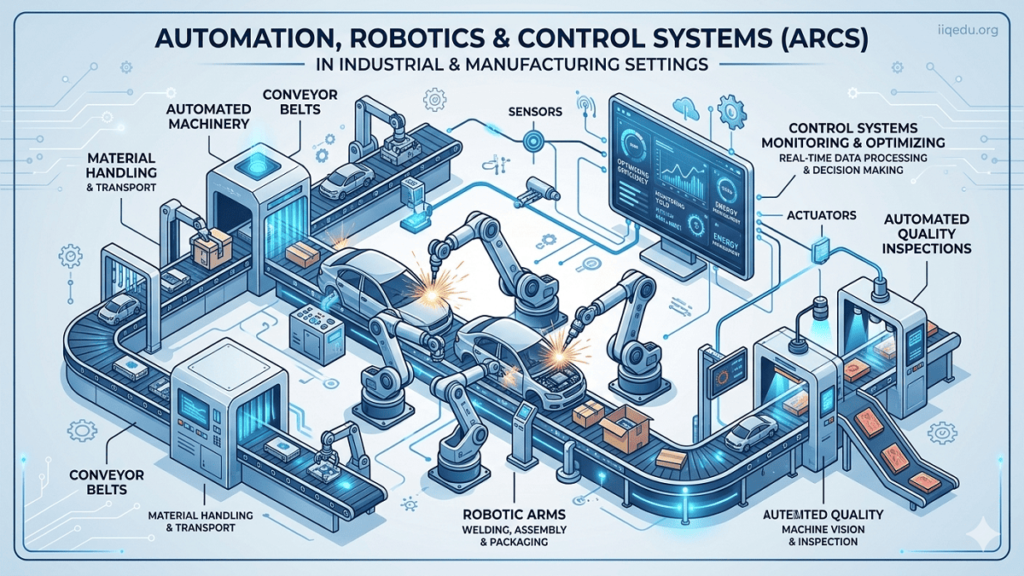
In a car manufacturing plant, robotic arms perform welding and assembly, sensors monitor quality, and control systems adjust machine operations in real-time. This reduces human error, increases production speed, and ensures consistent product quality.
What is Automation, Robotics & Control Systems?
Automation, Robotics & Control Systems (ARCS) refers to the integration of machines, software, and control technologies to perform tasks automatically or with minimal human intervention. These systems are designed to monitor, regulate, and optimize industrial processes, improving efficiency, precision, and consistency across manufacturing, production, and other technical operations.
Key Components
- Automation Systems: Machines or processes that operate automatically, such as conveyor belts or automated production lines.
- Robotics: Programmable machines that perform tasks autonomously or semi-autonomously, like robotic arms for assembly or welding.
- Control Systems: Software and hardware systems (e.g., PLCs, SCADA, PID controllers) that monitor and regulate processes in real-time.
- Sensors & Actuators: Devices that detect conditions (temperature, pressure, position) and perform actions (moving parts, adjusting valves).
Example
In a car manufacturing plant, robotic arms perform welding and assembly, sensors monitor quality, and control systems adjust machine operations in real time. This ensures consistent quality, faster production, and reduced human error.
In simple terms:
Automation, Robotics & Control Systems allow machines to work smarter, faster, and more accurately, reducing reliance on manual labor while improving productivity and product quality.
Who is Automation, Robotics & Control Systems required?
Automation, Robotics & Control Systems (ARCS) are required by organizations and professionals who aim to improve efficiency, accuracy, and consistency in production or industrial processes. These systems are especially essential in high-volume, high-precision, or hazardous operations.
Who Requires ARCS
1. Manufacturing Companies
- Use ARCS to automate assembly lines, reduce defects, and increase throughput.
2. Automotive Industry
- Employ robotic arms, welding robots, and painting automation for consistent vehicle production.
3. Electronics Manufacturers
- Rely on automation and robotics for PCB assembly, testing, and precision operations.
4. Healthcare & Pharmaceutical Companies
- Use laboratory automation, surgical robots, and packaging systems to maintain quality and safety.
5. Logistics & Warehousing
- Implement automated guided vehicles (AGVs), robotic sorting, and inventory control systems.
6. Industrial Engineers & Process Managers
- Require control systems to monitor, regulate, and optimize operations for efficiency and safety.
In simple terms:
ARCS is required by any organization or professional responsible for high-quality, efficient, and safe production or industrial operations where automation and precise control can reduce human error and improve productivity.
When is Automation, Robotics & Control Systems required?
Automation, Robotics & Control Systems (ARCS) are required when organizations need to improve efficiency, precision, and consistency in industrial or production processes while reducing human error and operational costs.
When ARCS Is Required
- High-Volume Production
- When production demands are large, manual operations become slow and inconsistent. Automation and robotics speed up processes and maintain quality.
- Precision-Critical Operations
- When tasks require high accuracy, such as PCB assembly, robotic welding, or pharmaceutical dosing.
- Hazardous Environments
- When work involves dangerous conditions like high temperatures, chemicals, or heavy machinery, ARCS ensures safety by minimizing human involvement.
- Complex Processes
- When processes have many interdependent steps that require continuous monitoring and control for optimal output.
- Cost Reduction and Efficiency
- When organizations aim to reduce labor costs, minimize waste, and improve production throughput.
In simple terms:
ARCS is required whenever tasks are repetitive, complex, high-volume, high-precision, or hazardous, and organizations want to improve quality, efficiency, and safety using automation and robotics.
Where is Automation, Robotics & Control Systems required?
Automation, Robotics & Control Systems (ARCS) are required in industries and environments where efficiency, precision, and safety are critical, and manual processes are insufficient or too slow.
Where ARCS Is Required
- Manufacturing Plants
- For automated assembly lines, CNC machines, welding, and packaging.
- Automotive Industry
- Robotic welding, painting, assembly, and inspection lines.
- Electronics Manufacturing
- PCB assembly, testing, and precision component handling.
- Pharmaceutical & Healthcare
- Laboratory automation, drug formulation, packaging, and surgical robots.
- Food & Beverage Industry
- Bottling, packaging, processing, and sorting operations.
- Logistics & Warehousing
- Automated guided vehicles (AGVs), robotic sorting, and inventory management.
- High-Tech & Industrial Equipment Manufacturing
- CNC machines, 3D printing, robotic assembly, and process control systems.
In simple terms:
ARCS is required wherever repetitive, precise, high-volume, or hazardous tasks need to be automated for improved quality, efficiency, and safety.
How is Automation, Robotics & Control Systems required?
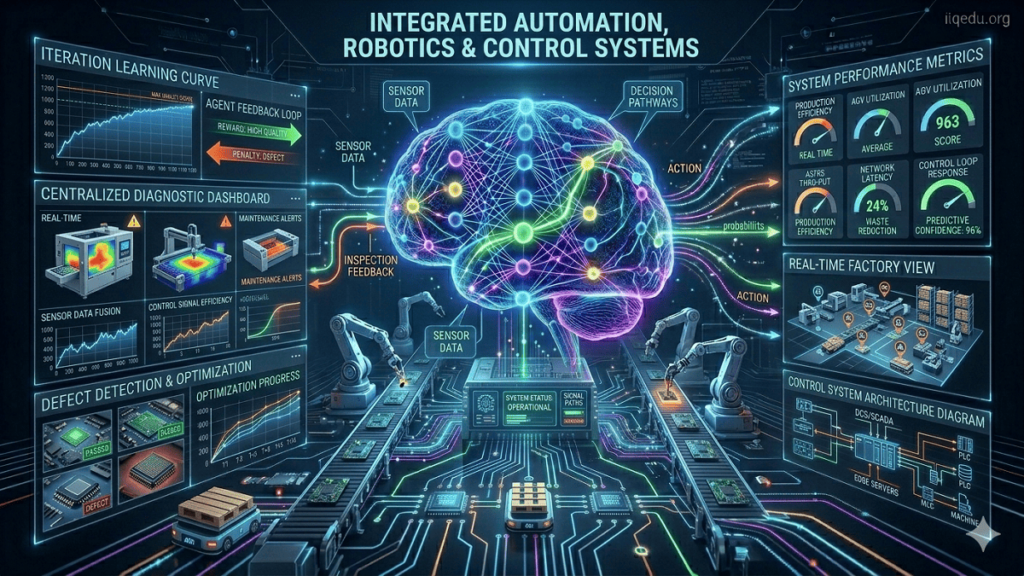
Automation, Robotics & Control Systems (ARCS) are required by implementing integrated systems that monitor, control, and optimize industrial processes to improve efficiency, precision, and safety. These systems use sensors, actuators, software, and robotics to perform tasks with minimal human intervention.
How ARCS Is Required
- Process Automation
- Automate repetitive or complex tasks, such as assembly, welding, packaging, or material handling.
- Robotics Implementation
- Deploy robotic arms, mobile robots, or collaborative robots (cobots) to perform precise and repetitive operations.
- Control Systems Integration
- Use PLCs, SCADA, or PID controllers to monitor process variables (temperature, pressure, speed) and adjust operations in real time.
- Sensor & Actuator Deployment
- Install sensors to collect real-time data and actuators to execute machine actions based on control system commands.
- Continuous Optimization
- Systems continuously analyze feedback from production processes to optimize performance, reduce defects, and increase throughput.
In simple terms:
ARCS is required by setting up automated, robotic, and control systems that can monitor and adjust production processes in real time, reducing human error, improving quality, and enhancing efficiency.
Case study of Automation, Robotics & Control Systems
1. Background
A major automotive manufacturer was facing challenges with high production costs, inconsistent quality, and slow assembly line processes. Manual operations and semi-automated systems were not sufficient to meet increasing demand and precision requirements.
The company decided to implement Automation, Robotics & Control Systems (ARCS) to optimize its assembly lines, improve product quality, and increase production efficiency.
2. Problem
The key issues included:
- High defect rates in assembled components
- Inefficient manual and semi-automated workflows
- Difficulty maintaining consistent quality across high-volume production
- Safety risks for workers handling repetitive and hazardous tasks
3. Solution: Implementing ARCS
Step 1: Automation
- Installed automated conveyor systems to move parts along the assembly line.
- Automated tasks like material handling, part feeding, and welding sequences.
Step 2: Robotics
- Deployed robotic arms for welding, painting, and assembly tasks.
- Used collaborative robots (cobots) to assist human workers in precision assembly without compromising safety.
Step 3: Control Systems
- Integrated PLCs (Programmable Logic Controllers) and SCADA systems to monitor production in real time.
- Used sensors and actuators to track position, temperature, and quality metrics, allowing automated adjustments.
Step 4: Optimization
- Continuous feedback from sensors and inspection systems allowed the control system to adjust robot actions, conveyor speeds, and process parameters automatically.
4. Results
After implementing ARCS, the company achieved:
- 45% reduction in defects on the assembly line
- 35% increase in production efficiency
- Significant reduction in labor-related errors and workplace accidents
- Consistent product quality across high-volume production lines
- Enhanced ability to scale production without compromising precision
5. Key Benefits
| Benefit | Impact |
|---|---|
| Automated processes | Reduced human error and repetitive labor |
| Robotics | Increased speed, precision, and safety |
| Real-time control | Continuous monitoring and adjustment for consistent quality |
| Reduced costs | Less waste, higher efficiency, and lower labor expenses |
| Scalability | Easier to expand production capacity without quality loss |
White paper of Automation, Robotics & Control Systems
Executive Summary
Automation, Robotics & Control Systems (ARCS) are essential technologies in modern manufacturing and industrial operations. By integrating automated machinery, robotic systems, and real-time control mechanisms, ARCS enables organizations to improve efficiency, ensure consistent quality, enhance safety, and reduce operational costs.
This white paper explores the applications, benefits, challenges, and future trends of ARCS across industries, highlighting its role in transforming production processes.
1. Introduction
Traditional manufacturing often relied on manual labor and semi-automated systems. While effective at a small scale, these approaches cannot meet modern demands for speed, precision, and quality.
ARCS combines automation, robotics, and control systems to provide intelligent, adaptive, and highly efficient production processes.
- Automation: Machines perform repetitive or complex tasks automatically.
- Robotics: Programmable machines execute tasks autonomously or collaboratively with humans.
- Control Systems: Software and hardware monitor and optimize production parameters in real time.
2. The Need for ARCS
Modern industries face challenges such as:
- Increasing demand for high-volume production
- Complexity in assembly lines and precision requirements
- Need for consistent quality across products
- Hazardous working conditions for humans
- Pressure to reduce operational costs and waste
ARCS addresses these challenges by providing automated, adaptive, and precise solutions for production and industrial processes.
3. Components of ARCS
3.1 Automation Systems
- Conveyor belts, automated production lines, packaging machines
- Reduce human intervention in repetitive tasks
3.2 Robotics
- Robotic arms, collaborative robots (cobots), mobile robots
- Perform precision tasks like welding, painting, assembly, and material handling
3.3 Control Systems
- PLCs (Programmable Logic Controllers) and SCADA (Supervisory Control and Data Acquisition)
- Monitor and adjust processes in real time
- Utilize sensors and actuators to maintain quality and efficiency
4. Applications Across Industries
| Industry | ARCS Application |
|---|---|
| Automotive | Robotic welding, painting, assembly lines |
| Electronics | PCB assembly, testing, precision handling |
| Food & Beverage | Bottling, packaging, processing lines |
| Pharmaceuticals | Drug formulation, packaging, lab automation |
| Logistics & Warehousing | AGVs, robotic sorting, inventory management |
| High-Tech Manufacturing | CNC machines, 3D printing, precision assembly |
5. Benefits of ARCS
| Benefit | Impact |
|---|---|
| Increased productivity | Faster and continuous operations |
| Consistent quality | Reduced defects and errors |
| Cost efficiency | Lower labor costs and waste |
| Safety improvement | Minimizes hazardous human exposure |
| Real-time optimization | Adjusts processes for maximum efficiency |
6. Challenges and Considerations
- High Initial Investment: Implementation can require significant capital expenditure
- Skilled Workforce: Engineers and technicians are needed to manage, maintain, and program ARCS
- Integration Complexity: Combining automation, robotics, and control systems with existing infrastructure
- Data Management: High volume of sensor and process data requires robust analytics
7. Future Trends
- Smart Factories / Industry 4.0: ARCS integrated with IoT, AI, and machine learning
- Collaborative Robotics (Cobots): Human-robot collaboration for flexible production
- Predictive Maintenance: Using ARCS data to anticipate failures and reduce downtime
- Digital Twins: Simulating production lines to optimize performance before physical implementation
Industry application of Automation, Robotics & Control Systems
Automation, Robotics & Control Systems (ARCS) are widely used across industries to enhance efficiency, ensure consistent quality, reduce human error, and improve safety. Here’s how they are applied in different sectors:
1. Automotive Industry
- Robotic Assembly Lines: Robotic arms handle welding, painting, and component assembly.
- Quality Inspection: Automated vision systems detect defects in parts or assembled vehicles.
- Material Handling: Conveyors and AGVs transport components efficiently across the factory floor.
2. Electronics Manufacturing
- PCB Assembly: Robots perform precise soldering and component placement.
- Testing & Inspection: Automated systems test electronic boards for defects or inconsistencies.
- Microelectronics: Robotics manage high-precision operations that are challenging for humans.
3. Food & Beverage Industry
- Filling & Packaging Lines: Automation ensures accurate filling levels and sealing.
- Sorting & Quality Control: Robots and vision systems detect damaged or defective products.
- Processing Automation: Maintains consistent cooking, mixing, or bottling conditions.
4. Pharmaceutical & Healthcare
- Laboratory Automation: Robots handle repetitive lab tasks like sample preparation and analysis.
- Drug Manufacturing: Automated systems maintain precise measurements, mixing, and packaging.
- Surgical Robotics: Assist surgeons in performing minimally invasive and precise operations.
5. Logistics & Warehousing
- Automated Guided Vehicles (AGVs): Transport goods across warehouses efficiently.
- Robotic Sorting Systems: Sort and organize packages for shipping.
- Inventory Management: Sensors and control systems track stock levels in real time.
6. High-Tech & Industrial Equipment Manufacturing
- CNC Machines & 3D Printing: Automation ensures precision in manufacturing complex components.
- Process Control Systems: Monitor and optimize multiple variables like speed, temperature, and pressure.
- Robotic Assembly: Handles delicate or repetitive assembly tasks to maintain consistent quality.
Key Takeaway
ARCS is required wherever precision, high-volume production, safety, and efficiency are critical. By integrating automation, robotics, and control systems, industries can reduce human error, improve throughput, maintain quality, and lower operational costs.
Ask FAQs
What are Automation, Robotics & Control Systems (ARCS)?
ARCS refers to the integration of automated machines, robotic systems, and control technologies to perform tasks with minimal human intervention, improving efficiency, precision, and safety in industrial and manufacturing processes.
Why are ARCS important in manufacturing?
ARCS are important because they increase productivity, ensure consistent quality, reduce human error, and improve workplace safety. They also help manufacturers handle high-volume and complex processes efficiently.
Who uses Automation, Robotics & Control Systems?
ARCS are used by manufacturing companies, automotive and electronics industries, pharmaceutical and healthcare organizations, logistics operators, and industrial engineers responsible for optimizing production, maintaining quality, and ensuring safety.
How do ARCS improve efficiency and quality?
ARCS improve efficiency by automating repetitive or complex tasks and using robots for precise operations. Control systems monitor real-time data and adjust machine parameters, while sensors detect issues early, reducing defects and maintaining consistent product quality.
What are the benefits of implementing ARCS?
Key benefits include:
Increased productivity and throughput
Reduced defects and improved quality
Lower operational costs and waste
Safer work environments
Real-time monitoring and adaptive process optimization
Source: Innovative Industry
Table of Contents
Disclaimer:
The information provided about Automation, Robotics & Control Systems (ARCS) is for educational and informational purposes only. Implementation results may vary depending on industry, equipment, and operational conditions. Organizations should evaluate their specific requirements before applying these technologies in real-world environments.