Autonomous Inspection Drones
Autonomous Inspection Drones are unmanned aerial vehicles (UAVs) designed to perform inspections without human control, navigating complex environments using sensors, cameras, and AI-based flight systems. They are widely used in industries where manual inspections are risky, time-consuming, or difficult to access.
Purpose
- Inspect hard-to-reach areas such as rooftops, towers, pipelines, and wind turbines.
- Collect real-time data on equipment condition, structural integrity, or environmental hazards.
- Reduce human exposure to dangerous or hazardous environments.
- Support predictive maintenance and quality assurance.
Key Features
- Autonomous Navigation: Uses GPS, LiDAR, and computer vision to navigate without manual control.
- High-Resolution Sensors & Cameras: Captures images, thermal data, and structural measurements.
- Real-Time Data Transmission: Sends inspection data to centralized control systems for analysis.
- AI & Machine Learning: Detects anomalies, defects, or irregularities automatically.
- Integration: Works with IoT platforms, SCADA, or facility management software for predictive insights.
Applications Across Industries
- Energy & Utilities: Inspect wind turbines, solar panels, pipelines, and power lines.
- Construction & Infrastructure: Monitor bridges, towers, dams, and buildings.
- Oil & Gas: Inspect offshore rigs, pipelines, and storage tanks.
- Telecommunications: Inspect antennas, towers, and network infrastructure.
- Rail & Transportation: Inspect railway tracks, tunnels, and bridges safely.
Benefits
- Safety: Minimizes human exposure to hazardous or hard-to-reach areas.
- Efficiency: Covers large areas quickly compared to manual inspections.
- Accuracy: High-resolution imaging and AI analysis detect defects and anomalies reliably.
- Cost-Effective: Reduces labor costs and downtime from manual inspections.
- Data-Driven Insights: Enables predictive maintenance and informed decision-making.
Example Scenario
In a wind farm, autonomous drones inspect turbine blades for cracks or erosion. High-resolution cameras and thermal sensors capture real-time data, which is analyzed automatically to identify maintenance needs before failures occur, reducing downtime and maintenance costs.
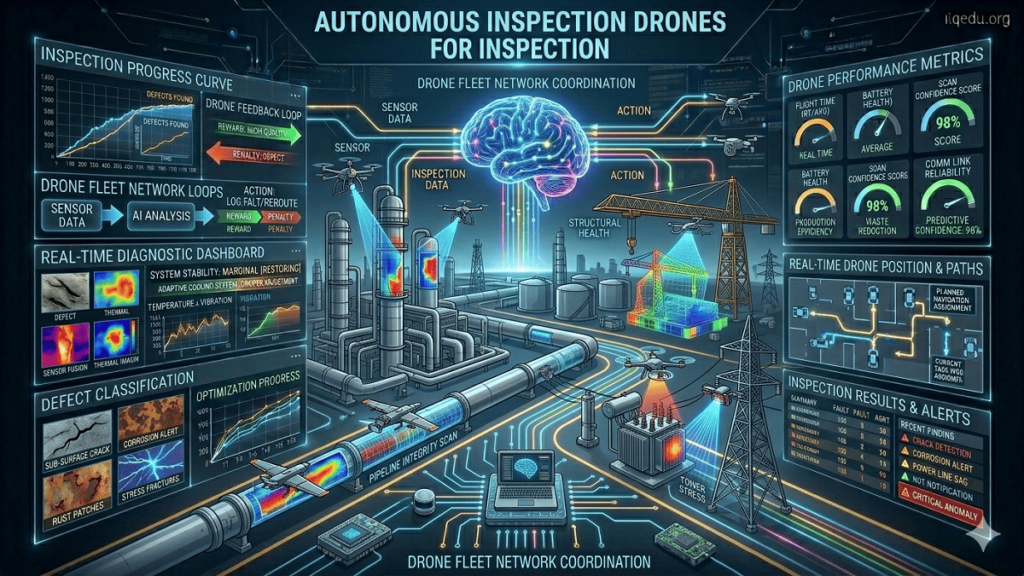
What is Autonomous Inspection Drones?
Autonomous Inspection are unmanned aerial vehicles (UAVs) capable of performing inspections without manual control. They use sensors, cameras, GPS, and AI-based navigation systems to autonomously monitor, inspect, and collect data from equipment, infrastructure, or facilities.
Unlike traditional drones, autonomous inspection can plan their flight paths, avoid obstacles, capture high-resolution data, and analyze anomalies in real time without human intervention.
Key Features
- Autonomous Navigation: Uses GPS, LiDAR, or computer vision to fly predefined or adaptive routes.
- Sensors & Cameras: Captures images, thermal data, and structural measurements.
- Real-Time Data Transmission: Sends inspection data to central monitoring systems.
- AI Analysis: Detects defects, cracks, corrosion, or anomalies automatically.
- Integration: Works with IoT platforms, SCADA, or facility management systems for predictive maintenance.
Example
In a solar farm, autonomous fly over panels to detect cracks, dirt accumulation, or shading issues. Data is sent to the monitoring system, enabling maintenance teams to act before production loss occurs.
In simple terms:
Autonomous inspection drones are smart flying robots that inspect infrastructure, collect data, and detect problems automatically, improving safety, efficiency, and accuracy.
Who is required Autonomous Inspection Drones?
Autonomous Drones are required by organizations, engineers, and industries that need safe, efficient, and accurate inspection of infrastructure, equipment, or facilities, especially in locations that are hard to reach, hazardous, or large in scale.
Who Requires Autonomous Inspection Drones
- Energy & Utilities Companies
- Inspect wind turbines, solar farms, power lines, and pipelines safely and efficiently.
- Construction & Infrastructure Firms
- Monitor bridges, towers, dams, and high-rise buildings for structural integrity.
- Oil & Gas Industry
- Inspect offshore rigs, storage tanks, and pipelines in remote or hazardous areas.
- Telecommunications Companies
- Inspect antennas, towers, and network infrastructure.
- Transportation & Rail Operators
- Monitor railway tracks, tunnels, and bridges for defects or maintenance needs.
In simple terms:
Autonomous drones are required by any organization that needs to perform inspections safely, quickly, and accurately in areas that are difficult, dangerous, or time-consuming for humans to access.
When is required Autonomous Inspection Drones?
Autonomous Drones are required whenever inspections need to be performed safely, efficiently, and accurately in environments that are hazardous, hard to reach, or extensive.
When Autonomous Inspection Drones Are Required
- Hazardous Environments
- Areas with high voltage, extreme heights, toxic chemicals, or unstable structures.
- Hard-to-Reach Locations
- Towers, wind turbines, bridges, dams, pipelines, or offshore rigs.
- Large-Scale Facilities
- Solar farms, industrial plants, or extensive infrastructure where manual inspection is time-consuming.
- High-Frequency Inspections
- Situations where inspections must be performed regularly to prevent failures or downtime.
- Data-Driven Maintenance
- When real-time monitoring and predictive maintenance are required to reduce equipment failures.
In simple terms:
Autonomous drones are required anytime inspections must be safe, fast, and accurate, especially in hazardous, large, or hard-to-access areas.
Where is required Autonomous Inspection Drones?
Autonomous Drones are required in industries and locations where inspections are difficult, hazardous,Autonomous Drones are required in industries and locations where inspections are difficult, hazardous, or time-consuming, and where real-time data collection improves safety and efficiency.
Where Autonomous Inspection Drones Are Required
- Energy & Utilities
- Wind farms, solar farms, power lines, substations, and pipelines.
- Construction & Infrastructure
- Bridges, dams, towers, high-rise buildings, and other large structures.
- Oil & Gas Industry
- Offshore rigs, storage tanks, and pipelines in remote or hazardous locations.
- Telecommunications
- Antennas, towers, and network infrastructure.
- Transportation & Railways
- Railway tracks, tunnels, airports, and road infrastructure for safety inspections.
In simple terms:
Autonomous drones are required wherever inspections need to be fast, accurate, and safe—especially in hazardous, large-scale, or hard-to-reach areas.
How is required Autonomous Inspection Drones?
Autonomous Drones are required by deploying advanced UAVs with autonomous navigation, sensors, and AI-based data analysis to perform inspections without human intervention. They are implemented to safely and efficiently monitor equipment, infrastructure, or facilities while collecting actionable data in real time.
How Autonomous Inspection Drones Are Implemented
- Autonomous Navigation
- Drones are programmed to fly along predefined routes or use AI and computer vision to navigate dynamically.
- Sensors & Cameras
- Equipped with high-resolution cameras, thermal sensors, LiDAR, and environmental sensors to capture detailed inspection data.
- Real-Time Data Transmission
- Inspection data is sent to control centers or monitoring systems for immediate analysis and reporting.
- AI & Analytics Integration
- AI algorithms analyze collected data to detect defects, cracks, corrosion, or anomalies automatically.
- System Integration
- Connects with IoT platforms, SCADA, or facility management software for predictive maintenance and workflow optimization.
In simple terms:
Autonomous drones are required by deploying intelligent flying robots that navigate autonomously, inspect infrastructure, collect data, and detect problems in real time, improving safety, efficiency, and accuracy.
Case study of Autonomous Inspection Drones
1. Background
A leading renewable energy company operated a large wind farm with over 100 turbines spread across a hilly and remote area. Regular inspections were required to:
- Detect blade cracks, erosion, and mechanical wear
- Monitor electrical components and connections
- Ensure overall operational efficiency
Manual inspections were time-consuming, costly, and risky due to the height of turbines and challenging terrain.
2. Problem
- Manual inspections took several hours per turbine and required safety harnesses and specialized crews.
- Safety risks were high, with technicians exposed to heights and harsh weather conditions.
- Inconsistent inspection results led to undetected issues, sometimes causing turbine downtime and lost energy production.
3. Solution: Implementation of Autonomous Drones
Step 1: Drone Deployment
- Equipped drones with high-resolution cameras, thermal sensors, and LiDAR for structural and electrical inspections.
- Programmed autonomous flight paths for each turbine to ensure consistent coverage.
Step 2: Data Collection & Transmission
- Drones captured images, thermal readings, and vibration data automatically.
- Data was transmitted in real time to a central monitoring system for analysis.
Step 3: AI Analysis & Reporting
- AI algorithms analyzed data to detect blade cracks, hotspots, or misaligned components.
- Maintenance alerts were automatically generated for priority repairs, enabling predictive maintenance.
4. Results
| Metric | Improvement |
|---|---|
| Inspection Time | Reduced from 6 hours to 30 minutes per turbine |
| Safety | Eliminated human exposure to high-risk areas |
| Fault Detection | Early detection of 95% of minor blade and electrical issues |
| Operational Efficiency | Increased turbine uptime by 8–10% |
| Cost Savings | Reduced labor and downtime costs significantly |
5. Key Benefits
- Safety: Technicians no longer exposed to heights or harsh conditions
- Efficiency: Multiple turbines inspected quickly without human fatigue
- Accuracy: High-resolution imaging and AI detection improved defect identification
- Predictive Maintenance: Early alerts prevented failures and reduced downtime
- Data Management: Centralized inspection records for analysis and compliance
6. Conclusion
This case study demonstrates that autonomous drones are highly effective for monitoring complex, hazardous, or large-scale industrial assets. By integrating autonomous flight, sensors, and AI analytics, companies can achieve faster, safer, and more accurate inspections while reducing costs and downtime.
Key Takeaway:
Autonomous drones transform traditional inspection practices by providing continuous, data-driven, and risk-free monitoring, making them essential for industries like renewable energy, oil & gas, construction, and infrastructure.
White paper of Autonomous Inspection Drones
Executive Summary
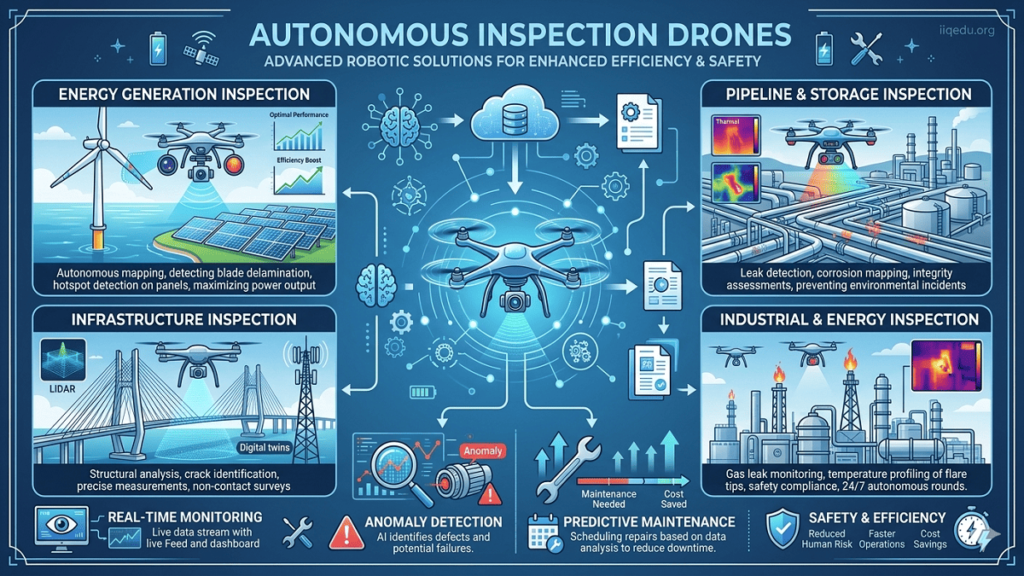
Autonomous Drones are unmanned aerial vehicles (UAVs) capable of performing automated inspections without human control. Equipped with high-resolution cameras, thermal sensors, LiDAR, and AI-based navigation systems, these drones collect data from hard-to-reach, hazardous, or large-scale infrastructure.
This white paper explores the purpose, components, industry applications, benefits, challenges, and future trends of autonomous drones, highlighting their role in improving safety, operational efficiency, and predictive maintenance.
1. Introduction
Traditional inspection methods in industries like energy, construction, and oil & gas are often manual, time-consuming, and risky. Autonomous drones automate this process, enabling:
- Faster inspections
- Accurate data collection
- Reduced safety risks
- Integration with digital monitoring platforms
2. Why Autonomous Inspection Drones Are Needed
- Hazardous Environments: Reduce human exposure to heights, chemicals, and electrical hazards.
- Hard-to-Reach Locations: Inspect towers, turbines, pipelines, bridges, and offshore rigs.
- Large Facilities: Cover extensive areas quickly and efficiently.
- Data-Driven Maintenance: Provide predictive insights and early fault detection.
- Quality Assurance & Compliance: Ensure regulatory standards are met consistently.
3. Components of Autonomous Inspection Drones
| Component | Function |
|---|---|
| Autonomous Navigation System | GPS, LiDAR, or computer vision to navigate autonomously |
| Sensors & Cameras | Capture high-resolution images, thermal readings, and structural measurements |
| AI & Analytics | Detect defects, anomalies, or irregularities automatically |
| Communication Modules | Transmit real-time data to monitoring or control systems |
| Integration Platforms | Connect with SCADA, IoT, or facility management systems for predictive maintenance |
4. Industry Applications
| Industry | Application |
|---|---|
| Energy & Utilities | Inspect wind turbines, solar panels, power lines, and pipelines |
| Construction & Infrastructure | Monitor bridges, dams, towers, and high-rise buildings |
| Oil & Gas | Inspect offshore rigs, storage tanks, and pipelines |
| Telecommunications | Inspect antennas, towers, and network infrastructure |
| Transportation & Rail | Inspect railway tracks, tunnels, and airport infrastructure |
5. Benefits
| Benefit | Impact |
|---|---|
| Safety | Minimizes human exposure to hazardous areas |
| Efficiency | Reduces inspection time for large-scale assets |
| Accuracy | High-resolution imaging and AI analysis improve defect detection |
| Predictive Maintenance | Early fault detection reduces downtime and costs |
| Data Management | Centralized and consistent inspection records |
6. Challenges and Considerations
- Initial Investment: High cost of drones, sensors, and software integration
- Technical Complexity: Requires skilled personnel for setup, programming, and maintenance
- Environmental Limitations: Weather conditions can affect drone performance
- Integration Needs: Must work seamlessly with existing control and monitoring systems
7. Future Trends
- AI & Machine Learning Enhancements: Smarter anomaly detection and predictive analytics
- Swarm Drone Technology: Coordinated inspections by multiple drones simultaneously
- Digital Twins: Simulate drone inspections for planning and optimization
- Collaborative Drones: Work alongside human operators safely in mixed environments
- Autonomous Decision-Making: Drones analyze data and recommend maintenance actions automatically
8. Conclusion
Autonomous drones transform traditional inspection methods by offering safe, efficient, and data-driven monitoring for industries where manual inspections are risky or inefficient. Their integration into industrial workflows reduces downtime, improves predictive maintenance, and ensures consistent quality and compliance.
Key Takeaway:
Organizations adopting autonomous drones gain enhanced safety, operational efficiency, and actionable insights, making them an essential tool for modern industrial monitoring.
Industry application of Autonomous Inspection Drones
Autonomous Inspection Drones are transforming how industries perform inspections by providing safe, fast, and accurate monitoring of hard-to-reach or hazardous areas. Equipped with high-resolution cameras, thermal sensors, LiDAR, and AI, these drones reduce manual labor while improving operational efficiency and safety.
1. Energy & Utilities
- Wind Farms: Inspect turbine blades, gearboxes, and towers for cracks or erosion.
- Solar Farms: Monitor panel alignment, dirt accumulation, or shading issues.
- Power Lines & Substations: Detect faults, corrosion, or loose connections in high-voltage areas.
2. Construction & Infrastructure
- Bridges and Dams: Inspect structural integrity, cracks, and erosion.
- High-Rise Buildings: Monitor facades, rooftops, and hard-to-access areas.
- Towers & Industrial Facilities: Inspect equipment, chimneys, and pipelines.
3. Oil & Gas Industry
- Offshore Rigs: Inspect platforms, pipelines, and tanks without exposing workers to hazards.
- Onshore Pipelines: Detect leaks, corrosion, or pressure anomalies along long pipelines.
- Storage Tanks: Monitor for structural damage or potential safety risks.
4. Telecommunications
- Antenna & Tower Inspection: Check signal equipment, structural stability, and alignment.
- Network Infrastructure: Monitor cell towers and remote communication sites.
5. Transportation & Railways
- Railway Tracks & Tunnels: Detect cracks, misalignments, or debris.
- Airports & Roads: Inspect runways, lighting systems, and elevated structures.
- Bridges & Overpasses: Monitor condition without disrupting traffic.
Key Takeaway
Autonomous inspection drones are required anywhere inspections must be fast, safe, and accurate, particularly in hazardous, hard-to-reach, or large-scale industrial environments. They help industries reduce costs, improve safety, enable predictive maintenance, and ensure operational efficiency.
Ask FAQs
What are Autonomous Inspection Drones?
Autonomous inspection drones are unmanned aerial vehicles (UAVs) that can perform inspections without human control. They use sensors, cameras, GPS, and AI navigation to monitor equipment, infrastructure, or facilities, capturing real-time data for analysis.
Why are Autonomous Inspection Drones important?
They provide safe, efficient, and accurate inspections, especially in hazardous, hard-to-reach, or large-scale environments. They reduce human risk, speed up inspections, and enable predictive maintenance through data-driven insights.
Who uses Autonomous Inspection Drones?
Industries such as energy, utilities, construction, oil & gas, telecommunications, transportation, and rail use autonomous drones to inspect infrastructure, pipelines, towers, wind turbines, and other assets.
When are Autonomous Inspection Drones required?
They are required when inspections involve hazardous areas, elevated structures, remote locations, or large facilities, where manual inspections are risky, slow, or inefficient.
What are the benefits of using Autonomous Inspection Drones?
Key benefits include:
Enhanced Safety: Reduces human exposure to dangerous areas
Improved Efficiency: Covers large areas quickly
High Accuracy: Detects defects and anomalies reliably
Predictive Maintenance: Enables early fault detection
Cost Savings: Reduces labor and downtime costs
Source: Aerones
Table of Contents
Disclaimer:
The information provided about Autonomous Inspection Drones is for educational and informational purposes only. Implementation results may vary depending on industry, equipment, and operational conditions. Organizations should evaluate their specific needs and consult with experts before deploying drones for inspection.