Reinforcement Learning in Manufacturing QC
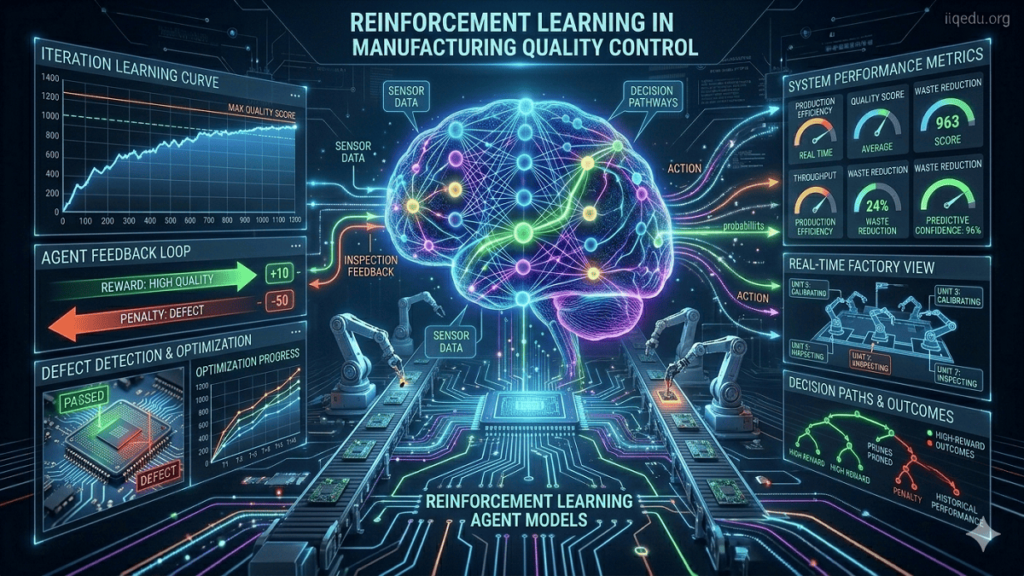
Reinforcement Learning (RL) is a type of machine learning where an agent learns to make decisions by interacting with an environment and receiving feedback in the form of rewards or penalties. In manufacturing quality control (QC), RL can be applied to optimize processes, reduce defects, and improve product quality by continuously learning from production data.
Purpose of Reinforcement Learning in QC
- Improve process efficiency by adjusting machine parameters automatically
- Minimize defective products and reduce waste
- Optimize production schedules for quality and throughput
- Enable adaptive quality control in real-time
How Reinforcement Learning Works in Manufacturing QC
- Agent: The RL system or algorithm that makes decisions (e.g., adjusting machine speed, temperature, or pressure)
- Environment: The manufacturing process where products are produced
- Action: Choices the agent can make, such as changing process parameters
- Reward: Feedback based on quality metrics (e.g., lower defect rate = higher reward)
- Learning: The agent continuously updates its strategy to maximize long-term rewards
Applications in Manufacturing QC
- Assembly Line Optimization: Adjusts machine parameters to reduce errors
- Predictive Maintenance: Learns when equipment may fail to prevent quality issues
- Automated Inspection: Optimizes robotic inspection systems to detect defects
- Process Parameter Tuning: Continuously adjusts variables like temperature, pressure, or speed to maintain product quality
- Supply Chain QC: Ensures raw materials meet quality standards before entering production
Benefits
- Reduced defect rates and waste
- Improved consistency and product quality
- Adaptive QC processes that respond to changing production conditions
- Reduced reliance on manual inspection
- Data-driven decision-making for process improvements
Example Scenario
A bottling plant implements RL in its filling machines. The RL agent adjusts the fill speed and nozzle pressure based on feedback from quality sensors. Over time, the system learns the optimal settings that minimize overfilling and spillage, improving overall product quality.
What is Reinforcement Learning in Manufacturing QC?
machine learning algorithms to optimize production processes and improve product quality by learning from feedback. In RL, an agent (the algorithm) interacts with the manufacturing environment, makes decisions (actions), and receives rewards or penalties based on the quality outcomes. Over time, the agent learns the best strategies to maximize quality and minimize defects.
Key Features
- Agent-based learning: The RL system learns optimal actions from trial and error
- Feedback-driven: Rewards are given for actions that improve quality, penalties for defects
- Continuous improvement: The system adapts over time to maintain consistent product quality
Example
In an automotive assembly line, an RL agent can adjust robot arm movements or machine settings to minimize defects in assembled components. As the system receives feedback from quality sensors, it learns the most effective actions to maintain high-quality standards.
In simple terms:
Reinforcement Learning in Manufacturing QC teaches machines to automatically improve processes by learning from quality outcomes, reducing defects, and optimizing production.
Who is Reinforcement Learning in Manufacturing QC required?
Reinforcement Learning (RL) in Manufacturing Quality Control (QC) is required by organizations and professionals responsible for maintaining product quality, optimizing production processes, and reducing defects. It is especially useful in environments with complex, high-volume manufacturing operations where manual quality control is insufficient.
Who Requires RL in Manufacturing QC
1. Production Managers
They use RL to optimize machine settings, assembly lines, and production workflows for consistent quality.
2. Quality Assurance (QA) Teams
QA teams benefit from RL by reducing defect rates and improving inspection accuracy through automated process optimization.
3. Manufacturing Engineers
Engineers implement RL to adjust process parameters (temperature, pressure, speed) for optimal product quality.
4. Data Scientists and AI Specialists
These professionals design and maintain RL models that learn from production data to enhance quality control strategies.
5. Organizations with High-Volume or Complex Production
Industries such as automotive, electronics, pharmaceuticals, and consumer goods require RL to maintain consistent quality and reduce waste.
In simple terms:
Reinforcement Learning in Manufacturing QC is required by any organization or professional responsible for ensuring high-quality production while optimizing efficiency and reducing defects.
When is Reinforcement Learning in Manufacturing QC required?
Reinforcement Learning (RL) in Manufacturing Quality Control (QC) is required when organizations need to improve product quality, reduce defects, and optimize production processes through data-driven, adaptive decision-making. It is especially useful in complex, high-volume, or dynamic manufacturing environments.
When RL in Manufacturing QC Is Required
1. When Production Processes Are Complex
When machines, assembly lines, or robotic systems have many variables that affect product quality, RL can optimize settings automatically.
2. When High-Volume Production Exists
In large-scale manufacturing, manual quality control is often too slow; RL can continuously monitor and adjust processes in real time.
3. When Defect Reduction Is Critical
When even small defects can cause major losses, RL helps predict and prevent errors before they occur.
4. When Process Conditions Change Frequently
In dynamic manufacturing environments where temperature, pressure, or materials vary, RL adapts in real time to maintain quality.
5. When Continuous Improvement Is Needed
When organizations want to improve processes over time without relying solely on manual adjustments or pre-programmed rules.
In simple terms:
Reinforcement Learning in Manufacturing QC is required whenever companies want to proactively optimize production processes and maintain high-quality standards in a fast, adaptive, and automated way.
Where is Reinforcement Learning in Manufacturing QC required?
Reinforcement Learning (RL) in Manufacturing Quality Control (QC) is required in industries and environments where complex production processes, high volumes, and strict quality standards demand adaptive, data-driven optimization.
Where RL in Manufacturing QC Is Required
1. Automotive Industry
- Optimizing assembly lines, robotic arms, and component quality
- Reducing defects in engines, chassis, or electronics
2. Electronics Manufacturing
- Improving PCB assembly and soldering accuracy
- Minimizing defective electronic components
3. Pharmaceuticals
- Ensuring consistent quality in drug formulation and packaging
- Optimizing process parameters like temperature, mixing, and filling
4. Food and Beverage Industry
- Maintaining consistent product quality in bottling, packaging, and processing
- Adjusting machinery automatically to reduce waste
5. Consumer Goods Manufacturing
- Enhancing production consistency for plastics, textiles, or household items
- Detecting and preventing defective products in real time
6. High-Tech and Industrial Equipment Manufacturing
- Optimizing CNC machines, 3D printing, and automated production lines
- Minimizing errors in precision components
In simple terms:
Reinforcement Learning in Manufacturing QC is required wherever production is complex, quality standards are high, and adaptive, automated optimization can prevent defects and improve efficiency.
How is Reinforcement Learning in Manufacturing QC required?
Reinforcement Learning (RL) in Manufacturing Quality Control (QC) is required by implementing RL algorithms to continuously monitor, optimize, and improve production processes based on quality feedback. It enables adaptive, real-time decision-making to reduce defects and improve efficiency.
How RL in Manufacturing QC Is Required
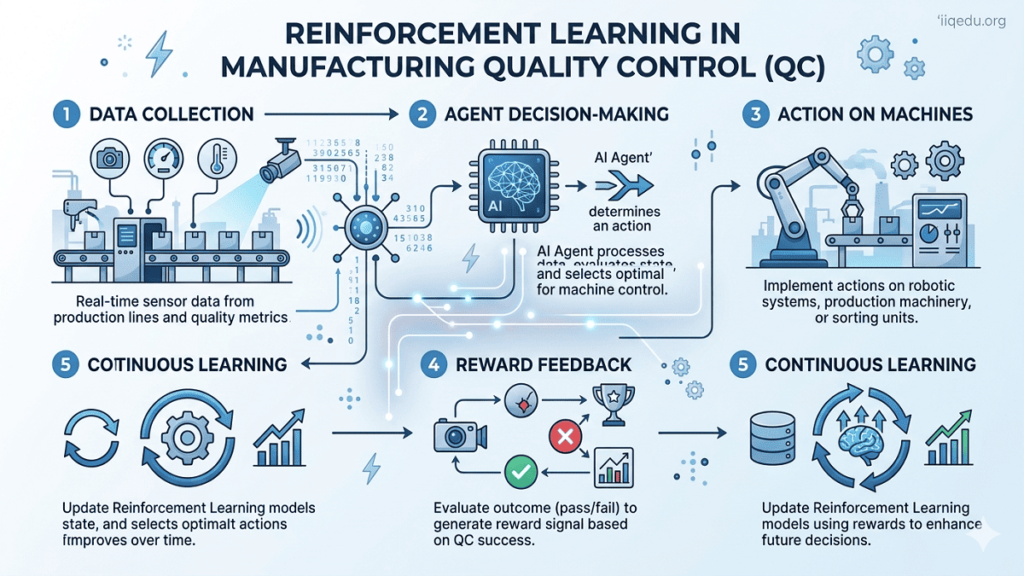
1. Data Collection
- Gather production data from machines, sensors, robotic systems, and inspection results.
2. Define Actions
- Determine controllable process parameters, such as temperature, pressure, speed, or assembly sequences, that the RL agent can adjust.
3. Set Rewards and Penalties
- Assign rewards for actions that improve product quality (e.g., lower defect rates) and penalties for actions that produce poor-quality output.
4. Train the RL Agent
- Use historical and real-time production data to train the RL system to learn which actions maximize quality over time.
5. Implement Real-Time Monitoring
- Deploy the RL agent to continuously monitor and adjust production parameters during manufacturing.
6. Continuous Learning and Optimization
- The RL system adapts to changing conditions, such as material variations or environmental factors, to maintain consistent quality.
In simple terms:
Reinforcement Learning is required in Manufacturing QC by applying adaptive algorithms that learn from production feedback to automatically optimize processes, reduce defects, and improve product quality in real time.
Case study of Reinforcement Learning in Manufacturing QC
1. Background
A large automotive parts manufacturer was experiencing high defect rates in engine component assembly. Manual quality control and traditional rule-based automation were unable to optimize the assembly line in real time.
The company decided to implement Reinforcement Learning (RL) to reduce defects, optimize machine parameters, and improve overall product quality.
2. Problem
The manufacturer faced several challenges:
- High volume of defective components
- Manual adjustments were time-consuming and inconsistent
- Traditional automation could not adapt to dynamic production conditions
- Quality issues caused rework, increased costs, and delayed shipments
3. Solution: Applying Reinforcement Learning
Step 1: Data Collection
The company collected data from:
- Robotic assembly arms
- Production machines (speed, pressure, torque)
- Sensor readings (temperature, vibration, alignment)
- Final inspection and defect reports
Step 2: Define the RL System
- Agent: The RL algorithm controlling machine parameters
- Environment: The assembly line and production process
- Actions: Adjusting machine speed, torque, alignment, and pressure
- Reward Function: Positive reward for low defect rates, penalty for defects
Step 3: Training
The RL agent was trained using historical and real-time data. Through trial and error, it learned the optimal combinations of machine settings to maximize product quality.
Step 4: Deployment
The RL system was deployed to automatically adjust machines in real time while monitoring quality sensors and defect rates.
4. Results
After implementing RL in QC, the manufacturer observed:
- 40% reduction in defective components
- 30% decrease in rework and waste
- Faster detection and correction of quality issues
- Improved consistency and reliability of assembly line output
5. Key Benefits
| Benefit | Impact |
|---|---|
| Automated process optimization | Machines adjust in real-time without human intervention |
| Reduced defect rates | Higher-quality output and fewer recalls |
| Adaptive quality control | Responds to changing materials or conditions |
| Cost savings | Less waste, reduced rework, and improved throughput |
| Data-driven decision-making | Continuous learning for future process improvements |
6. Conclusion
This case study demonstrates that Reinforcement Learning can transform quality control in manufacturing. By enabling machines to learn optimal process parameters from feedback, RL helps organizations reduce defects, improve efficiency, and maintain consistent product quality, moving from reactive QC to proactive, adaptive quality management.
White paper of Reinforcement Learning in Manufacturing QC
Executive Summary
Reinforcement Learning (RL), a type of machine learning, is transforming Manufacturing Quality Control (QC) by enabling machines and processes to learn optimal actions from real-time feedback. Instead of relying solely on manual inspection or fixed automation rules, RL systems continuously adapt process parameters to maximize product quality, minimize defects, and improve efficiency.
This white paper explores the applications, benefits, challenges, and future trends of Reinforcement Learning in manufacturing QC.
1. Introduction
Quality control in manufacturing has traditionally relied on manual inspection, predefined rules, and static automation. While effective to an extent, these approaches cannot adapt in real time to variations in materials, machine conditions, or environmental factors.
Reinforcement Learning provides a solution by allowing an AI agent to learn from trial and error, adjusting process parameters based on quality feedback. The system aims to maximize long-term rewards—typically defined as higher product quality and lower defect rates.
2. The Need for Reinforcement Learning in Manufacturing QC
Modern manufacturing faces several challenges:
- High complexity of production lines with multiple interdependent variables
- Variability in raw materials, machinery, and environmental conditions
- Large-scale production where manual QC is impractical
- Need for real-time process optimization to maintain consistent quality
RL addresses these challenges by enabling adaptive, automated quality control that continuously learns and improves.
3. How Reinforcement Learning Works in QC
Key Components
- Agent: RL algorithm controlling production process parameters
- Environment: The manufacturing line or production process
- Actions: Adjustable process parameters (e.g., speed, temperature, pressure, torque)
- Reward Function: Feedback based on quality outcomes (e.g., fewer defects = higher reward)
- Learning: The agent learns the optimal actions over time to maximize rewards
Workflow
- Data Collection: Gather sensor readings, machine data, and QA inspection reports
- Simulation & Training: Train RL agents using historical and real-time production data
- Deployment: Implement RL agents to adjust machine parameters in real time
- Continuous Monitoring: RL agents adapt to changes and continuously improve production quality
4. Applications in Manufacturing
Automotive Industry
- Optimizing robotic assembly lines
- Reducing defects in engines, chassis, and electronics
Electronics Manufacturing
- Improving precision in PCB assembly
- Reducing soldering and component defects
Pharmaceuticals
- Ensuring consistent drug formulation and packaging
- Optimizing mixing, filling, and inspection processes
Food and Beverage
- Maintaining consistency in bottling, packaging, and processing
- Adjusting machinery to reduce waste
Consumer Goods
- Enhancing production quality of textiles, plastics, and household items
- Detecting defects in real time
5. Benefits of RL in Manufacturing QC
| Benefit | Impact |
|---|---|
| Real-time process optimization | Machines adjust automatically to maximize quality |
| Reduced defect rates | Fewer defective products and recalls |
| Adaptive quality control | Responds to dynamic production conditions |
| Cost reduction | Less waste, reduced rework, improved throughput |
| Data-driven improvement | Continuous learning for future production optimization |
6. Challenges and Considerations
- Data Quality: RL systems require high-quality, consistent sensor and production data
- Complex Model Training: Designing effective reward functions and models can be complex
- Integration: RL must integrate with existing manufacturing and automation systems
- Skilled Personnel: Requires expertise in AI, machine learning, and industrial processes
7. Future Trends
- Integration with Industry 4.0 and smart factories
- Use of digital twins to simulate production processes for RL training
- Advanced deep reinforcement learning for complex, multi-variable processes
- Combining RL with predictive analytics for end-to-end quality management
Industry application of Reinforcement Learning in Manufacturing QC
Reinforcement Learning (RL) is increasingly being applied across manufacturing industries to optimize processes, reduce defects, and improve product quality. By continuously learning from feedback, RL enables adaptive, real-time quality control.
1. Automotive Industry
- Robotic Assembly Lines: RL optimizes robot arm movements to reduce assembly errors.
- Engine and Component Quality: Adjusts machine settings in real-time to minimize defective engine or chassis parts.
- Paint and Coating Processes: Learns optimal parameters for uniform coating quality.
2. Electronics Manufacturing
- PCB Assembly: RL adjusts soldering and placement parameters to reduce defects.
- Component Testing: Optimizes testing sequences to detect faulty components faster.
- Microelectronics: Ensures precision in highly sensitive manufacturing steps.
3. Pharmaceuticals
- Drug Formulation: RL adjusts process parameters like mixing and temperature to ensure consistent quality.
- Packaging Lines: Optimizes filling and sealing processes to minimize waste and defects.
- Quality Compliance: Learns to maintain regulatory standards automatically.
4. Food and Beverage Industry
- Bottling and Packaging: RL ensures consistent product fill levels and packaging quality.
- Processing Lines: Adjusts temperature, mixing, or cooking times for uniform product output.
- Waste Reduction: Reduces spillage, overfilling, or spoilage through adaptive control.
5. Consumer Goods Manufacturing
- Textiles and Apparel: RL optimizes machinery settings to reduce defects in fabrics or garments.
- Plastic and Molded Products: Learns optimal injection or molding parameters to prevent faulty products.
- Household Items: Enhances consistency and reduces production errors in everyday items.
6. Industrial Equipment & High-Tech Manufacturing
- CNC Machines & 3D Printing: RL tunes machine parameters for high-precision production.
- Tool Wear Management: Learns to adjust cutting speeds or tool usage to maintain quality.
- Assembly Automation: Optimizes multi-step robotic operations for minimal errors.
Key Takeaway
Reinforcement Learning in Manufacturing QC is applied wherever complex production processes, high-quality standards, and real-time adaptability are required. By continuously learning from feedback, RL helps industries reduce defects, improve efficiency, and ensure consistent product quality.
Ask FAQs
What is Reinforcement Learning in Manufacturing QC?
Reinforcement Learning (RL) in Manufacturing Quality Control is a type of machine learning where an AI agent learns to optimize production processes by interacting with the environment, receiving feedback, and continuously improving actions to maximize product quality and reduce defects.
Why is Reinforcement Learning important in manufacturing QC?
RL is important because it allows production processes to adapt in real time, automatically optimizing machine parameters and workflows to minimize defects, improve efficiency, and maintain high-quality standards without relying solely on manual adjustments.
Who uses Reinforcement Learning in Manufacturing QC?
RL is used by production managers, quality assurance teams, manufacturing engineers, and data scientists in industries such as automotive, electronics, pharmaceuticals, food and beverage, and consumer goods, where consistent quality is critical.
How does Reinforcement Learning improve quality control?
RL improves QC by continuously learning from production feedback. It adjusts process parameters (e.g., speed, temperature, pressure) to reduce defects, optimize workflows, and maintain consistent product quality even under changing production conditions.
What are the benefits of using Reinforcement Learning in manufacturing QC?
Key benefits include:
Reduced defect rates and production errors
Real-time adaptive process optimization
Reduced rework and waste
Improved product consistency and reliability
Continuous, data-driven process improvement
Source: IBM Technology
Table of Contents
Disclaimer:
The information provided about Reinforcement Learning in Manufacturing Quality Control (QC) is for educational and informational purposes only. Results may vary depending on production processes, data quality, and implementation methods. Organizations should evaluate their specific requirements before applying these techniques in real-world manufacturing environments.