Closed-loop Process Control
In modern industries, maintaining accuracy and stability in processes is extremely important. One of the most effective ways to achieve this is through closed-loop process control. This system continuously monitors the output of a process and automatically adjusts it to maintain the desired result.
What is Closed-Loop Process Control?
Closed-loop process control is a control system where the output of a process is measured and fed back to the controller. The controller compares the actual output with the desired value (called the setpoint) and makes adjustments to reduce any difference between them.
In simple words, the system checks its own performance and corrects itself whenever there is an error.
How It Works
A closed-loop control system usually includes the following components:
- Setpoint – The desired value of the process (for example, a target temperature).
- Sensor – Measures the actual output of the process.
- Controller – Compares the measured value with the setpoint.
- Actuator – Adjusts the process to correct any error.
- Feedback – The measured value sent back to the controller.
If the actual output is different from the desired value, the controller detects the error and sends instructions to the actuator to correct it.
Example of Closed-Loop Control
A common example is a room temperature control system. Suppose the thermostat is set to 25°C. If the room temperature drops below this value, the thermostat detects the change and turns on the heater. Once the temperature reaches the set value, the heater stops automatically. This constant monitoring and adjustment is what makes the system a closed-loop control system.
Advantages of Closed-Loop Process Control
Closed-loop systems offer several benefits:
- Higher accuracy
- Automatic error correction
- Better system stability
- Ability to handle disturbances in the process
Because of these advantages, closed-loop control is widely used in industries such as manufacturing, chemical processing, power plants, and automation systems.
What is Closed-loop Process Control?
Closed-loop process control is a control system in which the output of a process is continuously measured and fed back to the controller, allowing the system to automatically adjust the input to maintain the desired value (setpoint).
Simple Explanation
In a closed-loop system, the controller constantly checks whether the actual output matches the desired output. If there is any difference (called error), the controller makes corrections to bring the system back to the required value.
How It Works
- A setpoint (desired value) is given.
- A sensor measures the actual output of the process.
- The controller compares the measured value with the setpoint.
- If there is a difference, the controller sends a signal to an actuator to adjust the process.
- The corrected output is measured again, and the cycle continues.
Example
A thermostat-controlled air conditioner is a common example.
- If the room temperature rises above the set temperature, the AC turns on.
- Once the desired temperature is reached, it turns off automatically.
Key Benefit
The main advantage of closed-loop control is that it automatically corrects errors and maintains accuracy, even when disturbances occur in the system.
In short: Closed-loop process control uses feedback from the output to control and stabilize the process automatically.
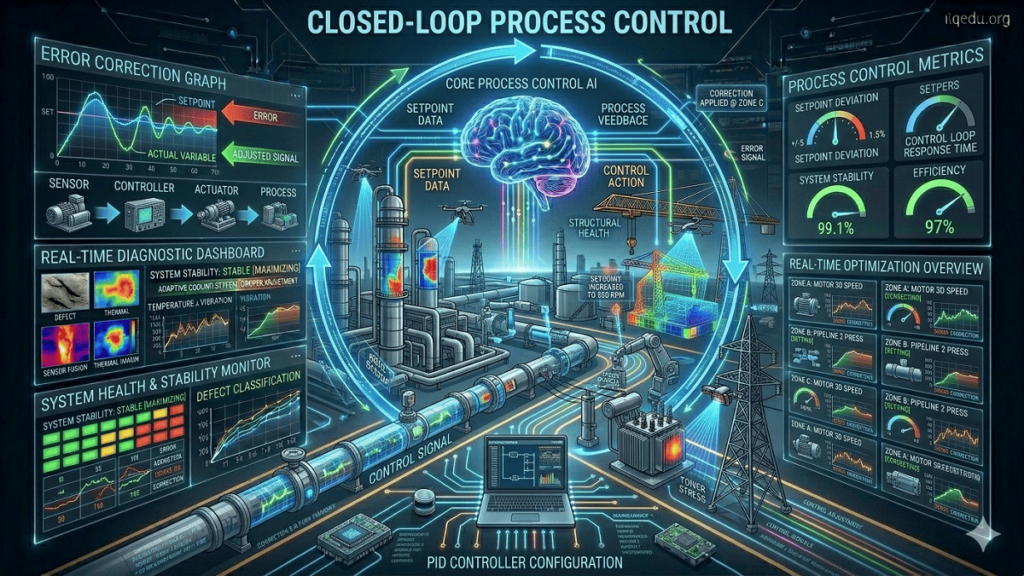
Who requires Closed-loop Process Control?
Closed-loop process control is required by industries and systems that need high accuracy, stability, and automatic correction of errors during operations. It is commonly used where maintaining exact process conditions is important. ⚙️
1. Manufacturing Industries
Factories use closed-loop control to maintain precise speed, pressure, temperature, and position in machines.
Example: CNC machines and robotic arms.
2. Chemical and Pharmaceutical Industries
These industries require strict control of temperature, pressure, and chemical concentration during production to ensure product quality and safety.
3. Power Plants
Power generation systems use closed-loop control to regulate voltage, turbine speed, and steam pressure for stable electricity production.
4. HVAC Systems
Heating, ventilation, and air conditioning systems use closed-loop control to maintain comfortable indoor temperature and humidity.
5. Automotive Industry
Modern vehicles use closed-loop control in systems like cruise control, fuel injection, and engine management.
6. Aerospace and Robotics
Aircraft autopilot systems and robots use closed-loop control to maintain stable movement, direction, and position.
When is Closed-loop Process Control required?
Closed-loop process control is required when a system must maintain a desired output accurately by automatically correcting any errors using feedback.
Situations When Closed-Loop Process Control Is Required
1. When high accuracy is needed
Closed-loop control is used when the output must stay very close to the desired value.
Example: Maintaining a specific temperature in a furnace.
2. When disturbances may affect the process
If external factors such as load changes, environmental conditions, or variations in input can disturb the system, closed-loop control helps correct them automatically.
3. When continuous monitoring is required
In processes where the output must be monitored constantly, feedback control ensures the system adjusts itself in real time.
4. When automatic correction is necessary
Closed-loop systems are useful when manual adjustments are impractical or too slow.
5. When system stability and reliability are important
Industries that require consistent product quality or stable operations use closed-loop control.
Example
A temperature control system in an industrial oven uses closed-loop control. If the temperature drops below the setpoint, the system automatically increases heating to bring it back to the desired level.
In simple terms: Closed-loop process control is required whenever a system needs continuous feedback and automatic adjustments to maintain the desired performance.
Where is Closed-loop Process Control required?
Closed-loop process control is required in systems and industries where precise control of a process is necessary to maintain the desired output. It is widely used in applications that need continuous monitoring and automatic adjustments.
1. Manufacturing Industries
Closed-loop control is used to regulate machine operations such as speed, position, pressure, and temperature. It helps maintain product quality and consistency.
2. Chemical and Pharmaceutical Plants
These industries require accurate control of chemical reactions, temperature, pressure, and concentration levels to ensure safe and reliable production.
3. Power Plants
Closed-loop systems are used to control turbine speed, steam pressure, and voltage levels for stable electricity generation.
4. HVAC Systems
Heating, ventilation, and air conditioning systems use closed-loop control to maintain comfortable indoor temperature and humidity levels in buildings.
5. Automotive Systems
Modern vehicles use closed-loop control in systems such as cruise control, fuel injection, and engine management to improve performance and efficiency.
6. Robotics and Automation
Robots and automated machines use closed-loop control to maintain precise movement, position, and speed during operation.
How is Closed-loop Process Control required?
Closed-loop process control is implemented by using a feedback system that continuously measures the output of a process and adjusts the input to maintain the desired value (setpoint).
How Closed-Loop Process Control Works
1. Setting the Desired Value (Setpoint)
The process begins by defining the required output value, such as a specific temperature, pressure, or speed.
2. Measuring the Output
A sensor or measuring device monitors the actual output of the process.
3. Sending Feedback to the Controller
The measured output is sent back to the controller as feedback.
4. Comparing Output with Setpoint
The controller compares the actual output with the desired setpoint and determines if there is an error (difference).
5. Correcting the Error
If a difference exists, the controller sends a signal to the actuator or final control element to adjust the process input.
6. Continuous Monitoring
The system keeps measuring and correcting the output continuously until the output matches the setpoint.
Example
In a temperature control system, if the measured temperature drops below the desired value, the controller increases the heating. When the temperature reaches the setpoint, the controller reduces or stops heating.
Case study of Closed-loop Process Control
Temperature Control in an Industrial Furnace
Background
In many manufacturing industries such as steel production and ceramics, maintaining a constant furnace temperature is critical for product quality. If the temperature becomes too high or too low, it can damage materials or produce defective products. To solve this problem, industries use a closed-loop process control system.
Problem
A manufacturing plant needed to maintain a furnace temperature at 800°C during the heating process. However, factors such as heat loss, changes in fuel supply, and opening of furnace doors caused fluctuations in temperature.
Solution: Closed-Loop Control System
The plant implemented a closed-loop temperature control system with the following components:
- Setpoint
The desired temperature of the furnace was set to 800°C. - Temperature Sensor
A temperature sensor was installed inside the furnace to continuously measure the actual temperature. - Controller
A controller compared the measured temperature with the setpoint value. - Actuator (Control Valve or Heater)
If the temperature dropped below 800°C, the controller increased the fuel supply or heating power. If the temperature rose above the setpoint, the controller reduced the fuel supply. - Feedback Loop
The sensor continuously sent temperature data back to the controller, allowing real-time adjustments.
Working of the System
- When the furnace temperature fell to 780°C, the sensor detected the drop.
- The controller calculated the error between the setpoint (800°C) and the measured value.
- The controller increased the fuel supply to the burner.
- The temperature gradually returned to 800°C.
- The system continued monitoring and adjusting the temperature automatically.
Results
- Stable furnace temperature was maintained.
- Product quality improved.
- Energy consumption was optimized.
- Human intervention was reduced.
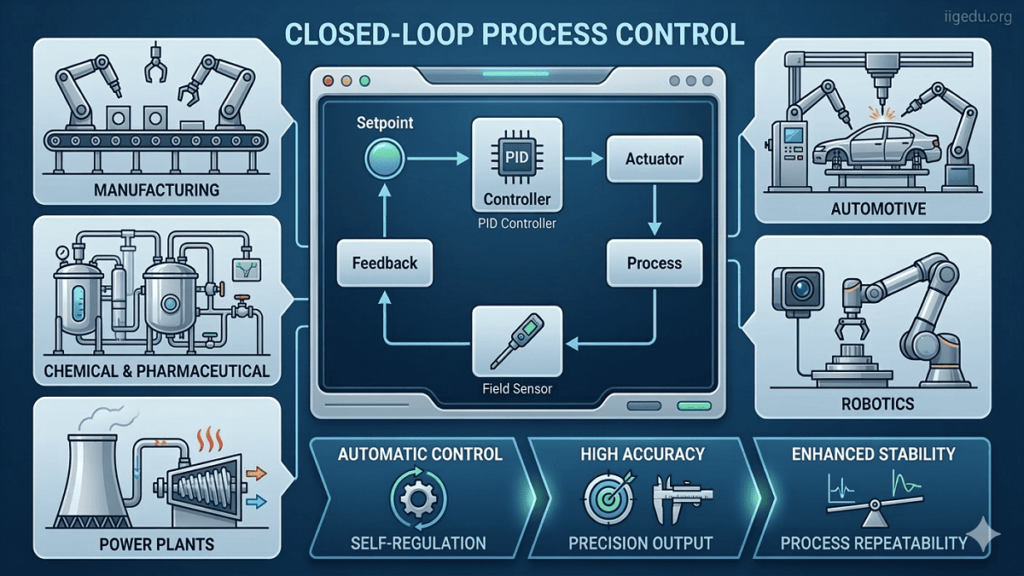
An infographic showing how closed-loop process control improves accuracy, automation, and stability across multiple industries.
White paper of Closed-loop Process Control
Abstract
Closed-loop process control is a fundamental concept in modern industrial automation. It uses continuous feedback from a system’s output to automatically adjust inputs and maintain desired operating conditions. This white paper explains the principles, architecture, benefits, and industrial applications of closed-loop process control systems.
1. Introduction
Industrial processes require accurate control of variables such as temperature, pressure, flow rate, and speed. Manual control methods are often insufficient because industrial environments experience constant disturbances and changing conditions. Closed-loop process control provides an automated solution by continuously monitoring process outputs and correcting deviations from desired values.
Closed-loop control systems are widely used in manufacturing, research laboratories, and large-scale industrial operations to ensure consistent and reliable process performance. ()
2. Definition of Closed-Loop Process Control
Closed-loop process control is a system in which the output of a process is measured and fed back to the controller. The controller compares the measured output with a predefined setpoint and adjusts the process input to minimize the difference (error). ()
This feedback mechanism enables the system to automatically maintain stable operating conditions and compensate for disturbances.
3. Basic Components of a Closed-Loop Control System
A typical closed-loop process control system consists of the following components:
- Setpoint (SP) – The desired value of the process variable.
- Sensor or Measurement Device – Measures the actual output of the process.
- Controller – Compares the measured value with the setpoint and calculates the required correction.
- Actuator or Final Control Element – Implements the controller’s command to adjust the process.
- Process/Plant – The system or operation being controlled.
- Feedback Path – Sends measured data back to the controller.
These components work together to form a feedback loop that continuously regulates the system.
4. Working Principle
Closed-loop control operates through the following steps:
- The system receives a desired reference value (setpoint).
- Sensors measure the current process output.
- The controller compares the measured output with the setpoint.
- If a deviation exists, the controller calculates an error signal.
- The controller sends a corrective command to the actuator.
- The actuator modifies the process to reduce the error.
This cycle repeats continuously to maintain system stability.
5. Control Methods
Closed-loop control systems commonly use different control strategies, including:
- On/Off Control – Simple switching control used in thermostats.
- Proportional Control (P) – Control action proportional to the error.
- Integral Control (I) – Eliminates steady-state error.
- Derivative Control (D) – Predicts system behavior and improves stability.
These methods are often combined in PID controllers, which are widely used in industrial process control.
6. Applications
Closed-loop process control is used in many industries, including:
Manufacturing Industry
Controls machine speed, position, and quality parameters in automated production lines.
Chemical and Pharmaceutical Plants
Maintains accurate temperature, pressure, and concentration levels during chemical reactions.
Power Generation Systems
Regulates turbine speed, voltage, and steam pressure in power plants.
Automotive Systems
Used in cruise control, engine management, and braking systems.
Building Automation
Maintains temperature and humidity in HVAC systems.
7. Benefits of Closed-Loop Process Control
Closed-loop systems offer several advantages:
- Improved accuracy and precision
- Automatic correction of disturbances
- Better process stability
- Reduced human intervention
- Increased product quality
Because of these benefits, closed-loop control has become a core technology in industrial automation and smart manufacturing systems.
8. Challenges and Limitations
Despite its advantages, closed-loop control systems also present some challenges:
- Higher system complexity
- Increased installation and maintenance cost
- Requirement for accurate sensors and calibration
- Need for controller tuning
However, advancements in digital control systems and industrial computing continue to improve system performance and reliability.
9. Future Trends
With the emergence of Industry 4.0, closed-loop process control is becoming more intelligent through the integration of:
- Industrial Internet of Things (IIoT)
- Artificial intelligence and predictive analytics
- Digital twins and data-driven optimization
These technologies enable real-time monitoring and adaptive control for more efficient industrial processes.
10. Conclusion
Closed-loop process control is a critical technology for maintaining accurate and stable operation in industrial systems. By continuously measuring system outputs and adjusting inputs through feedback, these systems ensure reliable performance and improved efficiency. As industries move toward smarter and more automated environments, closed-loop control will remain a key element in modern process automation.
Keywords
Closed-loop control, process automation, feedback control, PID controller, industrial process control, automation systems.
Industry application of Closed-loop Process Control
Closed-loop process control is widely used in industries where precise monitoring and automatic adjustment of process variables are required. It helps maintain stability, improve efficiency, and ensure consistent product quality.
1. Manufacturing Industry
In manufacturing plants, closed-loop control systems regulate machine operations such as speed, position, pressure, and temperature.
Example: CNC machines use feedback from sensors to maintain accurate cutting positions and speeds.
2. Chemical and Pharmaceutical Industry
Chemical and pharmaceutical processes require strict control of temperature, pressure, flow rate, and concentration during reactions. Closed-loop systems ensure safe operations and consistent product quality.
3. Power Generation Industry
Power plants use closed-loop control to maintain turbine speed, boiler pressure, and voltage output. This helps ensure stable electricity generation and efficient energy production.
4. Automotive Industry
Modern vehicles use closed-loop control in systems such as fuel injection, engine control, cruise control, and anti-lock braking systems (ABS). These systems improve performance, fuel efficiency, and safety.
5. Food and Beverage Industry
Closed-loop control is used to maintain temperature, mixing ratios, and processing time during food production to ensure product consistency and safety.
6. HVAC and Building Automation
Heating, ventilation, and air conditioning systems use closed-loop control to regulate temperature, humidity, and air flow in buildings, hospitals, and offices.
7. Robotics and Automation
Industrial robots rely on closed-loop control systems to maintain accurate motion, position, and speed, which is essential for tasks such as assembly, welding, and packaging.
Conclusion
Closed-loop process control plays an essential role in modern industries by providing automatic monitoring, accurate control, and improved system stability. It is a key technology in industrial automation and smart manufacturing systems.
#closed-loopprocesscontrolinmumbai #closed-loopprocesscontrolinIndia
Ask FAQs
What is closed-loop process control?
Closed-loop process control is a system where the output is continuously measured and fed back to the controller so that the input can be adjusted automatically to maintain the desired setpoint.
What are the main components of a closed-loop process control system?
The main components include a setpoint, sensor, controller, actuator (final control element), process/plant, and feedback path.
What is the difference between open-loop and closed-loop control systems?
Open-loop systems operate without feedback and cannot automatically correct errors, while closed-loop systems use feedback to monitor the output and make automatic corrections.
What are the advantages of closed-loop process control?
The advantages include higher accuracy, automatic error correction, improved stability, and better process efficiency.
Where is closed-loop process control commonly used?
It is commonly used in manufacturing industries, chemical plants, power plants, automotive systems, HVAC systems, and robotics for maintaining precise control of processes.
Source: WR Training Contact
Table of Contents
Disclaimer
The information provided in this document is for educational and informational purposes only. While every effort has been made to ensure accuracy, the content may not cover all aspects of closed-loop process control. Readers are encouraged to consult industry professionals or technical resources before applying any concepts in practical or industrial environments.