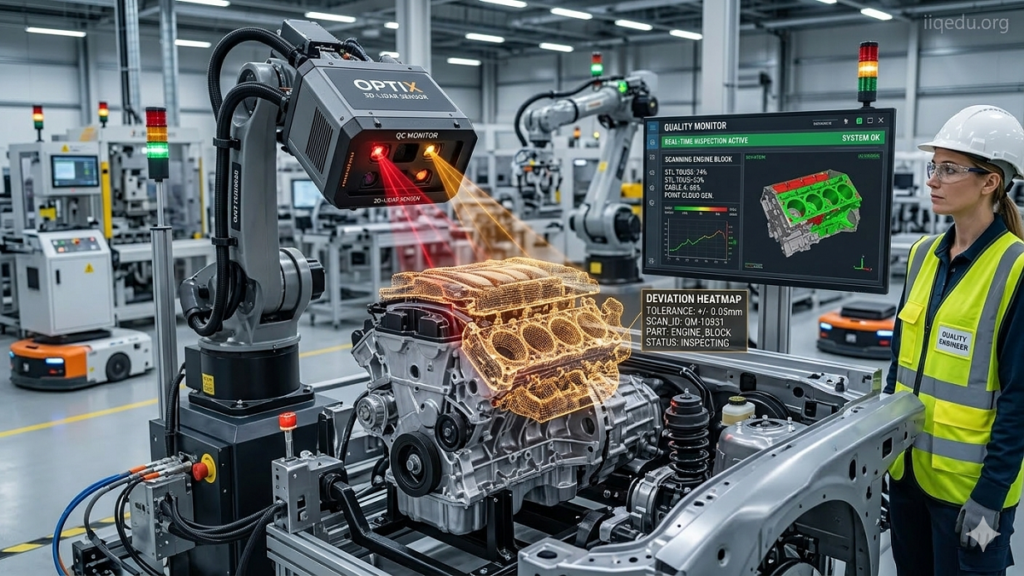
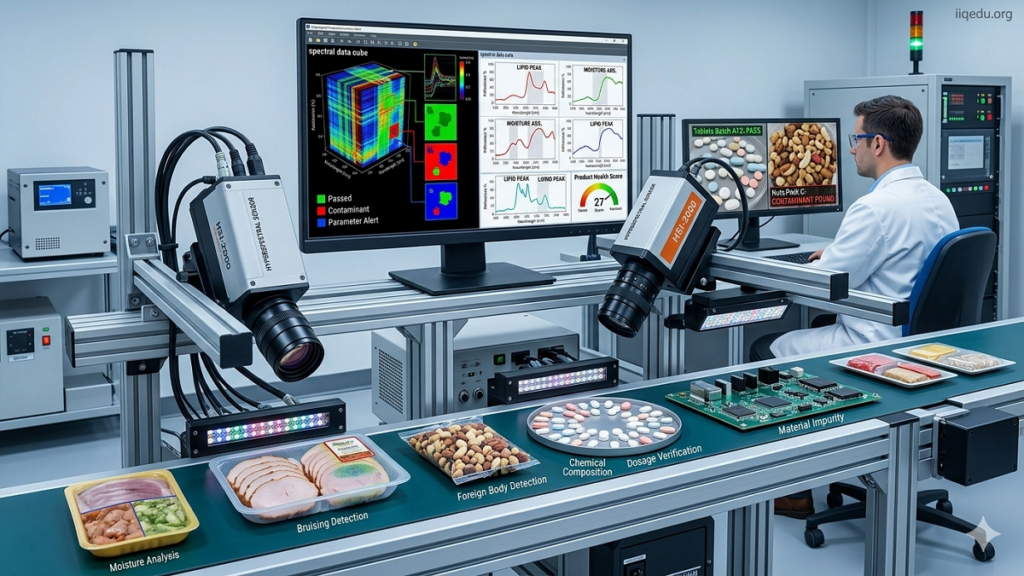
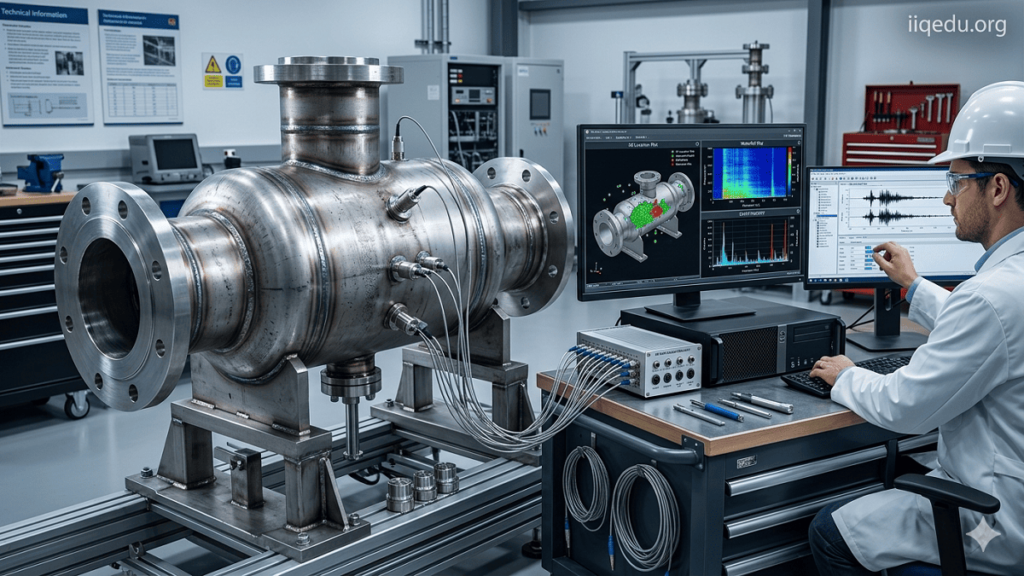
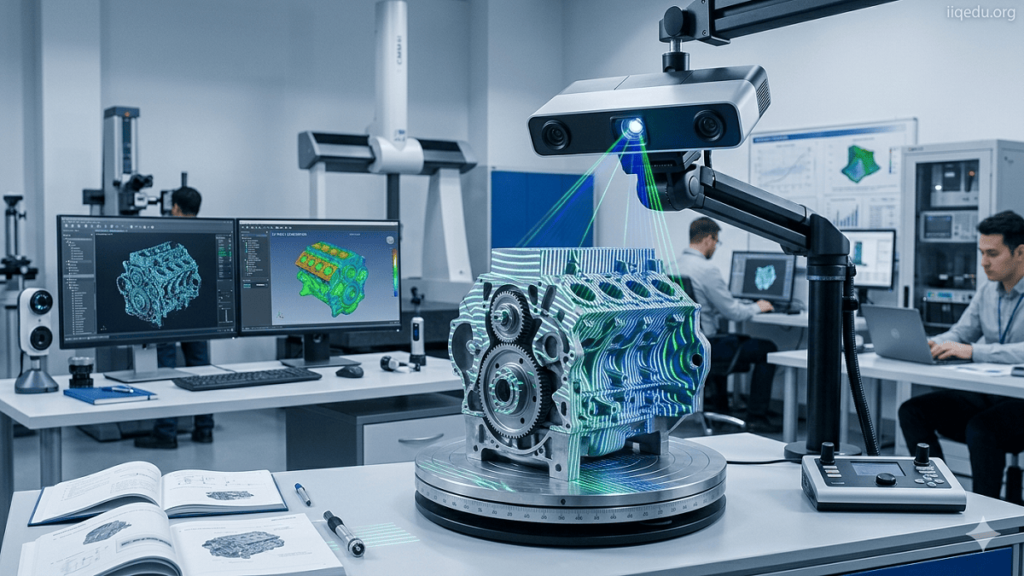
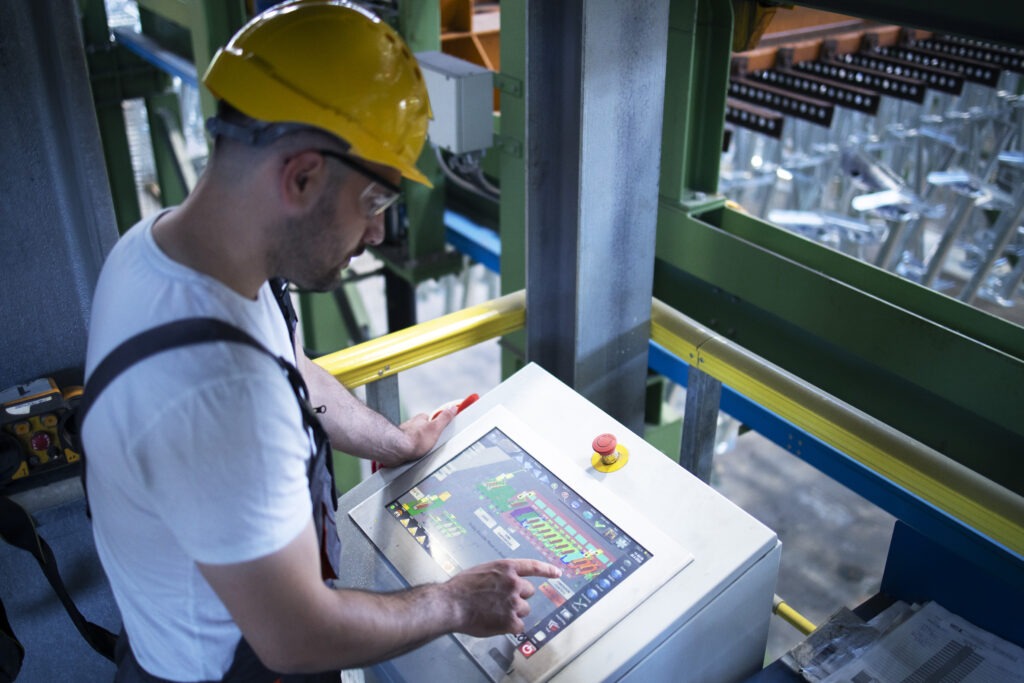
Multi-sensor fusion in QC system inspecting products on a factory conveyor using cameras, laser scanners, and thermal sensors while AI software analyzes quality data in real time. Multi-sensor fusion in QC
Advanced Sensing & Vision, Multi-sensor Fusion in QC

Multi-sensor Fusion in QC

This image illustrates a multi-sensor fusion quality control system in a smart factory. Cameras, laser scanners, and thermal sensors simultaneously inspect products on a conveyor belt. Data from each sensor is combined and analyzed by an AI-based monitoring system to detect defects and ensure product quality. A watermark ‘iiqedu.org’ appears in the top-right corner of the image

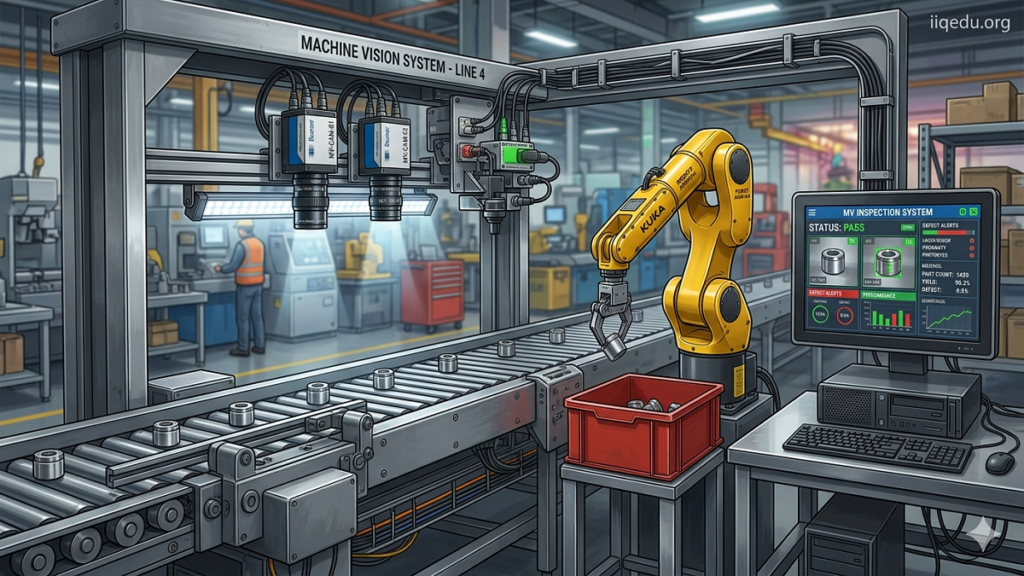
Industrial machine vision system inspecting products on a conveyor belt with cameras, sensors, and robotic arms. Computer analyzes images in real-time. Watermark 'iiqedu.org' visible in the top-right corner.
Advanced Sensing & Vision, Machine Vision Systems

Machine Vision Systems

This illustration shows a modern machine vision system used in industrial automation. Cameras and sensors capture images of products on a conveyor belt, while a computer processes the data to detect defects or measure dimensions. Robotic arms act based on the system’s analysis. The image includes a watermark ‘iiqedu.org’ in the top-right corner for branding.

Additive Manufacturing & Smart Materials, Smart Materials with Self-Healing Properties

Smart Materials with Self-Healing Properties

Smart Materials with Self-Healing Properties “Smart materials with self-healing properties” are a fascinating subset of advanced materials that possess the inherent ability to autonomously repair damage, such as cracks, scratches, or punctures, without external human intervention. This capability is inspired by biological systems, where living organisms regenerate and heal their own tissues. The goal of self-healing materials is to extend the lifespan of products, reduce maintenance costs, improve reliability, and prevent catastrophic failures, especially in applications where inspection and repair are difficult or expensive. How Self-Healing Materials Work (Mechanisms): Self-healing mechanisms can broadly be categorized into two main types: Types of Materials Being Developed for Self-Healing: Self-healing properties are being explored across various material classes: Industrial Applications and Benefits: The potential impact of self-healing materials spans numerous industries: Benefits: Research and Development in India (Maharashtra focus): India, particularly Maharashtra, has a strong and growing research ecosystem in materials science. While specific commercial products might still be emerging, research institutes and some companies are actively working on self-healing materials: The field of self-healing smart materials is still evolving rapidly, moving from lab-scale demonstrations to commercial applications. The ability to autonomously repair damage without human intervention holds immense promise for improving the longevity, safety, and sustainability of a vast array of products and infrastructure. What is Smart Materials with Self-Healing Properties? Smart materials with self-healing properties are an advanced class of materials that possess the inherent capability to autonomously detect and repair damage (such as cracks, scratches, or punctures) within themselves, without requiring external human intervention. This ability mimics biological healing processes, where living organisms regenerate and mend their own tissues. The primary goal of developing self-healing materials is to extend the lifespan of products, reduce maintenance and repair costs, Smart Materials, enhance reliability, and prevent catastrophic failures, especially in applications where accessibility for repair is difficult, dangerous, or expensive. Core Concept: Autonomy in Repair The “smart” aspect comes from the material’s ability to sense damage and initiate a repair mechanism on its own. This self-repair capability can be categorized by the method of healing: Types of Materials Incorporating Self-Healing Properties: Self-healing capabilities are being developed across various material categories: Why are these “Smart Materials” Important? The significance of self-healing materials lies in their potential to revolutionize numerous industries by addressing fundamental challenges: The development of smart materials with self-healing properties represents a paradigm shift, moving towards materials that are not merely passive structural components but active participants in maintaining their own integrity and extending their functional lifetime. Sources Who is require Smart Materials with Self-Healing Properties? Courtesy: Top 10 You Should Know Smart materials with self-healing properties are required by any industry or application where: Here’s a breakdown of the key sectors and specific applications that require self-healing smart materials: 1. Construction and Infrastructure This is arguably the largest potential market, given the pervasive issue of material degradation (cracks, corrosion) in buildings, bridges, and roads. Smart Materials. 2. Aerospace and Defense High-performance, lightweight materials are critical, and structural integrity is non-negotiable. 3. Automotive Industry Focus on safety, durability, aesthetics, and reducing maintenance for consumers. 4. Consumer Electronics Driven by the demand for more durable, flexible, and aesthetically pleasing devices. 5. Energy Sector Improving the longevity and efficiency of energy generation and storage systems. 6. Biomedical and Healthcare For implants, drug delivery, and diagnostic tools where long-term stability and biocompatibility are paramount. 7. Robotics and Soft Robotics Enhancing the durability and adaptability of robotic components. In essence, anyone seeking to reduce lifecycle costs, enhance product reliability, improve safety, and push the boundaries of material durability for their products and infrastructure is in need of smart materials with self-healing properties. The growing research and development in India, particularly in institutions like IIT Bombay and NCL Pune, indicates a rising domestic interest and capability in delivering these transformative solutions for various industrial applications. When is require Smart Materials with Self-Healing Properties? Smart materials with self-healing properties are required when the consequences of material degradation or damage outweigh the current cost and complexity of implementing such advanced solutions. This often translates to situations where: Here’s a breakdown of when self-healing smart materials are required, often corresponding to specific stages of a product’s lifecycle or ongoing operational needs: 1. During the Design & Development Phase (When Designing for Durability & Reliability) 2. In Manufacturing (When Ensuring Long-Term Quality and Reducing Defects) 3. During Installation & Initial Operation (When Mitigating Early Damage) 4. Throughout the Operational Lifespan (When Facing Continuous Wear & Tear) 5. In Remote, Inaccessible, or Hazardous Environments 6. When Lifecycle Cost Reduction is a Key Performance Indicator In essence, smart materials with self-healing properties are required whenever the conventional approach of “inspect and repair/replace” becomes inefficient, unsafe, or economically unsustainable, pushing the boundaries towards “self-sustaining” or “self-managing” material systems. Where is require Smart Materials with Self-Healing Properties? Smart materials with self-healing properties are required in virtually any environment or application where material degradation, damage, or wear and tear is a recurring problem, and where intervention (inspection, maintenance, repair, or replacement) is costly, difficult, dangerous, or needs to be minimized. Here’s a breakdown of “where” these materials are needed, spanning various industries and specific locations/components: 1. Construction and Infrastructure 2. Aerospace and Defense 3. Automotive Industry 4. Consumer Electronics 5. Energy Sector 6. Biomedical and Healthcare 7. Robotics and Soft Robotics 8. Coatings and Adhesives Industry In summary, self-healing materials are required globally wherever durability, reliability, and reduced maintenance costs are critical performance indicators, especially in challenging environments or for long-lived assets. From the massive civil infrastructure projects in India’s growing cities (like Mumbai’s metro, new highways) to its burgeoning aerospace and electronics industries, the demand for materials that can intelligently manage their own integrity is only set to increase. How is require Smart Materials with Self-Healing Properties? The requirement for Smart Materials with Self-Healing Properties is fundamentally about how we ensure that the healing capability is present, effective, and reliable throughout the material’s intended lifespan. This involves a specialized approach to Quality Assurance


Additive Manufacturing & Smart Materials, Shape Memory Alloy QA

Shape Memory Alloy QA

Shape Memory Alloy QA Shape Memory Alloy QA, particularly Nickel-Titanium (NiTi or Nitinol), possess unique thermomechanical properties like the Shape Memory Effect (SME) and Superelasticity (SE) (also known as Pseudoelasticity). These properties make them highly attractive for advanced applications in demanding sectors. However, their unique behavior also necessitates a specialized approach to Quality Assurance (QA). Here’s a breakdown of QA for Shape Memory Alloys: 1. Key Properties Requiring Rigorous QA for SMAs: Unlike conventional metals, the QA of SMAs extends beyond typical mechanical properties to include their functional, temperature-dependent behavior. 2. QA Methodologies and Techniques for SMAs: To ensure the quality of SMAs, a combination of specialized and conventional testing methods is used: 3. Relevant QA Standards and Guidelines: Several ASTM standards are specifically developed for Nitinol and other SMAs, particularly due to their widespread use in medical devices. While many are specific to NiTi, the principles apply broadly to other SMAs. 4. QA in the SMA Product Lifecycle: In conclusion, QA for Shape Memory Alloys is about ensuring the predictable and repeatable functional behavior of these “smart” materials. It goes beyond conventional material testing to encompass their unique phase transformation characteristics and thermomechanical response. This specialized QA approach is critical for the reliable and safe deployment of SMAs in their growing range of advanced industrial applications. What is Shape Memory Alloy QA? Shape Memory Alloy (SMA) Quality Assurance (QA) is a specialized and critical process that goes beyond conventional metallurgy to ensure these unique “smart” materials consistently exhibit their extraordinary thermomechanical properties: the Shape Memory Effect (SME) and Superelasticity (SE). Unlike typical metals where QA focuses primarily on strength, hardness, and ductility, SMA QA must also rigorously control and verify: The “How” of SMA QA in Practice: SMA QA is implemented through: In essence, SMA QA ensures that the “memory” and “superelasticity” of these alloys are not just inherent properties, but are consistently and predictably engineered into the final product, meeting the stringent demands of their advanced applications. Who is require Shape Memory Alloy QA? Courtesy: Science In Society Shape Memory Alloy (SMA) Quality Assurance (QA) is required by anyone who designs, manufactures, or uses SMA components in applications where their unique functional properties (Shape Memory Effect or Superelasticity) are critical to performance, reliability, and safety. This is especially true for industries where product failure can have severe consequences. Here are the key players and industries that require SMA QA: 1. Medical Device Manufacturers This is by far the largest and most stringent sector for SMA QA, particularly for Nitinol (Nickel-Titanium) alloys. 2. Aerospace & Defense Industry SMAs are gaining traction for lightweighting, morphing structures, actuators, and vibration damping in aircraft and spacecraft. 3. Automotive Industry SMAs are used in niche applications for actuators, sensors, and sometimes even for aesthetic or safety features. 4. Consumer Electronics & Robotics SMAs find applications in miniaturized actuators, haptic feedback devices, and flexible components in smartphones, wearables, and small robots. 5. Industrial & General Actuation Beyond specific industries, any application using SMAs as actuators, sensors, or connectors (e.g., thermal valves, anti-scalding devices, couplings) requires QA. 6. Research & Development (R&D) Institutions & Material Suppliers While not producing end-user products, these entities are crucial to SMA QA. In summary, SMA QA is required by any entity in the supply chain that contributes to the functional performance or safety of a product containing a Shape Memory Alloy component. This includes raw material producers, part manufacturers, integrators, and ultimately, regulatory bodies that oversee the safety and efficacy of products in critical domains. when is require Shape Memory Alloy QA? Shape Memory Alloy (SMA) Quality Assurance (QA) is not a single event but a continuous and intensifying process that is required at every stage of the SMA component’s lifecycle, from the initial raw material production through manufacturing, assembly, and even into its operational life. The level of rigor for QA increases significantly as the component moves towards final product integration and deployment, especially in critical applications. Here’s a breakdown of “when” SMA QA is required: 1. Raw Material Production (Melting, Forging, Drawing of SMA Alloys) 2. Component Manufacturing / Fabrication (Wire Forming, Stamping, Machining, Additive Manufacturing) 3. Assembly & Integration into a Larger Device/System 4. Final Product Release Testing 5. Regulatory Submission & Certification 6. Post-Market Surveillance (for Commercialized Products) In essence, SMA QA is required continuously throughout the material and product journey. It’s built in from the ground up, verified at critical junctures, and monitored even after deployment, reflecting the unique and critical nature of Shape Memory Alloys. where is require Shape Memory Alloy QA? Shape Memory Alloy (SMA) Quality Assurance (QA) is required wherever the reliable and predictable functional performance of an SMA component is critical to the safety, efficacy, or intended operation of a product or system. This encompasses both specific stages of the product lifecycle and the industries involved. Here’s a breakdown of “where” SMA QA is required: I. Where in the Product Lifecycle: SMA QA is not a one-time check but a continuous process integrated into every phase of a product’s development and manufacturing: II. Where in Industries & Applications: SMA QA is most rigorously applied in industries with high stakes for product failure: In summary, SMA QA is required throughout the entire product value chain and across diverse industries where the unique functional characteristics of Shape Memory Alloys are leveraged for critical applications, demanding uncompromising reliability and performance. How is require Shape Memory Alloy QA? You’re asking “How is Shape Memory Alloy (SMA) QA required?” This question delves into the practical implementation, methodologies, and systematic approaches that organizations must adopt to ensure the quality of SMA components. It’s about the processes, tests, and management systems that are put in place. Here’s a detailed explanation of how SMA QA is required: 1. By Implementing a Robust Quality Management System (QMS) This is the foundational and overarching requirement. A QMS provides the framework for all quality activities within an organization dealing with SMAs. 2. Through Precise Material Characterization & Control This focuses
Quality Standards in Metal Additive Manufacturing
Additive Manufacturing & Smart Materials, Quality Standards in Metal Additive Manufacturing

Quality Standards in Metal Additive Manufacturing

Quality standards in metal additive manufacturing (AM) define the requirements for materials, processes, and final parts to ensure safety, reliability, and performance. They cover areas such as material certification, process control, dimensional accuracy, mechanical properties, and post-processing. Key standards include ISO/ASTM 52900 (general AM terminology), ISO/ASTM 52910 (design guidelines), and industry-specific standards for aerospace, medical, and automotive applications. Compliance ensures reproducibility, reduces defects, and supports certification of critical components.

Contact Detail

B-401, Om Kaveri CHS Ltd, Nagindas Pada, Next to Shivsena Office, Nalasopara (East), Dist.- Palghar
Maharastra (401209).
admin@iiqedu.org
+91 9322728183

Community

Follow Us

2025 Copyright iiqedu.org

Scroll to Top