Collaborative Robots (Cobots) for QA
Collaborative robots (Cobots) are robots designed to work safely alongside humans in a shared workspace. In Quality Assurance (QA), cobots are used to inspect, test, and verify products to ensure they meet required standards and specifications.
What Are Cobots?
Cobots are lightweight, flexible robotic systems equipped with sensors and safety features that allow them to operate close to human workers without the need for heavy safety barriers. They assist workers by performing repetitive or precision-based inspection tasks.
How Cobots Are Used in QA
Cobots help improve quality control processes by performing tasks such as:
1. Visual Inspection
Cobots equipped with cameras and vision systems can inspect products for defects, scratches, or incorrect assembly.
2. Measurement and Testing
They can measure dimensions, weight, or pressure to ensure products meet design specifications.
3. Repetitive Quality Checks
Cobots perform repetitive inspections consistently without fatigue, reducing human error.
4. Data Collection and Reporting
Cobots can collect inspection data and send it to monitoring systems for analysis and reporting.
Benefits of Cobots in Quality Assurance
Improved Accuracy
Cobots can perform inspections with high precision and consistency.
Higher Productivity
They can work continuously and speed up quality inspection processes.
Reduced Human Error
Automation reduces mistakes that can occur during manual inspection.
Better Worker Safety
Cobots handle repetitive or potentially hazardous inspection tasks.
Flexibility
Cobots can be reprogrammed easily for different inspection tasks or products.
Industry Applications
Cobots for QA are used in several industries, including:
- Automotive manufacturing
- Electronics production
- Pharmaceutical and medical device manufacturing
- Food and beverage processing
- Consumer goods manufacturing
What are Collaborative Robots (Cobots) for QA?
Collaborative Robots (Cobots) for Quality Assurance (QA) are robots designed to work safely alongside human workers to help inspect, test, and verify products to ensure they meet quality standards.
Cobots are equipped with sensors, cameras, and safety features that allow them to operate in the same workspace as humans without large safety barriers. In quality assurance processes, they assist in checking products for defects, measuring dimensions, and performing repetitive inspection tasks with high accuracy.
Key Functions of Cobots in QA
- Visual inspection to detect defects or damages in products
- Measurement and testing to verify size, weight, or performance
- Automated quality checks for consistent inspection
- Data collection and reporting for quality monitoring and analysis
Simple Example
In an electronics factory, a cobot with a vision system can inspect circuit boards to detect missing components or assembly errors before the product moves to the next stage of production.
In simple terms, cobots for QA help industries improve product quality by combining robotic precision with human supervision.
Who are Collaborative Robots (Cobots) for QA required?
Collaborative Robots (Cobots) for Quality Assurance (QA) are required by organizations and industries that need accurate, consistent, and efficient product inspection to maintain high quality standards.
1. Manufacturing Companies
Manufacturing industries use cobots to inspect products, detect defects, and ensure consistent production quality.
2. Automotive Industry
Automotive manufacturers require cobots to check vehicle parts, assemblies, and components for defects and correct measurements.
3. Electronics Industry
Electronics companies use cobots to inspect circuit boards, small components, and devices where high precision is necessary.
4. Pharmaceutical and Medical Device Companies
These industries require strict quality checks to ensure that medicines and medical devices meet safety and regulatory standards.
5. Food and Beverage Industry
Cobots help inspect packaging, labeling, and product quality to maintain hygiene and safety standards.
6. Quality Control Departments
Quality control teams in factories and production facilities use cobots to automate inspection tasks and reduce human error.
In simple terms, cobots for QA are required by industries that need reliable, accurate, and efficient quality inspection in their production processes.
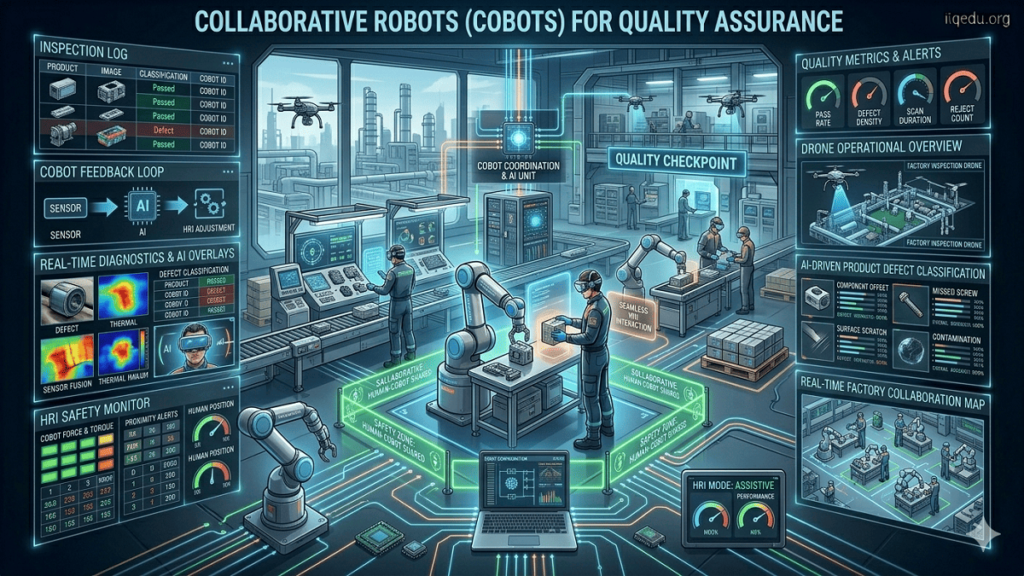
When are Collaborative Robots (Cobots) for QA required?
Collaborative Robots (Cobots) for Quality Assurance (QA) are required when industries need reliable, accurate, and consistent inspection of products during manufacturing and production processes.
Situations When Cobots for QA Are Required
1. When high inspection accuracy is needed
Cobots are used when products must be checked with high precision, especially in industries like electronics, automotive, and medical devices.
2. When inspection tasks are repetitive
In production lines where the same quality checks must be performed repeatedly, cobots help perform these tasks consistently without fatigue.
3. When production volume is high
Cobots are useful in high-volume manufacturing where manual inspection alone cannot keep up with production speed.
4. When human error must be reduced
Automated inspection with cobots helps minimize mistakes that may occur during manual quality checks.
5. When worker safety is important
Cobots can handle inspection tasks in environments that may be uncomfortable or potentially unsafe for workers.
In simple terms, cobots for QA are required when industries need faster, more accurate, and consistent quality inspections during production.
Where are Collaborative Robots (Cobots) for QA required?
Collaborative Robots (Cobots) for Quality Assurance (QA) are required in workplaces where products must be inspected carefully to ensure they meet quality standards. They are mainly used in industrial and manufacturing environments.
1. Manufacturing Plants
Cobots are used on production lines to inspect products for defects, verify assembly, and maintain consistent product quality.
2. Automotive Factories
In automotive manufacturing, cobots check vehicle parts, assemblies, and components to ensure they meet design specifications.
3. Electronics Production Facilities
Cobots inspect circuit boards, microcomponents, and electronic devices where precision and detailed inspection are essential.
4. Pharmaceutical and Medical Device Manufacturing
These facilities use cobots to inspect medicines, packaging, and medical devices to ensure they meet strict safety and quality standards.
5. Food and Beverage Processing Plants
Cobots are used to check packaging quality, labeling accuracy, and product consistency.
6. Research and Testing Laboratories
Cobots assist in testing and inspection tasks that require precise measurements and consistent procedures.
In simple terms, cobots for QA are required in industries and facilities where accurate, reliable, and efficient product inspection is necessary.
How are Collaborative Robots (Cobots) for QA required?
Collaborative Robots (Cobots) for Quality Assurance (QA) are implemented by integrating robotic systems with sensors, cameras, and software that can inspect, test, and verify product quality during production.
How Cobots for QA Are Used
1. Integration with Production Lines
Cobots are installed on manufacturing lines where they can inspect products during or after the production process.
2. Use of Vision Systems
Cobots are equipped with cameras and vision systems that allow them to detect defects, scratches, missing parts, or incorrect assembly.
3. Sensor-Based Measurements
Cobots use sensors to measure product dimensions, weight, pressure, or alignment to ensure they meet required specifications.
4. Automated Testing Procedures
They perform repetitive quality tests such as functional checks, pressure tests, or electrical testing.
5. Data Collection and Monitoring
Cobots record inspection results and send data to monitoring systems, helping companies analyze quality trends and improve processes.
6. Human–Robot Collaboration
Cobots work alongside human inspectors, assisting them with precise and repetitive tasks while humans handle complex decision-making.
In simple terms, cobots for QA are required by integrating robotic technology into inspection processes to automate quality checks and improve accuracy and efficiency.
Case study of Collaborative Robots (Cobots) for QA
Background
A mid-sized electronics manufacturing company producing printed circuit boards (PCBs) faced challenges in maintaining consistent product quality. Manual inspection was time-consuming and sometimes resulted in missed defects due to worker fatigue and high production volumes.
Problem
The company experienced several issues in its quality assurance process:
- Inconsistent inspection results due to human error
- Slow inspection speed compared to production rate
- Increased labor costs for manual quality checks
- Difficulty detecting very small defects on circuit boards
These problems affected production efficiency and product reliability.
Solution
To improve the QA process, the company introduced collaborative robots (cobots) equipped with machine vision systems. The cobots were installed on the production line to assist human inspectors.
The system included:
- A cobot arm for handling and positioning the circuit boards
- High-resolution cameras for visual inspection
- Sensors to detect alignment and assembly accuracy
- Software for automated defect detection
Implementation
The cobot was programmed to pick up each circuit board and place it under a vision inspection system. The camera analyzed the board to detect issues such as:
- Missing components
- Incorrect component placement
- Soldering defects
- Surface damage
If a defect was detected, the system automatically marked the product for further inspection or removal.
Results
After implementing cobots for QA, the company observed several improvements:
- Inspection accuracy increased significantly
- Production speed improved because inspections became faster
- Human inspectors were able to focus on complex quality issues
- Overall product defect rates were reduced
- Data collected from inspections helped improve process control
Conclusion
This case study demonstrates how collaborative robots can enhance quality assurance by combining automation, precision, and human oversight. By integrating cobots into the inspection process, manufacturers can improve efficiency, reduce errors, and maintain consistent product quality.
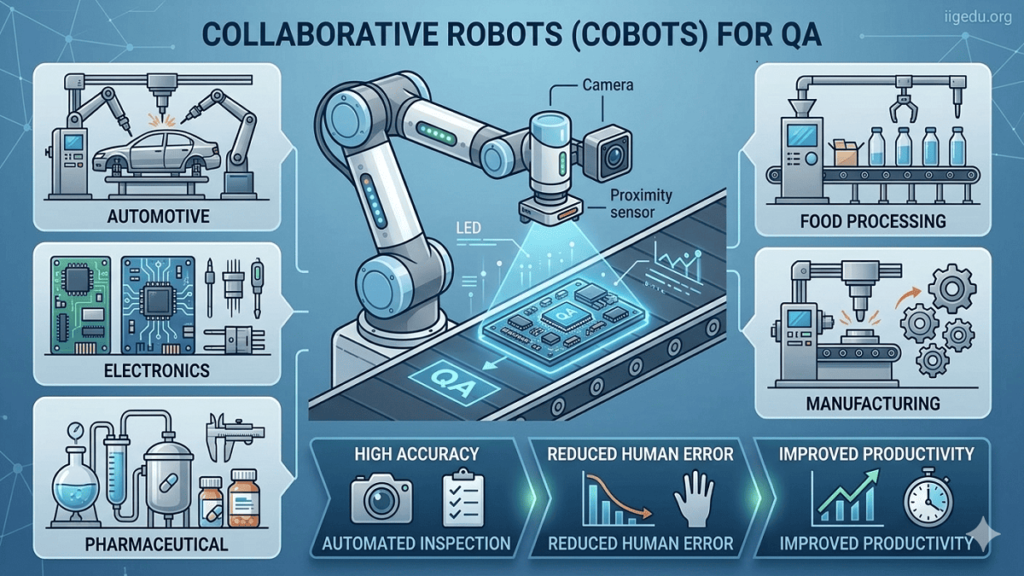
An infographic illustrating how collaborative robots help improve quality assurance through automated inspection and precise defect detection.
White paper of Collaborative Robots (Cobots) for QA
Abstract
Collaborative robots, commonly known as cobots, are transforming quality assurance processes in modern industries. Unlike traditional industrial robots, cobots are designed to work safely alongside human operators, enabling flexible and efficient inspection and testing tasks. This white paper explores the role of cobots in quality assurance, their architecture, benefits, applications, and future trends in industrial automation.
1. Introduction
Quality assurance is a critical function in manufacturing and production systems. Companies must ensure that their products meet strict quality standards while maintaining high productivity. Traditional manual inspection methods often struggle with issues such as human error, fatigue, and limited speed.
Collaborative robots provide a practical solution by automating inspection tasks while still allowing human supervision. Their ability to work alongside humans without large safety barriers makes them ideal for modern factories and flexible production environments. ()
2. What Are Collaborative Robots (Cobots)?
Collaborative robots are robotic systems designed to operate safely in shared workspaces with humans. They are equipped with advanced sensors, force-limiting technology, and intelligent control systems that enable safe interaction with human workers. ()
In quality assurance, cobots are commonly used for tasks such as visual inspection, measurement, defect detection, and automated testing during the manufacturing process.
3. Key Components of Cobot-Based QA Systems
A typical cobot-based quality assurance system includes the following components:
- Collaborative Robot Arm – Handles product positioning and inspection tasks.
- Vision Systems and Cameras – Detect defects, assembly errors, and surface damage.
- Sensors – Measure dimensions, weight, or alignment.
- Control Software – Analyzes inspection data and detects deviations.
- Human Operator Interface – Allows workers to monitor and manage the inspection process.
Together, these components enable automated inspection and real-time monitoring of product quality.
4. Working Principle of Cobots in QA
Cobots improve quality assurance by automating repetitive inspection procedures. The general workflow includes:
- The cobot picks or positions the product on the inspection station.
- Cameras and sensors capture visual or dimensional data.
- The system compares the collected data with predefined quality standards.
- If a defect is detected, the system flags or removes the product.
- Inspection data is recorded for analysis and process improvement.
Cobots perform these tasks continuously with consistent precision, reducing inspection errors and increasing reliability.
5. Benefits of Cobots in Quality Assurance
Improved Accuracy
Cobots use sensors and vision systems to perform precise inspections, reducing human error in quality checks. ()
Higher Productivity
Automating inspection tasks allows cobots to operate continuously and increase inspection speed compared with manual methods. ()
Consistent Quality Control
Cobots perform tasks repeatedly with the same precision, ensuring uniform product quality across production batches. ()
Enhanced Worker Safety
Cobots can handle repetitive or hazardous inspection tasks while humans focus on supervision and decision-making. ()
Data-Driven Quality Management
Inspection data collected by cobots can be used for process optimization and quality monitoring.
6. Industrial Applications
Automotive Industry
Cobots inspect vehicle components, assemblies, and weld quality to ensure compliance with safety standards.
Electronics Manufacturing
Cobots inspect printed circuit boards (PCBs) for missing components, solder defects, or assembly errors.
Pharmaceutical and Medical Device Production
Cobots verify packaging, labeling, and device assembly to meet regulatory standards.
Food and Beverage Industry
Cobots check packaging integrity, labeling accuracy, and product consistency.
Metal and Machinery Manufacturing
Cobots inspect parts for dimensional accuracy and surface defects before final assembly.
These applications demonstrate the versatility of cobots in maintaining strict quality standards across industries.
7. Challenges and Limitations
Although cobots offer many benefits, some challenges remain:
- Initial investment and integration costs
- Requirement for proper programming and calibration
- Limited payload capacity compared to traditional industrial robots
- Need for skilled technicians for maintenance and monitoring
However, advances in artificial intelligence, machine vision, and robotics software are helping overcome these limitations.
8. Future Trends
Cobots are expected to play a major role in Industry 4.0 and Industry 5.0 manufacturing environments. Emerging trends include:
- AI-powered visual inspection systems
- Integration with Industrial Internet of Things (IIoT) platforms
- Mobile cobots for flexible inspection tasks
- Predictive quality analytics based on inspection data
These developments will further enhance automation and quality control in smart factories.
9. Conclusion
Collaborative robots are becoming an essential tool in modern quality assurance systems. By combining robotic precision with human oversight, cobots enable faster inspections, improved accuracy, and safer workplaces. As manufacturing continues to evolve toward intelligent and flexible production systems, cobots will play a key role in ensuring consistent product quality and operational efficiency.
Keywords
Collaborative robots, cobots, quality assurance, robotic inspection, industrial automation, smart manufacturing.
Industry application of Collaborative Robots (Cobots) for QA
Collaborative robots (cobots) are widely used in industries to improve product inspection, testing, and quality control. Their ability to work safely with human operators makes them ideal for modern manufacturing environments.
1. Automotive Industry
In automotive manufacturing, cobots inspect vehicle components such as engines, brake systems, and body parts. They check for defects, correct assembly, and proper alignment to ensure safety and reliability.
2. Electronics Industry
Electronics manufacturers use cobots to inspect printed circuit boards (PCBs), microchips, and electronic devices. Cobots detect missing components, soldering defects, and assembly errors with high precision.
3. Pharmaceutical and Medical Device Industry
Cobots help ensure strict quality standards by inspecting medicine packaging, labeling, and medical devices. They verify product accuracy and compliance with safety regulations.
4. Food and Beverage Industry
In food processing plants, cobots are used to inspect packaging quality, labeling accuracy, and product consistency to maintain hygiene and safety standards.
5. Consumer Goods Manufacturing
Cobots inspect everyday products such as appliances, toys, and household items to detect defects and ensure product quality before they reach customers.
6. Metal and Machinery Industry
Cobots are used to check the dimensions, surface finish, and structural quality of metal parts and machine components.
Conclusion
Collaborative robots are transforming quality assurance in many industries by providing accurate inspections, reducing human error, and improving production efficiency. Their flexibility and safety make them an important tool in modern industrial automation.
#collaborativerobotsforqainvasai #collaborativerobotsforqainmumbai ##collaborativerobotsforqainindia
Ask FAQs
What are Collaborative Robots (Cobots) in Quality Assurance?
Collaborative robots, or cobots, are robots designed to work safely with human workers to inspect, test, and verify products to ensure they meet quality standards.
How do cobots improve quality assurance processes?
Cobots improve QA by performing precise inspections, detecting defects, reducing human error, and providing consistent results during production.
Which industries use cobots for quality assurance?
Cobots are widely used in industries such as automotive, electronics, pharmaceutical, food and beverage, and consumer goods manufacturing.
What tasks can cobots perform in quality assurance?
Cobots can perform tasks such as visual inspection, dimensional measurement, product testing, defect detection, and data collection for quality analysis.
What are the advantages of using cobots for QA?
The main advantages include improved inspection accuracy, increased productivity, reduced human error, better worker safety, and flexible automation.
Source: TRADESAFE
Table of Contents
Disclaimer
The information provided in this content is for educational and informational purposes only. While efforts have been made to ensure accuracy, readers should consult qualified professionals or technical experts before applying these concepts in real-world industrial environments.