E-commerce Product Quality
E-commerce Product Quality refers to the standard and condition of products sold online, ensuring they meet customer expectations and company specifications. High-quality products lead to customer satisfaction, positive reviews, and repeat purchases, while poor-quality items increase returns, complaints, and brand damage.
Key Factors Affecting Product Quality in E-commerce
1. Product Authenticity
- Ensuring items are genuine and not counterfeit
- Important for branded products, electronics, and luxury goods
2. Material and Build Quality
- Durability, strength, and finish of products
- Critical for apparel, electronics, furniture, and household goods
3. Accurate Descriptions and Images
- Product images, specifications, and details must match the actual item
- Prevents customer dissatisfaction and returns
4. Packaging and Delivery
- Proper packaging prevents damage during shipping
- Timely delivery enhances perceived quality
5. Compliance and Safety Standards
- Products must comply with local and international regulations
- Ensures safety for electronics, toys, and food items
Importance of E-commerce Product Quality
- Builds trust between sellers and customers
- Reduces returns and operational costs
- Enhances brand reputation
- Drives repeat purchases and positive reviews
What is E-commerce Product Quality?
E-commerce Product Quality refers to the standard, condition, and reliability of products sold through online platforms. It ensures that items meet customer expectations, match their descriptions and images, and comply with safety and industry standards.
High-quality e-commerce products are:
- Authentic: Genuine, not counterfeit
- Durable: Made with good materials and workmanship
- Accurately described: Product specifications, features, and images match the actual item
- Well-packaged: Protected during shipping to prevent damage
- Safe and compliant: Meets regulations for safety, labeling, and usage
In simple terms: E-commerce Product Quality ensures that customers receive exactly what they expect, which improves satisfaction, reduces returns, and protects the seller’s brand reputation.
Who is E-commerce Product Quality required?
E-commerce product quality is required by everyone involved in the online shopping process, but the legal responsibility is not shared equally. It is required by a specific chain of participants, each with distinct duties.
The Seller (Platform Merchant) is the primary party responsible for quality. They are required to keep records of their purchases and sales, display accurate product information, and provide necessary permits or inspection reports.
The E-commerce Platform is required to act as a gatekeeper. They must verify seller qualifications and product information before items are listed and conduct regular monitoring to remove problematic products.
Government Regulators are required to enforce the rules. They create supervision lists, conduct random spot checks on products, and penalize sellers or platforms that violate quality standards.
Manufacturers and Suppliers are required to build quality from the start by ensuring raw materials and production processes meet required specifications.
Third-Party Inspectors are required to provide independent verification through pre-shipment testing and professional inspection reports, especially for high-risk goods.
Consumers are required to participate by reporting issues, which helps regulators and platforms identify problems and improve the system.
When is E-commerce Product Quality required?
E-commerce product quality is required at multiple critical points throughout the product lifecycle, from before a product is made available for sale to long after it has been purchased.
Before Product Launch
Quality assurance is required well before a product reaches the online marketplace. Sellers and platforms need to verify product information and compliance documentation before any item can be listed for sale. This advance verification ensures that only products meeting standards become available to consumers.
During Production
For manufactured goods, quality control is required while items are still being made. Inspections should take place when production is partially complete, typically when twenty to fifty percent of the order is finished. This timing allows manufacturers to identify and correct problems before they affect the entire batch, preventing costly waste and rework.
Before Shipment
The most universal timing requirement for quality verification is before products leave the factory. Pre-shipment inspections occur after manufacturing is fully complete but before goods are loaded for transport. At this stage, products should be one hundred percent manufactured and at least eighty percent packed. Inspectors conduct sampling and testing to catch defects before items begin their journey to customers.
Upon Platform Listing
When sellers create product listings, quality review is required within a specific window. On many platforms, the quality control team reviews new listings within one to three business days of submission. Listings may be rejected during this review if product descriptions are poor quality or if information is insufficient.
Throughout the Product Lifecycle
Quality management is required on an ongoing basis through continuous monitoring. Sellers must maintain performance metrics like order defect rates below specified thresholds at all times. Platforms constantly monitor these metrics, and failure to maintain standards can result in listing removal or account suspension at any point.
By Specific Regulatory Deadlines
Governments sometimes impose fixed deadlines for quality compliance. For example, by January first of 2026, all products traded on e-commerce platforms in certain jurisdictions must declare quality standards certification according to their risk classification. High-risk items require certification from independent organizations, and this documentation must be in place by the deadline.
At Time of Consumer Complaint
Quality assurance is also triggered when problems arise. When consumers report issues with products, this creates an immediate requirement for investigation. Regulators and platforms may respond to complaints by conducting spot checks, requesting documentation, or initiating enforcement actions against sellers who cannot prove their products meet standards.
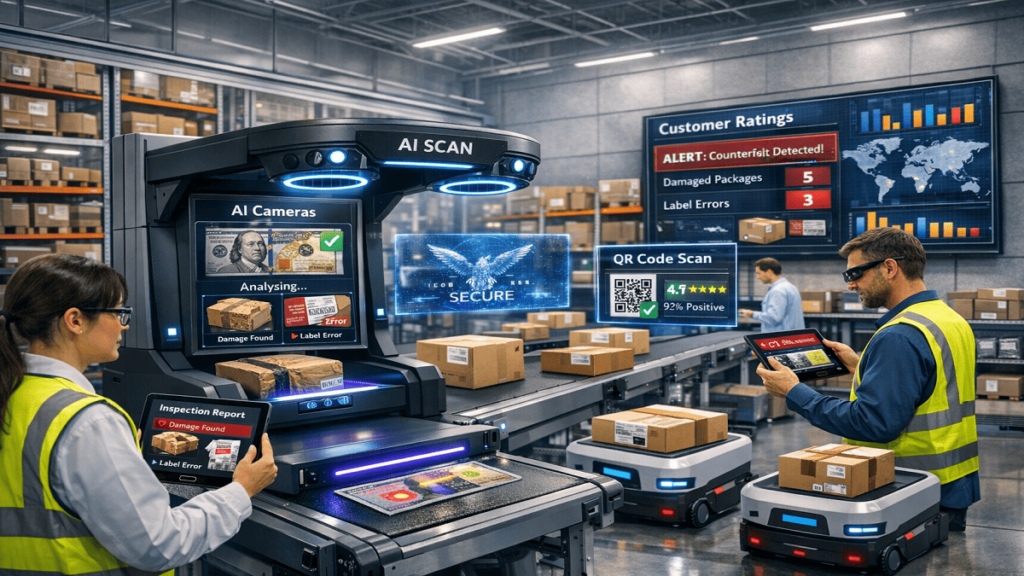
Where is E-commerce Product Quality required?
E-commerce product quality is required in a wide range of physical and digital locations, spanning manufacturing facilities, independent testing laboratories, e-commerce platform infrastructure, and the digital storefront itself. These locations form a global network designed to catch defects and ensure compliance before products ever reach consumers.
At Manufacturing Facilities
The physical location where quality is most critically required is at the factory. In Guangdong province, which includes Shenzhen and Guangzhou, quality inspections are required at facilities producing electronics, consumer tech, and smart devices. Inspectors here verify compliance with international standards before products ship to markets in North America and Europe.
In Fujian province, quality checks are required at factories producing footwear, textiles, and light industrial goods. Local inspection firms conduct apparel safety testing and chemical compliance verification for regulations. Zhejiang province, particularly around Hangzhou and Yiwu, requires quality verification at facilities making hardware, kitchenware, and general merchandise.
At Independent Testing Laboratories
E-commerce product quality is required at accredited third-party laboratories. These laboratories are recognized by major online marketplaces for compliance testing and certification services. They offer chemical, functional, safety, textile, and packaging testing across multiple locations.
Testing facilities operate in major cities including Shenzhen, Dongguan, Guangzhou, Hangzhou, Ningbo, Xiamen, and Tianjin. Each laboratory specializes in different product categories, from electronics to textiles to toys and food contact materials.
Within E-Commerce Platform Facilities
Some e-commerce platforms operate their own physical quality laboratories. These facilities serve as comprehensive self-built quality testing laboratories operated directly by the platform. They conduct daily quality testing, spot checks, and random inspections on all products sold through their marketplace.
Products that fail inspection at these laboratories are prohibited from entering platform warehouses and cannot be sold. Some platforms have built specialized authentication laboratories in regional hub cities and rapid testing laboratories in fresh food warehouses across the country. These specialized labs work alongside headquarters facilities to form comprehensive product quality testing systems.
At Seller Warehouses and Distribution Centers
Quality verification is required at warehouses and distribution centers at key quality control points. Pre-shipment inspections occur when products are fully manufactured and at least partially packed into cartons. Inspectors at these locations conduct comprehensive sampling inspection using industry standard levels to ensure bulk goods quality meets requirements.
Container loading supervision is another required quality check at warehouse locations, ensuring proper packing and preventing damage during transit. This final physical check before products leave for customers catches defects that might have been missed earlier in the process.
On the Digital Storefront
Quality requirements exist in the virtual space of the e-commerce website itself. Online sales channels must maintain high-quality presentation with fast access and loading times, clear navigation, and secure payment methods. Product pages require detailed, accurate information with multiple images showing items from different perspectives.
The website design must convey a high-quality image without any gimmicky elements or flea market atmosphere. Customer service quality is required through responsive communication channels including email, telephone, and online chat with clearly indicated response times.
At Cross-Border Compliance Centers
For international e-commerce, quality verification is required at specialized compliance centers that handle documentation for multiple markets. These facilities provide quality control services for both domestic and export markets. They handle certifications for shipments to various countries with different regulatory requirements.
Within Digital Quality Assurance Systems
Quality requirements exist within software testing environments for e-commerce platforms. Dedicated digital quality assurance teams test e-commerce functionality across browsers, devices, and integration points. These virtual locations ensure that the shopping experience itself meets quality standards through regression testing, API validation, and performance testing.
How is E-commerce Product Quality required?
E-commerce product quality is required through a multi-layered system of processes, standards, and technologies that span the entire product lifecycle. These requirements manifest in four primary ways: through physical inspection processes, through digital and automated quality assurance systems, through regulatory and compliance frameworks, and through systematic quality management approaches.
Through Physical Inspection Processes
Physical inspection is required at multiple points along the supply chain. Pre-shipping inspection is conducted after manufacturing is complete but before freight loading, using standardized methods like Acceptable Quality Level sampling based on international standards. This inspection verifies visual appearance, functionality, packaging integrity, and documentation accuracy. Inspectors check quantity against purchase orders, examine products for physical damage, test features to ensure they operate correctly, and verify that packaging is secure and properly labeled.
At fulfillment centers, quality and quantity control is required upon delivery of every incoming shipment. Warehouse teams verify all supporting documents including waybills, invoices, and purchase orders to confirm that delivered items match expectations. Products are physically counted, inspected for damage, and checked for the presence of all required components. Damaged or defective items are isolated and flagged for further inspection or return. Barcode scanning then registers products in warehouse management systems for real-time inventory tracking.
For high-value items like electronics and for products subject to regulatory changes, inspections must align with updated harmonized system codes and changing rules. Regional code updates require verification during the inspection process to prevent customs delays and compliance issues.
Through Digital and Automated Quality Assurance Systems
E-commerce platforms require sophisticated digital quality assurance that tests every digital touchpoint from browsing to checkout. This involves systematically testing and validating platforms, processes, and integrations to find and fix issues before they affect customers. Quality assurance covers functionality, performance, security, and user experience.
Automated testing tools handle repetitive testing tasks such as verifying checkout flows and promotional codes. These tools perform frequent regression testing to ensure core functionality remains intact after updates. Manual testing complements automation by evaluating aesthetics, usability, and unexpected user behaviors that automated scripts might miss.
Cross-platform testing is required to ensure consistent functionality across desktop, tablet, smartphone, and different browsers including Chrome, Safari, Firefox, and Edge. Responsive design testing is particularly critical given the rapid growth of mobile commerce.
AI-powered intelligent quality control systems are increasingly required to handle the scale of e-commerce. These systems use computer vision and natural language processing to automate review across the entire supply chain. Deep learning models can identify printing errors as small as fractions of a millimeter before products are listed. One apparel retailer using intelligent quality control reduced customer complaints about items not matching descriptions by over half and shortened return and exchange cycles significantly.
These systems also enable predictive risk management. By analyzing historical return data, artificial intelligence can detect when a product component has a quality pass rate below industry average and trigger early warning mechanisms. This allows problems to be traced back to raw material supplier deviations and addressed through recalls within days.
Through Regulatory Compliance and Testing Frameworks
Product testing is required to ensure compliance with target market regulations and standards. Different markets have distinct requirements. The European Union requires CE marking. The United States requires FCC compliance and adherence to various state-level regulations. Various international regulations govern chemical restrictions.
A qualified testing process typically includes sample preparation, laboratory testing, third-party verification, factory inspection, and pre-shipment sampling. For small appliances going to international markets, key testing includes electrical safety tests like insulation performance and voltage withstand testing, electromagnetic compatibility, and material environmental requirements. Apparel products require testing for chemical content, color fastness, and stitching strength.
Product testing takes multiple forms throughout development. Concept testing evaluates ideas before prototype investment to understand purchase intent. Prototype and usability testing assesses how real users interact with the product, revealing issues like confusing assembly instructions that might require video demonstrations instead of printed inserts. Quality testing examines features and performance under specific conditions, while durability testing simulates long-term use through repeated stress tests, temperature changes, and other conditions.
Safety and compliance testing verifies products meet government regulations and industry standards. Portable chargers must meet strict standards for electrical and physical safety and pass transportation tests for vibration, shock, and altitude simulation. Drop tests from various heights, vibration tables mimicking bumpy delivery rides, and unboxing tests with real users are all part of ensuring products reach consumers intact.
Through Systematic Quality Management Approaches
Quality management systems provide the formal framework of policies, processes, and procedures that ensure consistent quality standards. These systems comprise four components working together.
Quality planning defines quality standards and how to achieve them, setting criteria for product durability or website uptime and determining measurement methods.
Quality control involves inspecting and testing outputs to ensure they meet standards before reaching customers. This includes regularly testing checkout processes for bugs or inspecting shipment batches to verify every product is correct and in perfect condition.
Quality assurance focuses on behind-the-scenes business processes, auditing operational procedures like order fulfillment steps to verify they are being followed and effective.
Quality improvement continuously makes changes to enhance results and customer satisfaction based on collected data and process reviews.
Several established methodologies guide quality management implementation. Kaizen, the Japanese philosophy of continuous improvement, encourages all employees to make small, incremental changes regularly rather than implementing massive overhauls. Six Sigma provides a data-driven methodology for improving processes by identifying and eliminating defects through a structured approach of defining, measuring, analyzing, improving, and controlling. The ISO 9001 standard provides globally recognized requirements and guidelines for establishing effective quality management systems.
Through Continuous Monitoring and User Experience Testing
Quality requirements extend beyond pre-launch testing into ongoing monitoring. Load testing identifies how systems perform under peak traffic during events like major sales holidays, ensuring platforms do not crash or slow down during critical revenue periods. Uptime monitoring services provide real-time alerts about potential downtime or speed degradation using various monitoring tools.
User experience testing evaluates intuitive navigation, fast page load times, mobile responsiveness, and accessibility standards. Regular usability testing sessions and customer feedback loops identify friction points that technical testing might miss. Various analytics tools provide heatmaps, session recordings, and user feedback widgets to visualize where users click, scroll, or drop off during shopping.
Through Counterfeit Detection and Brand Protection
Platforms require sophisticated detection tools to identify and remove counterfeit products. Image analysis tools scan for brand names appearing anywhere in product images, with results shared for manual quality control analysis. Logo detection models scan images for existing or manually fed logos, running thorough checks and flagging potential infringements for manual investigation.
Image matching tools conduct exhaustive scans based on curated images and historical data from previous deactivations, detecting similarity to previously removed copies even when brand names are not visible on products. Keyword-based flagging expands model capabilities to scan text for matching keywords in product descriptions, identifying indirect counterfeiting attempts.
Compliance verification creates checker mechanisms at catalog upload that block listings from going live for sellers without brand authorization. Protected brands face stringent checks ensuring only authorized suppliers can list products.
Through Data Analysis and Digital Management
Testing data analysis is required to identify trends, batch issues, and potential risks before they become large-scale problems. Comparative analysis examines parameter differences across batches, suppliers, and processes. Trend analysis tracks quality pass rate changes over time and key performance indicator fluctuations. Abnormal data tracking focuses on borderline values, marginally passing items, and temporarily corrected issues to prevent hidden non-conforming products from reaching consumers.
Statistical process control and other analytical tools quantify process stability and product consistency. When quality pass rates suddenly drop for a batch, investigations trace back to raw material batches, production equipment changes, or operator variations. Cross-verification with historical complaints, returns, and after-sales data identifies high-risk categories and supply chain weak points.
Digital platforms enable automated data collection, real-time dashboards, intelligent alerts, and cross-department collaboration between quality control, research and development, procurement, operations, and finance. When test pass rate anomalies are detected, systems automatically connect with inventory, logistics, and after-sales modules to lock high-risk batches and suspend shipments.
Through Consumer Feedback Integration
Quality requirements include mechanisms for capturing and acting on consumer feedback. Central location tests gather qualitative feedback in controlled environments like research facilities, with observers noting body language and reactions in real time. In-home usage tests ship products to participants for use in natural environments, ideal for products requiring long feedback periods and providing more realistic satisfaction and usage data.
Limited releases launch products with minimal marketing push, treating the launch as a rehearsal to gather feedback from early adopters and valued customers. These insider testers gain early access and influence over product assortment while providing valuable insights before full market release.
Case study of E-commerce Product Quality
Under Armour, the American sportswear company known for innovative performance apparel, faced a significant challenge in their Japanese e-commerce operations. The company had fewer physical stores compared to other major apparel companies and relied heavily on online sales, which resulted in a high number of product returns from their online try-on experience .
The core problem was that customers were uncertain about fit when purchasing apparel and shoes online, leading to excessive returns. Under Armour lacked effective measures to mitigate the cause of these returns and needed a solution that would work for both clothing and footwear .
The company integrated a size recommendation widget into their existing user journey. This tool alleviated uncertainty about fit without creating additional friction in the purchasing flow. They also layered an analytics platform on top of the fitting service, which allowed their team to monitor performance and continuously adjust their approach based on real-time data .
The results were substantial. Comparing year-on-year performance from October to December, Under Armour reduced the total amount of size-based returns by 27 percent and successfully achieved their target return rate of less than 3 percent. When examining returns specifically for size-related reasons, the rate dropped even below the brand’s overall return rate. Under Armour continues to conduct detailed analysis of returned merchandise and revise their recommendation logic to further reduce returns in the future .
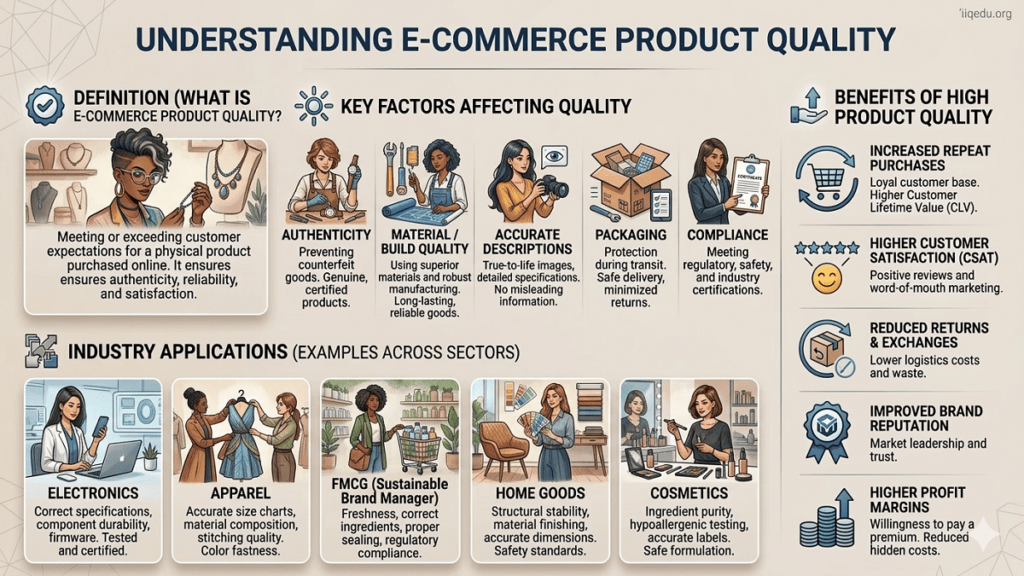
A visual guide showing how E-commerce Product Quality ensures customer satisfaction, reduces returns, and strengthens brand trust.
White paper of E-commerce Product Quality
1. Introduction
E-commerce Product Quality is a critical factor in online retail. Unlike physical stores, customers cannot touch or test products before purchase. Therefore, product quality directly impacts customer satisfaction, brand reputation, return rates, and overall business performance. Ensuring high-quality products is essential for building trust and sustaining long-term growth in the e-commerce sector.
2. Industry Overview
The e-commerce industry spans multiple sectors, including electronics, apparel, cosmetics, home goods, and food. With rapid growth in online shopping, quality management has become more challenging due to factors such as diverse suppliers, complex logistics, and lack of direct consumer interaction. Low-quality products can lead to negative reviews, higher return rates, and loss of customer loyalty.
3. Key Factors Affecting E-commerce Product Quality
a. Product Authenticity
- Ensures items are genuine, not counterfeit
- Particularly important for branded products, electronics, and luxury goods
b. Material and Build Quality
- Durability, finishing, and performance of products
- Critical for electronics, apparel, furniture, and household goods
c. Accurate Product Description & Images
- Product specifications, features, and images must match the actual item
- Misleading descriptions reduce customer trust
d. Packaging and Delivery
- Products must be packaged to prevent damage during shipping
- Timely delivery also impacts perceived quality
e. Compliance and Safety Standards
- Products should meet local and international safety and regulatory requirements
4. E-commerce Product Quality Assurance Methods
- Supplier vetting and audits
- Random batch inspections and sample testing
- Customer feedback monitoring
- Digital verification, QR codes, and tracking for authenticity
5. Benefits of Maintaining High Product Quality
- Increased customer satisfaction and loyalty
- Reduced return rates and operational costs
- Enhanced brand reputation and trust
- Competitive advantage in the market
6. Challenges
- Managing quality across multiple suppliers
- Ensuring product consistency in large volumes
- Handling damage during shipping and logistics
- Monitoring counterfeit and substandard products
7. Conclusion
E-commerce Product Quality is essential for sustaining trust and profitability in online retail. Businesses that implement strict quality assurance processes, accurate descriptions, proper packaging, and compliance checks can deliver superior customer experiences, reduce returns, and strengthen brand loyalty in a competitive digital marketplace.
Industry aoolication of E-commerce Product Quality
1. Online Retail Platforms
- Ensures products listed on platforms like Amazon, Flipkart, or Shopify meet quality standards
- Reduces returns, improves customer satisfaction, and builds trust
2. Electronics Industry
- Monitors product functionality, durability, and safety before shipping
- Prevents defective gadgets or devices from reaching customers
3. Apparel and Fashion Industry
- Ensures clothing, shoes, and accessories match descriptions, sizes, and material quality
- Improves customer experience and reduces size/fit complaints
4. Food and FMCG Industry
- Verifies freshness, packaging, and safety of perishable and packaged goods
- Compliance with hygiene and regulatory standards is critical
5. Home & Furniture Industry
- Ensures durability, finishing, and assembly quality of items sold online
- Reduces damage complaints and returns during delivery
6. Cosmetics and Personal Care
- Confirms product safety, ingredients, and packaging authenticity
- Prevents health hazards and maintains brand credibility
7. E-commerce Logistics & Supply Chain
- Ensures products are handled properly during storage and shipping
- Quality checks during transit maintain product condition and customer satisfaction
Conclusion:
E-commerce Product Quality is applied across retail platforms, electronics, apparel, FMCG, home goods, cosmetics, and logistics industries. Ensuring high product quality improves trust, reduces returns, and enhances brand reputation in the competitive online marketplace.
#e-commerceproductqualityinmumbai #e-commerceproductqualityinindia #e-commerceproductqualityinvasai
Ask FAQs
What is E-commerce Product Quality?
E-commerce Product Quality refers to the standard, condition, and reliability of products sold online, ensuring they meet customer expectations and match descriptions.
Why is E-commerce Product Quality important?
High product quality builds customer trust, reduces returns, improves reviews, and strengthens brand reputation. Low-quality products can lead to complaints and loss of sales.
Who is responsible for E-commerce Product Quality?
Online sellers, brands, manufacturers, suppliers, and e-commerce platforms are all responsible for ensuring products meet quality standards before delivery.
How is product quality ensured in e-commerce?
Quality is maintained through supplier audits, sample testing, accurate descriptions and images, proper packaging, and compliance with safety and regulatory standards.
What are the consequences of poor product quality in e-commerce?
Poor quality can result in negative reviews, high return rates, customer complaints, financial loss, and damage to the brand’s reputatio
Source: Racklify
Table of Contents
Disclaimer:
This content is for informational and educational purposes only. It does not constitute professional, legal, or business advice. Readers should verify information independently before applying it