Eddy Current Testing
Introduction
Eddy Current Testing (ECT) is a widely used non-destructive testing (NDT) method that detects surface and near-surface defects in conductive materials. It is based on electromagnetic principles and is commonly applied in industries such as aerospace, automotive, power generation, and manufacturing for quality control and safety inspection.
1. Principle of Eddy Current Testing
ECT operates on the principle of Electromagnetic Induction, discovered by Michael Faraday.
- When an alternating current (AC) flows through a coil, it generates a changing magnetic field.
- When this coil is placed near a conductive material, it induces circulating electrical currents called eddy currents within the material.
- Any defect (such as cracks or corrosion) disrupts the flow of these currents, causing measurable changes in the coil’s impedance.
These changes are detected and analyzed to identify flaws or variations in the material.
2. Equipment Used in ECT
- Probe/Coil: Generates and detects eddy currents.
- Eddy Current Instrument: Measures impedance changes and displays results.
- Display Unit/Software: Provides graphical signals for interpretation.
- Reference Standards: Used for calibration and comparison.
3. Applications of Eddy Current Testing
a. Aerospace Industry
- Detection of cracks in aircraft structures and engine components.
- Inspection of rivet holes and fatigue-prone areas.
b. Power Generation
- Inspection of heat exchanger tubes and boiler components.
- Detection of corrosion and wall thinning in conductive materials.
c. Automotive Industry
- Quality control of engine parts and metal components.
- Detection of surface defects in production lines.
d. Manufacturing Industry
- Sorting materials based on conductivity and composition.
- Measuring coating thickness and detecting surface flaws.
4. Advantages of Eddy Current Testing
- Non-destructive method with no damage to the test object.
- High sensitivity to small surface cracks.
- Rapid inspection with immediate results.
- No contact required in many applications.
- Minimal preparation compared to other testing methods.
5. Limitations of Eddy Current Testing
- Applicable only to electrically conductive materials.
- Limited penetration depth (mainly surface or near-surface defects).
- Requires skilled operators for accurate interpretation.
- Results can be affected by material properties such as conductivity and permeability.
6. Types of Eddy Current Testing
- Conventional Eddy Current Testing: Standard method for surface inspection.
- Pulsed Eddy Current Testing: Used for deeper penetration and corrosion detection.
- Array Eddy Current Testing: Uses multiple coils for faster and wider area inspection.
- Remote Field Testing: Used mainly for tube inspection in heat exchangers.
7. Industrial Importance
Eddy Current Testing plays a critical role in **Non-Destructive Testing by:
- Ensuring structural integrity and safety
- Reducing maintenance costs
- Preventing equipment failure
- Supporting regulatory compliance in critical industries
Summary
Eddy Current Testing is a reliable and efficient non-destructive testing technique used to detect surface defects, measure material properties, and ensure quality control in conductive materials. Its speed, accuracy, and versatility make it an essential tool in modern industrial inspection and maintenance practices.
References and Further Reading:
- American Society for Nondestructive Testing – Eddy Current Testing resources
- International Atomic Energy Agency (IAEA). Non-Destructive Testing Handbook
- Blitz, J. Electrical and Magnetic Methods of Non-Destructive Testing, Springer
#Eddy Current Testing in India
What is Eddy Current Testing?
Eddy Current Testing (ECT) is a non-destructive testing method used to detect surface and near-surface defects in electrically conductive materials. It works on the principle of Electromagnetic Induction, first described by Michael Faraday.
In this technique, an alternating current is passed through a coil, generating a changing magnetic field. When the coil is brought near a conductive material, it induces circulating currents within the material known as eddy currents. Any discontinuity—such as cracks, corrosion, or variations in thickness—disrupts these currents, causing measurable changes in the electrical response of the coil. These changes are analyzed to identify defects or material properties.
In simple terms:
Eddy Current Testing is a fast and reliable method to inspect metals and other conductive materials without causing damage, commonly used for detecting flaws, measuring thickness, and ensuring quality in industrial applications.
#Eddy Current Testing in Maharashtra
Who is Eddy Current Testing required?
Eddy Current Testing (ECT) is required by professionals, industries, and organizations that need to inspect electrically conductive materials for defects, quality, and safety without causing damage. It is a key method within Non-Destructive Testing, widely used where reliability and structural integrity are critical.
1. Engineers and Inspectors
- NDT engineers and technicians use ECT to detect cracks, corrosion, and material inconsistencies.
- Quality control inspectors rely on it during manufacturing to ensure components meet required standards.
2. Aerospace Industry Professionals
- Aircraft maintenance engineers and inspectors require ECT to:
- Detect fatigue cracks in aircraft structures
- Inspect engine components and fastener holes
- Ensures compliance with strict aviation safety regulations.
3. Power Plant and Energy Sector
- Engineers in power plants use ECT to inspect:
- Heat exchanger tubes
- Boilers and condensers
- Helps detect corrosion, wall thinning, and defects before failure occurs.
4. Automotive Industry
- Manufacturers and quality engineers require ECT for:
- Detecting surface defects in engine parts and metal components
- Ensuring product reliability and performance
5. Manufacturing and Production Industries
- Used by production teams for:
- Material sorting based on conductivity
- Measuring coating thickness
- Detecting flaws in metal products
6. Oil and Gas Industry
- Inspection professionals use ECT to examine:
- Pipelines and storage tanks
- Welds and structural components
- Essential for preventing leaks, failures, and environmental hazards.
7. Research and Testing Laboratories
- Scientists and researchers use ECT for:
- Studying material properties
- Conducting experimental analysis on conductive materials
8. Maintenance and Safety Teams
- Maintenance personnel require ECT for routine inspection of equipment to:
- Identify early signs of damage
- Reduce downtime and maintenance costs
Summary
Eddy Current Testing is required by:
- Engineers and NDT professionals
- Aerospace and aviation inspectors
- Power plant and energy sector personnel
- Automotive and manufacturing industries
- Oil and gas inspection teams
- Research laboratories and maintenance teams
It is essential wherever safe, accurate, and non-destructive inspection of conductive materials is needed to ensure quality, performance, and safety.
#Eddy Current Testing in Gujrat
When is Eddy Current Testing required?
Eddy Current Testing (ECT) is required whenever there is a need to inspect electrically conductive materials for defects, material properties, or structural integrity without causing damage. It is a widely used method within Non-Destructive Testing, particularly suited for detecting surface and near-surface flaws.
1. During Quality Control in Manufacturing
- ECT is required during production to ensure components meet required specifications.
- Used to detect surface cracks, porosity, and material inconsistencies.
- Helps maintain product reliability and reduce defects before products reach the market.
2. For Detection of Surface and Near-Surface Defects
- Required when identifying flaws such as:
- Cracks
- Corrosion
- Pitting
- Wear and tear
- Particularly effective for early-stage defect detection in metals.
3. During Preventive Maintenance
- ECT is used for routine inspection of equipment to identify issues before failure occurs.
- Common in industries where equipment reliability is critical, such as aerospace and power plants.
4. In Safety-Critical Applications
- Required in sectors where failure can lead to serious consequences, including:
- Aircraft structures
- Pipelines
- Pressure vessels
- Ensures compliance with safety standards and regulations.
5. For Inspection of Heat Exchangers and Tubes
- ECT is widely used to inspect:
- Heat exchanger tubes
- Boiler tubes
- Condenser tubes
- Detects corrosion, wall thinning, and internal defects efficiently.
6. When Measuring Coating Thickness
- Required to evaluate the thickness of protective coatings (e.g., paint, plating) on conductive materials.
- Ensures coatings meet quality and durability standards.
7. For Material Sorting and Identification
- Used to differentiate materials based on electrical conductivity.
- Common in recycling, manufacturing, and alloy verification processes.
8. When Rapid and Non-Contact Inspection Is Needed
- ECT is preferred when:
- Quick inspection is required
- Direct contact is not feasible
- Minimal surface preparation is desired
Summary
Eddy Current Testing is required when:
- Detecting surface or near-surface defects
- Performing quality control during manufacturing
- Conducting preventive maintenance and safety inspections
- Inspecting tubes, pipelines, and critical components
- Measuring coating thickness or sorting materials
- Fast, non-destructive, and reliable inspection is needed
#Eddy Current Testing in Pune
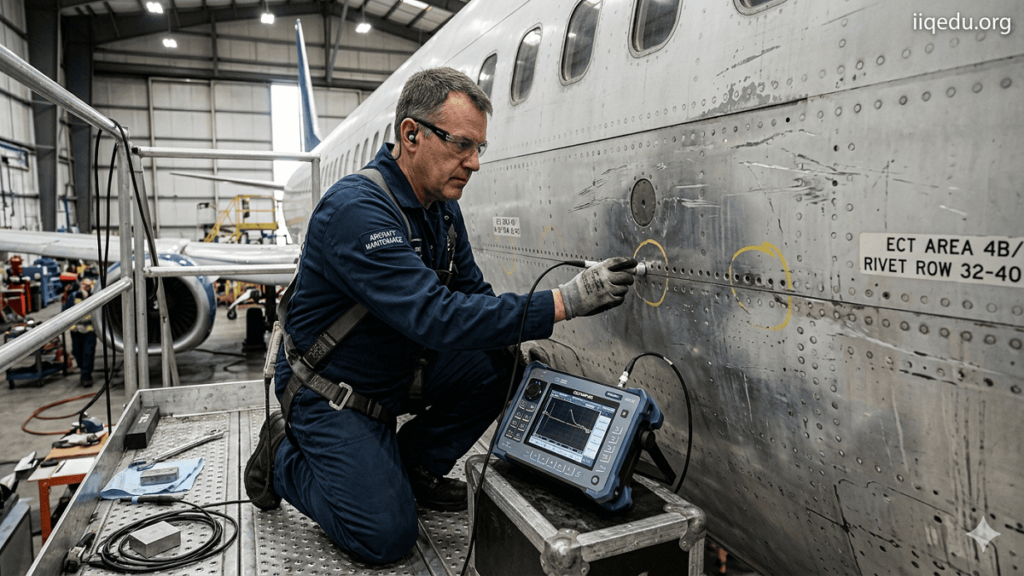
Where is Eddy Current Testing required?
Eddy Current Testing (ECT) is required in a wide range of industrial, manufacturing, and research environments where electrically conductive materials must be inspected for defects, quality, and safety. It is a core technique within Non-Destructive Testing, particularly suited for surface and near-surface inspection.
1. Aerospace Industry
- Used in aircraft manufacturing plants and maintenance facilities.
- Applied to inspect:
- Aircraft fuselage and wings
- Engine components and turbine blades
- Fastener holes and rivet areas
2. Power Plants and Energy Facilities
- Required in:
- Thermal power plants
- Nuclear power stations
- Renewable energy installations
- Used to inspect:
- Heat exchanger tubes
- Boilers and condensers
- Turbine components
3. Oil and Gas Industry
- Applied in both onshore and offshore facilities.
- Used for inspection of:
- Pipelines and storage tanks
- Weld joints and structural components
- Drilling and refinery equipment
4. Manufacturing and Production Units
- Found in factories producing metal components and machinery.
- Used for:
- Quality control of parts
- Detection of surface defects
- Material sorting and verification
5. Automotive Industry
- Used in automobile manufacturing plants and testing labs.
- Applied to inspect:
- Engine components
- Transmission systems
- Welded joints and metal structures
6. Railway and Transportation Sector
- Required in railway maintenance depots and inspection facilities.
- Used for:
- Rail track inspection
- Detection of cracks in wheels and axles
- Ensuring safety of transportation systems
7. Metal Processing and Fabrication Units
- Used in industries involving:
- Casting
- Forging
- Rolling and welding
- Helps detect internal and surface flaws during processing.
8. Research Laboratories and Testing Centers
- Applied in academic and industrial research labs for:
- Material property analysis
- Experimental studies on conductivity and defect behavior
9. Field and On-Site Inspections
- Portable ECT equipment allows use in:
- Construction sites
- Maintenance operations in remote areas
- Infrastructure inspection (bridges, pipelines)
Summary
Eddy Current Testing is required in locations where conductive materials must be inspected safely and efficiently, including:
- Aerospace facilities
- Power plants and energy sectors
- Oil and gas installations
- Manufacturing and automotive industries
- Railway and transportation systems
- Metal processing units
- Research laboratories
- Field and on-site inspection environments
#Eddy Current Testing in Ahemdabad
How is Eddy Current Testing required?
Eddy Current Testing (ECT) is required through a structured inspection process that involves generation of electromagnetic fields, interaction with conductive materials, and analysis of signal variations. It is a key technique within Non-Destructive Testing, used for detecting surface and near-surface defects efficiently and without damaging the test object.
1. Determining the Need for ECT
ECT is required when:
- The material is electrically conductive (e.g., metals).
- Inspection is needed for surface or near-surface defects.
- Non-destructive, fast, and precise testing is necessary.
Engineers or inspectors decide to use ECT based on inspection standards, safety requirements, and material properties.
2. Equipment Setup
The process begins with proper setup of ECT equipment:
- Probe/Coil: Generates an alternating magnetic field.
- Eddy Current Instrument: Supplies current and measures impedance changes.
- Calibration Standards: Used to set reference signals for accurate comparison.
The system is calibrated according to material type, thickness, and expected defect size.
3. Generation of Eddy Currents
ECT operates on Electromagnetic Induction, discovered by Michael Faraday:
- Alternating current flows through the probe coil.
- This produces a changing magnetic field.
- When placed near a conductive material, eddy currents are induced within it.
4. Interaction with Material
- The induced eddy currents flow in circular paths within the material.
- If the material is uniform and defect-free, the current flow remains stable.
- If there are defects (cracks, corrosion, voids), they disturb the current flow.
5. Detection and Signal Measurement
- Disturbances in eddy currents cause changes in the electrical impedance of the probe.
- These changes are detected by the instrument and displayed as signals or graphs.
6. Data Interpretation
- Skilled inspectors analyze signal variations to determine:
- Presence of defects
- Size and location of flaws
- Material properties such as conductivity or thickness
- Interpretation often requires experience and reference standards for accuracy.
7. Reporting and Decision-Making
- Results are documented in inspection reports.
- Based on findings, decisions are made regarding:
- Acceptance or rejection of components
- Maintenance or repair requirements
- Safety compliance
Summary
Eddy Current Testing is required through the following step-by-step process:
- Identify inspection need based on material and application.
- Set up and calibrate ECT equipment.
- Generate eddy currents using electromagnetic induction.
- Observe interaction of currents with the material.
- Detect signal changes caused by defects.
- Interpret results and prepare reports.
#Eddy Current Testing in Kolkata
Case Study of Eddy Current Testing
Background
An aerospace maintenance organization was responsible for routine inspection of aging aircraft. Over time, repeated stress cycles can cause fatigue cracks around rivet holes in the aircraft fuselage.
Problem
- Traditional inspection methods were time-consuming and sometimes failed to detect very small cracks.
- There was a need for a highly sensitive and fast inspection technique to ensure safety and compliance with aviation standards.
Solution Using ECT
- Engineers implemented Eddy Current Testing using high-frequency probes.
- The technique was based on Electromagnetic Induction, discovered by Michael Faraday.
- Probes were scanned over rivet holes and stress-prone areas of the fuselage.
Results
- Detected micro-cracks that were not visible to the naked eye.
- Reduced inspection time significantly compared to manual methods.
- Improved aircraft safety and prevented potential structural failure.
Outcome
ECT became a standard inspection method in routine aircraft maintenance schedules.
Case Study 2: Heat Exchanger Tube Inspection (Power Plant)
Background
A thermal power plant experienced reduced efficiency due to suspected corrosion in heat exchanger tubes.
Problem
- Internal corrosion and wall thinning were difficult to detect without dismantling the system.
- Shutdowns for manual inspection were costly and time-consuming.
Solution Using ECT
- Eddy Current Testing probes were inserted into the tubes.
- Low-frequency signals were used to detect deeper defects such as corrosion and erosion.
Results
- Identified corroded and weakened tubes accurately.
- Enabled targeted replacement instead of complete system overhaul.
- Minimized downtime and maintenance costs.
Outcome
The plant improved operational efficiency and extended equipment lifespan through regular ECT inspections.
Case Study 3: Automotive Component Quality Control
Background
An automotive manufacturer needed to ensure that engine components met strict quality standards before assembly.
Problem
- Surface cracks and material inconsistencies in metal parts could lead to product failure.
- Manual inspection methods were inconsistent and slow.
Solution Using ECT
- Automated Eddy Current Testing systems were integrated into the production line.
- Components were scanned in real time for defects and conductivity variations.
Results
- Rapid detection of surface flaws and defects.
- Improved consistency in quality control.
- Reduced rejection rates and production losses.
Outcome
ECT enhanced manufacturing efficiency and ensured higher product reliability.
Key Insights from the Case Studies
Across different industries, Eddy Current Testing has demonstrated:
- High sensitivity in detecting small surface and near-surface defects
- Reduced inspection time and improved workflow efficiency
- Cost savings through preventive maintenance and targeted repairs
- Enhanced safety in critical applications such as aerospace and power generation
Conclusion
These case studies highlight the importance of Eddy Current Testing as a reliable and efficient inspection method. By leveraging the principles of electromagnetic induction, ECT enables industries to detect defects early, maintain safety standards, and optimize operational performance without damaging materials.
References and Further Reading
- American Society for Nondestructive Testing – Eddy Current Testing resources
- International Atomic Energy Agency (IAEA). Non-Destructive Testing Handbook
- Blitz, J. Electrical and Magnetic Methods of Non-Destructive Testing, Springer
#Eddy Current Testing in Chennai
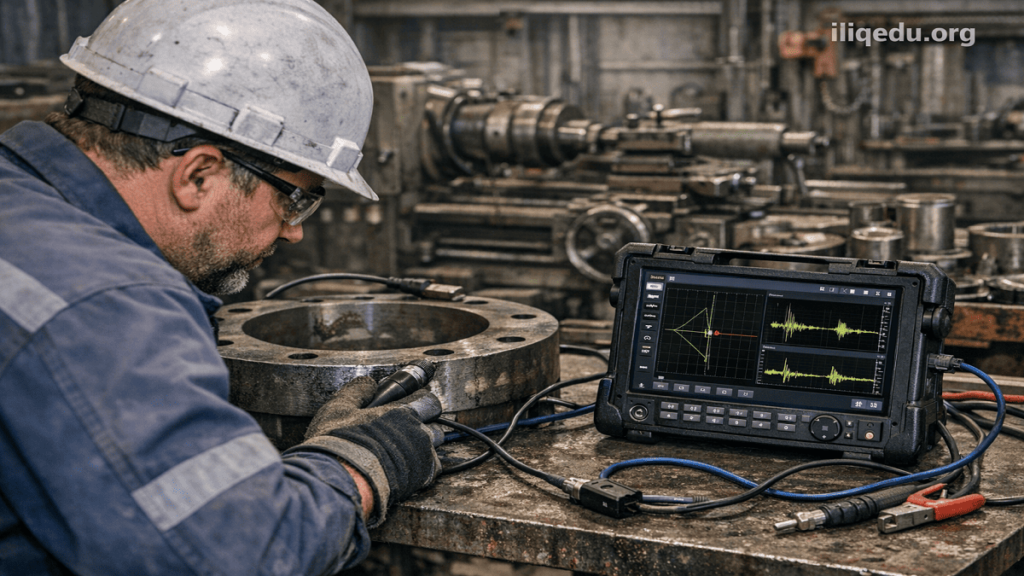
White Paper of Eddy Current Testing
1. Executive Summary
Eddy Current Testing (ECT) is a highly effective non-destructive testing method used to evaluate electrically conductive materials for defects, material properties, and structural integrity. Based on the principle of Electromagnetic Induction, ECT enables rapid, accurate, and non-invasive inspection.
This white paper provides a comprehensive overview of ECT, including its principles, technology, applications, benefits, limitations, implementation strategies, and future trends. ECT plays a critical role in industries such as aerospace, power generation, automotive, and manufacturing, where safety and reliability are essential.
2. Introduction
Eddy Current Testing is a key technique within Non-Destructive Testing, allowing inspection without damaging the material under test. The method relies on electromagnetic fields to detect surface and near-surface discontinuities in conductive materials.
Since its development from the discoveries of Michael Faraday, ECT has evolved into a sophisticated inspection tool supported by digital instrumentation, automation, and advanced data analysis.
3. Technical Principles
3.1 Fundamental Concept
ECT operates by inducing circulating currents (eddy currents) in a conductive material using an alternating magnetic field.
- A coil carrying alternating current produces a changing magnetic field.
- This field induces eddy currents in the test material.
- Disruptions in current flow indicate defects or variations in material properties.
3.2 Key Parameters
- Frequency: Determines depth of penetration.
- Conductivity: Affects current flow behavior.
- Permeability: Influences magnetic interaction.
- Lift-off: Distance between probe and surface affecting sensitivity.
4. Equipment and System Components
An ECT system typically includes:
- Probe/Coil: Generates and senses eddy currents.
- Eddy Current Instrument: Supplies AC signal and measures impedance changes.
- Display/Software Interface: Visualizes signals for interpretation.
- Calibration Standards: Provide reference signals for accurate defect detection.
5. Applications
5.1 Aerospace Industry
- Crack detection in aircraft structures
- Inspection of turbine blades and fastener holes
5.2 Power Generation
- Inspection of heat exchanger tubes and boilers
- Detection of corrosion and wall thinning
5.3 Automotive Industry
- Quality control of engine components
- Detection of surface defects in production
5.4 Manufacturing Sector
- Material sorting based on conductivity
- Coating thickness measurement
- Surface flaw detection
5.5 Oil and Gas Industry
- Pipeline and weld inspection
- Monitoring corrosion and structural integrity
6. Advantages of Eddy Current Testing
- Non-destructive and non-invasive
- High sensitivity to small surface defects
- Rapid inspection with immediate results
- Minimal surface preparation required
- Capability for automation in production environments
7. Limitations and Challenges
- Applicable only to conductive materials
- Limited penetration depth (surface and near-surface)
- Requires skilled operators for interpretation
- Results influenced by material properties and geometry
8. Implementation Considerations
8.1 Calibration and Standards
Proper calibration using reference standards is essential to ensure accuracy and repeatability.
8.2 Operator Training
Skilled personnel are required to interpret signals and distinguish between defects and material variations.
8.3 Integration with Systems
Modern ECT systems can be integrated with:
- Automated inspection lines
- Data acquisition and analysis software
- Quality management systems
9. Economic and Operational Impact
9.1 Cost Efficiency
- Reduces need for destructive testing
- Minimizes downtime through preventive maintenance
- Lowers repair costs by early defect detection
9.2 Productivity Gains
- Faster inspection processes
- Real-time results enable immediate decision-making
- Increased throughput in manufacturing
10. Future Trends
10.1 Advanced Signal Processing
Enhanced algorithms improve defect detection and reduce noise.
10.2 Automation and Robotics
Integration with robotic systems enables inspection of complex geometries.
10.3 Artificial Intelligence (AI)
AI is being used to assist in defect recognition and predictive maintenance.
10.4 Portable and Wireless Systems
Compact devices allow field inspections in remote and challenging environments.
11. Conclusion
Eddy Current Testing is a powerful and versatile non-destructive testing method that ensures safety, quality, and efficiency in industrial operations. Its ability to detect defects quickly and accurately without damaging materials makes it indispensable in modern engineering and maintenance practices.
With ongoing advancements in automation, digital processing, and AI, ECT is expected to become even more efficient and widely adopted across industries.
12. References (Selected)
- American Society for Nondestructive Testing – Eddy Current Testing resources
- International Atomic Energy Agency (IAEA). Non-Destructive Testing Handbook
- Blitz, J. Electrical and Magnetic Methods of Non-Destructive Testing, Springer
- Hellier, C. Handbook of Nondestructive Evaluation, McGraw-Hill
#Eddy Current Testing in Hyderabad
Industry Application of Eddy Current Testing
Eddy Current Testing (ECT) is a widely used inspection technique in modern industries for evaluating electrically conductive materials. As a key method within Non-Destructive Testing, ECT enables detection of defects, measurement of material properties, and assurance of product quality without causing damage.
1. Aerospace Industry
The aerospace sector relies heavily on ECT due to strict safety requirements.
Applications:
- Detection of fatigue cracks in aircraft structures
- Inspection of rivet holes, fasteners, and fuselage panels
- Evaluation of turbine blades and engine components
Importance:
- Prevents structural failures
- Ensures compliance with aviation safety standards
- Supports routine maintenance and airworthiness
2. Power Generation Industry
ECT is critical in maintaining efficiency and safety in power plants.
Applications:
- Inspection of heat exchanger tubes
- Detection of corrosion, erosion, and wall thinning
- Monitoring of boilers and condensers
Benefits:
- Reduces unexpected breakdowns
- Improves plant efficiency
- Enables predictive maintenance
3. Oil and Gas Industry
The oil and gas sector uses ECT extensively for infrastructure integrity.
Applications:
- Inspection of pipelines and storage tanks
- Evaluation of weld joints and drilling equipment
- Detection of corrosion and material degradation
Advantages:
- Prevents leaks and environmental hazards
- Supports regulatory compliance
- Enables on-site and remote inspections
4. Automotive Industry
ECT is widely used in automotive manufacturing for quality assurance.
Applications:
- Inspection of engine components and transmission parts
- Detection of surface cracks and defects
- Verification of weld quality
Benefits:
- Enhances vehicle safety and reliability
- Reduces production defects
- Improves manufacturing efficiency
5. Manufacturing and Metal Processing
ECT plays a vital role in ensuring product quality in manufacturing.
Applications:
- Detection of flaws in castings, forgings, and rolled products
- Material sorting based on conductivity
- Measurement of coating thickness
Advantages:
- Non-contact and fast inspection
- Suitable for automated production lines
- Reduces material wastage
6. Railway and Transportation Sector
ECT is used for maintaining safety in transportation systems.
Applications:
- Inspection of rail tracks for cracks and defects
- Evaluation of train wheels and axles
- Monitoring structural integrity of transport components
Importance:
- Prevents accidents and failures
- Ensures operational safety
- Supports regular maintenance programs
7. Electronics and Electrical Industry
ECT is useful in inspecting conductive components in electronics.
Applications:
- Detection of defects in wires and conductive parts
- Quality control of electrical components
- Measurement of conductivity variations
Benefits:
- Ensures product reliability
- Detects micro-level defects
- Supports precision manufacturing
8. Defense and Military Applications
ECT is used in defense systems where reliability is critical.
Applications:
- Inspection of military aircraft and vehicles
- Evaluation of weapon systems and structural components
- Maintenance of defense infrastructure
Advantages:
- Enhances operational readiness
- Ensures safety and durability of equipment
9. Research and Development Laboratories
ECT is applied in scientific and engineering research.
Applications:
- Study of material properties and conductivity
- Development of new testing techniques
- Experimental analysis of defect behavior
Summary
Eddy Current Testing is widely applied across industries due to its ability to provide:
- Non-destructive inspection of conductive materials
- Accurate detection of surface and near-surface defects
- Fast and efficient quality control
- Enhanced safety and reliability
Its versatility and effectiveness make ECT an essential tool in modern industrial operations, particularly in sectors where precision, safety, and performance are critical.
References and Further Reading
- American Society for Nondestructive Testing – Eddy Current Testing resources
- International Atomic Energy Agency (IAEA). Non-Destructive Testing Handbook
- Hellier, C. Handbook of Nondestructive Evaluation, McGraw-Hill
- Blitz, J. Electrical and Magnetic Methods of Non-Destructive Testing, Springer
#Eddy Current Testing in Mumbai
Ask FAQs
What is Eddy Current Testing?
Eddy Current Testing (ECT) is a non-destructive method used to detect surface and near-surface defects in conductive materials by inducing electrical currents and analyzing their behavior.
What types of materials can be tested using ECT?
ECT is mainly used for electrically conductive materials, such as metals (aluminum, copper, steel). It cannot be used on non-conductive materials like plastics or ceramics.
What are the main advantages of Eddy Current Testing?
Non-destructive and safe
High sensitivity to small cracks
Fast inspection with immediate results
Requires minimal surface preparation
Can be automated for industrial use
What are the limitations of Eddy Current Testing?
Limited to surface and near-surface inspection
Requires skilled operators for interpretation
Results may be affected by material properties and geometry
Not suitable for non-conductive materials
Where is Eddy Current Testing commonly used?
ECT is widely used in industries such as aerospace, power generation, automotive, oil and gas, and manufacturing for defect detection, quality control, and preventive maintenance.
Source: FOERSTER Group
Table of Contents
Disclaimer:
This content is for educational and informational purposes only and should not be considered professional engineering or technical advice. Always consult qualified experts or certified inspectors for specific testing and application requirements.