Laser Surface Profilometry
What is Laser Surface Profilometry?
Laser Surface Profilometry (LSP) is a non-contact measurement technique used to analyze the topography, roughness, and texture of a surface with high precision. By using laser beams to scan the surface, it generates three-dimensional (3D) profiles of the material, enabling detailed inspection for quality control, research, and industrial applications.
Unlike contact methods, LSP does not physically touch the surface, which prevents surface damage and allows measurement of delicate, soft, or complex materials.
2. Principle of Laser Surface Profilometry
LSP operates on the principle of Laser Triangulation:
- A laser beam is projected onto the surface.
- The reflected light is captured by a detector at a known angle.
- The displacement of the laser spot due to surface irregularities is calculated.
- A 3D profile of the surface is generated, showing roughness, height variations, and defects.
Other advanced LSP systems use interferometry or confocal microscopy for higher resolution measurements.
3. Who Requires Laser Surface Profilometry?
LSP is required by:
- Manufacturing engineers for quality control of precision components
- Research scientists studying material surfaces
- Aerospace and automotive industries for inspecting critical parts
- Semiconductor and electronics manufacturers for micro- and nano-scale surface analysis
- Medical device companies for implants and surgical tools
4. When is Laser Surface Profilometry Required?
- During quality inspection of machined, polished, or coated surfaces
- For research and development of new materials
- To analyze wear and corrosion in industrial components
- When surface roughness and texture affect product performance
- In non-destructive testing of sensitive or delicate materials
5. Where is Laser Surface Profilometry Used?
- Aerospace: turbine blades, fuselage panels, and coatings
- Automotive: engine components, brake discs, and surface finishes
- Electronics and Semiconductors: wafers, microchips, and sensors
- Medical Devices: implants, surgical tools, and prosthetics
- Metallurgy and Manufacturing: machined parts, coatings, and material characterization
6. How is Laser Surface Profilometry Performed?
- Preparation: The surface is cleaned; reflective coatings may be applied if necessary.
- Laser Scanning: The device scans the surface using triangulation, confocal, or interferometry methods.
- Data Acquisition: Reflected light is measured by detectors.
- Data Processing: Software generates a 3D map of surface topography, roughness, and defects.
- Analysis: Measurements are compared to standards or design specifications for quality control.
7. Applications of Laser Surface Profilometry
- Quality Control: Checking flatness, roughness, and surface defects
- Material Research: Studying wear, corrosion, and coating properties
- Precision Engineering: Ensuring tolerances on high-precision components
- Additive Manufacturing: Inspecting 3D-printed parts for surface uniformity
- Medical and Biotech: Measuring implant surfaces and surgical instruments
8. Advantages
- Non-contact and non-destructive
- High accuracy and resolution (micro- and nano-scale)
- Applicable to complex geometries
- Rapid measurement with digital data output
- Integration with automated production lines
9. Limitations
- Sensitive to surface reflectivity; very dark or transparent surfaces may require coating
- Limited measurement range for very large components
- High initial equipment cost
- Requires trained operators for interpretation of complex 3D data
10. Conclusion
Laser Surface Profilometry is an essential tool in modern industries and research for precise surface analysis. It allows manufacturers and researchers to ensure product quality, enhance performance, and advance material science by providing detailed 3D surface data without damaging the sample.
#Laser Surface Profilometry in Delhi
Who is Laser Surface Profilometry required?
Laser Surface Profilometry (LSP) is required by professionals and organizations that need precise, non-contact measurement of surface topography for quality control, research, and industrial applications. It is especially important in industries where surface quality directly affects performance, safety, or functionality.
1. Manufacturing and Quality Control Engineers
- Inspect machined, polished, or coated surfaces for flatness, roughness, and defects.
- Ensure that components meet tolerance and design specifications.
- Common in industries producing precision metal parts, optical components, and machinery.
2. Research Scientists and Material Engineers
- Study surface properties, wear, corrosion, and coating performance.
- Analyze micro- and nano-scale surface features for material development.
- Essential in academia, industrial research labs, and R&D departments.
3. Aerospace Industry Professionals
- Inspect turbine blades, fuselage panels, and high-performance coatings.
- Detect surface imperfections that could affect aerodynamic efficiency and structural integrity.
- Required in both manufacturing and maintenance inspections.
4. Automotive Industry Experts
- Analyze engine components, brake discs, and surface finishes for reliability.
- Measure surface roughness and texture to ensure friction, wear, and performance standards.
5. Electronics and Semiconductor Engineers
- Measure surface uniformity on wafers, microchips, and sensors.
- Ensure precision and performance in high-tech electronic devices.
6. Medical Device Manufacturers
- Inspect implants, surgical instruments, and prosthetics.
- Ensure biocompatibility, surface roughness, and regulatory compliance.
7. Additive Manufacturing and 3D Printing Specialists
- Evaluate 3D-printed parts for surface roughness and defects.
- Optimize post-processing and improve part quality.
Summary
Laser Surface Profilometry is required by:
- Manufacturing and quality engineers
- Material scientists and researchers
- Aerospace and automotive professionals
- Electronics and semiconductor engineers
- Medical device manufacturers
- Additive manufacturing specialists
It is essential wherever surface precision, defect detection, and non-contact measurement are critical for performance, safety, and product quality.
#Laser Surface Profilometry in Chennai
When is Laser Surface Profilometry required?
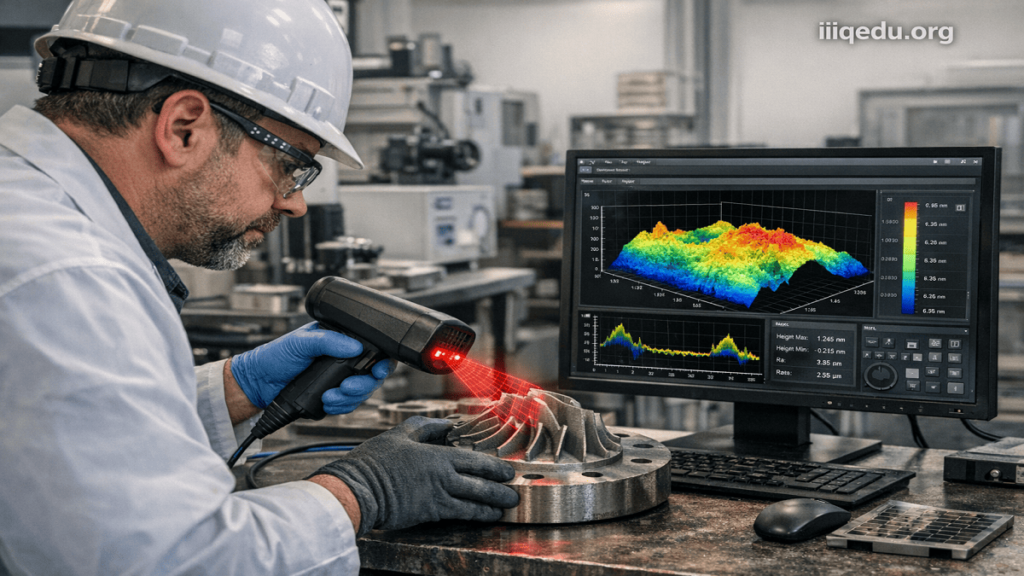
Laser Surface Profilometry (LSP) is required whenever there is a need to precisely measure, analyze, or control the surface topography of a material without causing damage. Its non-contact, high-resolution capabilities make it indispensable in industries where surface quality affects performance, safety, or functionality.
1. During Quality Control and Manufacturing Inspection
- Required to verify surface roughness, flatness, and texture of machined or polished components.
- Ensures that products meet design specifications and tolerance standards.
- Common in aerospace, automotive, and precision manufacturing.
2. For Surface Defect Detection
- Needed when inspecting for:
- Cracks, scratches, or pits
- Corrosion or wear
- Coating irregularities
- Critical in high-performance components where surface flaws can lead to failure.
3. In Research and Development (R&D)
- Required for material characterization and testing new surface treatments.
- Helps evaluate wear, corrosion, and coating properties over time.
- Used in laboratories for micro- and nano-scale surface analysis.
4. For Process Optimization
- Required to analyze surface texture in additive manufacturing or 3D printing.
- Ensures post-processing or finishing operations achieve target roughness or patterning.
- Used to improve product performance and efficiency.
5. In Safety-Critical Applications
- Required in industries such as aerospace, medical devices, and automotive.
- Ensures implants, surgical tools, turbine blades, or braking components meet safety standards.
- Detects defects that could compromise structural integrity or performance.
6. For Coating and Surface Treatment Verification
- Required when checking coating thickness, uniformity, and adherence.
- Ensures protective layers on metals or components meet durability and performance criteria.
7. For Non-Destructive Evaluation
- LSP is needed when contact methods are unsuitable, e.g., soft, delicate, or highly polished surfaces.
- Allows accurate measurement without damaging or altering the sample.
Summary
Laser Surface Profilometry is required:
- During quality control and manufacturing
- For detecting surface defects and irregularities
- In research and material development
- To optimize manufacturing processes
- In safety-critical and high-precision applications
- For verifying coatings and surface treatments
- When non-destructive evaluation is necessary
It is most beneficial whenever accuracy, non-contact measurement, and surface integrity are critical for product performance and reliability.
#Laser Surface Profilometry in Kolkata
Where is Laser Surface Profilometry required?
Laser Surface Profilometry (LSP) is required in any environment where precise, non-contact surface measurement is critical for quality, safety, or performance. Its high-resolution capabilities and non-destructive approach make it ideal across multiple industries.
1. Aerospace Industry
- Inspection of turbine blades, fuselage panels, and wing components
- Detection of micro-cracks, wear, or coating defects
- Ensures structural integrity and aerodynamic performance
2. Automotive Industry
- Measurement of engine components, brake discs, and precision parts
- Evaluation of surface roughness for friction, wear, and efficiency
- Ensures reliable performance and safety compliance
3. Electronics and Semiconductor Industry
- Surface inspection of microchips, wafers, sensors, and circuit boards
- Detection of microscopic defects and unevenness
- Critical for high-precision and high-performance electronic devices
4. Medical Devices and Biotechnology
- Inspection of implants, surgical tools, and prosthetics
- Ensures biocompatibility, surface roughness, and regulatory compliance
- Used in both manufacturing and R&D labs
5. Additive Manufacturing and 3D Printing Facilities
- Measurement of 3D-printed surfaces for roughness and uniformity
- Validation of post-processing and finishing operations
- Helps optimize production quality
6. Metallurgy and Material Processing Plants
- Inspection of machined, coated, or polished metal surfaces
- Detects corrosion, wear, and surface irregularities
- Ensures component quality and durability
7. Research Laboratories and Academic Institutions
- Used for material research, surface characterization, and experimental studies
- Measures micro- and nano-scale surface topography
- Supports innovation in coatings, composites, and new materials
8. Industrial Maintenance and Field Inspections
- Portable LSP systems allow on-site surface evaluation
- Useful for predictive maintenance and quality assurance in critical machinery
Summary
Laser Surface Profilometry is required wherever surface precision, defect detection, and quality control are essential. Common environments include:
- Aerospace and aviation facilities
- Automotive manufacturing plants
- Electronics and semiconductor labs
- Medical device manufacturing
- Additive manufacturing and 3D printing centers
- Metallurgy and industrial plants
- Research laboratories and field inspection sites
Its non-contact, high-resolution capability makes it indispensable for industries where surface quality affects performance, reliability, or safety.
#Laser Surface Profilometry in Ahemdabad
How is Laser Surface Profilometry required?
Laser Surface Profilometry (LSP) is required to be implemented through a structured process that ensures accurate, high-resolution, and non-destructive measurement of surface topography. Its execution involves careful preparation, scanning, and analysis to deliver reliable 3D surface profiles.
1. Surface Preparation
- Clean the surface to remove dust, oils, or debris that could interfere with laser reflection.
- Apply a reflective coating if the surface is too dark or transparent for accurate measurement.
- Ensure the component is stable and properly positioned for scanning.
2. Selection of Profilometry Method
Depending on the required resolution and surface type, one chooses:
- Laser Triangulation – for standard industrial surface measurements
- Confocal Laser Scanning – for micro-scale surface roughness and fine details
- Interferometry – for nano-scale precision and extremely flat surfaces
3. Equipment Setup
- Position the laser scanner or profilometer at the correct angle and distance.
- Calibrate the device using standard reference surfaces to ensure accurate measurements.
- Configure software parameters such as scanning speed, resolution, and field of view.
4. Surface Scanning
- The laser beam is projected onto the surface.
- Reflected light is captured by a detector, and displacement caused by surface features is measured.
- The scanner moves across the surface to capture a full 3D profile.
5. Data Acquisition and Processing
- Collected data is processed using profilometry software to generate detailed 3D maps.
- Surface roughness, peaks, valleys, and defects are quantified.
- Digital output allows comparison against design specifications or tolerance limits.
6. Analysis and Interpretation
- Engineers or researchers analyze the 3D profile to:
- Identify defects, scratches, or irregularities
- Measure surface roughness, texture, or coating thickness
- Evaluate wear, corrosion, or material performance
- Advanced software can generate color maps, contour plots, and statistical surface parameters.
7. Reporting and Decision-Making
- Results are documented in inspection reports or research outputs.
- Decisions on acceptance, rework, or process optimization are made based on measurements.
- In industrial applications, data can feed into quality control systems or automated production feedback loops.
Summary
Laser Surface Profilometry is required to be performed through a step-by-step process:
- Surface cleaning and preparation
- Selection of the appropriate laser scanning method
- Equipment setup and calibration
- Precise surface scanning
- Data acquisition and processing
- Analysis of surface features and defects
- Reporting and application of results
This structured approach ensures accurate, non-destructive, and reproducible measurement of surface topography, making LSP indispensable in high-precision industries, research labs, and quality-critical applications.
#Laser Surface Profilometry in Hyderabad
Case Study of Laser Surface Profilometry
Background
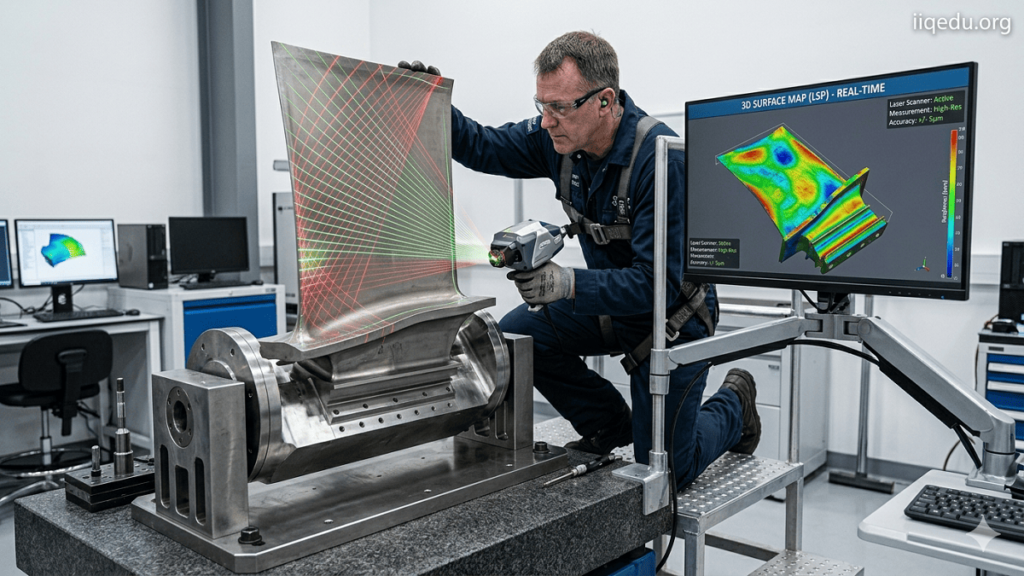
A leading aerospace manufacturer faced recurring issues with micro-defects on turbine blades that could affect performance and reduce lifespan. Traditional contact measurement methods were too slow and risked damaging the delicate components.
Problem
- Surface defects such as microscopic cracks, pitting, and coating inconsistencies went undetected during routine inspection.
- Manual methods were time-consuming, inconsistent, and could compromise surface integrity.
Solution Using LSP
- Laser Surface Profilometry was implemented to scan the turbine blades without contact.
- Confocal and triangulation-based LSP systems were used for high-resolution measurements.
- 3D surface maps were generated to visualize roughness, peaks, valleys, and micro-defects.
Results
- Detected micro-cracks and surface irregularities invisible to conventional methods.
- Reduced inspection time from several hours to minutes per blade.
- Improved coating uniformity and surface finish quality before assembly.
Outcome
The company integrated LSP into its routine quality control process, resulting in fewer defects, longer component lifespan, and enhanced safety in turbine operation.
Case Study 2: Additive Manufacturing Quality Control
Background
An industrial 3D printing facility producing metal parts for automotive and aerospace applications needed to ensure surface quality after printing and post-processing.
Problem
- 3D-printed components often had surface roughness variations and residual defects.
- Inconsistent finishes affected mechanical performance and assembly compatibility.
Solution Using LSP
- LSP was applied to measure surface roughness, layer uniformity, and defects.
- Scans produced 3D maps of each part, highlighting high spots, valleys, and anomalies.
- The system was integrated with post-processing workflows for real-time quality control.
Results
- Identified surface inconsistencies early, enabling corrective polishing or reprocessing.
- Reduced rejected parts by 30%, improving overall production efficiency.
- Provided digital documentation for traceability and regulatory compliance.
Outcome
LSP enabled consistent quality assurance in additive manufacturing, ensuring components met strict aerospace and automotive standards.
Case Study 3: Medical Implant Surface Analysis
Background
A medical device company needed to verify the surface roughness of titanium implants to ensure biocompatibility and promote bone integration.
Problem
- Contact measurement could damage delicate implant surfaces.
- Small surface variations could affect patient outcomes and regulatory compliance.
Solution Using LSP
- Non-contact LSP scanned the implant surfaces at micro- and nano-scale resolution.
- Generated detailed 3D surface topography maps to measure roughness, peaks, and valleys.
Results
- Accurately measured surface roughness critical for osseointegration.
- Allowed comparison against regulatory standards without damaging the implant.
- Improved confidence in implant performance and safety.
Outcome
Laser Surface Profilometry became a standard in implant quality control, enhancing patient safety and regulatory compliance.
Key Insights from Case Studies
- Non-contact measurement prevents surface damage on delicate components.
- High-resolution 3D mapping allows detection of micro- and nano-scale defects.
- Time efficiency and automation improve inspection workflows.
- Traceable digital data supports regulatory compliance and process optimization.
- LSP is versatile and applicable across aerospace, automotive, additive manufacturing, and medical industries.
Conclusion
Laser Surface Profilometry is a critical technology for modern industrial and research applications, offering:
- Precise surface characterization
- Non-destructive inspection
- Process optimization
- Quality assurance and compliance
These case studies highlight how LSP ensures product reliability, safety, and performance in high-precision industries.
#Laser Surface Profilometry in Patna
White Paper of Laser Surface Profilometry
1. Executive Summary
Laser Surface Profilometry (LSP) is a non-contact, high-resolution measurement technique used to evaluate the topography, roughness, and texture of surfaces. It is widely applied in aerospace, automotive, medical, semiconductor, and additive manufacturing industries, where surface integrity directly impacts performance, safety, and reliability.
This white paper provides a comprehensive overview of LSP, including its principles, equipment, applications, advantages, limitations, implementation strategies, and emerging trends.
2. Introduction
Modern manufacturing and research demand precise surface measurements to ensure product quality, regulatory compliance, and performance optimization. Traditional contact methods (stylus profilometers) are often unsuitable for delicate or small components.
LSP uses laser-based scanning techniques such as triangulation, confocal microscopy, and interferometry to produce accurate 3D surface profiles without physically contacting the material.
3. Technical Principles
3.1 Laser Triangulation
- Projects a laser spot onto the surface.
- Measures reflected light displacement using a detector.
- Calculates height variations to generate a 3D surface map.
3.2 Confocal Laser Scanning
- Focused laser beam captures fine surface details at micro-scale resolution.
- Ideal for components with complex geometries.
3.3 Interferometry
- Uses interference patterns of reflected laser light for nano-scale measurements.
- Provides extremely precise surface flatness and roughness data.
4. Equipment and Components
- Laser Scanner/Profilometer – Triangulation, confocal, or interferometry systems
- Detector/Camera – Captures reflected laser light
- Software Interface – Processes data and generates 3D surface maps
- Calibration Standards – Ensure accuracy and repeatability
- Positioning System – Ensures precise scanning of components
5. Industry Applications
5.1 Aerospace
- Turbine blades, fuselage panels, and coatings
- Detection of micro-cracks, wear, or coating defects
5.2 Automotive
- Engine components, brake discs, and surface finishes
- Measurement of roughness and friction-relevant properties
5.3 Medical Devices
- Implants, surgical tools, and prosthetics
- Ensures biocompatibility and surface roughness for osseointegration
5.4 Electronics & Semiconductors
- Microchips, wafers, sensors, and circuit boards
- Detection of microscopic surface defects
5.5 Additive Manufacturing
- 3D-printed metal and polymer components
- Surface uniformity and post-processing verification
5.6 Material Science Research
- Analysis of wear, corrosion, coatings, and surface treatments
- Micro- and nano-scale topography characterization
6. Advantages of Laser Surface Profilometry
- Non-contact, non-destructive measurement
- High accuracy and resolution (micro- and nano-scale)
- Applicable to complex geometries and delicate surfaces
- Rapid scanning with digital data output
- Integration with automated production lines
- Supports regulatory compliance and traceability
7. Limitations and Challenges
- Sensitive to surface reflectivity; may require coatings
- Limited measurement area for very large components
- High initial equipment and maintenance cost
- Requires trained operators for accurate data interpretation
8. Implementation Strategies
- Calibration: Use standard reference surfaces to ensure accuracy
- Training: Skilled personnel to interpret 3D data correctly
- Integration: Embed LSP in quality control or R&D workflows
- Automation: Connect with robotic or production systems for efficient scanning
- Data Management: Maintain digital records for traceability and compliance
9. Future Trends
- AI and Machine Learning: Automated defect detection and surface analysis
- Portable Profilometry Systems: On-site inspection for field maintenance
- High-Speed Scanning: Rapid quality control in industrial production
- Integration with Additive Manufacturing: Real-time monitoring of 3D-printed surfaces
- Advanced Imaging Algorithms: Improved resolution and noise reduction
10. Conclusion
Laser Surface Profilometry is a critical technology for industries and research requiring precise surface measurements. Its non-destructive, high-resolution, and versatile capabilities make it indispensable for:
- Ensuring product quality and reliability
- Detecting defects and surface irregularities
- Optimizing manufacturing processes
- Supporting regulatory compliance and R&D innovation
With advances in automation, AI, and portable systems, LSP is expected to become increasingly widespread in precision-critical applications.
#Laser Surface Profilometry in Pune
Industry Application of Laser Surface Profilometry
Laser Surface Profilometry (LSP) is a non-contact, high-resolution measurement technique widely adopted across industries where surface quality, defect detection, and precision are critical. Its ability to generate accurate 3D surface profiles makes it indispensable for modern manufacturing, research, and quality control processes.
1. Aerospace Industry
- Applications:
- Inspection of turbine blades, fuselage panels, and engine components
- Detection of micro-cracks, surface wear, and coating defects
- Benefits:
- Enhances safety and reliability
- Ensures compliance with aerospace quality standards
- Reduces maintenance downtime through predictive inspection
2. Automotive Industry
- Applications:
- Surface analysis of engine components, brake discs, gears, and transmission parts
- Measurement of surface roughness affecting friction and wear
- Benefits:
- Improves vehicle performance and component longevity
- Supports quality control in mass production
- Reduces defect rates and rework costs
3. Electronics and Semiconductor Industry
- Applications:
- Inspection of wafers, microchips, printed circuit boards, and sensors
- Detection of microscopic defects and surface irregularities
- Benefits:
- Ensures high precision and reliability of electronic devices
- Prevents failure in high-performance applications
- Supports micro- and nano-scale research
4. Medical Devices and Biotechnology
- Applications:
- Surface measurement of implants, surgical tools, and prosthetics
- Verification of roughness and texture for biocompatibility
- Benefits:
- Improves patient safety and device efficacy
- Ensures regulatory compliance
- Non-contact measurement preserves delicate surfaces
5. Additive Manufacturing and 3D Printing
- Applications:
- Inspection of metal and polymer 3D-printed parts
- Measurement of surface uniformity and layer consistency
- Benefits:
- Optimizes post-processing and finishing operations
- Ensures component performance and accuracy
- Reduces rejected parts and material waste
6. Metallurgy and Material Processing
- Applications:
- Analysis of machined, coated, or polished metal surfaces
- Detection of corrosion, wear, or surface irregularities
- Benefits:
- Enhances material durability and lifespan
- Supports quality control in industrial production
- Provides data for process optimization
7. Research and Development Laboratories
- Applications:
- Material characterization for coatings, composites, and surface treatments
- Study of wear, corrosion, and micro-structural properties
- Benefits:
- Provides precise micro- and nano-scale surface data
- Enables innovation in material science and engineering
- Supports publication-quality research and experimental validation
8. Industrial Maintenance and Field Inspections
- Applications:
- Portable LSP systems for on-site inspection of critical machinery
- Predictive maintenance of turbines, engines, and heavy industrial equipment
- Benefits:
- Reduces unplanned downtime
- Prevents catastrophic failures
- Provides real-time surface evaluation in industrial settings
Summary
Laser Surface Profilometry is required across a wide range of industries wherever surface integrity, precision, and non-destructive measurement are critical. Its applications span:
- Aerospace and aviation
- Automotive manufacturing
- Electronics and semiconductor production
- Medical device manufacturing
- Additive manufacturing and 3D printing
- Metallurgy and material processing
- Research and development laboratories
- Industrial maintenance and field inspections
The technology ensures product quality, safety, compliance, and performance, making it an essential tool for modern industry and research.
#Laser Surface Profilometry in Mumbai
Ask FAQs
What is Laser Surface Profilometry?
Laser Surface Profilometry (LSP) is a non-contact optical measurement technique used to analyze the topography, roughness, and texture of a surface. By scanning a laser beam across the material and capturing the reflected light, it generates high-resolution 3D surface profiles for quality control, research, and industrial applications.
What materials can be measured with LSP?
LSP can measure any reflective or semi-reflective material, including metals, ceramics, polymers, and coated surfaces. Dark or transparent surfaces may require a thin reflective coating for accurate measurement. It is widely used in aerospace, automotive, medical, electronics, and additive manufacturing industries.
What are the advantages of using Laser Surface Profilometry?
Non-contact measurement avoids surface damage
High resolution at micro- and nano-scale
Applicable to complex geometries
Rapid and digital data acquisition
Provides 3D topography and roughness analysis
Supports quality assurance, R&D, and regulatory compliance
What are the limitations of LSP?
Sensitive to surface reflectivity and transparency
Limited measurement area for very large components
High initial cost of equipment and maintenance
Requires trained operators to interpret complex 3D data
Not suitable for non-optically accessible surfaces without preparation
Where is Laser Surface Profilometry commonly used?
Aerospace: turbine blades, fuselage panels, and coatings
Automotive: engine parts, brake discs, and precision surfaces
Medical Devices: implants, surgical tools, and prosthetics
Electronics & Semiconductors: wafers, sensors, and microchips
Additive Manufacturing: 3D-printed components for surface quality control
Research Labs: material characterization, coatings, and surface science
Source: NANOVEA
Table of Contents
Disclaimer:
The information provided on Laser Surface Profilometry (LSP) is for educational and informational purposes only. While every effort has been made to ensure accuracy, the content should not replace professional consultation or industry-specific guidance. Users are responsible for verifying measurements, procedures, and applications according to relevant standards and regulations.