Machine Learning for Root Cause Analysis
Root Cause Analysis (RCA) is a systematic process for identifying the underlying causes of problems or incidents, rather than just addressing the symptoms. Integrating Machine Learning (ML) into RCA can significantly improve efficiency, accuracy, and predictive capabilities, especially in complex systems with large amounts of data. Here’s a structured breakdown of Machine Learning for Root Cause Analysis:
1. Overview of Root Cause Analysis
RCA aims to answer questions like:
- Why did this failure or incident occur?
- What sequence of events led to this outcome?
Traditional RCA methods include:
- 5 Whys – asking “why” repeatedly to dig deeper.
- Fishbone/Ishikawa Diagrams – mapping out potential causes by categories.
- Fault Tree Analysis (FTA) – visualizing causal relationships.
ML enhances RCA by handling large datasets, uncovering hidden patterns, and providing predictive insights.
2. How Machine Learning Fits Into RCA
ML can automate or assist RCA by:
- Detecting anomalies or failures – identifying events that deviate from normal behavior.
- Correlating events and metrics – finding patterns between symptoms and potential causes.
- Predicting likely root causes – based on historical failure data.
- Prioritizing investigations – suggesting which potential causes are most probable.
3. Data Requirements
Effective ML-based RCA requires:
- Historical incident logs – error reports, maintenance logs, sensor readings.
- System metrics – performance indicators, utilization, environmental conditions.
- Event sequences – timestamps of operations or failures.
- Labels (optional) – known root causes for supervised learning.
4. Machine Learning Techniques Used in RCA
| Technique | Application in RCA | Example |
|---|---|---|
| Supervised Learning | Predict root causes from labeled historical incidents | Decision Trees, Random Forests, Gradient Boosted Trees |
| Unsupervised Learning | Detect patterns or clusters in unlabeled failure data | K-Means, DBSCAN, Hierarchical Clustering |
| Anomaly Detection | Identify abnormal events that could trigger RCA | Isolation Forest, Autoencoders, One-Class SVM |
| Association Rule Mining | Discover relationships between events | Apriori, FP-Growth |
| Time-Series Analysis | Analyze sequences of events or metrics | LSTM, ARIMA, Temporal Convolutional Networks |
| Causal Inference | Identify causal relationships instead of correlations | Bayesian Networks, DoWhy library |
5. Typical ML Pipeline for RCA
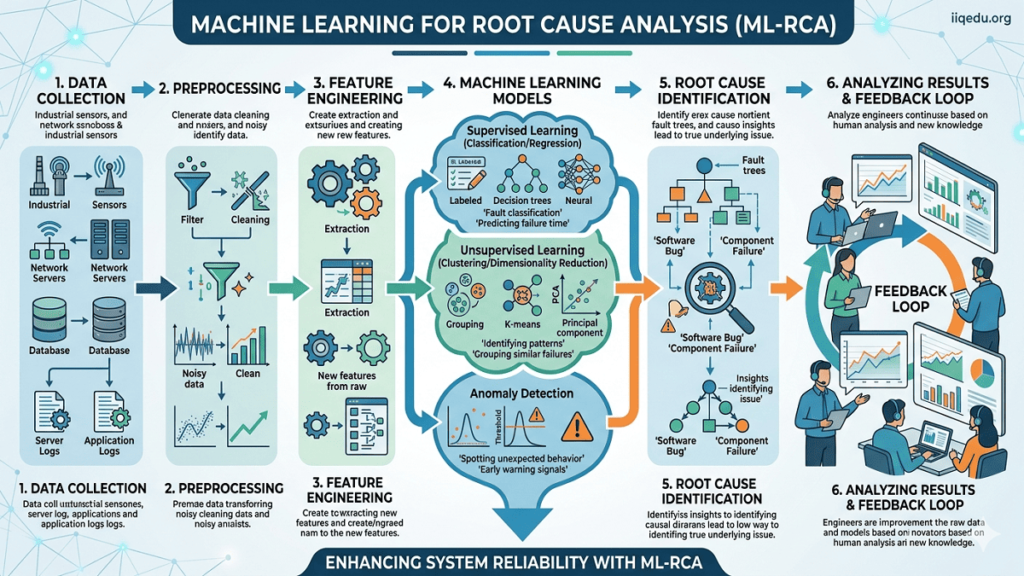
- Data Collection – gather logs, sensors, metrics.
- Data Preprocessing – clean data, handle missing values, normalize metrics.
- Feature Engineering – extract relevant features like error frequency, temporal sequences, environmental conditions.
- Model Selection – choose ML algorithms appropriate for labeled or unlabeled data.
- Training and Validation – train models on historical incidents.
- Inference & Interpretation – identify probable root causes and explain them.
- Feedback Loop – update models with new incidents to improve accuracy.
6. Challenges
- Data quality – incomplete or inconsistent logs reduce model accuracy.
- Imbalanced datasets – rare incidents may be underrepresented.
- Explainability – black-box models may be hard to trust for RCA.
- Causal vs Correlation – ML models often detect correlations, not true causes.
7. Best Practices
- Combine ML with domain expertise; human validation improves trust.
- Use explainable ML techniques (e.g., SHAP, LIME) to understand model predictions.
- Integrate ML into incident management systems for real-time RCA support.
- Maintain continuous learning pipelines to adapt to evolving systems.
Example Use Cases
- IT Operations: Detecting root causes of server outages using logs and performance metrics.
- Manufacturing: Identifying equipment failures using sensor data and production logs.
- Healthcare: Determining causes of adverse events in clinical workflows.
- Energy & Utilities: Diagnosing root causes of power outages or equipment malfunctions.
What is Machine Learning for Root Cause Analysis?
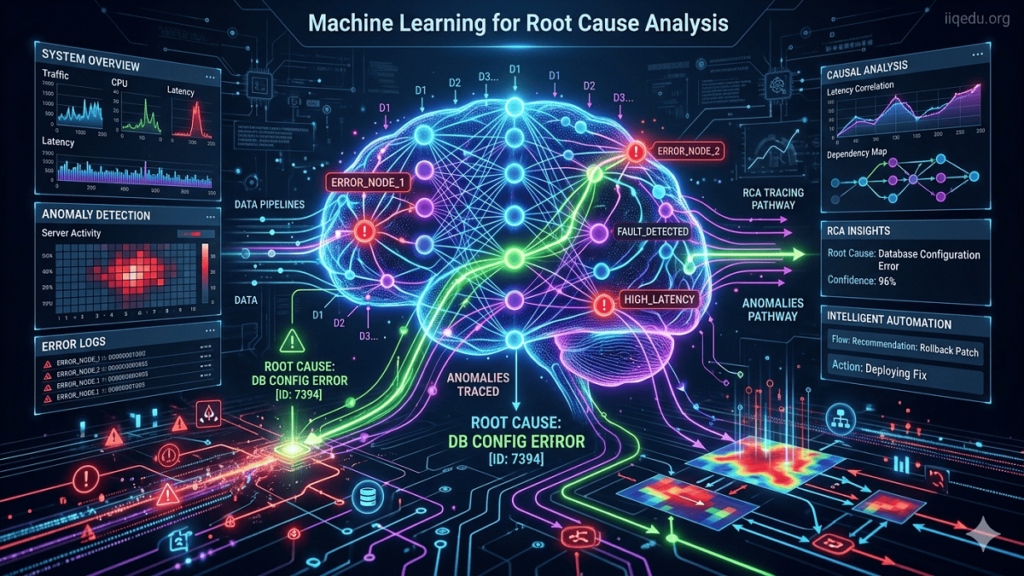
Machine Learning for Root Cause Analysis (ML for RCA) is the application of machine learning techniques to automatically identify the underlying causes of problems, failures, or anomalies in a system. Instead of manually investigating each incident, ML can analyze large amounts of historical and real-time data to detect patterns, correlations, and likely causes, helping organizations fix issues faster and prevent them from recurring.
Key Points:
- Purpose:
ML for RCA aims to discover the root cause of an issue rather than just addressing symptoms. It predicts or highlights probable causes based on past incidents. - How It Works:
- Collects data from logs, sensors, metrics, or system events.
- Processes and analyzes the data using ML algorithms.
- Identifies correlations, anomalies, or sequences that likely explain the failure.
- Suggests probable root causes for human validation or automated action.
- Common ML Techniques in RCA:
- Supervised Learning: Predicts causes from labeled historical failures (e.g., Random Forests, Decision Trees).
- Unsupervised Learning: Detects patterns or clusters in unlabeled data (e.g., K-Means, DBSCAN).
- Anomaly Detection: Finds abnormal events that may trigger problems (e.g., Autoencoders, Isolation Forest).
- Causal Inference: Attempts to distinguish true causes from mere correlations (e.g., Bayesian Networks).
- Benefits:
- Reduces time spent investigating failures.
- Handles large and complex datasets that are hard for humans to analyze manually.
- Improves preventive maintenance and system reliability.
- Enables predictive RCA by forecasting likely future failures.
- Challenges:
- Requires high-quality, comprehensive data.
- Models may detect correlation but not true causation without careful design.
- Explainability can be a challenge for complex ML models.
In short: ML for RCA is like having a smart detective that analyzes data from your systems, spots suspicious patterns, and points to the most likely underlying causes so you can fix problems faster and prevent them in the future.
Who is Machine Learning for Root Cause Analysis required?
I think you meant “Who needs Machine Learning for Root Cause Analysis?” or “Who requires ML for RCA?”. Let me explain clearly:
Machine Learning for Root Cause Analysis is required by organizations or teams that deal with complex systems where problems are frequent, large in volume, or hard to diagnose manually. It’s especially valuable when traditional methods like checklists or manual inspections are too slow or error-prone.
Typical Users / Stakeholders:
- IT & Operations Teams (IT Ops / DevOps)
- Detecting server crashes, application errors, or network failures.
- Example: Using ML to pinpoint why a cloud service went down by analyzing logs and performance metrics.
- Manufacturing & Industrial Teams
- Diagnosing machine failures, production line stoppages, or quality defects.
- Example: Predictive maintenance using sensor data to find root causes before equipment breaks.
- Energy & Utilities Companies
- Understanding causes of power outages, pipeline leaks, or equipment faults.
- Healthcare & Medical Systems
- Investigating adverse events, medical device malfunctions, or workflow failures.
- Business Analytics Teams
- Identifying causes behind process inefficiencies, customer churn, or financial anomalies.
- Safety & Compliance Teams
- Analyzing incidents or safety breaches to prevent recurrence.
Why They Need It:
- Volume: High number of incidents make manual analysis impractical.
- Complexity: Multiple interconnected systems make cause identification hard.
- Speed: Fast root cause identification reduces downtime and cost.
- Predictive Insight: Helps prevent future problems before they occur.
In short: Any organization that operates complex systems, generates lots of data, and wants to solve problems faster, prevent downtime, and reduce costs can benefit from ML for RCA.
When is Machine Learning for Root Cause Analysis required?
Machine Learning for Root Cause Analysis (ML for RCA) is required when traditional methods are insufficient to identify underlying problems efficiently or accurately. In other words, it’s needed whenever systems or processes are complex, data-heavy, or failure-prone.
Key Situations When ML for RCA Is Required:
- High Volume of Incidents or Data
- When logs, events, or errors are generated faster than humans can analyze.
- Example: A cloud platform with thousands of error logs per day.
- Complex Interconnected Systems
- When multiple subsystems interact and failures are hard to trace manually.
- Example: Manufacturing plants with automated assembly lines or multi-component machinery.
- Recurring or Hard-to-Diagnose Problems
- When the same type of incident happens repeatedly, but the cause is unclear.
- Example: Intermittent server crashes with no obvious trigger.
- Need for Predictive Maintenance or Prevention
- When you want to anticipate failures before they occur.
- Example: Predicting equipment breakdowns in a factory to schedule maintenance proactively.
- Time-Sensitive Decision Making
- When quick root cause identification is critical to minimize downtime or losses.
- Example: Financial transaction failures that need immediate resolution to prevent customer impact.
- Data Complexity Beyond Human Analysis
- When patterns, correlations, or sequences in data are too subtle or hidden for manual inspection.
- Example: IoT sensor networks producing multi-dimensional data streams.
In short: ML for RCA is required when speed, accuracy, and scale of problem detection exceed human capability, especially in environments with complex systems, large datasets, recurring failures, or high stakes for downtime.
Where is Machine Learning for Root Cause Analysis required?
Machine Learning for Root Cause Analysis (ML for RCA) is required wherever complex systems operate, failures are costly, or large volumes of data are generated. Essentially, it’s needed “wherever problems happen and humans can’t easily trace them manually.”
Key Areas / Industries Where ML for RCA Is Required:
- Information Technology (IT) & Cloud Operations
- Data centers, cloud services, networks, and software systems.
- Example: Diagnosing server outages, network latency issues, or application errors.
- Manufacturing & Industrial Automation
- Factories, production lines, assembly robots, and industrial IoT systems.
- Example: Identifying causes of equipment failures or quality defects in production.
- Energy & Utilities
- Power grids, pipelines, renewable energy plants, and water treatment systems.
- Example: Root cause analysis of blackouts, equipment faults, or leakage events.
- Healthcare & Medical Systems
- Hospitals, clinics, and medical devices.
- Example: Investigating adverse events, device malfunctions, or workflow inefficiencies.
- Finance & Banking
- Transaction systems, fraud detection platforms, and risk management processes.
- Example: Identifying causes behind failed transactions or anomalies in trading systems.
- Transportation & Logistics
- Railways, airlines, shipping fleets, and autonomous vehicles.
- Example: Diagnosing equipment malfunctions, delays, or supply chain disruptions.
- Telecommunications
- Cellular networks, broadband systems, and satellite communications.
- Example: Pinpointing causes of dropped calls, network congestion, or service outages.
- Safety-Critical Environments
- Aviation, defense, and chemical plants.
- Example: Investigating safety incidents or near-misses to prevent recurrence.
In short: ML for RCA is required anywhere complex systems generate high volumes of data, failures are costly, or humans cannot quickly identify the root cause manually.
How is Machine Learning for Root Cause Analysis required?
You’re asking “How is Machine Learning for Root Cause Analysis required?”, which I interpret as “How is ML applied or used for Root Cause Analysis?”. Let me explain clearly.
Machine Learning is used to support and automate the process of identifying the root causes of problems or failures by analyzing data patterns that are too complex for humans to process manually. Here’s how it’s applied step by step:
1. Data Collection
- Gather all relevant data from systems, sensors, logs, or incident reports.
- Examples:
- Server logs, performance metrics, and error messages.
- Sensor readings from machines in a factory.
- Event sequences in IoT devices or networks.
2. Data Preprocessing
- Clean the data to remove noise or missing values.
- Normalize or standardize metrics for analysis.
- Convert textual logs into structured features if needed (e.g., error codes, timestamps).
3. Feature Engineering
- Identify which data attributes might indicate potential causes.
- Examples:
- Frequency of errors per device.
- Sequence of events leading to a failure.
- Environmental conditions like temperature or humidity in industrial systems.
4. ML Model Selection
- Choose the right machine learning approach based on available data:
| Approach | How It’s Used for RCA |
|---|---|
| Supervised Learning | Predicts the root cause using historical labeled incidents (Decision Trees, Random Forests). |
| Unsupervised Learning | Detects clusters or patterns in unlabeled failure data (K-Means, DBSCAN). |
| Anomaly Detection | Identifies abnormal events that might trigger a failure (Isolation Forest, Autoencoders). |
| Causal Inference | Tries to identify actual cause-effect relationships (Bayesian Networks). |
5. Model Training and Validation
- Train the ML model using historical data.
- Validate using unseen incidents to ensure it can predict or identify root causes accurately.
6. Root Cause Identification
- The trained ML model analyzes new incidents.
- It outputs likely root causes, ranked by probability or severity.
- Can also highlight patterns or correlations that humans might miss.
7. Feedback and Continuous Learning
- Human experts validate the ML predictions.
- The model is updated with new data, improving accuracy over time.
In simple terms:
Machine Learning is required for RCA by analyzing large, complex datasets to automatically detect patterns, anomalies, or causes of failures, which speeds up diagnosis, reduces downtime, and improves preventive maintenance.
Case study of Machine Learning for Root Cause Analysis
1. Background
A large manufacturing plant was experiencing frequent breakdowns in one of its critical assembly lines.
- Breakdowns caused production delays, high maintenance cost, and missed delivery deadlines.
- Traditional RCA (manual log review + expert interviews) was too slow and often inconclusive.
The company decided to apply Machine Learning to automate and improve RCA.
2. The Problem
- Machines had hundreds of sensors generating data every second (temperature, vibration, pressure, RPM, etc.).
- When a machine failed, there were thousands of correlated variables, making manual analysis infeasible.
- The questions were:
- Can we predict failures before they occur?
- Can we identify the true root causes behind these failures?
3. ML-Based RCA Approach
Step 1: Data Collection
- Collected sensor data for the past 12 months.
- Gathered failure logs with timestamps and technician notes.
- Included maintenance records and environmental conditions (humidity, shift timing, etc.).
Step 2: Data Preprocessing
- Cleaned missing or inconsistent entries.
- Aligned sensor readings with failure timestamps.
- Engineered new features such as:
- Average vibration over the last hour
- Temperature spikes in the last 24 hours
- Rate of pressure change
Step 3: Model Training
Two ML models were used:
Anomaly Detection Model
- Trained to detect unusual patterns in sensor behavior.
- Algorithm: Isolation Forest + Autoencoder
Supervised Classification Model
- Used labeled data (failure types + known root causes).
- Algorithm: Random Forest Classifier (good at handling mixed numeric data).
Step 4: Root Cause Identification
When a breakdown occurred:
- Anomaly Detector flagged unusual sensor patterns before the failure.
- Classification Model predicted the most likely root cause (e.g., “Bearing Wear”, “Hydraulic Leak”, “Overheating”).
- Results were presented with feature importance scores using SHAP values — so engineers could see which signals mattered most.
4. Results
Improved Prediction Accuracy
- The system predicted 87% of failures 24–72 hours in advance.
- Precision of root cause identification improved from 40% (manual) to 78% (ML-assisted).
Operational Impact
- Reduced unplanned downtime by 30% in 6 months.
- Maintenance crews could proactively target machines before failure.
- Engineers discovered new insights:
- One sensor previously thought irrelevant showed strong correlation with specific failures.
- Temperature spikes combined with pressure drops were a signature of upcoming maintenance needs.
5. What Made It Successful?
| Success Factor | Why It Mattered |
|---|---|
| Large Historical Dataset | Required enough events for ML training |
| Continuous Sensor Streams | Enabled early anomaly detection |
| Expert Validation Loop | Engineers verified ML results |
| Explainability (SHAP/LIME) | Built trust in model outputs |
6. Challenges Encountered
- Early versions had high false positives — solved with better feature engineering.
- Missing or unsynchronized timestamps required extra preprocessing.
- Domain experts still needed to interpret complex patterns — ML aided but didn’t fully replace human insight.
7. Key Takeaway
Machine Learning didn’t just speed up RCA — it transformed it.
Instead of reacting to failures, the plant moved to:
Predict failures
Identify likely causes quickly
Prioritize corrective action
Reduce downtime and maintenance cost
White paper of Machine Learning for Root Cause Analysis
Below is a comprehensive “white paper” on Machine Learning for Root Cause Analysis (ML‑RCA) — structured like a professional industry document you could use for presentations, proposals, or strategy planning.
WHITE PAPER
Machine Learning for Root Cause Analysis
Accelerating Problem Diagnosis in Complex Systems with Intelligent Automation
Executive Summary
Root Cause Analysis (RCA) is a foundational process used to identify the underlying causes of faults, failures, and incidents across industries — from IT operations and manufacturing to healthcare and energy systems. Traditional RCA approaches (manual logs, expert interviews, reactive troubleshooting) struggle with scale, complexity, and data volume.
Machine Learning (ML) enriches RCA by automating pattern discovery, detecting anomalies, correlating events, and predicting likely causes before human engineers can diagnose issues. ML‑driven RCA enhances accuracy, reduces downtime, and enables proactive maintenance.
This white paper explains what ML for RCA is, why it matters, how it works, real implementation approaches, challenges, and best practices for adoption.
1. Introduction & Background
1.1 What Is Root Cause Analysis (RCA)?
Root Cause Analysis refers to a set of methods used to determine why an undesirable event occurred — not just what happened. Its objective is to remove the root cause so that the event does not happen again.
1.2 What Is Machine Learning?
Machine Learning is a field of Artificial Intelligence where computational models learn patterns from data to make predictions or decisions without being explicitly programmed.
1.3 Why Combine ML with RCA?
ML accelerates RCA by:
- Handling large and complex datasets.
- Identifying latent patterns humans might miss.
- Providing early warnings for impending failures.
- Supporting semi‑automated diagnosis.
2. The Need for ML‑Driven RCA
2.1 Growing System Complexity
Modern systems generate terabytes of logs and metrics (e.g., distributed IT environments, IoT sensors, industrial control systems), overwhelming conventional RCA.
2.2 High Cost of Failures
Downtime and unresolved incidents translate into financial loss, safety hazards, customer dissatisfaction, and regulatory risk.
2.3 Limitations of Traditional RCA
Manual or rule‑based RCA struggles with:
- Scalability
- Hidden multi‑variable dependencies
- Temporal sequences of events
ML is required when data complexity and volume exceed human analytical capacity.
3. Machine Learning Techniques in RCA
3.1 Supervised Learning
Used when labelled historical incidents exist (e.g., failure type A → cause X).
Techniques: Decision Trees, Random Forests, Gradient Boosting.
3.2 Unsupervised Learning
When labels are unavailable, ML clusters behavior to identify outliers or patterns.
Techniques: K‑Means, Hierarchical Clustering, DBSCAN.
3.3 Anomaly Detection
Detects deviations from normal patterns that often precede failures.
Techniques: Isolation Forests, Statistical Models, Autoencoders.
3.4 Time‑Series Analysis
Analyzes temporal data streams to detect early warning indicators or lead‑lag relationships.
Techniques: ARIMA, LSTM, Temporal Convolutional Networks.
3.5 Causal Inference & Bayesian Methods
Attempts to distinguish causation from correlation.
Techniques: Bayesian Networks, Granger Causality, DoWhy Framework.
4. ML‑RCA Implementation Framework
A standard implementation follows these stages:
4.1 Data Ingestion
Collect:
- Logs
- Metrics
- Events
- Sensor streams
- Maintenance and incident records
Goal: Unify structured and unstructured data.
4.2 Data Preprocessing
- Cleaning missing or inconsistent data
- Normalization and feature extraction
- Event sequencing
4.3 Feature Engineering
Develop features relevant to failure onset:
- Moving averages
- Derivative changes (e.g., slope of vibration values)
- Error frequencies
Effective feature engineering often determines success.
4.4 Model Selection
Choose models based on:
- Availability of labels
- Data volume
- Real‑time vs. batch processing requirements
4.5 Training & Validation
Train models on historical data and validate with “hold‑out” sets.
Use cross‑validation and performance metrics (Accuracy, Precision, Recall, F1, AUC).
4.6 Deployment & Inference
Use the trained models to:
- Detect anomalies in live data streams
- Suggest probable root causes
- Provide explainability (feature importance, SHAP/LIME)
4.7 Continuous Learning
New incidents and corrections feed back into model retraining cycles.
5. Use Cases & Applications
| Domain | Example |
|---|---|
| IT & Cloud | Automated diagnosis of server outages |
| Manufacturing | Predictive maintenance of equipment |
| Telecommunications | Root cause of network degradation |
| Energy Utilities | Blackout cause identification |
| Healthcare | Diagnostic support for equipment anomalies |
6. Benefits of ML‑Driven RCA
- Faster diagnosis: Reduced time from failure to root cause determination.
- Higher accuracy: Detect complex interactions beyond human pattern recognition.
- Predictive capability: Warn before failures occur.
- Scalability: Handles millions of events and logs.
- Data‑driven insights: Quantifies the probability of root causes.
7. Challenges & Limitations
7.1 Data Quality
Incomplete or noisy data degrades model accuracy.
7.2 Model Interpretability
Black‑box ML models must be explainable for human trust.
7.3 Correlation vs. True Causation
ML shows patterns; validating true cause may need domain knowledge.
7.4 Change Management
Teams need training and workflows that incorporate ML outputs.
8. Best Practices for Adoption
- Combine ML models with expert review loops.
- Use explainable AI techniques (SHAP, LIME).
- Maintain a versioned dataset and model repository.
- Automate anomaly detection and alerts.
- Continuously refine models with new incident data.
9. Case Example (Summary)
A factory integrated sensor data from assembly equipment into an ML pipeline that:
- Reduced unplanned downtime by ~30%
- Predicted 87% of failures 24–72 hours in advance
- Identified underlying causes with ~78% accuracy
(Corroborated via expert verification and feature explainability.)
10. Future Trends
- Real‑time streaming analytics
- Causal discovery frameworks
- Federated learning for cross‑site RCA models
- Integration with digital twins
Industry application of Machine Learning for Root Cause Analysis
Here’s a structured overview of industry applications of Machine Learning for Root Cause Analysis (ML-RCA), showing how different sectors use it to identify, prevent, and resolve problems efficiently:
1. Information Technology (IT) & Cloud Operations
Use Case: Diagnosing server outages, software failures, and network issues.
How ML Helps:
- Analyzes logs and performance metrics to detect anomalies.
- Correlates events across multiple servers to pinpoint root causes.
- Predicts potential failures before they impact users.
Example: Cloud providers use ML-RCA to reduce downtime and automate incident response in large-scale data centers.
2. Manufacturing & Industrial Automation
Use Case: Predictive maintenance and equipment failure analysis.
How ML Helps:
- Processes sensor data (temperature, vibration, pressure) from machinery.
- Detects early signs of mechanical wear or malfunction.
- Suggests the most probable failure source for maintenance crews.
Example: Automotive assembly lines use ML to prevent machine breakdowns, reducing production delays and costs.
3. Energy & Utilities
Use Case: Diagnosing power grid failures, pipeline leaks, and equipment faults.
How ML Helps:
- Analyzes SCADA and IoT sensor data to detect anomalies.
- Identifies the most likely cause of blackouts or equipment faults.
- Supports preventive maintenance and reduces unplanned outages.
Example: Electricity providers use ML-RCA to predict transformer failures and prevent large-scale outages.
4. Healthcare
Use Case: Investigating adverse events and medical equipment malfunctions.
How ML Helps:
- Analyzes electronic health records (EHR) and device logs.
- Detects patterns leading to patient safety incidents.
- Supports root cause identification of device or procedural failures.
Example: Hospitals use ML-RCA to reduce medical device downtime and improve patient safety.
5. Finance & Banking
Use Case: Detecting transaction failures, fraud, and operational errors.
How ML Helps:
- Analyzes transaction logs to identify anomalies or failure patterns.
- Determines likely root causes, such as system errors or process bottlenecks.
- Enables faster resolution and regulatory compliance.
Example: Banks use ML-RCA to trace the root cause of failed payments across complex transaction networks.
6. Telecommunications
Use Case: Diagnosing network congestion, dropped calls, and service outages.
How ML Helps:
- Correlates network metrics (signal strength, traffic load, device behavior).
- Identifies the subsystem or location causing performance degradation.
- Prioritizes troubleshooting for high-impact areas.
Example: Telecom operators use ML-RCA to quickly restore service and prevent recurring issues.
7. Transportation & Logistics
Use Case: Vehicle breakdowns, supply chain disruptions, and delay causes.
How ML Helps:
- Monitors fleet telemetry and environmental data.
- Detects patterns that lead to mechanical failures or bottlenecks.
- Suggests preventive measures to reduce downtime.
Example: Airlines and shipping companies use ML-RCA to prevent delays and improve operational efficiency.
Key Takeaway
Machine Learning for RCA is applied across industries wherever complex systems generate large volumes of data, and failures are costly or safety-critical. It transforms reactive problem-solving into proactive maintenance and predictive insights.
Ask FAQs
What is Machine Learning for Root Cause Analysis?
Machine Learning for Root Cause Analysis (ML-RCA) is the use of machine learning algorithms to automatically identify the underlying causes of failures, incidents, or anomalies in complex systems. It analyzes historical and real-time data to detect patterns, correlations, and likely causes, helping organizations fix issues faster and prevent recurrence.
Who needs ML for Root Cause Analysis?
Organizations operating complex systems, such as IT services, manufacturing plants, energy grids, healthcare facilities, or telecom networks, benefit most. ML-RCA helps teams that face high data volumes, recurring failures, or costly downtime, enabling faster diagnosis and preventive action.
When is Machine Learning for RCA required?
ML-RCA is required when traditional manual analysis is too slow or inaccurate, especially in situations involving:
Large volumes of logs or sensor data
Complex, interconnected systems
Frequent or hard-to-diagnose failures
High-cost downtime or safety-critical operations
How does Machine Learning help in Root Cause Analysis?
Machine Learning assists RCA by:
Detecting anomalies in system behavior
Correlating multiple variables to identify likely causes
Predicting failures before they occur
Prioritizing which root causes to investigate first
This accelerates diagnosis and reduces human effort while improving accuracy.
Which industries use ML for Root Cause Analysis?
ML-RCA is widely used in:
IT & Cloud Operations – server outages and application errors
Manufacturing – predictive maintenance and equipment failure
Energy & Utilities – power outages and equipment faults
Healthcare – device failures and adverse events
Finance & Banking – transaction failures and fraud detection
Telecommunications – network performance issues
Transportation & Logistics – fleet breakdowns and supply chain delays
Source: IBM Technology
Table of Contents
Disclaimer:
The information provided about Machine Learning for Root Cause Analysis (ML-RCA) is for educational and informational purposes only. It is not intended as professional, legal, or financial advice. Implementation results may vary depending on data quality, system complexity, and organizational context. Users should exercise their own judgment and consult qualified experts before applying these methods in real-world environments.