Natural Language Processing for QA Reports
Natural Language Processing (NLP) is a branch of Artificial Intelligence that enables computers to understand, analyze, and generate human language. When applied to Quality Assurance (QA) reports, NLP helps automatically analyze written test reports, defect logs, and feedback to improve software or product quality.
Purpose of NLP in QA Reports
NLP helps organizations process large volumes of QA documentation and extract meaningful insights. Instead of manually reading hundreds of reports, NLP tools can quickly identify patterns, defects, and trends.
How NLP is Used in QA Reports
1. Automated Report Analysis
NLP models analyze QA test reports and summarize key findings, errors, and outcomes.
2. Defect Classification
NLP automatically categorizes bugs or defects based on their descriptions.
3. Sentiment Analysis
It evaluates tester feedback or user comments to determine satisfaction or problem severity.
4. Keyword Extraction
Important terms such as error codes, system modules, and test results are extracted automatically.
5. Trend Detection
NLP identifies recurring issues across multiple QA reports over time.
Technologies Used
Common NLP techniques used in QA report analysis include:
- Text Classification
- Named Entity Recognition (NER)
- Topic Modeling
- Sentiment Analysis
- Text Summarization
Tools often used include Python libraries such as:
- NLTK
- spaCy
- Transformers
- TensorFlow
- PyTorch
Industry Applications
NLP for QA reports is widely used in:
- Software Development – analyzing bug reports and test cases
- Manufacturing – reviewing product inspection reports
- Healthcare – analyzing clinical QA documentation
- Customer Support – evaluating issue reports from users
Benefits
- Faster QA report analysis
- Reduced manual effort
- Early detection of recurring issues
- Improved decision-making
- Better product quality
Example Scenario
A software company receives thousands of bug reports during testing. NLP models automatically analyze these reports, classify the issues, and generate summaries for QA managers, allowing them to quickly prioritize critical bugs.
What is Natural Language Processing for QA Reports?
Natural Language Processing for QA Reports refers to the use of Natural Language Processing (NLP) techniques to analyze, understand, and extract useful information from Quality Assurance (QA) reports, which are usually written in natural language by testers, inspectors, or engineers.
QA reports often contain descriptions of bugs, defects, test results, feedback, and observations. NLP helps computers automatically process this text data to identify important patterns, classify issues, and summarize findings.
Key Functions of NLP in QA Reports
- Text Analysis: Understanding the content of QA reports.
- Bug Classification: Automatically categorizing defects based on descriptions.
- Keyword Extraction: Identifying important terms such as error codes or affected modules.
- Sentiment Analysis: Evaluating tester feedback or user comments.
- Automatic Summarization: Creating short summaries of long QA reports.
Example
In a software company, testers may write hundreds of bug reports. NLP tools can analyze these reports, group similar issues together, and highlight the most critical problems, helping teams resolve them faster.
How is Natural Language Processing for QA Reports required?
Natural Language Processing (NLP) for QA Reports is required to efficiently analyze large volumes of text-based quality assurance data and extract meaningful insights automatically. QA reports often contain detailed descriptions of defects, testing results, and feedback written in natural language, which can be time-consuming to analyze manually. NLP helps process this information quickly and accurately.
How NLP is Required for QA Reports
1. Automating Report Analysis
NLP tools automatically read and analyze QA reports to identify key issues, saving time compared to manual review.
2. Defect Classification
It categorizes bugs or defects based on their descriptions, helping teams organize and prioritize issues.
3. Extracting Important Information
NLP extracts keywords, error codes, system modules, and test results from reports for easier tracking.
4. Summarizing Large Reports
It generates concise summaries of lengthy QA reports so managers can quickly understand the main findings.
5. Detecting Patterns and Trends
NLP identifies recurring issues or patterns across multiple reports, helping teams improve product quality.
6. Improving Decision-Making
By analyzing QA data efficiently, NLP provides insights that help teams fix problems faster and improve future testing processes.
In simple terms:
NLP is required in QA reports to automate text analysis, detect defects, extract useful insights, and improve the overall efficiency of quality assurance processes.
When is Natural Language Processing for QA Reports required?
Natural Language Processing (NLP) for QA Reports is required when organizations need to analyze large amounts of text-based testing data quickly and accurately. It becomes especially useful when manual review of QA reports is time-consuming or inefficient.
When NLP for QA Reports is Required
1. When There Are Large Volumes of QA Reports
When companies generate many test reports, bug descriptions, or inspection notes that are difficult to review manually.
2. When Quick Analysis Is Needed
When teams need fast insights from QA reports to identify critical defects and fix issues quickly.
3. When Reports Contain Unstructured Text
When QA reports are written in natural language rather than structured data, making them harder to analyze using traditional tools.
4. When Detecting Patterns or Recurring Issues
When organizations want to identify repeated defects or quality issues across multiple reports.
5. When Improving Quality and Decision-Making
When managers need summarized insights from QA reports to make better decisions about product improvements.
In simple terms:
NLP for QA Reports is required when organizations need to efficiently analyze large amounts of written testing data to identify issues, detect patterns, and improve quality faster.
Where is Natural Language Processing for QA Reports required?
Natural Language Processing (NLP) for QA Reports is required in industries and environments where large amounts of text-based quality assurance reports are generated and need to be analyzed efficiently. It helps organizations extract insights from written reports, defect descriptions, and inspection notes.
Where NLP for QA Reports Is Required
1. Software Development Companies
Used to analyze bug reports, test case results, and developer notes to identify software defects quickly.
2. Manufacturing Industry
Applied to product inspection reports, defect logs, and quality control documentation to detect production issues.
3. Healthcare Sector
Used to review medical quality assurance reports, clinical notes, and equipment inspection reports.
4. Customer Support and Service Centers
Helps analyze issue reports, feedback, and complaint logs to identify recurring product problems.
5. Automotive and Engineering Industries
Used to analyze testing reports, safety inspection documents, and failure analysis reports.
6. Telecommunications and IT Services
Helps analyze service incident reports, system logs, and troubleshooting documents.
In simple terms:
NLP for QA Reports is required wherever organizations produce large volumes of written quality assurance reports and need automated analysis to improve quality and efficiency.
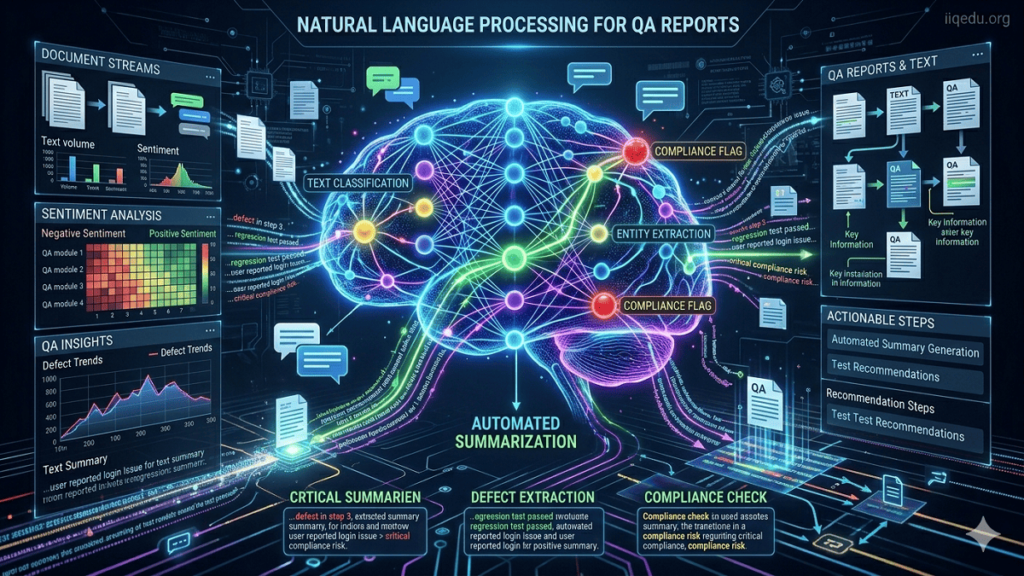
How is Natural Language Processing for QA Reports required?
Natural Language Processing (NLP) for QA Reports is required by applying NLP techniques to automatically analyze, organize, and extract useful information from text-based quality assurance reports. It helps transform unstructured text data into meaningful insights that improve the QA process.
How NLP for QA Reports Is Required
1. Collecting QA Report Data
First, QA reports such as bug descriptions, test results, inspection notes, and feedback are collected from testing systems or documentation.
2. Text Preprocessing
The text data is cleaned by removing unnecessary words, correcting errors, and converting the text into a format that machines can understand.
3. Applying NLP Techniques
Different NLP methods are used, such as:
- Text Classification to categorize defects or issues
- Keyword Extraction to identify important terms
- Sentiment Analysis to understand tester feedback
- Named Entity Recognition (NER) to identify modules, error codes, or product components
4. Pattern and Trend Detection
NLP models analyze multiple reports to detect recurring defects or common quality problems.
5. Generating Summaries and Insights
The system automatically summarizes long QA reports and provides insights that help QA teams prioritize issues and improve product quality.
In simple terms:
NLP is required in QA reports by processing and analyzing written testing data automatically to detect defects, extract key information, and improve the efficiency of quality assurance processes.
Case study of Natural Language Processing for QA Reports
1. Background
A large software development company receives thousands of Quality Assurance (QA) reports and bug descriptions during product testing. These reports are written by testers in natural language and contain details about defects, test results, and observations.
Manually reading and analyzing all these reports was time-consuming and inefficient, causing delays in fixing critical issues.
To solve this problem, the company implemented Natural Language Processing (NLP) to automatically analyze QA reports.
2. Problem
The company faced several challenges:
- Large number of bug reports generated daily
- Reports written in unstructured text format
- Difficulty identifying similar or recurring defects
- Slow prioritization of critical issues
These issues slowed down the software release cycle and affected product quality.
3. NLP-Based Solution
The company built an NLP system to process QA reports automatically.
Step 1: Data Collection
- Gathered QA reports, bug descriptions, and testing notes from the defect tracking system.
Step 2: Text Preprocessing
- Removed stop words and unnecessary symbols
- Standardized terminology
- Converted text into machine-readable format
Step 3: NLP Techniques Applied
The system used several NLP techniques:
- Text Classification – Categorized bugs into types (UI issue, performance issue, security issue).
- Keyword Extraction – Identified important terms such as error codes or affected modules.
- Topic Modeling – Detected common themes in QA reports.
- Text Summarization – Generated short summaries for QA managers.
Step 4: Automated Reporting
The system created dashboards and summaries showing:
- Most common defects
- Frequently affected modules
- High-priority issues
4. Results
After implementing NLP, the company achieved:
- 60% faster analysis of QA reports
- Improved bug classification accuracy
- Faster identification of recurring defects
- Reduced manual effort for QA teams
- Improved software quality before release
5. Key Benefits
| Benefit | Impact |
|---|---|
| Automated report analysis | Saves time |
| Better defect classification | Improves issue tracking |
| Pattern detection | Prevents recurring problems |
| Faster decision-making | Speeds up product releases |
6. Conclusion
This case study shows that Natural Language Processing can significantly improve the efficiency of analyzing QA reports. By automatically processing large volumes of testing data, organizations can identify defects faster, detect recurring issues, and improve product quality.
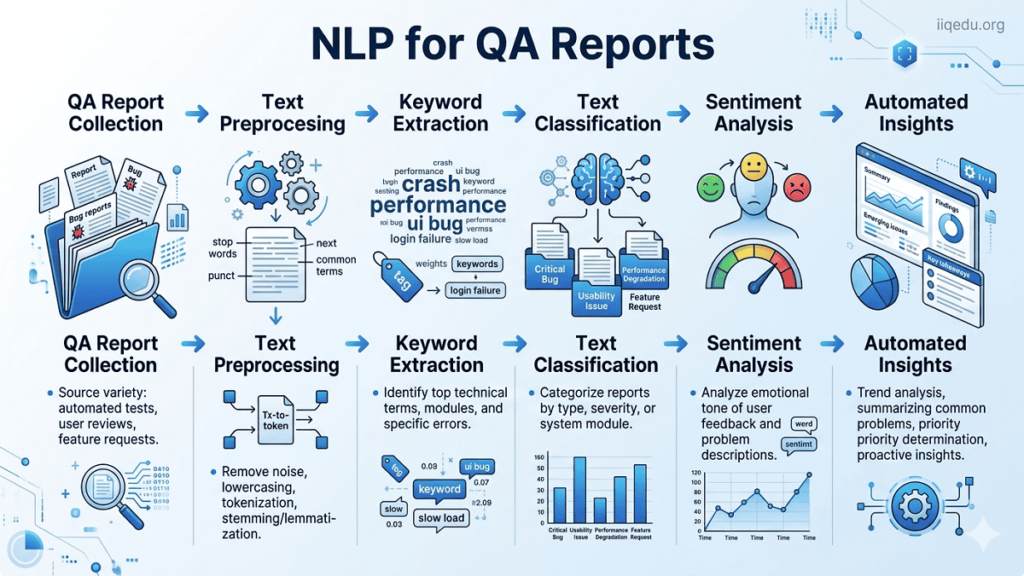
“Diagram illustrating how Natural Language Processing (NLP) helps analyze QA reports, detect defects, and generate insights. Watermark: iiqedu.org.
White paper of Natural Language Processing for QA Reports
Executive Summary
Quality Assurance (QA) processes generate large volumes of reports such as bug descriptions, testing feedback, inspection notes, and incident logs. These reports are often written in unstructured natural language, making manual analysis slow and inefficient.
Natural Language Processing (NLP) provides automated techniques for analyzing textual data, extracting insights, and identifying quality issues quickly. By applying NLP to QA reports, organizations can detect defects faster, identify recurring problems, and improve overall product or system quality.
1. Introduction
Natural Language Processing (NLP) is a branch of Artificial Intelligence that enables computers to analyze and interpret human language in written or spoken form. NLP techniques allow machines to extract meaning from large volumes of text and transform unstructured data into structured insights.
QA teams produce many documents during testing cycles, including:
- Bug reports
- Test results
- Inspection logs
- Customer feedback
- Incident documentation
Because these documents are text-heavy and often unstructured, traditional analysis methods struggle to extract meaningful patterns efficiently.
2. Problem Statement
Organizations face several challenges when analyzing QA reports:
Large Volume of Data
Modern systems generate thousands of QA reports during development and testing.
Unstructured Text Format
Reports are written in natural language rather than structured databases.
Manual Analysis Limitations
Manual review is time-consuming and prone to human error.
Slow Issue Identification
Critical defects may remain hidden within large datasets.
These challenges highlight the need for automated text analysis solutions.
3. Role of NLP in QA Reports
NLP helps convert unstructured QA documentation into structured insights by performing tasks such as:
Text Classification
Automatically categorizing defect types or report categories.
Information Extraction
Identifying important elements such as:
- error codes
- affected modules
- system components
Sentiment Analysis
Evaluating tester feedback or user comments to identify severity or dissatisfaction.
Topic Modeling
Detecting common issues appearing across multiple QA reports.
Text Summarization
Creating short summaries of lengthy testing documentation.
4. Architecture of NLP-Based QA Report Analysis
A typical NLP QA analysis system includes the following stages:
Data Collection
QA reports are collected from systems such as:
- bug tracking tools
- defect management platforms
- testing frameworks
Data Preprocessing
The text is cleaned and prepared through:
- tokenization
- stop-word removal
- normalization
Feature Extraction
Key textual features are identified using methods like:
- TF-IDF
- word embeddings
- contextual language models
Model Processing
Machine learning or deep learning models analyze the data.
Output Generation
The system generates:
- defect classifications
- summary reports
- analytics dashboards
5. Technologies Used
Common NLP tools and frameworks include:
- Python NLP libraries (NLTK, spaCy)
- Transformer models (BERT, GPT)
- Machine learning frameworks (TensorFlow, PyTorch)
Modern NLP systems often combine machine learning with linguistic processing to improve accuracy.
6. Industry Applications
Software Development
Analyzing bug reports and testing documentation.
Manufacturing
Reviewing product inspection reports and defect logs.
Healthcare
Analyzing clinical QA documentation and diagnostic reports.
Telecommunications
Analyzing service incident reports and troubleshooting records.
For example, in healthcare, NLP has been used to automatically analyze radiology reports and extract key medical information for monitoring and research.
7. Benefits of NLP for QA Reports
| Benefit | Impact |
|---|---|
| Faster report analysis | Reduces manual workload |
| Early defect detection | Improves product reliability |
| Automated classification | Organizes QA data efficiently |
| Pattern discovery | Identifies recurring issues |
| Data-driven decision-making | Enhances product quality |
8. Challenges
Despite its advantages, NLP implementation presents some challenges:
Data Quality
Inconsistent report formats can affect accuracy.
Model Training Requirements
Large labeled datasets are often required.
Context Understanding
Some reports contain ambiguous language.
Integration Complexity
NLP systems must integrate with existing QA tools.
9. Future Trends
Future developments in NLP for QA include:
- AI-powered automated bug triaging
- conversational QA assistants
- integration with DevOps pipelines
- advanced transformer-based language models
These technologies will enable real-time QA analysis and predictive quality monitoring.
Industry application of Natural Language Processing for QA Reports
Natural Language Processing (NLP) is widely used across industries to analyze Quality Assurance (QA) reports, defect logs, inspection notes, and feedback written in natural language. By automatically processing these reports, NLP helps organizations detect issues faster and improve product or service quality.
1. Software Development Industry
In software companies, QA teams generate many bug reports, test case results, and defect descriptions. NLP is used to:
- Classify bugs automatically
- Identify recurring software issues
- Summarize testing reports for developers
This helps speed up the software debugging and release process.
2. Manufacturing Industry
Manufacturing companies produce inspection reports, defect logs, and quality control documentation. NLP helps:
- Analyze product defect descriptions
- Detect patterns in quality issues
- Improve production processes
This leads to better product quality and reduced manufacturing errors.
3. Healthcare Industry
Healthcare organizations generate clinical QA reports, medical device testing reports, and patient safety documentation. NLP is used to:
- Analyze medical quality reports
- Detect safety issues in healthcare processes
- Identify recurring equipment problems
This improves patient safety and healthcare service quality.
4. Telecommunications Industry
Telecom companies handle network testing reports, service failure reports, and incident logs. NLP helps:
- Analyze network performance reports
- Detect common service issues
- Improve troubleshooting efficiency
This supports faster network problem resolution.
5. Automotive Industry
Automotive companies generate vehicle testing reports, safety inspection documents, and defect reports. NLP helps:
- Identify common mechanical issues
- Analyze testing feedback from engineers
- Improve vehicle safety and performance
6. Customer Support and Service Industry
Companies collect customer complaints, issue reports, and feedback forms as part of QA processes. NLP helps:
- Analyze customer feedback
- Detect recurring service problems
- Improve service quality and user satisfaction
Key Takeaway
Natural Language Processing for QA reports is applied across industries wherever large amounts of text-based quality data need to be analyzed efficiently. It enables organizations to detect defects quickly, discover patterns, and make data-driven quality improvements.
Ask FAQs
What is Natural Language Processing for QA Reports?
Natural Language Processing (NLP) for QA Reports refers to the use of NLP techniques to analyze and extract useful information from quality assurance documents such as bug reports, test results, inspection notes, and feedback. It helps organizations automatically identify defects, patterns, and insights from text-based reports.
Why is NLP important for QA report analysis?
NLP is important because QA reports often contain large amounts of unstructured text. NLP helps automate the analysis process, allowing teams to quickly identify critical issues, detect recurring defects, and improve product quality without manually reviewing every report.
How does NLP improve the QA process?
NLP improves the QA process by automatically classifying defects, extracting key information from reports, summarizing long documents, and detecting patterns across multiple reports. This helps QA teams resolve issues faster and make better quality decisions.
Which industries use NLP for QA reports?
Many industries use NLP for QA reports, including software development, manufacturing, healthcare, telecommunications, and automotive industries. These sectors generate large volumes of testing and inspection reports that benefit from automated analysis.
What are the main benefits of using NLP for QA reports?
The main benefits include faster report analysis, reduced manual workload, better defect detection, improved decision-making, and enhanced overall product or service quality.
Source: Gate Smashers
Table of Contents
Disclaimer:
The information provided about Natural Language Processing for QA Reports is for educational and informational purposes only. Implementation results may vary depending on data quality, tools used, and organizational requirements. Users should evaluate their specific needs before applying these methods in real-world environments.