Deep Learning in Visual Inspection
Deep Learning in Visual Inspection refers to the use of advanced deep neural networks to automatically analyze images and videos from production lines, detecting defects, anomalies, or inconsistencies in products. Unlike traditional rule-based visual inspection systems, deep learning models learn patterns from large datasets, enabling them to detect even subtle defects with high accuracy.
Key Benefits
- High Accuracy: Detects small, complex defects that manual inspections or traditional systems may miss.
- Speed and Efficiency: Real-time analysis of production line images to prevent defective products from progressing.
- Reduced Human Error: Automates repetitive inspection tasks, reducing dependency on manual checks.
- Adaptability: Models can learn new defect types without complete reprogramming.
- Scalability: Can monitor multiple production lines or products simultaneously.
Industry Applications
- Automotive: Detect surface scratches, paint defects, or assembly issues.
- Electronics: Identify soldering defects, component misplacements, or micro-cracks.
- Pharmaceuticals: Ensure packaging integrity, label accuracy, and product consistency.
- Food & Beverage: Detect packaging errors, foreign objects, or surface defects.
- Consumer Goods: Inspect textures, colors, or finishes for quality assurance.
How Deep Learning Works in Visual Inspection
- Data Collection: Capture images or videos from production lines using cameras or sensors.
- Data Labeling: Annotate defects or quality standards for training.
- Model Training: Train deep neural networks (e.g., CNNs) to recognize defects.
- Deployment: Integrate trained models into production lines for real-time inspection.
- Continuous Learning: Update models with new defect types or product variations to maintain accuracy.
What is Deep Learning in Visual Inspection?
Deep Learning in Visual Inspection is the application of advanced artificial intelligence, specifically deep neural networks, to automatically examine images or videos of products during manufacturing or production processes. Unlike traditional rule-based inspection systems, which rely on predefined criteria, deep learning models learn patterns from large datasets of images, enabling them to detect defects, anomalies, or inconsistencies—even subtle ones that human inspectors or conventional systems might miss.
How It Works
- Data Collection: Cameras and sensors capture high-resolution images or videos of products on production lines.
- Data Labeling: Defective and non-defective items are annotated to train the model.
- Model Training: Deep neural networks, often Convolutional Neural Networks (CNNs), learn to distinguish defects from acceptable products.
- Deployment: Trained models are integrated into production lines for real-time visual inspection.
- Continuous Learning: Models are updated with new defect patterns or product variations to maintain accuracy over time.
Key Advantages
- Detects complex, subtle defects not easily visible to humans.
- Operates in real time to prevent defective products from reaching customers.
- Reduces human error and labor costs in repetitive inspections.
- Scales across multiple production lines and products.
- Adapts to new defect types without full system redesign.
Example:
In an electronics factory, deep learning can automatically detect soldering defects or missing components on circuit boards, ensuring only high-quality products move forward for assembly or shipment.
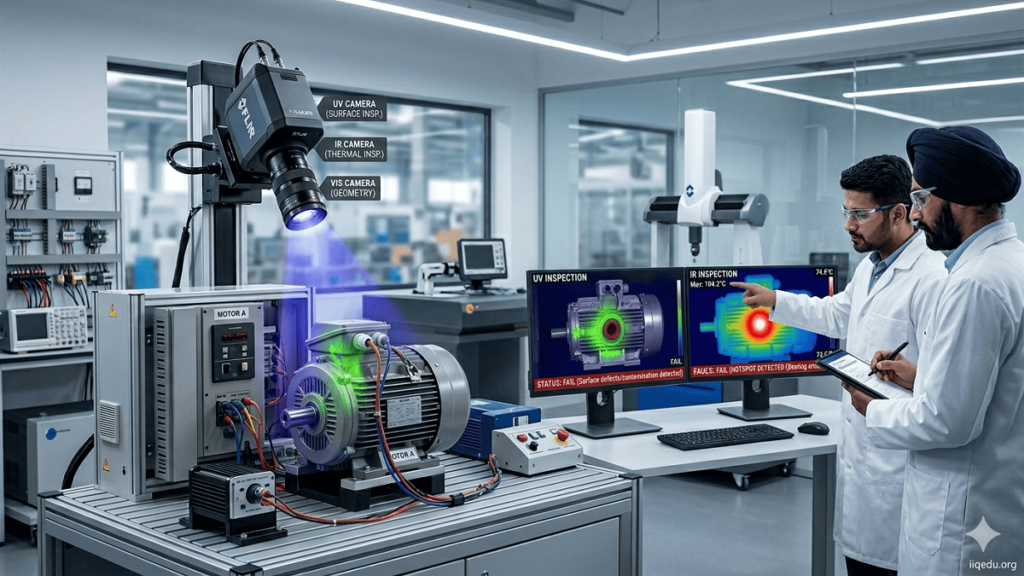
Who is Deep Learning in Visual Inspection required?
Deep Learning in Visual Inspection is required by organizations that need highly accurate, real-time, and scalable quality control for their products. It is particularly valuable for industries where even minor defects can lead to safety risks, regulatory issues, or customer dissatisfaction.
Key Users and Industries
- Manufacturing Companies
- Factories producing high-volume goods require automated inspection to maintain consistency, reduce defects, and optimize production efficiency.
- Automotive Industry
- Car manufacturers and suppliers use deep learning to detect paint defects, scratches, assembly errors, or component misalignments, ensuring vehicle safety and reliability.
- Electronics & Semiconductor Industry
- Detects soldering defects, missing or misaligned components, micro-cracks, and PCB anomalies that are difficult to identify manually.
- Pharmaceutical & Healthcare Industry
- Ensures packaging integrity, label accuracy, and product safety to comply with regulatory standards.
- Food & Beverage Industry
- Detects packaging defects, foreign objects, or surface imperfections, maintaining safety and hygiene standards.
- Consumer Goods & Luxury Products
- Ensures texture, color, and finish consistency in products like cosmetics, apparel, and electronics.
- Large Enterprises with Multi-Site Operations
- Organizations with multiple production lines or suppliers benefit from deep learning to standardize quality monitoring and inspections across all sites efficiently.
When is Deep Learning in Visual Inspection required?
Deep Learning (DL) is used in visual inspection when traditional methods can’t handle complexity. Here are the main situations:
- Products or defects vary a lot
If items have different shapes, sizes, colors, or textures, DL can adapt, while rule-based systems struggle. - Defects are hard to define
Tiny scratches, cracks, or irregular patterns are often too subtle for traditional algorithms. DL learns from examples. - High accuracy is required
When even small mistakes are costly, DL can match or exceed human-level inspection. - New or changing products
DL can be retrained easily for new designs, while traditional systems need manual reprogramming. - Complex features
If inspection needs to combine color, texture, shape, and context, DL can analyze all at once. - High-speed inspection
For production lines with thousands of items, DL can quickly and reliably detect defects.
Where is Deep Learning in Visual Inspection required?
Deep Learning is required in industries and situations where traditional image processing struggles. Typical areas include:
- Electronics and Semiconductors
Detecting tiny cracks, scratches, or missing components on chips and circuit boards. - Automotive Industry
Checking car parts for dents, paint defects, or assembly errors on varied shapes and sizes. - Food and Beverage
Spotting bruises, discoloration, or foreign objects in fruits, vegetables, or packaged goods. - Pharmaceuticals
Inspecting pills, bottles, or packaging for defects or labeling errors. - Metal and Manufacturing
Detecting surface corrosion, scratches, or irregular welds in metal parts. - Textiles and Apparel
Finding stitching errors, stains, or fabric defects on clothes.
Bottom line: DL is required wherever defects are subtle, irregular, or products vary in appearance, making traditional rule-based inspection unreliable.
How is Deep Learning in Visual Inspection required?
Deep Learning (DL) is used in visual inspection by teaching computers to “see” like humans. Instead of writing strict rules, DL learns from examples of good and defective products. Here’s how it works:
- Collect Images
Take photos of products, including normal ones and ones with defects. - Train the Model
Feed these images into a DL model. The model learns to identify patterns that indicate defects. - Automatic Feature Extraction
Unlike traditional methods, DL automatically finds important features (shape, texture, color, patterns) without manual programming. - Inspect in Real-Time
Once trained, the model can quickly analyze products on the production line, detecting defects reliably. - Adapt and Improve
If new defects appear or products change, the model can be retrained with new images, keeping inspection up-to-date.
Bottom line: DL is required when you need fast, accurate, and flexible inspection that traditional methods can’t handle.
Case study of Deep Learning in Visual Inspection
Problem
An automotive company struggled to detect scratches, dents, and paint defects on metal car panels. Their old rule-based system often missed defects or flagged normal parts by mistake. Manual inspection was slow and costly.
Solution
They used deep learning to improve inspection:
- Collect Images – Thousands of photos of good and defective panels were gathered.
- Train the Model – A deep learning model learned to spot scratches, dents, and paint issues automatically.
- Inspect in Real Time – Cameras on the production line captured panels, and the model flagged defects instantly.
Results
- More accurate detection, fewer missed defects
- Faster inspection without slowing production
- Easy to adapt to new defects or panel designs
Takeaway: Deep learning is effective when defects are subtle, irregular, or difficult to define with rules, making visual inspection faster and more reliable.
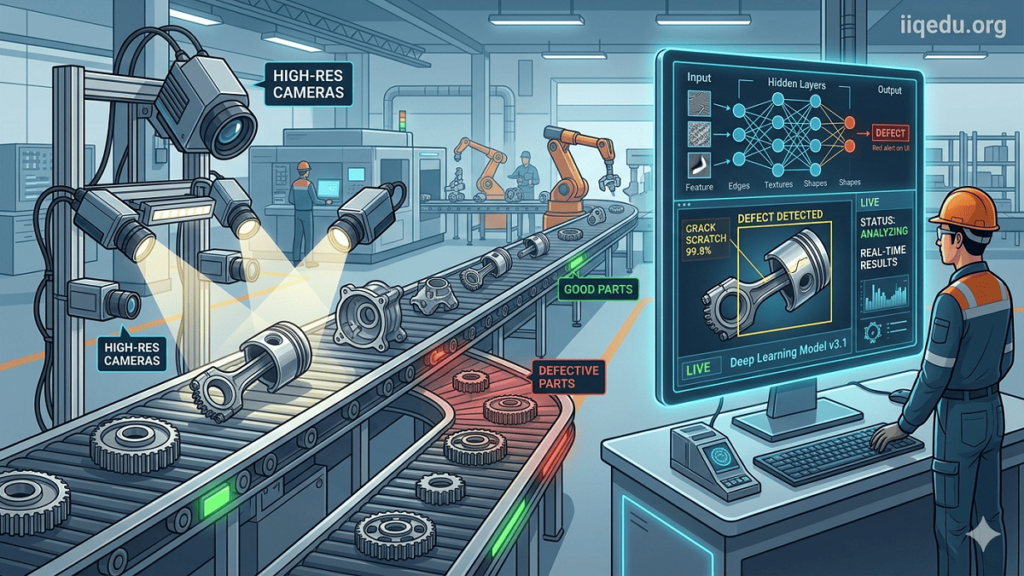
Deep Learning automates visual inspection by detecting defects on production line products, improving accuracy and efficiency.
White paper of Deep Learning in Visual Inspection
Introduction
Visual inspection is critical in modern manufacturing and quality control. Traditionally, rule-based computer vision systems have been used to identify defects in products. However, these systems struggle when defect patterns are irregular, products vary in appearance, or high accuracy is required. Deep Learning (DL) offers a powerful alternative by learning directly from data rather than relying on manually defined rules.
What is Deep Learning in Visual Inspection?
Deep Learning uses neural networks, especially convolutional neural networks (CNNs), to automatically analyze images. Instead of programming specific rules, DL models learn features from labeled image data. Once trained, they can identify defects or anomalies in new images with high accuracy.
Why Use Deep Learning?
Deep Learning is particularly useful when:
- Defects are subtle or varied
- Products differ in shape, size, or texture
- Traditional methods generate false positives or miss defects
- Inspection must be fast and reliable on high-speed production lines
- The system needs to adapt easily to new products or defect types
How Deep Learning Works in Visual Inspection
- Data Collection
Images of products — both normal and defective — are captured. More data leads to better learning. - Training the Model
A deep learning model is trained using labeled images. The model learns complex patterns that distinguish good products from defects. - Deployment
Cameras capture real-time images on the production line. The trained model classifies each image and flags defects automatically. - Continuous Improvement
The system can be retrained with new data to improve performance or adapt to new defect types.
Industry Application of Deep Learning in Visual Inspection
1. Automotive Industry
- Detect scratches, dents, or paint defects on car panels.
- Inspect assembly quality and identify missing or misaligned components.
- Ensure consistent quality in high-speed production lines.
2. Electronics and Semiconductors
- Detect micro-cracks, soldering defects, or missing components on circuit boards.
- Inspect chips and semiconductor wafers for surface anomalies.
- Improve accuracy in small, intricate, high-precision components.
3. Food and Beverage
- Detect bruises, discoloration, or foreign objects in fruits, vegetables, and packaged foods.
- Check packaging integrity, labels, and expiry dates.
- Ensure food safety and compliance with regulations.
4. Pharmaceuticals
- Inspect pills, capsules, and bottles for defects or contamination.
- Verify labels, packaging, and seal integrity.
- Maintain strict quality standards in high-speed production.
5. Textiles and Apparel
- Detect stitching errors, holes, stains, or fabric defects.
- Monitor pattern consistency and quality of finished garments.
- Reduce returns and improve customer satisfaction.
6. Metal and Manufacturing
- Detect surface corrosion, scratches, weld defects, or machining errors.
- Inspect metal sheets, pipes, and mechanical parts.
- Support predictive maintenance and reduce defective product output.
7. Glass and Ceramics
- Detect cracks, chips, or surface defects.
- Inspect uniformity and quality of finished products.
- Reduce breakage and production waste.
Ask FAQs
What is Deep Learning in visual inspection?
Answer: Deep Learning is a type of AI that uses neural networks to analyze images. In visual inspection, it automatically detects defects or anomalies in products without needing manually written rules.
When is Deep Learning needed over traditional methods?
Answer: DL is needed when defects are subtle, irregular, or products vary in shape, color, or texture. Traditional rule-based methods often miss these defects or give false alarms.
Which industries use Deep Learning for inspection?
Answer: Industries like automotive, electronics, pharmaceuticals, food and beverage, textiles, metal manufacturing, and glass production use DL to detect defects and ensure quality.
How does a Deep Learning inspection system work?
Answer: The system collects images of products, trains a DL model to recognize defects, and then inspects new products in real-time. The model can be updated to adapt to new defect types.
What are the benefits of using Deep Learning in visual inspection?
Answer: Benefits include higher defect detection accuracy, fewer false alarms, faster inspection on production lines, and easy adaptation to new products or defect types.
Source: Acrovision
Table of Contents
Summary
Deep learning has transformed visual inspection in modern manufacturing, offering unprecedented accuracy, speed, and automation compared to traditional inspection methods. Visual inspection is a critical step in quality control (QC) and quality assurance (QA), where products are examined for defects, misalignments, surface anomalies, or deviations from design specifications. Manual inspection is often labor-intensive, prone to human error, and limited in detecting subtle defects, particularly on high-speed production lines. Deep learning addresses these challenges by leveraging large datasets and advanced neural networks to automatically identify and classify defects in real time.
Deep learning-based visual inspection systems utilize high-resolution cameras or imaging sensors to capture detailed images of products. These images are then processed by convolutional neural networks (CNNs) or other deep learning architectures trained to recognize patterns corresponding to defects. Unlike traditional machine vision systems, which rely on fixed rules or thresholds for detection, deep learning models learn from vast amounts of labeled data and can generalize to detect new or unexpected defects without manual reprogramming. This adaptability makes deep learning especially effective for complex products with varying textures, shapes, and materials.
The workflow of deep learning in visual inspection typically begins with data acquisition. Cameras capture images from multiple angles, often under controlled lighting conditions, to ensure high-quality input. The collected data is labeled to indicate defect-free and defective areas, which forms the training set for the neural network. Once trained, the deep learning model can process images in real time, highlighting defects and anomalies on dashboards or visual overlays. These insights enable engineers and quality managers to make immediate decisions, reducing the risk of defective products reaching customers.
One of the major advantages of deep learning in visual inspection is its ability to scale across production lines while maintaining consistent accuracy. High-speed manufacturing lines can generate thousands of product images per minute, which traditional inspection systems cannot handle effectively. Deep learning models, however, can process large volumes of images rapidly and continuously, ensuring comprehensive inspection without slowing down production. Additionally, deep learning algorithms can be continuously retrained with new data to adapt to changes in product designs, materials, or production conditions, providing a dynamic and future-proof solution.
Applications of deep learning in visual inspection span multiple industries. In electronics manufacturing, it identifies soldering defects, misaligned components, and micro-cracks. In automotive production, it detects paint imperfections, dents, and assembly errors. In pharmaceuticals and food industries, deep learning ensures packaging integrity, labeling accuracy, and product uniformity. By integrating with other technologies such as AI-driven predictive maintenance and robotics, deep learning further enhances efficiency, reduces waste, and supports overall operational excellence.
In conclusion, deep learning has revolutionized visual inspection by offering automated, accurate, and scalable defect detection. It minimizes human error, adapts to complex product variations, and integrates seamlessly into high-speed production environments. As industrial demands continue to grow for higher quality, faster throughput, and lower costs, deep learning in visual inspection emerges as a vital technology, ensuring consistent product quality, operational efficiency, and customer satisfaction.
Disclaimer: The information provided here is for general informational purposes only and does not constitute professional advice. Results from Deep Learning visual inspection may vary depending on the industry, equipment, and implementation.