QA Automation Frameworks in Software
QA Automation Frameworks are structured sets of guidelines, tools, and practices used to automate software testing. They provide a standardized approach to design, develop, and execute automated tests efficiently. Using a framework helps improve test coverage, reduces manual effort, and ensures consistency across software testing projects.
What Is a QA Automation Framework?
A QA automation framework is a collection of tools, coding standards, and best practices that support automated testing. It defines:
- How test scripts are written and executed
- How test data is managed
- How results are reported
- Integration with CI/CD pipelines
Frameworks help teams avoid redundant work and make automation more maintainable, reusable, and scalable.
Types of QA Automation Frameworks
- Linear Scripting Framework
- Scripts are written sequentially without modularity.
- Simple but hard to maintain for large applications.
- Modular Testing Framework
- Application is divided into independent modules.
- Test scripts for each module can be reused.
- Data-Driven Framework
- Test data is stored separately (Excel, CSV, or databases).
- Same test scripts run with multiple data sets.
- Keyword-Driven Framework
- Uses keywords to represent actions (e.g., “Click,” “Login”).
- Testers can create tests without coding knowledge.
- Hybrid Testing Framework
- Combines two or more frameworks for flexibility and better coverage.
- Behavior-Driven Development (BDD) Framework
- Uses human-readable language (e.g., Gherkin) to describe tests.
- Tools like Cucumber or SpecFlow integrate with automation scripts.
Benefits of QA Automation Frameworks
- Consistency and Standardization: Ensures uniform testing practices.
- Reusability: Test scripts can be reused across projects.
- Efficiency: Speeds up testing and reduces manual effort.
- Integration: Works with CI/CD pipelines for continuous testing.
- Better Reporting: Automated reporting helps track defects and quality metrics.
Popular QA Automation Tools
- Selenium: Open-source tool for web application testing.
- Appium: For mobile app automation (Android/iOS).
- Cypress: Modern tool for front-end testing.
- TestNG/JUnit: Frameworks for Java-based testing.
- Cucumber: BDD framework supporting readable test scenarios.
Conclusion
QA Automation Frameworks are essential for modern software development. They ensure efficient, reliable, and scalable automated testing, enabling faster release cycles, higher product quality, and reduced manual effort. Selecting the right framework depends on the project size, complexity, and team expertise.
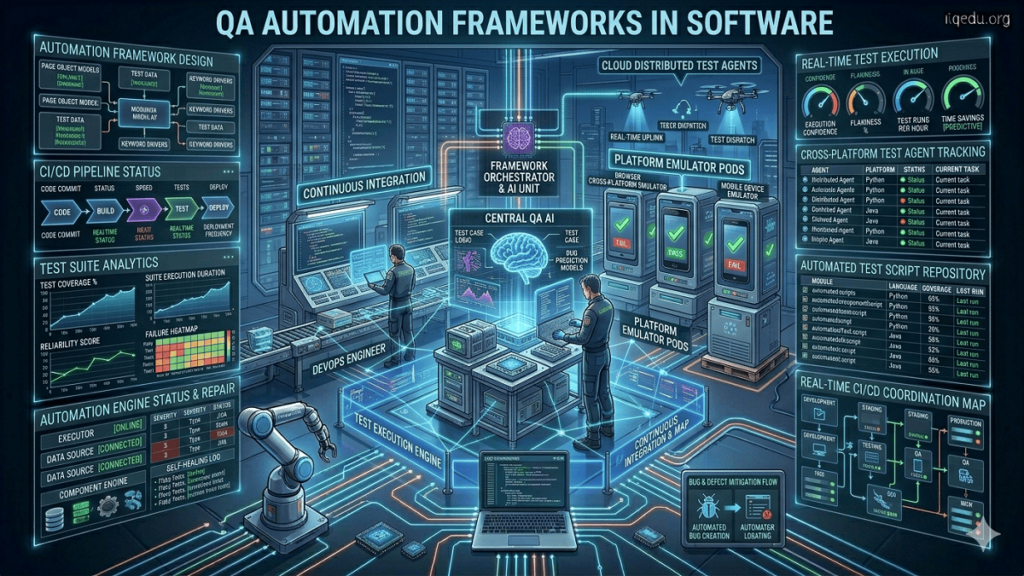
What is QA Automation Frameworks in Software?
QA Automation Frameworks in Software are structured sets of guidelines, tools, and best practices used to automate software testing. They provide a standardized approach for designing, developing, and executing automated tests efficiently.
Key Points:
- Purpose: To reduce manual testing effort, improve consistency, and ensure reliable test coverage.
- Components: Includes test scripts, test data, reporting mechanisms, and integration with CI/CD pipelines.
- Functionality: Frameworks define how tests are written, executed, and maintained, making automation easier to manage and scale.
Example:
A data-driven framework stores test data separately (like in Excel or a database), allowing the same test scripts to run multiple times with different inputs, reducing redundancy and increasing test coverage.
In simple terms: QA automation frameworks are blueprints for efficiently automating software tests in a structured and maintainable way.
Who is QA Automation Frameworks in Software required?
QA Automation Frameworks in Software are required by organizations and teams involved in software development and testing who want to ensure faster, reliable, and consistent testing.
Who Needs QA Automation Frameworks?
- Software Development Companies
- To automate repetitive tests, reduce manual effort, and speed up release cycles.
- QA and Testing Teams
- To improve test coverage, maintain consistency, and manage complex test cases efficiently.
- Enterprises with Large Software Systems
- To handle regression testing across multiple modules and versions.
- Agile and DevOps Teams
- To integrate automated tests into CI/CD pipelines for continuous testing.
- Organizations Focused on High-Quality Products
- To ensure software reliability, reduce defects, and enhance customer satisfaction.
In short: QA automation frameworks are required wherever software needs efficient, scalable, and reliable automated testing.
When is QA Automation Frameworks in Software required?
QA Automation Frameworks in Software are required whenever organizations need consistent, efficient, and reliable testing of software applications.
Situations When It Is Required
1. High Frequency of Regression Testing
- When software is updated frequently, automated tests ensure that new changes don’t break existing functionality.
2. Large or Complex Applications
- For applications with many modules or workflows, frameworks help manage tests in a structured and maintainable way.
3. Agile and Continuous Integration/Delivery (CI/CD) Environments
- Automated tests can run continuously as part of the CI/CD pipeline, speeding up releases while maintaining quality.
4. Repetitive or Time-Consuming Tests
- Manual execution of the same test repeatedly is inefficient; automation frameworks handle this efficiently.
5. Ensuring Consistent Test Coverage
- When consistent and repeatable testing is required across multiple environments or platforms, automation frameworks ensure accuracy and reliability.
In short: QA automation frameworks are required whenever software testing needs to be faster, repeatable, and maintainable, especially in modern development environments.
Where is QA Automation Frameworks in Software required?
QA Automation Frameworks in Software are required in any organization or project that wants to improve software quality, speed up testing, and ensure consistent results.
Key Reasons They Are Required
- To Reduce Manual Testing Effort
- Automates repetitive and time-consuming tests, saving time and resources.
- To Ensure Consistency and Accuracy
- Standardized frameworks reduce human errors and maintain uniform testing practices.
- For Faster Release Cycles
- Supports agile and DevOps environments with continuous integration and continuous delivery (CI/CD).
- To Manage Large or Complex Applications
- Structured frameworks make it easier to handle tests across multiple modules and environments.
- For Better Test Coverage and Reporting
- Automation frameworks allow running more test cases efficiently and generate detailed reports for analysis.
In short: QA automation frameworks are required wherever there is a need for efficient, scalable, and reliable automated software testing.
How is QA Automation Frameworks in Software required?
QA Automation Frameworks in Software are required by implementing a structured system of tools, guidelines, and practices that enable automated testing of applications.
How They Are Implemented
1. Selecting the Framework Type
- Choose the right type based on project needs: linear scripting, modular, data-driven, keyword-driven, hybrid, or BDD frameworks.
2. Setting Up the Test Environment
- Install the necessary tools (e.g., Selenium, Appium, TestNG, JUnit, or Cucumber).
- Configure browsers, devices, or servers for testing.
3. Writing Standardized Test Scripts
- Develop reusable and maintainable test scripts according to framework standards.
4. Managing Test Data
- For data-driven frameworks, store test data in external files (Excel, CSV, databases) to run multiple test scenarios with the same scripts.
5. Integrating with CI/CD Pipelines
- Connect automation scripts to CI/CD tools like Jenkins, GitLab, or Azure DevOps for continuous testing during development.
6. Executing and Reporting Tests
- Run automated tests across environments, collect results, and generate reports for analysis.
Example:
In a keyword-driven framework, a tester can write test scenarios using predefined keywords like “Click,” “EnterText,” or “Verify,” and the framework executes them without additional coding.
In simple terms: QA automation frameworks are required by organizing tools, scripts, and data in a systematic way to automate tests efficiently, consistently, and reliably.
Case study of QA Automation Frameworks in Software
Background
A mid-sized e-commerce company faced challenges in maintaining the quality of its web and mobile applications. With frequent updates, new features, and high user traffic, manual testing was time-consuming, inconsistent, and prone to errors.
Problem
- Regression testing took too long and delayed releases.
- Manual tests were inconsistent across environments (desktop, mobile, and browsers).
- High defect leakage into production caused poor user experience.
- Limited reporting and traceability for quality metrics.
Solution: Implementing a QA Automation Framework
The company decided to implement a hybrid QA automation framework combining data-driven and keyword-driven approaches:
- Framework Setup
- Tools: Selenium WebDriver for web, Appium for mobile, TestNG for test execution, and Jenkins for CI/CD integration.
- Structured folders and scripts for reusable test cases.
- Test Data Management
- Test data stored in Excel and JSON files for running multiple test scenarios.
- Keyword-Driven Testing
- Keywords like “Click,” “Login,” “VerifyPrice,” and “AddToCart” were used to automate common actions.
- Integration with CI/CD
- Automated tests were triggered for every new build using Jenkins to ensure continuous testing.
- Reporting and Analysis
- TestNG generated detailed reports for passed/failed tests and defect tracking.
Implementation Process
- Developed reusable modules for login, product search, cart management, and checkout.
- Test scripts were executed across multiple browsers and devices automatically.
- CI/CD integration ensured immediate feedback to developers for any failed tests.
Results
- Regression testing time reduced by 60%
- Defect leakage into production reduced by 40%
- Test coverage increased by 50% across web and mobile applications
- Faster release cycles enabled weekly updates without compromising quality
- Improved collaboration between QA and development teams due to CI/CD integration
Conclusion
Implementing a QA automation framework helped the company improve software quality, reduce manual effort, and accelerate release cycles. The hybrid framework provided flexibility, reusability, and maintainability, making automated testing more efficient and scalable.
Key Takeaway: A well-structured QA automation framework enables organizations to deliver high-quality software faster while maintaining consistency and reliability in testing.
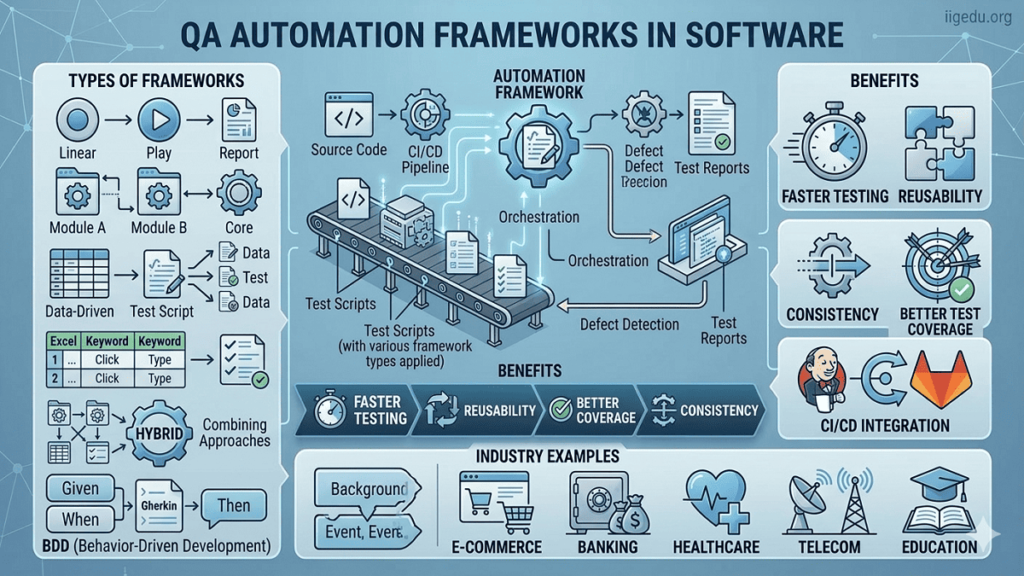
An infographic explaining the different QA automation frameworks, their advantages, and how they are used across industries like e-commerce, banking, healthcare, and telecom.
Industry application of QA Automation Frameworks in Software
QA Automation Frameworks are widely used across industries to improve software quality, accelerate testing, and ensure consistent results. Here are key industry applications:
1. E-Commerce
- Automates testing of websites and mobile apps for product search, checkout, payment, and user experience.
- Regression tests run frequently after each update to ensure new features don’t break existing functionality.
2. Banking and Financial Services
- Ensures accuracy and security of online banking platforms, payment gateways, and trading applications.
- Automates functional, performance, and security tests to maintain regulatory compliance.
3. Healthcare and Medical Software
- Automates testing of electronic health records (EHR), patient portals, and medical devices.
- Ensures compliance with strict standards like HIPAA while reducing manual testing errors.
4. Telecommunications
- Tests network management software, mobile applications, and billing systems.
- Automation frameworks validate service reliability, performance, and security.
5. Education and E-Learning Platforms
- Ensures learning management systems (LMS) and online portals work across browsers and devices.
- Automates repetitive tasks like login, course registration, and assessment workflows.
6. Travel and Hospitality
- Automates testing of booking systems, flight management, and mobile apps.
- Ensures seamless user experience and integration with third-party APIs.
7. Retail and Consumer Applications
- Tests loyalty programs, mobile apps, and online platforms for consistent functionality.
- Supports frequent feature updates with minimal downtime.
#qaautomationframeworksinsoftwareinmumbai #qaautomationframeworksinsoftwareinindia
Ask FAQs
What is a QA Automation Framework in software?
A QA Automation Framework is a structured set of tools, guidelines, and best practices used to automate software testing efficiently and consistently.
Who needs QA Automation Frameworks?
Software development teams, QA teams, agile/DevOps environments, and enterprises with large or complex applications need automation frameworks to ensure faster and reliable testing.
When is a QA Automation Framework required?
It is required when applications need frequent regression testing, have multiple modules, require cross-platform testing, or when fast release cycles demand continuous testing.
What are the main benefits of QA Automation Frameworks?
They provide reusability, consistency, faster testing, better test coverage, integration with CI/CD, and detailed reporting of test results.
What types of QA Automation Frameworks exist?
Common types include linear scripting, modular, data-driven, keyword-driven, hybrid, and BDD (Behavior-Driven Development) frameworks, each suited for different project needs.
Source: Automation Step by Step
Table of Contents
Summary
Quality Assurance (QA) has evolved significantly with the integration of advanced technologies such as artificial intelligence, machine learning, automation, and IoT. Modern QA practices go beyond traditional testing by focusing on predictive, adaptive, and intelligent systems that enhance accuracy, efficiency, and decision-making across industries.
Machine Learning plays a crucial role in root cause analysis by identifying hidden patterns in large datasets and tracing issues back to their origin. Similarly, Natural Language Processing (NLP) enables organizations to extract meaningful insights from unstructured QA reports, improving defect analysis and communication. Predictive Quality Analytics further enhances this by forecasting potential defects and quality issues before they occur, allowing teams to take proactive measures.
Reinforcement Learning introduces adaptive decision-making into QA processes, especially in manufacturing environments. Systems learn continuously from feedback, optimizing quality control strategies over time. This is complemented by Adaptive and Closed-Loop Control Systems, which use real-time feedback to automatically adjust operations and maintain stability, ensuring consistent product quality.
Automation and robotics have transformed QA in industrial settings. Technologies such as Automated Guided Vehicles (AGVs) and Autonomous Inspection Drones enable efficient, safe, and real-time inspection of equipment and infrastructure. Collaborative Robots (Cobots) work alongside human operators to enhance precision and productivity while maintaining safety standards. These systems are often integrated with IoT, creating interconnected environments where devices communicate seamlessly, enabling intelligent automation and real-time monitoring.
In software development, QA Automation Frameworks streamline testing processes by enabling scalable and repeatable test execution. Integration with CI/CD pipelines ensures continuous testing and faster delivery of high-quality software. These frameworks support various approaches, including data-driven and hybrid models, improving test coverage and reliability.
Overall, the convergence of these technologies is reshaping QA into a proactive, data-driven discipline. Organizations can now detect issues earlier, respond faster, and maintain higher standards of quality across both manufacturing and software domains. This transformation not only reduces costs and risks but also enhances customer satisfaction and operational excellence in an increasingly competitive landscape.
Quality Assurance (QA) has evolved significantly with the integration of advanced technologies such as artificial intelligence, machine learning, automation, and IoT. Modern QA practices go beyond traditional testing by focusing on predictive, adaptive, and intelligent systems that enhance accuracy, efficiency, and decision-making across industries.
Machine Learning plays a crucial role in root cause analysis by identifying hidden patterns in large datasets and tracing issues back to their origin. Similarly, Natural Language Processing (NLP) enables organizations to extract meaningful insights from unstructured QA reports, improving defect analysis and communication. Predictive Quality Analytics further enhances this by forecasting potential defects and quality issues before they occur, allowing teams to take proactive measures.
Reinforcement Learning introduces adaptive decision-making into QA processes, especially in manufacturing environments. Systems learn continuously from feedback, optimizing quality control strategies over time. This is complemented by Adaptive and Closed-Loop Control Systems, which use real-time feedback to automatically adjust operations and maintain stability, ensuring consistent product quality.
Automation and robotics have transformed QA in industrial settings. Technologies such as Automated Guided Vehicles (AGVs) and Autonomous Inspection Drones enable efficient, safe, and real-time inspection of equipment and infrastructure. Collaborative Robots (Cobots) work alongside human operators to enhance precision and productivity while maintaining safety standards. These systems are often integrated with IoT, creating interconnected environments where devices communicate seamlessly, enabling intelligent automation and real-time monitoring.
In software development, QA Automation Frameworks streamline testing processes by enabling scalable and repeatable test execution. Integration with CI/CD pipelines ensures continuous testing and faster delivery of high-quality software. These frameworks support various approaches, including data-driven and hybrid models, improving test coverage and reliability.
Overall, the convergence of these technologies is reshaping QA into a proactive, data-driven discipline. Organizations can now detect issues earlier, respond faster, and maintain higher standards of quality across both manufacturing and software domains. This transformation not only reduces costs and risks but also enhances customer satisfaction and operational excellence in an increasingly competitive landscape.
Furthermore, the adoption of digital twins and real-time simulation models is adding another layer of intelligence to QA processes. These virtual replicas of physical systems allow organizations to test scenarios, predict failures, and optimize performance without disrupting actual operations. Cloud computing and edge computing also play a vital role by enabling faster data processing and scalable infrastructure for QA analytics.
Another key advancement is the use of advanced visualization and dashboards, which provide stakeholders with clear, actionable insights. These tools improve collaboration across teams and support faster decision-making. As industries continue to embrace Industry 4.0 principles, QA is becoming more integrated, automated, and intelligent. This shift ensures not only higher product and software quality but also long-term sustainability, innovation, and competitive advantage in a rapidly evolving technological landscape.
Disclaimer:
The information provided is for educational purposes only. Always consult qualified professionals before implementing QA automation frameworks in real-world software projects.