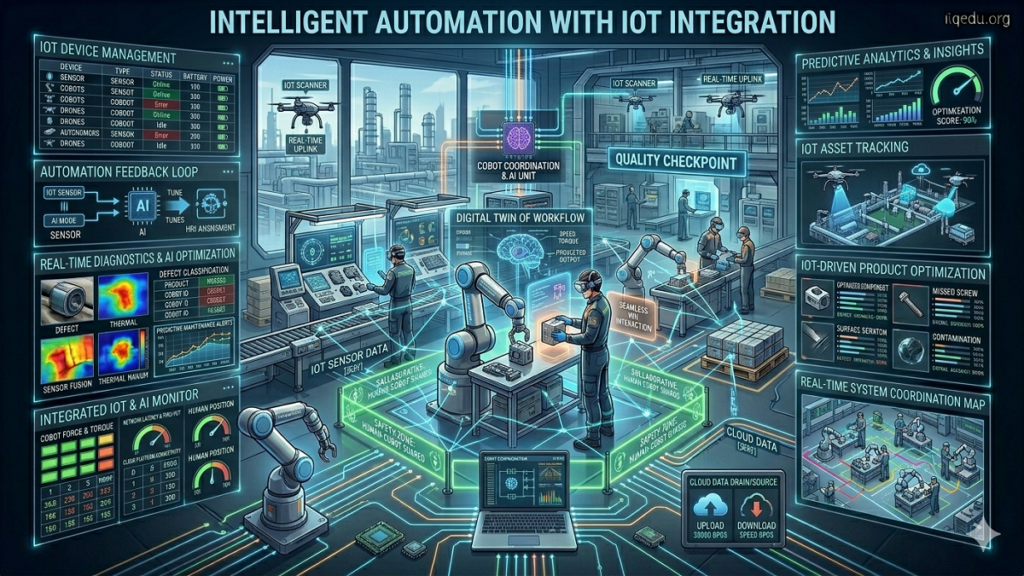
Intelligent Automation with IoT Integration
Intelligent automation with IoT integration refers to the use of smart devices, sensors, and connected systems to automate processes while collecting, analyzing, and acting on real-time data. By combining Artificial Intelligence (AI), machine learning, and Internet of Things (IoT) technologies, businesses can make automated decisions, optimize operations, and improve efficiency.
What Is Intelligent Automation with IoT Integration?
Intelligent automation is the application of advanced technologies like AI, robotics, and software to automate complex processes. When integrated with IoT, these automated systems can:
- Monitor equipment and processes in real time
- Detect anomalies and predict failures
- Make data-driven decisions without human intervention
- Adapt dynamically to changing conditions
Essentially, IoT provides the data and connectivity, while intelligent automation provides the decision-making and execution.
Key Components
- IoT Sensors and Devices – Collect real-time data from machines, products, or environments.
- Connectivity – Networks (Wi-Fi, 5G, LPWAN) transmit data to processing systems.
- Data Analytics and AI – Analyze the data to detect patterns, anomalies, and trends.
- Automation Systems – Execute decisions through software, robotics, or control systems.
- Feedback Loop – Continuously monitor results to improve system performance.
Benefits
- Operational Efficiency: Automates repetitive tasks and optimizes processes.
- Predictive Maintenance: Detects potential equipment failures before they occur.
- Cost Reduction: Reduces downtime and resource wastage.
- Data-Driven Insights: Provides actionable intelligence for decision-making.
- Scalability: Systems can adapt to growing data volumes and complex processes.
Industry Applications
- Manufacturing: Smart factories use IoT-enabled machines with automated control to optimize production lines.
- Energy and Utilities: Predictive maintenance and energy management for power plants and grids.
- Healthcare: Remote monitoring, smart devices, and automated workflows for patient care.
- Supply Chain & Logistics: Automated inventory management, fleet tracking, and warehouse optimization.
- Smart Buildings: Intelligent HVAC, lighting, and security systems that respond to real-time conditions.
Conclusion
Intelligent automation with IoT integration enables organizations to combine real-time data, AI-driven analysis, and automated execution for smarter, faster, and more efficient operations. As industries adopt these technologies, businesses can achieve higher productivity, lower costs, and better operational resilience.
What is Intelligent Automation with IoT Integration?
Intelligent Automation with IoT Integration is the combination of smart automation technologies and Internet of Things (IoT) devices to monitor, analyze, and control processes automatically in real time.
Simple Explanation
- Intelligent Automation (IA): Uses technologies like artificial intelligence (AI), machine learning, and robotics to make decisions and execute tasks automatically.
- IoT Integration: Connects sensors, devices, and machines to collect real-time data and share it across systems.
When combined, IA and IoT enable systems to automatically detect issues, optimize operations, and make data-driven decisions without human intervention.
Example
In a smart factory, IoT sensors on machines collect data on temperature, vibration, and performance. The intelligent automation system analyzes this data and automatically adjusts machine settings or schedules maintenance before a breakdown occurs.
Who are Intelligent Automation with IoT Integration required?
Intelligent Automation with IoT Integration is required by organizations that need real-time monitoring, automated decision-making, and optimized operations. It is especially valuable in industries where efficiency, reliability, and predictive insights are critical.
1. Manufacturing Companies
Factories and smart factories require intelligent automation with IoT to monitor production lines, optimize machine performance, and reduce downtime.
2. Energy and Utilities
Power plants, grids, and renewable energy systems use it to track energy production, detect anomalies, and perform predictive maintenance.
3. Healthcare Providers
Hospitals and clinics need IoT-integrated automation for patient monitoring, automated workflows, and equipment management.
4. Logistics and Supply Chain
Companies in warehousing, transportation, and delivery use it to track inventory, optimize routes, and automate inventory management.
5. Smart Buildings and Infrastructure
Intelligent automation with IoT helps manage HVAC systems, lighting, security, and resource usage efficiently in commercial and residential buildings.
In simple terms: It is required by organizations that need automation combined with real-time data to improve efficiency, reduce errors, and make smarter operational decisions.
When is Intelligent Automation with IoT Integration required?
Intelligent Automation with IoT Integration is required whenever organizations need real-time monitoring, data-driven decision-making, and automated optimization of processes.
Situations When It Is Required
1. When operational efficiency must be maximized
Organizations use intelligent automation with IoT to streamline workflows, reduce delays, and optimize resource usage.
2. When predictive maintenance is needed
If machines or equipment are critical to operations, IoT sensors can detect anomalies, and intelligent automation can schedule maintenance before failures occur.
3. When data-driven decisions are critical
Organizations that rely on real-time insights for process control, supply chain management, or energy usage benefit from automated data analysis and response.
4. When manual monitoring is impractical
In complex or high-volume operations, human monitoring is too slow or error-prone, so automation integrated with IoT ensures consistent performance.
5. When scalability and adaptability are needed
Organizations that expect growth or frequent process changes require systems that can adjust automatically based on IoT data.
In simple terms: Intelligent automation with IoT integration is required whenever a business wants smarter, faster, and more reliable operations with minimal human intervention.
Where is Intelligent Automation with IoT Integration required?
Intelligent Automation with IoT Integration is required in industries and environments where real-time data, automation, and process optimization are critical for efficiency, accuracy, and productivity.
1. Manufacturing and Smart Factories
Used to monitor production lines, optimize machinery, reduce downtime, and improve quality control.
2. Energy and Utilities
Applied in power plants, smart grids, and renewable energy systems for predictive maintenance, energy management, and system optimization.
3. Healthcare and Hospitals
Used for patient monitoring, automated workflows, equipment tracking, and operational efficiency in clinical settings.
4. Logistics and Supply Chain
Helps with warehouse management, inventory tracking, automated sorting, and route optimization for deliveries.
5. Smart Buildings and Infrastructure
Applied in commercial and residential buildings to manage HVAC, lighting, security systems, and resource usage efficiently.
6. Agriculture
Used in precision farming to monitor soil conditions, crop health, and automate irrigation and fertilization.
In simple terms: It is required anywhere real-time monitoring, automation, and data-driven optimization can improve efficiency, reduce costs, or enhance operational reliability.
How is Intelligent Automation with IoT Integration required?
Intelligent Automation with IoT Integration is required by implementing a connected system where IoT devices collect real-time data and intelligent automation systems analyze and act on it automatically.
How It Is Implemented
1. IoT Sensors and Devices
Install sensors on machines, equipment, or processes to capture real-time data such as temperature, vibration, pressure, or usage.
2. Connectivity and Networking
Use networks (Wi-Fi, 5G, LPWAN) to transmit collected data to automation systems or cloud platforms for processing.
3. Data Analytics and AI
Analyze the incoming data using AI and machine learning to detect patterns, predict failures, and make decisions.
4. Automated Execution
The automation system executes actions based on insights, such as adjusting machine parameters, scheduling maintenance, or optimizing workflow.
5. Feedback and Optimization
Continuous monitoring ensures the system adapts dynamically to changes, improving efficiency and preventing errors.
Example:
In a smart factory, IoT sensors on assembly machines detect abnormal vibration. The intelligent automation system analyzes the data, predicts a potential failure, and automatically adjusts machine settings or schedules maintenance before a breakdown occurs.
In simple terms: It is required by connecting IoT data with intelligent automation to enable real-time, self-optimizing, and efficient operations.
Case study of Intelligent Automation with IoT Integration
Background
A mid-sized automotive parts manufacturer faced challenges in maintaining production efficiency and minimizing downtime. Equipment failures, inconsistent process performance, and delayed maintenance checks were causing production losses and increased operational costs.
Problem
The company identified several issues:
- Frequent unplanned equipment downtime
- Manual monitoring of machinery was slow and prone to errors
- High maintenance costs due to reactive repairs
- Lack of real-time insights into production line performance
Solution: Intelligent Automation with IoT Integration
The manufacturer implemented an intelligent automation system integrated with IoT sensors across its production lines. Key components included:
- IoT Sensors – Installed on machines to monitor temperature, vibration, and operational status in real time.
- Connectivity Platform – Data from sensors transmitted to a central cloud-based analytics system.
- AI and Automation Software – Analyzed sensor data to detect anomalies, predict equipment failures, and recommend actions.
- Automated Control – The system automatically adjusted machine settings and scheduled maintenance based on predictive insights.
Implementation
- IoT sensors continuously collected data on machine health and production performance.
- AI algorithms identified patterns indicating potential failures or inefficiencies.
- When anomalies were detected, the system either sent alerts to engineers or automatically adjusted machine operations to prevent downtime.
- Data was logged for ongoing process optimization and reporting.
Results
After implementing the system, the company achieved:
- Reduction in unplanned downtime by 40%
- 10% increase in overall production efficiency
- Predictive maintenance reduced maintenance costs by 25%
- Real-time visibility into production processes allowed faster decision-making
- Improved product quality due to optimized machine performance
Conclusion
This case study demonstrates how intelligent automation integrated with IoT can transform manufacturing operations. By connecting real-time data with automated decision-making, the company achieved higher efficiency, lower costs, and reduced downtime.
Key Takeaway:
Intelligent automation with IoT enables proactive, data-driven, and self-optimizing industrial operations, making it essential for modern smart factories.
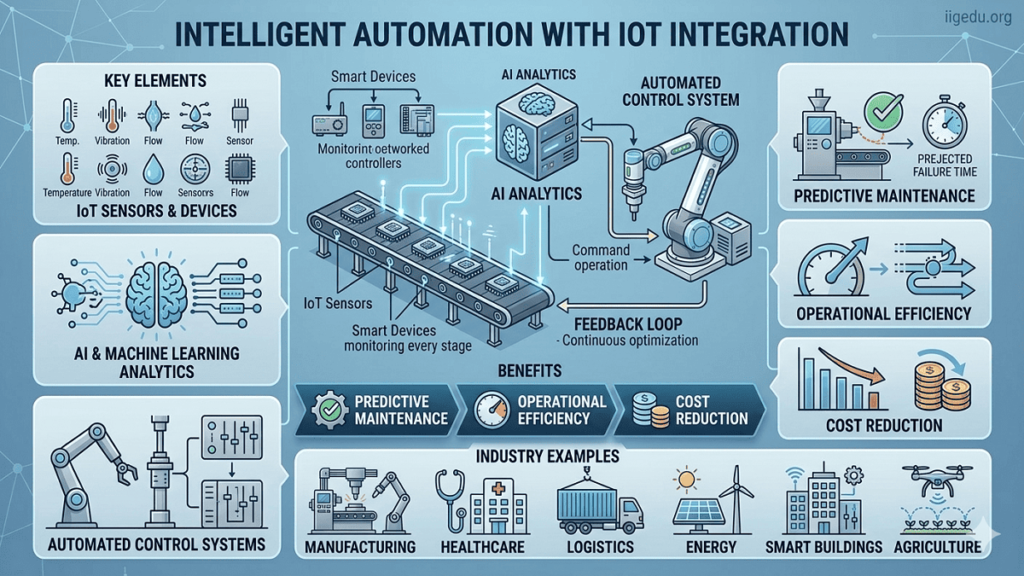
An infographic illustrating how intelligent automation combined with IoT enables predictive maintenance, operational efficiency, and data-driven decision-making across multiple industries.
White paper of Intelligent Automation with IoT Integration
Abstract
Intelligent automation integrated with the Internet of Things (IoT) represents a transformative approach to modern industrial operations. By combining real-time data from IoT devices with advanced automation technologies such as artificial intelligence (AI) and machine learning, organizations can achieve self-optimizing, efficient, and predictive operations. This white paper explores the architecture, benefits, applications, and future trends of intelligent automation with IoT integration.
1. Introduction
In today’s fast-paced industrial environment, businesses face pressure to improve productivity, reduce downtime, and maintain quality while managing complex processes. Traditional automation systems often lack real-time responsiveness and adaptive decision-making capabilities.
Intelligent automation integrated with IoT addresses these limitations by combining:
- IoT Devices and Sensors: Capture real-time operational data from machines, equipment, and processes.
- AI and Machine Learning: Analyze data for insights, predictions, and anomaly detection.
- Automation Systems: Act on data to optimize performance, reduce human intervention, and ensure operational continuity.
This combination allows businesses to move from reactive operations to predictive and self-optimizing processes. (iotforall.com)
2. Key Components
- IoT Sensors and Devices: Monitor temperature, pressure, vibration, flow, energy usage, and more.
- Connectivity Infrastructure: Networks such as Wi-Fi, 5G, or LPWAN transmit data to cloud or on-premise analytics platforms.
- Data Analytics and AI Systems: Detect patterns, predict failures, and recommend actions.
- Automation and Control Systems: Automatically execute corrective actions, adjustments, or workflow optimization.
- Feedback Loops: Continuously monitor performance to refine and improve processes.
3. Working Principle
The intelligent automation system with IoT integration operates in the following steps:
- IoT devices collect real-time operational data.
- Data is transmitted to a centralized analytics platform.
- AI and analytics systems process data to detect anomalies, inefficiencies, or potential failures.
- Automation systems adjust machine operations, schedules, or workflows to optimize performance.
- Continuous feedback ensures the system adapts dynamically to changing conditions.
4. Benefits
- Operational Efficiency: Automation and data-driven insights reduce delays and improve productivity.
- Predictive Maintenance: Early detection of equipment issues prevents unplanned downtime.
- Cost Reduction: Minimizes resource wastage and reduces maintenance costs.
- Enhanced Decision-Making: Provides actionable insights for managers and operators.
- Scalability: Easily adapts to complex processes and growing data volumes.
5. Industrial Applications
- Manufacturing: Smart factories monitor production lines, optimize machinery, and maintain quality control.
- Energy and Utilities: Predictive maintenance for power plants, smart grids, and renewable energy systems.
- Healthcare: Automated patient monitoring, medical equipment tracking, and workflow optimization.
- Logistics and Supply Chain: Real-time inventory tracking, automated sorting, and route optimization.
- Smart Buildings: Automated HVAC, lighting, and security systems responding to real-time conditions.
- Agriculture: Precision farming with automated irrigation, fertilization, and crop monitoring.
6. Challenges
- High initial setup and integration costs.
- Requirement for skilled personnel to manage and maintain systems.
- Data security and privacy concerns due to connected devices.
- Complex system calibration and alignment with existing processes.
7. Future Trends
- AI-Enhanced Automation: Advanced predictive and prescriptive analytics for smarter decision-making.
- Industrial IoT Expansion: More connected devices generating real-time operational data.
- Digital Twins: Virtual models of systems to simulate and optimize operations.
- Edge Computing: Real-time processing of IoT data near the source for faster response times.
- Integration with Industry 4.0 and 5.0 Initiatives: Driving fully autonomous and intelligent production systems.
8. Conclusion
Intelligent automation with IoT integration is transforming industrial operations by combining real-time data, automated decision-making, and predictive capabilities. Organizations that implement these technologies achieve higher efficiency, reduced downtime, cost savings, and improved operational resilience. As industries continue to adopt smart and connected systems, intelligent automation with IoT will remain a cornerstone of digital transformation.
Keywords
Intelligent automation, IoT integration, industrial automation, smart factories, predictive maintenance, AI-driven operations, smart manufacturing.
Industry application of Intelligent Automation with IoT Integration
Intelligent automation integrated with IoT is used across industries to improve operational efficiency, reduce costs, and enable real-time decision-making.
1. Manufacturing and Smart Factories
- IoT sensors monitor machine performance, production lines, and quality metrics.
- Automation systems adjust operations in real time to optimize output.
- Example: Smart factories use predictive maintenance to prevent equipment failures.
2. Energy and Utilities
- IoT devices track power generation, grid performance, and energy consumption.
- Automated systems balance loads and detect anomalies to prevent outages.
- Example: Smart grids optimize electricity distribution based on real-time demand.
3. Healthcare and Hospitals
- Patient monitoring devices collect vital signs and transmit data to AI systems.
- Automation manages workflows, alerts staff, and schedules interventions.
- Example: Remote patient monitoring allows predictive care and reduces hospital visits.
4. Logistics and Supply Chain
- IoT trackers monitor inventory, shipments, and warehouse conditions.
- Automated systems manage routing, sorting, and delivery schedules.
- Example: Warehouses use real-time data to optimize storage and reduce delays.
5. Smart Buildings and Infrastructure
- Connected HVAC, lighting, and security systems respond to environmental and occupancy data.
- Automation optimizes energy usage and maintains comfort and safety.
- Example: Intelligent building management systems reduce energy costs while improving efficiency.
6. Agriculture
- IoT sensors monitor soil moisture, temperature, and crop health.
- Automation systems control irrigation, fertilization, and harvesting schedules.
- Example: Precision farming improves crop yield and reduces resource waste.
In summary: Intelligent automation with IoT integration is required anywhere real-time monitoring, predictive insights, and automated optimization can enhance efficiency, reduce costs, and improve decision-making.
#intelligentautomationwithiotintegrationinmumbai #intelligentautomationwithiotintegrationinindia
What is Intelligent Automation with IoT Integration?
Intelligent automation with IoT integration combines smart automation technologies (like AI and machine learning) with IoT devices to monitor, analyze, and control processes automatically in real time.
Who needs Intelligent Automation with IoT Integration?
Industries that require real-time monitoring, predictive maintenance, and process optimization—such as manufacturing, healthcare, logistics, energy, and smart buildings—benefit from this technology.
What are the key benefits of integrating IoT with intelligent automation?
Key benefits include improved operational efficiency, predictive maintenance, cost reduction, data-driven decision-making, and scalable automated processes.
How does IoT integration enhance automation?
IoT devices collect real-time data from equipment, machines, or environments. Intelligent automation systems analyze this data to detect anomalies, optimize operations, and execute decisions automatically.
In which industries is Intelligent Automation with IoT Integration commonly applied?
It is commonly applied in manufacturing, energy and utilities, healthcare, logistics and supply chain, smart buildings, and agriculture for process optimization, monitoring, and predictive decision-making.
Source: Automatedo
Table of Contents
Disclaimer
The information provided here is for educational and informational purposes only. While efforts have been made to ensure accuracy, readers should consult qualified professionals or technical experts before applying intelligent automation or IoT integration in real-world operations.