Self-learning Manufacturing Lines
Self-learning manufacturing lines are advanced production systems that use artificial intelligence (AI), machine learning (ML), and IoT to automatically optimize processes, detect defects, and improve efficiency without constant human intervention. These systems can analyze real-time data, learn from patterns, and adjust operations autonomously, making manufacturing more flexible, efficient, and adaptive.
What Are Self-Learning Manufacturing Lines?
Self-learning manufacturing line combine smart sensors, robotics, AI algorithms, and connected machinery to monitor production processes continuously. The system identifies inefficiencies, predicts maintenance needs, and adapts operational parameters based on historical and real-time data. Unlike traditional manufacturing, which relies heavily on human oversight and fixed routines, self-learning lines evolve over time to optimize output quality, reduce waste, and enhance productivity.
Key Features:
- Real-time monitoring of production processes
- Predictive maintenance of machines
- Automatic quality control and defect detection
- Adaptive scheduling and resource optimization
- Continuous process improvement through AI learning
Why Are Self-Learning Manufacturing Lines Important?
- Efficiency: Reduce downtime and improve throughput.
- Quality: Detect and correct defects automatically.
- Flexibility: Adapt quickly to product or design changes.
- Cost Reduction: Optimize resource usage and reduce waste.
- Data-Driven Decisions: Insights from real-time analytics improve production strategies.
Industry Applications
- Automotive Manufacturing – Adaptive assembly lines that adjust robot speed and torque for different car models.
- Electronics Manufacturing – Real-time defect detection and adjustment in PCB assembly.
- Food and Beverage – Optimizing packaging and production schedules dynamically.
- Pharmaceuticals – Maintaining precision and quality in drug production.
- Consumer Goods – Automating high-volume production with minimal human intervention.
Conclusion
Self-learning manufacturing line represent the next evolution of smart factories, enabling industries to achieve higher efficiency, better quality, and greater flexibility. By leveraging AI, IoT, and real-time data, these lines continuously improve themselves, making manufacturing more adaptive, intelligent, and future-ready.
What are Self-learning Manufacturing Lines?
Self-Learning Manufacturing Line are advanced production systems that use artificial intelligence (AI), machine learning (ML), and IoT technologies to monitor, analyze, and optimize manufacturing processes autonomously.
Key Points:
- Autonomous Learning: The system collects real-time data from sensors, machines, and production workflows, then learns patterns to improve efficiency and quality over time.
- Adaptive Operations: It can adjust machine parameters, production speed, and workflows automatically based on current conditions and historical data.
- Predictive Maintenance: Detects potential equipment failures before they occur, reducing downtime.
- Automated Quality Control: Identifies defects and adjusts processes in real time, reducing errors and waste.
- Continuous Improvement: Over time, the system evolves to optimize production output, energy use, and resource allocation without constant human intervention.
Example:
In an automotive assembly line, self-learning systems can adjust robot movements, torque, and speed dynamically to maintain precision across different car models, ensuring consistent quality while minimizing production delays.
In short: Self-learning manufacturing line are intelligent, adaptive, and autonomous production systems that continuously improve efficiency, quality, and flexibility in modern industrial environments.
Who are Self-learning Manufacturing Lines required?
Self-Learning Manufacturing Line are required by organizations and industries that need high efficiency, flexibility, and quality in production while reducing manual intervention and errors.
Who Needs Self-Learning Manufacturing Lines
- Automotive Manufacturers
- For adaptive assembly lines that handle multiple car models with varying specifications.
- Electronics Manufacturers
- For precision assembly of PCBs, semiconductors, and consumer electronics with minimal defects.
- Pharmaceutical Companies
- To maintain strict quality standards in drug production and packaging.
- Food and Beverage Industry
- For dynamic production scheduling, packaging, and real-time quality monitoring.
- Consumer Goods and High-Volume Manufacturing
- To automate repetitive tasks while optimizing efficiency, reducing waste, and improving product consistency.
In short: Self-learning manufacturing line are required wherever industries need autonomous, adaptive production systems that can optimize processes, maintain high quality, and respond quickly to changes in demand or product design.
When are Self-learning Manufacturing Lines required?
Self-Learning Manufacturing Lines are required whenever industries need to automate, optimize, and adapt production processes in real time to maintain efficiency, quality, and flexibility.
Situations When They Are Required
- High-Volume Production
- When large quantities of products must be manufactured consistently and efficiently.
- Complex or Variable Products
- When production lines handle multiple product types, models, or customizations requiring dynamic adjustments.
- Quality-Critical Manufacturing
- In industries like automotive, electronics, and pharmaceuticals where even minor defects are unacceptable.
- Dynamic Environments
- When production conditions, machine performance, or materials vary, requiring real-time process optimization.
- Need for Predictive Maintenance
- To detect equipment issues before failures occur, reducing downtime and maintenance costs.
In short: Self-learning manufacturing lines are required whenever production needs to be adaptive, precise, and continuously optimized to meet high standards of efficiency, quality, and flexibility in modern manufacturing environments.
Where are Self-learning Manufacturing Lines required?
Self-Learning Manufacturing Lines are required in industries and production environments where efficiency, quality, and adaptability are critical.
Key Areas Where They Are Required
- Automotive Industry
- For adaptive assembly lines that handle multiple car models and variations with precision.
- Electronics Manufacturing
- In PCB assembly, semiconductor production, and consumer electronics where accuracy and defect reduction are essential.
- Pharmaceutical Industry
- For drug manufacturing, packaging, and quality control, ensuring compliance with strict regulations.
- Food and Beverage Industry
- For dynamic production scheduling, packaging optimization, and real-time quality monitoring.
- Consumer Goods & High-Volume Manufacturing
- For large-scale production of goods with consistent quality and minimal human intervention.
In short: Self-learning manufacturing lines are required anywhere high-volume, complex, or quality-critical production occurs, enabling real-time process optimization, defect reduction, and adaptive manufacturing for modern industrial environments.
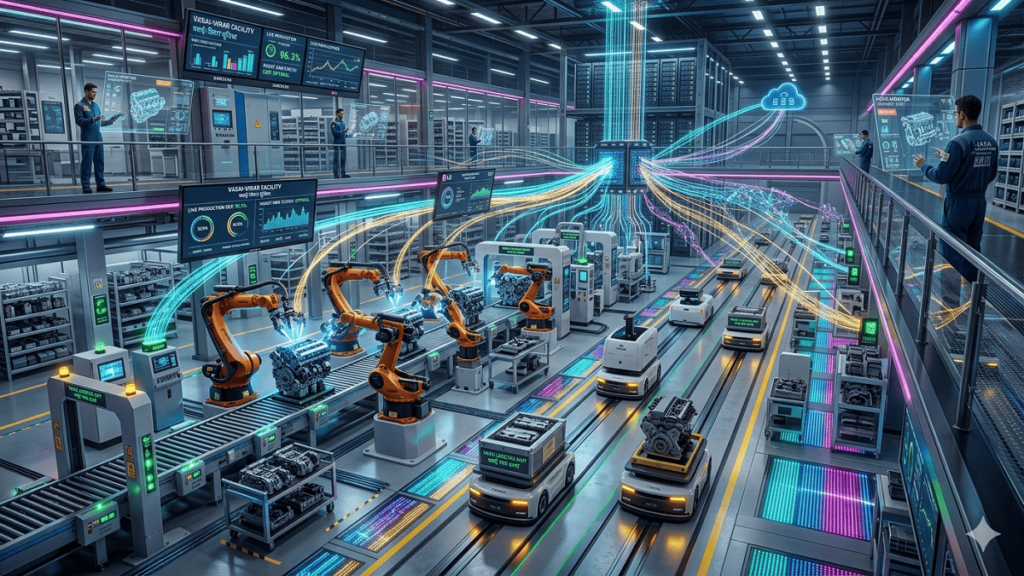
How are Self-learning Manufacturing Lines required?
Self-Learning Manufacturing Lines are required by implementing intelligent systems that monitor, analyze, and adapt production processes autonomously.
How They Are Implemented
- Smart Sensors and IoT Devices
- Collect real-time data on machine performance, production flow, and product quality.
- AI and Machine Learning Algorithms
- Analyze historical and real-time data to detect patterns, predict failures, and identify optimization opportunities.
- Autonomous Process Adjustments
- Automatically adjust machine parameters, production speed, and workflows to maintain efficiency and quality.
- Predictive Maintenance
- Monitor equipment health to anticipate and prevent breakdowns, reducing downtime.
- Continuous Improvement Loops
- Systems learn from every production cycle, improving processes, reducing waste, and increasing productivity over time.
Example:
In electronics manufacturing, self-learning lines can detect a misaligned PCB, automatically adjust robotic arms, and recalibrate the assembly process without human intervention, ensuring consistent quality and reducing defects.
In short: Self-learning manufacturing lines are required by integrating AI, IoT, and real-time analytics into production systems, allowing factories to operate autonomously, efficiently, and adaptively while continuously improving performance and quality.
Case study of Self-learning Manufacturing Lines
Background
A leading automotive manufacturer wanted to increase production efficiency and reduce defects in its assembly lines while handling multiple car models with varying specifications. Traditional assembly lines required frequent manual adjustments and monitoring, leading to downtime, inconsistent quality, and higher labor costs.
Problem
- Manual intervention was needed to adjust robot operations for different car models.
- Quality issues arose due to variations in materials, tools, and assembly tolerances.
- Production downtime occurred due to equipment maintenance and error correction.
- The company struggled to scale operations efficiently while maintaining high-quality standards.
Solution: Implementing Self-Learning Manufacturing Lines
The company deployed self-learning manufacturing lines equipped with:
- Smart Sensors and IoT Devices
- Monitored robotic arms, conveyor systems, and assembly tools in real time.
- AI and Machine Learning Algorithms
- Analyzed production data to detect deviations, predict maintenance needs, and optimize operations.
- Autonomous Adjustments
- Robots automatically modified speed, torque, and positioning based on real-time conditions and product specifications.
- Predictive Maintenance
- Reduced unplanned downtime by detecting equipment wear or failure before it occurred.
Results
- Defect rates decreased by 50%, improving overall product quality.
- Production throughput increased by 30%, enabling faster delivery times.
- Downtime reduced significantly, thanks to predictive maintenance and autonomous adjustments.
- QA teams could focus on complex testing and process improvements rather than routine monitoring.
- The system continuously learned from production cycles, further optimizing efficiency over time.
Conclusion
By implementing self-learning manufacturing lines, the automotive manufacturer achieved higher efficiency, improved quality, and greater flexibility. The lines were able to adapt to changing product requirements and production conditions autonomously, reducing human intervention and operational costs.
Key Takeaway: Self-learning manufacturing lines are particularly effective in high-volume, multi-model production environments, enabling adaptive, intelligent, and continuously improving manufacturing processes.
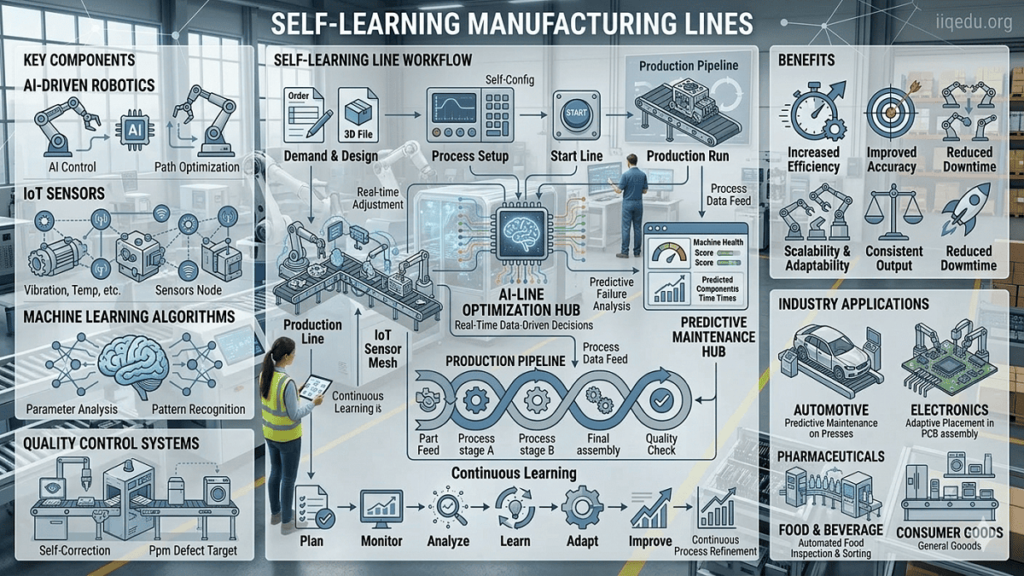
An infographic explaining self-learning manufacturing lines, highlighting AI-driven robotics, IoT-enabled sensors, predictive maintenance, adaptive workflows, and their benefits in industries like automotive, electronics, pharmaceuticals, food and beverage, and consumer goods.
White paper of Self-learning Manufacturing Lines
Abstract
Self-learning manufacturing lines are the next evolution of smart factories, integrating artificial intelligence (AI), machine learning (ML), IoT, and robotics to create autonomous, adaptive production systems. These lines continuously monitor, analyze, and optimize manufacturing processes, reducing defects, improving efficiency, and enabling real-time decision-making. This white paper explores the technology, benefits, implementation strategies, challenges, and industry applications of self-learning manufacturing lines.
1. Introduction
Traditional manufacturing lines rely heavily on human oversight and fixed routines. While automation has improved efficiency, it often lacks the ability to adapt dynamically to changing conditions or learn from production data. Self-learning manufacturing lines address these limitations by using AI-driven algorithms, connected sensors, and robotics to continuously optimize operations, detect defects, and predict maintenance needs.
The result is a production system that evolves over time, improving quality, reducing waste, and maximizing throughput without constant human intervention.
2. Key Components of Self-Learning Manufacturing Lines
- Smart Sensors and IoT Devices
- Collect real-time data on equipment, workflows, and environmental conditions.
- Machine Learning and AI Algorithms
- Analyze historical and live data to identify patterns, optimize processes, and predict failures.
- Robotics and Automated Equipment
- Adjust operations autonomously, including speed, torque, and positioning.
- Data Analytics and Feedback Loops
- Provide continuous insights for process improvement and decision-making.
- Predictive Maintenance Systems
- Detect potential equipment failures and schedule maintenance proactively.
3. Benefits
- Enhanced Efficiency: Reduce production downtime and increase throughput.
- Improved Quality: Detect and correct defects automatically.
- Flexibility: Adapt quickly to product design changes and variable production requirements.
- Cost Reduction: Optimize resource usage and minimize waste.
- Data-Driven Decision Making: Use insights from production data to improve strategies and processes.
4. Industry Applications
- Automotive Manufacturing – Adaptive assembly lines for multiple car models with precision.
- Electronics Manufacturing – Real-time defect detection and optimization in PCB and semiconductor assembly.
- Food and Beverage – Dynamic scheduling, packaging optimization, and quality monitoring.
- Pharmaceuticals – Ensuring consistent production quality and regulatory compliance.
- Consumer Goods – High-volume automated production with minimal human intervention.
5. Implementation Challenges
- High initial investment in sensors, AI systems, and robotics.
- Integration with existing legacy systems.
- Requirement for skilled personnel to manage, monitor, and maintain the system.
- Handling and analyzing large volumes of production data effectively.
6. Future Trends
- AI-Enhanced Learning: Systems predicting process inefficiencies before they occur.
- Industrial IoT Integration: Fully connected factories with coordinated self-learning lines.
- Digital Twin Technology: Simulating production lines for predictive analysis and optimization.
- Autonomous Manufacturing: Minimizing human intervention in routine production tasks.
- Sustainable Manufacturing: Optimizing energy and resource consumption through intelligent adjustments.
7. Conclusion
Self-learning manufacturing lines represent a major step forward in industrial automation. By integrating AI, ML, IoT, and robotics, these systems enable autonomous, adaptive, and continuously improving production processes. Organizations adopting self-learning lines gain advantages in efficiency, quality, flexibility, and cost savings, making them well-positioned for the future of smart manufacturing.
Keywords
Self-learning manufacturing lines, smart factory, AI in manufacturing, adaptive production systems, predictive maintenance, industrial IoT, manufacturing automation.
Industry application of Self-learning Manufacturing Lines
Self-learning manufacturing lines are deployed in industries where efficiency, precision, adaptability, and continuous improvement are critical. By leveraging AI, IoT, machine learning, and robotics, these systems optimize production in real time, reduce errors, and improve throughput.
1. Automotive Industry
- Applications: Adaptive assembly lines that handle multiple car models, dynamic adjustments of robotic arms, and automated quality checks.
- Benefits: Consistent precision, faster production, reduced downtime, and improved defect detection.
2. Electronics Manufacturing
- Applications: PCB assembly, semiconductor fabrication, and device testing with automated defect detection.
- Benefits: High accuracy, reduced errors, and optimized production speed for complex electronics.
3. Pharmaceutical Industry
- Applications: Automated drug production, packaging, and monitoring of quality parameters in real time.
- Benefits: Ensures compliance with strict regulatory standards, reduces human error, and improves product consistency.
4. Food and Beverage Industry
- Applications: Dynamic scheduling of production lines, automated packaging, and quality monitoring.
- Benefits: Reduces waste, improves throughput, and ensures consistent product quality.
5. Consumer Goods and High-Volume Manufacturing
- Applications: Automated assembly, sorting, and packaging of goods in large-scale production facilities.
- Benefits: Enhances scalability, maintains product consistency, and lowers operational costs.
In short: Self-learning manufacturing lines are required in industries where production must adapt in real time, maintain high quality, and scale efficiently, enabling manufacturers to reduce waste, improve output, and respond quickly to changing product requirements.
#self-learningmanufacturinglinesinmumbai #self-learningmanufacturinglinesinindia
Ask FAQs
What are self-learning manufacturing lines?
Self-learning manufacturing lines are production systems that use AI, machine learning, IoT, and robotics to monitor, analyze, and autonomously optimize manufacturing processes in real time.
Who needs self-learning manufacturing lines?
Industries such as automotive, electronics, pharmaceuticals, food and beverage, and consumer goods benefit from these systems to improve efficiency, quality, and flexibility.
When are self-learning manufacturing lines required?
They are required in high-volume, complex, or quality-critical production environments, or whenever adaptive, real-time process optimization is needed.
How do self-learning manufacturing lines work?
They use sensors, AI algorithms, robotics, and feedback loops to collect data, detect defects, predict maintenance needs, and adjust production parameters automatically.
What are the benefits of self-learning manufacturing lines?
Benefits include improved efficiency, higher product quality, reduced downtime, cost savings, adaptability to changes, and data-driven decision-making for continuous process improvement.
Source: EconClips
Table of Contents
Summary:
Self-learning manufacturing lines represent the next evolution in industrial automation, combining artificial intelligence (AI), machine learning (ML), Internet of Things (IoT), and robotics to create autonomous, adaptive production systems. Unlike traditional manufacturing lines, which rely on fixed routines and human oversight, self-learning lines can monitor, analyze, and optimize production processes in real time, continuously improving efficiency, quality, and flexibility.
At the core of self-learning manufacturing lines are smart sensors and IoT devices, which collect real-time data on machine performance, workflow efficiency, environmental conditions, and product quality. This data is then analyzed by AI and machine learning algorithms, which detect patterns, predict potential issues, and provide insights to adjust operations autonomously. Robotic systems and automated equipment respond to these insights by modifying parameters such as speed, torque, and positioning, ensuring precise and consistent production.
One of the most significant advantages of self-learning manufacturing lines is predictive maintenance. By monitoring equipment health and analyzing performance data, these systems can predict failures before they occur, reducing unplanned downtime and maintenance costs. Additionally, automated quality control ensures that defects are detected and corrected in real time, minimizing waste and improving product consistency.
Self-learning lines are particularly beneficial in industries where production is high-volume, complex, or quality-critical. In the automotive sector, they enable adaptive assembly lines that handle multiple car models with precision. Electronics manufacturers use them to optimize PCB assembly and semiconductor production while reducing defects. Pharmaceutical companies benefit from maintaining strict compliance and quality standards in drug production, and the food and beverage industry can dynamically schedule production, optimize packaging, and monitor quality. Consumer goods manufacturers also gain efficiency and consistency in high-volume production environments.
The implementation of self-learning manufacturing lines brings numerous benefits: enhanced efficiency, improved product quality, cost savings, adaptability to design or production changes, and data-driven decision-making. Over time, these systems learn from each production cycle, creating a continuously improving manufacturing process.
In conclusion, self-learning manufacturing lines are a strategic investment for modern factories aiming to maximize productivity, maintain high-quality standards, and remain competitive in an increasingly dynamic industrial landscape. By integrating AI, IoT, and robotics, these systems enable manufacturers to operate autonomously, adaptively, and efficiently while continuously optimizing production processes for future growth.
Disclaimer:
This information is for educational purposes only. Organizations should consult industry experts before implementing self-learning manufacturing lines in production environments.