Robotic Process Automation in QA
Robotic Process Automation in QA refers to using software robots or “bots” to automate repetitive, rule-based tasks in software quality assurance (QA) and testing. By mimicking human actions in applications, RPA enhances testing efficiency, reduces manual effort, and ensures consistency.
What Is RPA in QA?
RPA involves deploying software bots to execute repetitive QA tasks, such as:
- Running regression tests
- Validating data consistency
- Comparing results across environments
- Logging defects and generating reports
Unlike traditional automation that requires complex coding, RPA can often be configured with low-code or no-code tools, making it easier to implement.
Why RPA Is Important in QA
- Efficiency: Automates repetitive tasks, saving time for testers.
- Accuracy: Reduces human errors in data validation and repetitive testing.
- Consistency: Ensures tests are executed in the same manner every time.
- Scalability: Bots can handle multiple applications and processes simultaneously.
- Integration: Works with legacy systems and modern applications without major changes.
Applications of RPA in QA
- Regression Testing: Run repetitive regression tests automatically.
- Data Validation: Verify large volumes of test data across multiple platforms.
- Test Case Execution: Execute predefined test cases in web or desktop applications.
- Reporting and Documentation: Generate test reports and log defects automatically.
- Cross-Platform Testing: Validate consistency across web, mobile, and desktop apps.
Conclusion
RPA in QA allows organizations to accelerate testing cycles, improve accuracy, and optimize resource usage. By automating repetitive tasks, QA teams can focus on complex test scenarios that require human judgment, enhancing overall software quality.
What is Robotic Process Automation in QA?
Robotic Process Automation in QA is the use of software robots or “bots” to automate repetitive, rule-based tasks in software quality assurance. These bots mimic human actions within applications to perform testing tasks efficiently and consistently.
Key Points:
- Purpose: Reduce manual effort, increase accuracy, and speed up QA processes.
- Tasks Automated: Regression testing, data validation, test case execution, report generation, and defect logging.
- Advantage Over Traditional Automation: RPA often uses low-code or no-code tools, making it easier to implement and integrate with both modern and legacy systems.
Example:
In a banking application, an RPA bot can automatically run regression tests on new software updates, validate large datasets across multiple platforms, and generate a defect report—all without human intervention.
In simple terms: RPA in QA allows software teams to automate repetitive testing tasks, freeing testers to focus on complex scenarios that require human judgment, while improving speed, accuracy, and consistency.
Who is Robotic Process Automation in QA required?
Robotic Process Automation in QA is required by organizations and teams that need to improve testing efficiency, accuracy, and scalability in their software quality assurance processes.
Who Needs RPA in QA
- Software Development Companies
- To automate repetitive test cases, regression testing, and data validation.
- QA and Testing Teams
- To reduce manual effort, eliminate human errors, and ensure consistent test execution.
- Enterprises with Large or Complex Systems
- To handle high-volume testing across multiple applications or platforms efficiently.
- Agile and DevOps Teams
- To integrate automated testing into CI/CD pipelines for faster releases.
- Organizations Using Legacy and Modern Systems
- RPA can work across web, desktop, and legacy applications without major changes.
In short: RPA in QA is required wherever there is a need to automate repetitive, rule-based QA tasks to save time, improve accuracy, and scale testing efforts across applications and environments.
When is Robotic Process Automation in QA required?
Robotic Process Automation in QA is required whenever organizations need to automate repetitive, rule-based testing tasks to improve efficiency, accuracy, and consistency.
Situations When RPA in QA Is Required
- Frequent Regression Testing
- When software updates occur regularly and the same tests must be repeated multiple times.
- Large Volumes of Test Data
- For validating data across multiple environments, platforms, or systems.
- Repetitive Manual Testing Tasks
- Tasks such as data entry, report generation, or test result comparison that consume significant manual effort.
- Integration Testing Across Systems
- When tests need to run across multiple applications, including legacy and modern systems.
- Fast Release Cycles in Agile/DevOps
- To support CI/CD pipelines where continuous and automated testing is critical.
In short: RPA in QA is required whenever automation of repetitive or high-volume QA tasks can save time, reduce errors, and accelerate testing cycles, allowing testers to focus on complex, exploratory, or judgment-based testing.
Where is Robotic Process Automation in QA required?
Robotic Process Automation (RPA) in QA is required in industries and environments where software quality, speed, and accuracy are critical and repetitive testing tasks are common.
Key Areas Where RPA in QA Is Required
- Banking and Financial Services
- For testing transaction workflows, data validation, and regulatory compliance in core banking applications.
- E-Commerce and Retail
- For automating order processing tests, payment gateway validation, and regression testing of web and mobile apps.
- Healthcare and Pharmaceuticals
- For validating electronic health records (EHR), patient portals, and medical software workflows.
- Telecommunications
- For testing billing systems, network applications, and customer portals.
- Enterprise Software Solutions
- For automating functional, regression, and integration testing across large-scale enterprise applications.
In short: RPA in QA is required anywhere repetitive, rule-based software testing tasks exist, especially in industries handling large datasets, complex workflows, or frequent software updates, where automation improves efficiency, consistency, and accuracy.
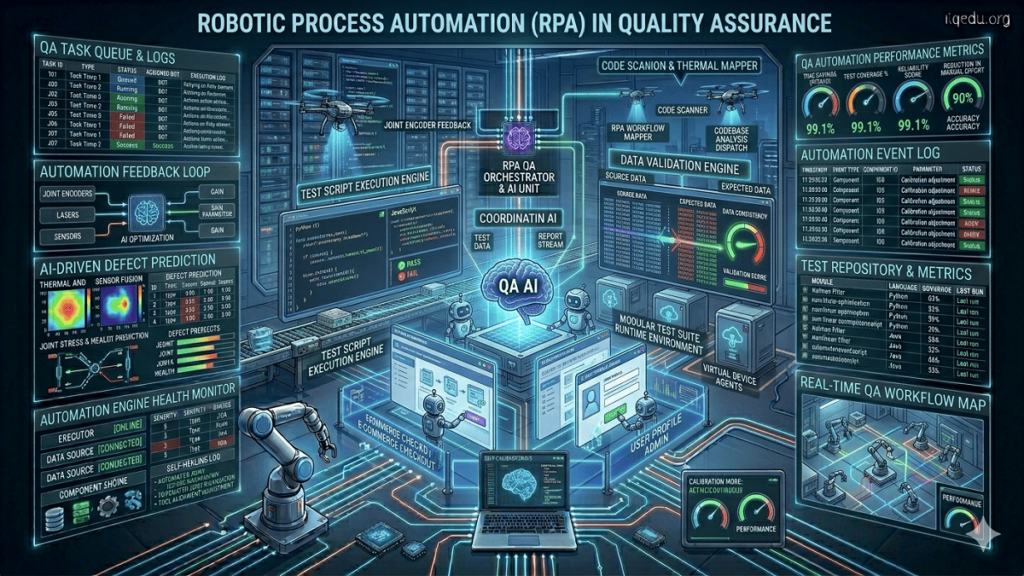
How is Robotic Process Automation in QA required?
Robotic Process Automation in QA is required by organizations and teams that need to improve efficiency, accuracy, and scalability in software testing.
Who Needs RPA in QA
- Software Development Companies
- To automate repetitive test cases, regression testing, and data validation.
- QA and Testing Teams
- To reduce manual effort, eliminate human errors, and ensure consistent test execution.
- Enterprises with Large or Complex Applications
- To efficiently manage high-volume testing across multiple systems.
- Agile and DevOps Teams
- To integrate automated testing into continuous integration/continuous delivery (CI/CD) pipelines.
- Organizations Using Both Legacy and Modern Systems
- RPA works across web, desktop, and legacy applications without major code changes.
In short: RPA in QA is required wherever there is a need to automate repetitive, rule-based testing tasks to save time, improve accuracy, and scale testing operations efficiently.
Case study of Robotic Process Automation in QA
Background
A leading banking and financial services company faced challenges in testing its core banking application during frequent software updates. Manual QA processes were time-consuming, error-prone, and could not keep up with the rapid release cycles demanded by the business. Regression testing, data validation, and report generation were particularly repetitive and resource-intensive.
Problem
- Manual testing of routine workflows took several weeks per release.
- High risk of human errors in data validation and test execution.
- Inconsistent testing results across different environments.
- Delayed releases affected customer experience and regulatory compliance.
Solution: Implementing RPA in QA
The company deployed RPA bots to automate repetitive QA tasks:
- Regression Testing Automation
- Bots executed predefined regression test cases across multiple banking modules automatically.
- Data Validation and Verification
- Bots checked large volumes of transactional data for accuracy across databases and applications.
- Report Generation
- Automated generation of test results and defect logs, reducing manual reporting effort.
- Integration Across Systems
- RPA bots worked seamlessly with core banking applications, web portals, and legacy systems.
Results
- Testing time reduced by 60%, enabling faster release cycles.
- Error rate dropped by 40%, ensuring higher data accuracy.
- Test coverage increased, as bots could run more test cases simultaneously.
- QA teams could focus on complex exploratory testing instead of repetitive tasks.
Conclusion
RPA in QA enabled the bank to accelerate testing, reduce human errors, and maintain compliance while improving overall software quality. By automating repetitive tasks, RPA allowed QA teams to focus on high-value activities, increasing efficiency and reliability across the organization.
Key Takeaway: Implementing RPA in QA is especially effective in industries with high-volume, repetitive, and rule-based testing needs.
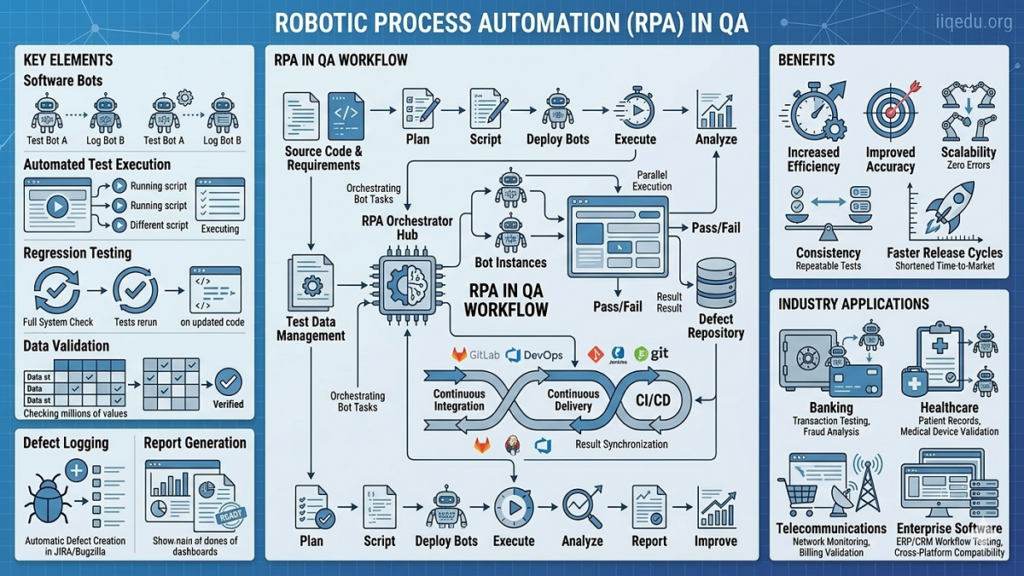
An infographic explaining Robotic Process Automation in QA, highlighting automated testing workflows, benefits like efficiency and accuracy, and applications in banking, healthcare, e-commerce, telecommunications, and enterprise software.
White paper of Robotic Process Automation in QA
Abstract
Robotic Process Automation in Quality Assurance (QA) leverages software bots to automate repetitive, rule-based testing tasks, enhancing efficiency, accuracy, and consistency in software testing. This white paper explores the principles, benefits, implementation strategies, and industry applications of RPA in QA, emphasizing its impact on modern software development and DevOps environments.
1. Introduction
Quality Assurance is a critical component of software development, ensuring that applications function correctly and meet business requirements. Traditional manual QA processes are often time-consuming, prone to human error, and unable to scale effectively with frequent software updates.
RPA in QA uses software bots to replicate human actions in testing processes. Bots can execute test cases, validate data, generate reports, and interact with multiple applications simultaneously. By automating repetitive tasks, RPA frees QA teams to focus on exploratory and complex testing scenarios, improving overall software quality.
2. Key Components of RPA in QA
- Software Bots
- Programs configured to execute predefined QA tasks across applications.
- Automation Workflows
- Define the sequence of testing steps and decision rules for bots to follow.
- Integration with Test Management Tools
- Connects RPA bots with CI/CD pipelines, defect management systems, and test reporting tools.
- Monitoring and Analytics
- Tracks bot performance, test coverage, and defect patterns in real time.
3. Benefits of RPA in QA
- Efficiency: Automates repetitive test cases, regression tests, and data validation.
- Accuracy: Reduces human errors in testing and data verification.
- Consistency: Ensures repeatable test execution across environments.
- Scalability: Bots can handle multiple applications and high-volume test cases simultaneously.
- Cost Savings: Reduces manual effort and accelerates release cycles.
4. Industry Applications
- Banking and Financial Services – Automated regression testing for core banking systems and compliance verification.
- E-Commerce – Testing order processing, payment gateways, and user interfaces.
- Healthcare – Validation of EHR systems, patient portals, and medical software.
- Telecommunications – QA for billing systems, network applications, and customer management portals.
- Enterprise Software – Functional, regression, and integration testing across large-scale applications.
5. Implementation Challenges
- Initial setup cost for RPA tools and infrastructure.
- Requirement for skilled personnel to design, deploy, and maintain bots.
- Integration with legacy systems and complex applications.
- Management of large volumes of test data and automation workflows.
6. Future Trends
- AI-Powered RPA: Intelligent bots capable of adaptive testing and predictive defect detection.
- RPA in CI/CD Pipelines: Seamless integration for continuous testing and DevOps automation.
- Cross-Platform Automation: Bots capable of testing web, mobile, and desktop applications simultaneously.
- Low-Code/No-Code Automation: Simplified RPA implementation for QA teams with minimal coding knowledge.
7. Conclusion
RPA in QA enables organizations to accelerate testing, reduce errors, and improve overall software quality. By automating repetitive and rule-based tasks, QA teams can focus on high-value testing activities, supporting faster releases and reliable applications. In today’s fast-paced software landscape, RPA has become an indispensable tool for modern QA processes.
Keywords
Robotic Process Automation in QA, RPA testing, automated software testing, regression testing automation, QA bots, DevOps automation, software quality assurance.
Industry application of Robotic Process Automation in QA
RPA in QA is widely applied in industries where repetitive, rule-based testing tasks are common, and software quality, speed, and accuracy are critical.
1. Banking and Financial Services
- Applications: Regression testing of core banking applications, transaction workflows, and compliance validation.
- Benefits: Faster testing, reduced human errors, and improved regulatory compliance.
2. E-Commerce and Retail
- Applications: Testing order processing, payment gateways, inventory management, and customer portals.
- Benefits: Ensures consistency across web and mobile platforms while accelerating release cycles.
3. Healthcare and Pharmaceuticals
- Applications: Validating electronic health records (EHR), patient portals, and medical software workflows.
- Benefits: Accurate data validation, compliance with regulations, and reduced testing effort.
4. Telecommunications
- Applications: Testing billing systems, network applications, and customer service portals.
- Benefits: Faster validation of critical systems and improved service reliability.
5. Enterprise Software Solutions
- Applications: Functional, regression, and integration testing for large-scale ERP, CRM, or SaaS applications.
- Benefits: Scalable automation for multiple systems, reducing manual effort and ensuring consistent quality.
In short: RPA in QA is essential for industries where high-volume, repetitive testing is needed, helping organizations save time, reduce errors, and improve overall software quality across multiple platforms and applications.
#roboticsprocessautomationinqainmumbai #roboticsautomationinqainindia
Ask FAQs
What is RPA in QA?
RPA in QA is the use of software bots to automate repetitive, rule-based testing tasks, such as regression testing, data validation, and report generation.
Who needs RPA in QA?
Organizations with high-volume or repetitive testing tasks, including software companies, banking, healthcare, and enterprise IT teams, benefit from RPA in QA.
When is RPA in QA required?
RPA is required during frequent regression testing, repetitive manual QA tasks, large-scale data validation, and fast release cycles in Agile or DevOps environments.
How does RPA in QA work?
Bots mimic human actions to execute test cases, validate data, log defects, and generate reports. They can work across legacy, web, and mobile applications.
What are the benefits of RPA in QA?
RPA improves efficiency, accuracy, consistency, scalability, and cost-effectiveness in testing, allowing QA teams to focus on complex and exploratory testing tasks.
Source: Simplilearn
Table of Contents
Summary
Robotic Process Automation (RPA) in Quality Assurance (QA) is transforming how organizations conduct software testing by automating repetitive, rule-based tasks that were traditionally handled manually. RPA uses software robots, or “bots,” to replicate human actions in digital systems, performing tasks such as executing test cases, validating data, logging defects, generating reports, and even interacting with multiple applications simultaneously. Unlike traditional test automation, RPA often requires minimal coding, making it accessible to QA teams and organizations with limited development resources.
The primary purpose of RPA in QA is to increase efficiency, reduce human error, and improve consistency in testing processes. Manual QA tasks, especially regression testing and data validation, are time-consuming and prone to mistakes, particularly when dealing with large-scale or complex applications. By deploying RPA bots, QA teams can automate these repetitive workflows, allowing them to focus on exploratory testing and scenarios that require human judgment. This shift not only accelerates the testing process but also enhances overall software quality and reliability.
RPA in QA is particularly valuable in industries with high-volume and repetitive testing needs. In the banking and financial services sector, for instance, RPA bots can automate regression tests on core banking systems, verify transaction workflows, and ensure compliance with regulatory standards. In e-commerce, bots can handle order processing, payment gateway validation, and cross-platform testing of web and mobile applications. Similarly, healthcare organizations benefit from RPA by validating electronic health records (EHR), patient portals, and other medical software systems, ensuring data accuracy and regulatory compliance. Telecommunications and enterprise software companies also use RPA to automate testing across multiple systems, improving scalability and reducing manual effort.
The benefits of RPA in QA are extensive. Efficiency is significantly improved, as bots can execute repetitive tests faster than human testers. Accuracy is enhanced because automated bots eliminate errors common in manual testing. Consistency ensures that tests are executed the same way every time, which is critical for regression and cross-platform testing. RPA also provides scalability, allowing organizations to run multiple test cases across applications simultaneously, something that is challenging with human testers alone. Moreover, RPA contributes to cost savings, as fewer human resources are required for repetitive tasks, and release cycles are accelerated.
Implementing RPA in QA comes with challenges. Organizations must invest in the right RPA tools, infrastructure, and skilled personnel to design, deploy, and maintain bots. Integration with legacy systems and complex applications can be difficult, and managing large volumes of test data requires careful planning. However, advances in AI-powered RPA, low-code platforms, and cross-platform automation tools are making adoption easier and more effective.
Looking ahead, RPA in QA is evolving with AI-enhanced bots, which can adaptively test applications and predict defects before they occur. Integration with CI/CD pipelines is enabling continuous automated testing, supporting Agile and DevOps methodologies. RPA is also increasingly capable of testing across web, mobile, and desktop platforms simultaneously, allowing organizations to maintain high-quality software in fast-paced development environments.
In conclusion, RPA in QA is a strategic tool for modern organizations aiming to accelerate testing, improve software quality, and optimize resource utilization. By automating repetitive, rule-based QA tasks, RPA allows QA teams to focus on higher-value activities, reduces errors, and ensures faster and more reliable software delivery. Industries ranging from banking and healthcare to e-commerce and enterprise IT are increasingly leveraging RPA to maintain competitive advantage in a rapidly evolving digital landscape.
Disclaimer:
This content is for educational purposes only. Organizations should consult QA and RPA specialists before implementing RPA in software testing processes.