Ultrasonic Phased Array
What is Ultrasonic Phased Array?
Ultrasonic Phased Array (UPA) is an advanced non-destructive testing (NDT) technique that uses multiple ultrasonic transducers arranged in an array to inspect materials for internal flaws such as cracks, corrosion, or weld defects. Unlike conventional ultrasonic testing (UT), a phased array can electronically steer, focus, and scan the ultrasonic beam without moving the probe mechanically, providing high-resolution imaging and greater inspection flexibility.
How It Works
- The array consists of multiple small ultrasonic elements in a single probe.
- Each element can be pulsed independently with a controlled time delay, which allows the ultrasonic beam to:
- Focus at specific depths
- Steer at various angles
- Sweep across a section electronically
- Echoes reflected from internal features are captured to produce a detailed cross-sectional image of the material.
- Common display formats include A-scan, B-scan, and C-scan images for analysis of defects.
Applications
Ultrasonic Phased Array is widely used in industries where structural integrity is critical:
- Oil & Gas
- Weld inspection in pipelines and pressure vessels
- Corrosion mapping in storage tanks and pipelines
- Aerospace
- Detecting delaminations, cracks, and voids in composite materials
- Inspecting aircraft fuselage and wing structures
- Power Generation
- Turbine blade inspection
- Boiler tube and heat exchanger evaluation
- Manufacturing
- Quality assurance of welds, castings, and forgings
- Inspection of additive-manufactured metal parts
Advantages Over Conventional UT
- Higher Resolution: Can detect smaller flaws and differentiate closely spaced defects.
- Faster Inspections: Electronic scanning reduces the need for mechanical probe movement.
- 3D Imaging Capability: Provides volumetric images for precise defect characterization.
- Flexible Beam Angles: Single probe can inspect multiple orientations without repositioning.
- Digital Record Keeping: Enables data storage for quality assurance and regulatory compliance.
Standards and References
- ASME Section V, Article 4 – Phased Array Ultrasonic Examination
- ISO 13588 – Non-destructive testing of welds — Ultrasonic testing using phased array technique
- API 1104 – Phased Array UT for pipeline weld inspection
References:
- Olympus, Phased Array Ultrasonic Testing (PAUT) Overview: https://www.olympus-ims.com/en/ndt-education/ndt-techniques/phased-array-ut/
- Krautkramer, Ultrasonic Testing of Materials, Springer: https://www.springer.com/gp/book/9783662534510
- ASME NDT Standards: https://www.asme.org/codes-standards/find-codes-standards
#Ultrasonic Phased Array in India
Who is Ultrasonic Phased Array required?
Ultrasonic Phased Array (UPA) is required by professionals and organizations that need precise, reliable, and non-destructive evaluation of materials and components. Specifically:
- Industrial Inspection Companies
- Companies providing non-destructive testing (NDT) services for pipelines, pressure vessels, storage tanks, and structural components.
- They rely on UPA to detect weld defects, cracks, corrosion, and volumetric flaws.
- Oil & Gas Industry
- Pipeline operators, refineries, and petrochemical plants use UPA to ensure the integrity of welded joints, pressure vessels, and high-pressure pipelines, preventing leaks or catastrophic failures.
- Aerospace and Aviation Manufacturers
- Aircraft manufacturers and maintenance teams require UPA to inspect fuselage panels, turbine blades, and composite structures for delaminations, fatigue cracks, and voids.
- Power Generation Sector
- Power plants, including nuclear, thermal, and renewable facilities, use UPA to inspect boiler tubes, turbine components, and heat exchangers for internal defects.
- Manufacturing and Fabrication Companies
- Companies producing welded structures, castings, forgings, or additive-manufactured parts rely on UPA for quality assurance and regulatory compliance.
- Regulatory and Certification Bodies
- Organizations that set and enforce safety standards require UPA inspections to verify compliance with ASME, ISO, and API codes.
Summary: UPA is required wherever high-precision, non-destructive evaluation is critical for safety, reliability, or regulatory compliance—primarily in oil & gas, aerospace, power generation, and high-quality manufacturing.
#Ultrasonic Phased Array in Maharashtra
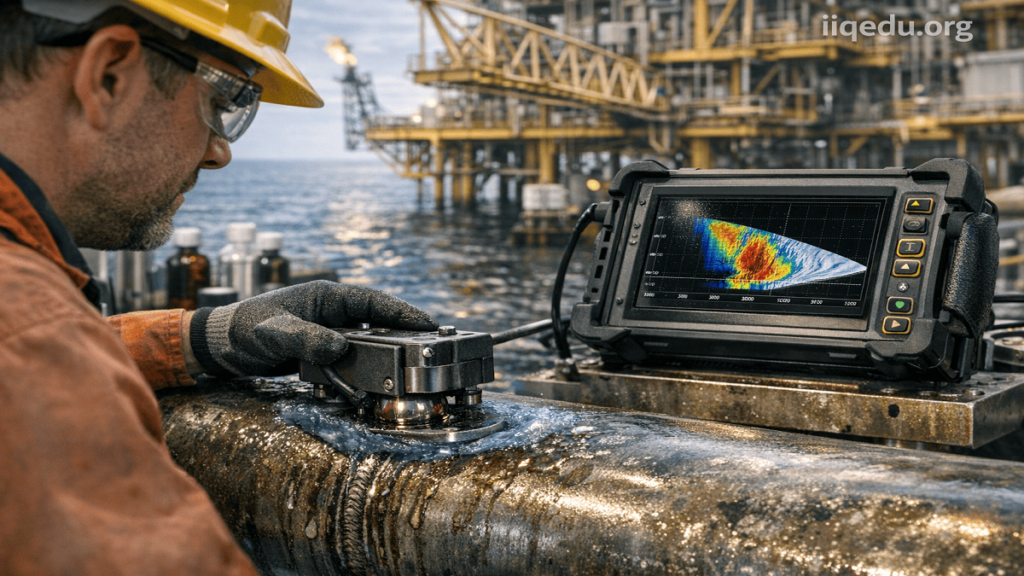
Where is Ultrasonic Phased Array required?
Ultrasonic Phased Array testing is required in environments where material integrity, structural reliability, and safety are critical. Specifically, it is applied in the following locations and contexts:
1. Oil & Gas Industry
- Pipelines: Inspecting welded joints and detecting cracks or corrosion in high-pressure oil and gas pipelines.
- Refineries and Storage Tanks: Monitoring internal corrosion, wall thinning, and weld defects in storage vessels and process equipment.
- Offshore Platforms: Inspecting structural components and risers exposed to harsh marine environments.
2. Aerospace Industry
- Aircraft Components: Testing fuselage panels, wing structures, and landing gear for cracks, voids, or delaminations.
- Turbine Blades: Inspecting jet engine blades and composite structures for fatigue damage or manufacturing defects.
3. Power Generation
- Nuclear, Thermal, and Hydro Plants: Inspecting boiler tubes, heat exchangers, and turbine components for corrosion, cracks, or wall thinning.
- Renewable Energy: Evaluating wind turbine blades and supporting structures for internal defects.
4. Manufacturing and Fabrication
- Welded Structures: Quality assurance of welds in pipelines, pressure vessels, and structural steel components.
- Metal Castings and Forgings: Detecting voids, inclusions, or cracks in critical load-bearing parts.
- Additive Manufacturing: Evaluating 3D-printed metal parts for internal porosity and defects.
5. Critical Infrastructure
- Bridges, offshore platforms, and other load-bearing structures where undetected internal flaws can compromise safety.
Summary:
Ultrasonic Phased Array is required where internal flaws, weld defects, or corrosion could compromise safety, performance, or compliance with industry standards. It is used across oil & gas, aerospace, power generation, manufacturing, and critical infrastructure.
Reference:
- Olympus, Phased Array Ultrasonic Testing (PAUT): https://www.olympus-ims.com/en/ndt-education/ndt-techniques/phased-array-ut/
- ASME Section V – NDT Standards: https://www.asme.org/codes-standards/find-codes-standards
#Ultrasonic Phased Array in Ahemdabad
When is Ultrasonic Phased Array required?
Ultrasonic Phased Array testing is required whenever high precision, non-destructive evaluation of materials is needed to ensure safety, reliability, or regulatory compliance. Key scenarios include:
1. During Manufacturing and Fabrication
- Weld Inspection: Immediately after welding pipelines, pressure vessels, or structural components to detect cracks, porosity, or incomplete fusion.
- Material Verification: Checking castings, forgings, and additive-manufactured parts for internal voids, inclusions, or structural inconsistencies.
- Coating and Layer Evaluation: Ensuring multilayered or composite materials are defect-free before assembly.
2. Pre-Service or Commissioning
- Safety-Critical Installations: Verifying integrity of pipelines, pressure vessels, and aircraft components before putting them into operation.
- Regulatory Compliance: Ensuring components meet standards such as ASME, ISO, or API before approval for service.
3. During In-Service Monitoring
- Corrosion and Erosion Detection: Inspecting pipelines, tanks, or turbines periodically to detect wall thinning or corrosion before failure occurs.
- Fatigue Monitoring: Evaluating areas prone to high cyclic stress, such as aircraft wings, turbine blades, or bridge supports.
- Predictive Maintenance: Using UPA data to schedule maintenance and prevent unplanned downtime.
4. Post-Incident or Failure Investigation
- Root Cause Analysis: After cracks, leaks, or structural failure, UPA helps locate the origin and extent of defects without destroying the component.
- Quality Control Review: Investigating if materials or welds failed to meet expected standards or design requirements.
Summary:
Ultrasonic Phased Array is required at all stages of a component’s lifecycle where internal defects, structural weaknesses, or material degradation can compromise safety, performance, or regulatory compliance—covering manufacturing, pre-service inspection, in-service monitoring, and failure analysis.
References:
- Olympus, Phased Array Ultrasonic Testing (PAUT): https://www.olympus-ims.com/en/ndt-education/ndt-techniques/phased-array-ut/
- ASME Section V – NDT Standards: https://www.asme.org/codes-standards/find-codes-standards
#Ultrasonic Phased Array in Banglore
How is Ultrasonic Phased Array required?
Ultrasonic Phased Array testing is performed as a systematic, non-destructive evaluation method that combines multiple ultrasonic transducers with advanced electronic control to inspect materials for internal defects. The procedure involves several key steps:
1. Define Testing Objectives
- Identify what needs inspection: welds, pipelines, pressure vessels, composite structures, or critical components.
- Determine defect types to detect: cracks, porosity, delaminations, wall thinning, or corrosion.
- Specify required resolution and inspection depth.
2. Select the Appropriate Phased Array Probe
- Choose a probe with the correct number of elements, frequency, and configuration to suit the material and defect size.
- High-frequency probes (5–15 MHz) are used for thin materials; lower frequencies (1–5 MHz) for thicker or highly attenuating materials.
3. Configure the Equipment
- Program the time delays and firing sequence of individual array elements to steer, focus, and sweep the ultrasonic beam electronically.
- Adjust the scan angle, focal depth, and range based on geometry and inspection requirements.
- Select the display type: A-scan (amplitude vs. time), B-scan (cross-section), or C-scan (plan view).
4. Prepare the Test Surface
- Clean the inspection area to remove dirt, rust, or coatings that may interfere with sound transmission.
- Apply a couplant (gel, water, or oil) to facilitate ultrasonic wave propagation between probe and material.
5. Conduct the Inspection
- Place the phased array probe on the test surface.
- Perform electronic scans to cover the area of interest; the beam can sweep multiple angles without moving the probe.
- Real-time data is captured for analysis, showing potential defects as echoes or indications on the display.
6. Analyze and Document Results
- Interpret A-, B-, and C-scan images to detect and size defects.
- Compare findings to acceptance criteria in industry standards such as ASME Section V, ISO 13588, or API 1104.
- Store digital records for quality assurance, regulatory compliance, or predictive maintenance.
Summary
Ultrasonic Phased Array is required whenever precise, non-destructive internal inspection is necessary. Its strength lies in electronically controlled beam steering and focusing, enabling fast, high-resolution detection of defects without moving the probe mechanically. The method is adaptable to welds, complex geometries, composites, and critical industrial components.
References:
- Olympus, Phased Array Ultrasonic Testing (PAUT): https://www.olympus-ims.com/en/ndt-education/ndt-techniques/phased-array-ut/
- Krautkramer, Ultrasonic Testing of Materials, Springer: https://www.springer.com/gp/book/9783662534510
- ASME Section V – NDT Standards: https://www.asme.org/codes-standards/find-codes-standards
#Ultrasonic Phased Array in Kolkata
Case Study of Ultrasonic Phased Array
Background
A major oil pipeline operator in North America faced challenges with weld integrity in high-pressure pipelines transporting crude oil across long distances. Conventional ultrasonic testing (UT) was insufficient for detecting complex flaws such as lack of fusion, porosity, and root cracks, especially in multi-pass welded joints. Ensuring early detection of defects was critical to prevent leaks, minimize downtime, and comply with regulatory standards such as ASME B31.3 and API 1104.
Objective
- Evaluate the internal quality of pipeline welds using a high-resolution inspection technique.
- Detect and size flaws that could compromise mechanical strength and operational safety.
- Establish a digital record of weld quality for compliance and future monitoring.
Methodology
- Equipment Selection:
- A 64-element phased array probe operating at 5 MHz was selected to balance penetration and resolution.
- The probe allowed electronic beam steering from 0° to 70°, covering the entire weld volume without physically moving the probe.
- Test Preparation:
- Weld surfaces were cleaned and a gel-based couplant applied for ultrasonic transmission.
- A calibration block with known defects ensured accurate sizing and detection.
- Inspection Procedure:
- Phased array scans were performed along circumferential and longitudinal passes.
- Real-time A-scan, B-scan, and C-scan images were recorded to identify defects and their orientation.
- Data analysis focused on identifying:
- Lack of fusion at the root or cap
- Porosity within weld passes
- Cracks or slag inclusions
- Data Documentation:
- Each weld section was digitally stored, including flaw type, size, and location.
- Reports were aligned with API 1104 acceptance criteria for weld inspection.
Results
- Detected multiple lack-of-fusion defects at the weld root that were undetectable using conventional UT.
- Identified small internal porosity clusters, enabling proactive repair before pipeline commissioning.
- Inspection reduced false positives and eliminated the need for repetitive physical probing, saving time and labor costs.
- Provided a full digital record for regulatory compliance and long-term monitoring.
Impact
- Safety: Prevented potential leaks or failures in high-pressure pipeline operations.
- Efficiency: Reduced inspection time by 40% compared to conventional UT methods.
- Compliance: Met ASME and API standards, ensuring legal and operational adherence.
- Decision-Making: Allowed maintenance teams to prioritize repairs based on precise flaw location and size.
Conclusion
This case study demonstrates that Ultrasonic Phased Array testing provides high-resolution, reliable detection of internal defects in critical welds where conventional methods are insufficient. Its electronic beam steering, focusing capabilities, and real-time imaging make it ideal for high-stakes industries such as oil & gas, aerospace, and power generation.
References:
- Olympus, Phased Array Ultrasonic Testing (PAUT): https://www.olympus-ims.com/en/ndt-education/ndt-techniques/phased-array-ut/
- ASME Section V – NDT Standards: https://www.asme.org/codes-standards/find-codes-standards
- API 1104 – Welding of Pipelines and Related Facilities: https://www.api.org/products-and-services/standards
#Ultrasonic Phased Array in Chennai
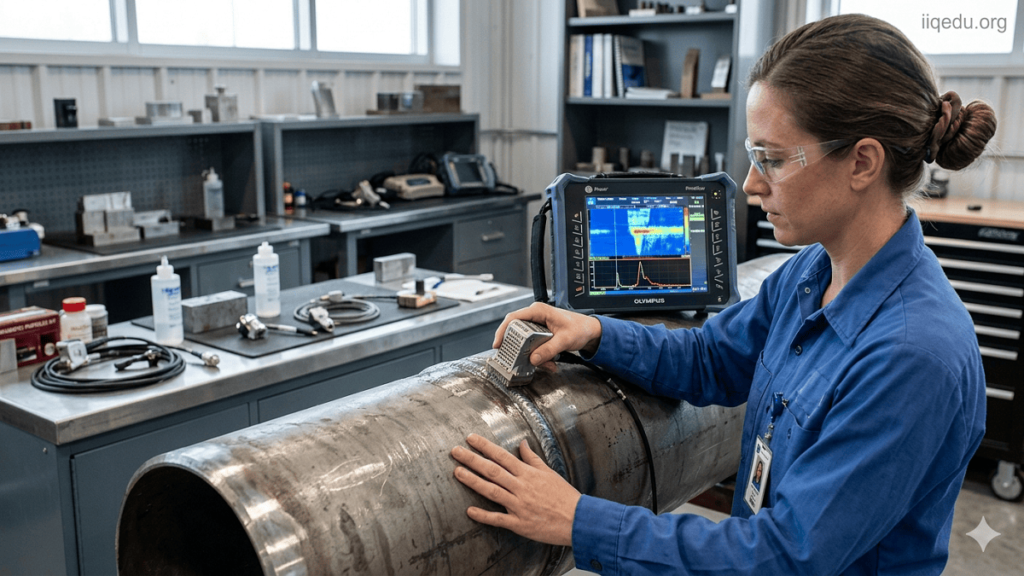
White Paper of Ultrasonic Phased Array
Executive Summary
Ultrasonic Phased Array (UPA) is a cutting-edge non-destructive testing (NDT) technique used to detect internal defects in materials and components with high accuracy. Unlike conventional ultrasonic testing, UPA uses electronically controlled multiple transducer elements to steer, focus, and scan ultrasonic beams, providing high-resolution, real-time imaging of welds, pipes, composites, and critical industrial structures.
UPA has become essential in industries such as oil & gas, aerospace, power generation, and manufacturing, enabling safer operations, reduced maintenance costs, and compliance with regulatory standards.
1. Introduction
Non-destructive testing ensures material integrity without impairing functionality. Among NDT methods, UPA offers superior flexibility and resolution by combining multiple ultrasonic elements in a phased array, allowing electronic steering and focusing of sound waves. This capability makes it ideal for inspecting complex geometries, welds, and critical structural components.
Key benefits include:
- Precise defect detection and sizing
- Faster inspection compared to conventional UT
- Ability to inspect complex and high-value components
- Digital record-keeping for compliance and traceability
2. Principles of Ultrasonic Phased Array
UPA uses multiple ultrasonic transducers in a single probe. Each element can be pulsed independently with controlled time delays. The main principles are:
- Electronic Beam Steering – The beam angle can be changed without moving the probe physically.
- Focusing – The beam can focus at specific depths for improved resolution.
- Sweeping – The beam can scan large areas electronically for comprehensive inspection.
- Data Imaging – A-scan (amplitude vs. time), B-scan (cross-section), and C-scan (plan view) provide detailed volumetric images.
3. Applications
3.1 Oil & Gas Industry
- Weld inspection in pipelines and pressure vessels
- Corrosion mapping of tanks and pipelines
- Offshore platform structural inspection
3.2 Aerospace Industry
- Detection of delaminations and voids in composite structures
- Inspection of fuselage panels and turbine blades
3.3 Power Generation
- Boiler tube, heat exchanger, and turbine blade inspection
- Predictive maintenance for nuclear, thermal, and renewable energy plants
3.4 Manufacturing
- Quality control of welded structures, castings, and forgings
- Additive manufacturing evaluation for internal porosity
3.5 Critical Infrastructure
- Bridges, offshore platforms, and load-bearing structures requiring early detection of internal flaws
4. Advantages Over Conventional Ultrasonic Testing
| Feature | UPA Advantage |
|---|---|
| Resolution | Detects smaller defects and closely spaced flaws |
| Speed | Electronic scanning reduces inspection time |
| Coverage | Multiple angles with a single probe |
| Imaging | 3D visualization of internal defects |
| Record-Keeping | Digital storage for compliance and audits |
5. Standards and Guidelines
- ASME Section V – NDT procedures for phased array ultrasonic testing
- ISO 13588 – Ultrasonic testing of welds using phased array
- API 1104 – Pipeline weld inspection standards
Compliance with these standards ensures reliable inspection, regulatory approval, and operational safety.
6. Case Study Summary
In a North American oil pipeline project, UPA detected lack-of-fusion defects and porosity in high-pressure welds that conventional UT could not identify. The results improved safety, reduced inspection time by 40%, and provided a digital record for regulatory compliance.
7. Conclusion
Ultrasonic Phased Array testing is a highly effective, non-destructive method for evaluating internal material integrity. Its electronic beam steering, high-resolution imaging, and adaptability make it essential for safety-critical industries. As industries adopt advanced materials and high-performance components, UPA will continue to be a core NDT tool for quality assurance, predictive maintenance, and regulatory compliance.
References
- Olympus, Phased Array Ultrasonic Testing (PAUT): https://www.olympus-ims.com/en/ndt-education/ndt-techniques/phased-array-ut/
- Krautkramer, Ultrasonic Testing of Materials, Springer: https://www.springer.com/gp/book/9783662534510
- ASME Section V – NDT Standards: https://www.asme.org/codes-standards/find-codes-standards
- API 1104 – Welding of Pipelines and Related Facilities: https://www.api.org/products-and-services/standards
#Ultrasonic Phased Array in Hyderabad
Industry Application of Ultrasonic Phased Array
Ultrasonic Phased Array (UPA) is widely used in industries where structural integrity, safety, and reliability are critical. Its ability to detect internal defects, evaluate weld quality, and inspect complex geometries makes it a preferred non-destructive testing (NDT) method across multiple sectors.
1. Oil & Gas Industry
- Pipeline Inspection: UPA is used to inspect welded joints in pipelines for cracks, lack of fusion, and corrosion, ensuring leak-free operations.
- Pressure Vessels and Tanks: Internal inspection of tanks and vessels to detect wall thinning, corrosion, and structural flaws.
- Offshore Platforms: Evaluates structural components exposed to harsh marine environments for fatigue and corrosion.
2. Aerospace Industry
- Aircraft Structural Inspection: UPA checks fuselage panels, wings, and landing gear for delaminations, cracks, and voids in both metal and composite materials.
- Turbine Blade Evaluation: Detects internal flaws in jet engine turbine blades, ensuring safety and performance under high stress and temperature.
3. Power Generation
- Nuclear, Thermal, and Hydro Plants: UPA inspects boiler tubes, heat exchangers, and turbine components to detect cracks, corrosion, and wall thinning.
- Wind Turbines: Evaluates blade integrity and structural support components for early detection of fatigue damage.
4. Manufacturing and Fabrication
- Weld Quality Assurance: Ensures multi-pass welded joints meet industry standards for structural integrity.
- Castings and Forgings: Detects internal defects like voids, inclusions, and cracks in high-value components.
- Additive Manufacturing: Evaluates 3D-printed metal parts for internal porosity and structural inconsistencies.
5. Infrastructure and Heavy Industry
- Bridges and Critical Structures: Inspects load-bearing steel and composite components for internal flaws that could compromise safety.
- Shipbuilding and Offshore Platforms: Monitors structural components for corrosion, weld defects, and fatigue.
Key Benefits Across Industries
- Early detection of defects prevents catastrophic failures.
- Reduces downtime and maintenance costs through predictive inspections.
- Complies with ASME, ISO, and API standards for quality assurance and regulatory requirements.
- Provides digital inspection records for traceability and auditing.
References:
- Olympus, Phased Array Ultrasonic Testing (PAUT): https://www.olympus-ims.com/en/ndt-education/ndt-techniques/phased-array-ut/
- ASME Section V – NDT Standards: https://www.asme.org/codes-standards/find-codes-standards
- API 1104 – Welding of Pipelines and Related Facilities: https://www.api.org/products-and-services/standards
#Ultrasonic Phased Array in Mumbai
Ask FAQs
What is Ultrasonic Phased Array (UPA)?
Ultrasonic Phased Array (UPA) is an advanced non-destructive testing (NDT) technique that uses multiple ultrasonic transducer elements arranged in an array to inspect materials for internal defects. By electronically controlling the timing of each element, UPA can steer, focus, and sweep the ultrasonic beam, producing high-resolution images of welds, pipelines, composite structures, and critical components without moving the probe mechanically.
Who requires Ultrasonic Phased Array testing?
UPA is required by industries and professionals where material integrity is critical, including:
Oil & gas operators for pipelines, pressure vessels, and offshore platforms.
Aerospace manufacturers and maintenance teams for aircraft structures and turbine blades.
Power generation plants for boiler tubes, heat exchangers, and turbines.
Manufacturing companies for welded structures, castings, and additive-manufactured parts.
Regulatory and quality assurance bodies to ensure compliance with ASME, ISO, and API standards.
When is Ultrasonic Phased Array required?
UPA is performed at multiple stages of a component’s lifecycle:
During manufacturing: Inspecting welds, castings, and high-value components before commissioning.
Pre-service: Verifying integrity of pipelines, pressure vessels, or aircraft parts before operation.
In-service monitoring: Detecting corrosion, fatigue, or wear in operational components.
Post-incident analysis: Investigating cracks, leaks, or structural failures without destructive methods.
Where is Ultrasonic Phased Array applied?
UPA is applied wherever internal defects could compromise safety, performance, or compliance:
Oil & gas pipelines, storage tanks, and offshore structures.
Aerospace components, including fuselage panels, wings, and turbine blades.
Power generation equipment such as turbines, boilers, and heat exchangers.
Manufacturing and fabrication of welded structures, castings, and additive-manufactured parts.
Critical infrastructure such as bridges and heavy load-bearing structures.
How is Ultrasonic Phased Array performed?
The process includes:
Defining objectives – identify the component, defect type, and inspection depth.
Probe selection – choosing the correct number of elements, frequency, and configuration.
Equipment setup – electronically programming delays to steer and focus the ultrasonic beam.
Surface preparation – cleaning and applying a couplant for sound transmission.
Inspection – performing electronic scans to generate A-scan, B-scan, and C-scan images.
Data analysis and documentation – interpreting defects, measuring size and orientation, and storing results for quality assurance or compliance.
Source: NDE 4.0
Table of Contents
Disclaimer:
The information provided is for general guidance and educational purposes. Results from Ultrasonic Phased Array testing may vary depending on materials, equipment, and operating conditions. The authors and publishers are not responsible for any outcomes, damages, or errors arising from the use of this information. Independent verification and professional consultation are recommended before making operational or safety decisions.