AI-driven Defect Detection
AI-Driven Defect Detection is the use of Artificial Intelligence (AI) and Machine Learning (ML) to automatically identify defects or faults in products, materials, or processes during manufacturing or inspection.
It is widely used in quality control systems to detect problems faster and more accurately than manual inspection.
1. How AI-Driven Defect Detection Works
Image/Data Capture
High-resolution cameras, sensors, or scanners capture images of products.
Data Processing
AI algorithms analyze the captured data using computer vision.
Model Training
Machine learning models are trained using thousands of images of good and defective products.
Defect Identification
The system automatically detects defects such as:
- cracks
- scratches
- dents
- missing components
- color variation
- surface contamination
Decision Making
The system flags defective items and can:
- reject the product automatically
- alert operators
- stop the production line
2. Technologies Used
Key technologies behind AI defect detection include:
- Computer Vision
- Deep Learning (CNN – Convolutional Neural Networks)
- Image Processing
- Machine Learning Algorithms
- Edge AI Cameras
- Industrial IoT Sensors
3. Types of Defects Detected
Examples in different industries:
| Industry | Defects Detected |
|---|---|
| Electronics | PCB solder defects, missing components |
| Automotive | paint scratches, dents |
| Food Industry | contamination, packaging damage |
| Textile | fabric tears, color inconsistency |
| Metal manufacturing | cracks, corrosion, deformation |
4. Advantages of AI Defect Detection
✔ Higher accuracy than manual inspection
✔ 24/7 continuous inspection
✔ Faster detection in real time
✔ Reduced human error
✔ Lower quality control costs
✔ Improved product consistency
5. Example Applications
- PCB inspection in electronics manufacturing
- Bottle cap and label inspection in food & beverage
- Automobile body paint inspection
- Pharmaceutical packaging inspection
- Solar panel crack detection
6. Challenges
- High initial setup cost
- Need for large training datasets
- Integration with existing production systems
- Model retraining when product design changes
Simple Definition:
AI-Driven Defect Detection is an automated quality inspection system that uses AI and computer vision to identify defects in products during manufacturing.
What is AI-driven Defect Detection?
AI-Driven Defect Detection is a technology that uses Artificial Intelligence (AI) and computer vision to automatically identify defects or faults in products during manufacturing, inspection, or quality control.
Instead of relying on human inspectors, the system uses cameras, sensors, and machine learning algorithms to analyze images or data and detect defects quickly and accurately.
Simple Definition
AI-driven defect detection is an automated inspection system that uses AI algorithms to detect product defects such as cracks, scratches, missing components, or contamination.
How It Works
Image/Data Capture
High-resolution cameras or sensors capture images of the product.
Data Processing
AI models analyze the images using computer vision techniques.
Model Training
The system is trained using many examples of good and defective products.
Defect Identification
The AI detects abnormalities like:
- cracks
- scratches
- dents
- missing parts
- surface damage
Action Taken
The system may:
- reject defective products
- alert operators
- stop the production line
Applications
AI-driven defect detection is widely used in:
- Electronics manufacturing – PCB defect detection
- Automotive industry – paint and surface inspection
- Food & beverage – packaging and contamination detection
- Textile industry – fabric defect detection
- Metal manufacturing – crack and corrosion detection
Benefits
✔ Faster inspection
✔ Higher accuracy than manual inspection
✔ Reduces human error
✔ Enables real-time quality control
✔ Improves product quality and consistency
In short:
AI-driven defect detection uses AI and machine vision to automatically find defects in products during manufacturing, helping companies maintain high quality and efficiency.
Who is AI-driven Defect Detection required?
AI-driven defect detection is required by organizations that need high accuracy and fast quality inspection in their production or service processes.
It is mainly used where manual inspection is slow, difficult, or prone to human error.
Manufacturing Industries
Manufacturers use AI defect detection to maintain product quality and reduce defective products.
Examples:
- Automotive industry – detecting scratches, dents, paint defects
- Electronics manufacturing – PCB soldering defects, missing components
- Metal and steel industry – cracks, corrosion, surface defects
- Plastic manufacturing – shape defects, molding issues
Food and Beverage Industry
Companies use AI inspection systems to ensure product safety and packaging quality.
Examples:
- Broken packaging
- Incorrect labeling
- Contamination detection
- Bottle cap or seal inspection
Pharmaceutical Industry
Pharmaceutical companies require strict quality control.
AI helps detect:
- Packaging defects
- Missing tablets or capsules
- Label errors
- Broken vials or ampoules
Textile and Garment Industry
AI systems detect:
- Fabric tears
- Color variation
- Stitching defects
- Pattern misalignment
Electronics & Semiconductor Industry
This industry needs extremely precise inspection, where even microscopic defects matter.
AI detects:
- micro-cracks
- chip defects
- soldering issues
- circuit errors
Logistics & Warehousing
AI inspection is used for:
- damaged packages
- barcode verification
- product sorting errors
In simple terms:
AI-driven defect detection is required by any industry that needs fast, accurate, and automated quality inspection to reduce defects and improve product reliability.
When is AI-driven Defect Detection required?
AI-driven defect detection is required when organizations need fast, accurate, and automated inspection to detect defects during production or quality control. It becomes important in situations where manual inspection is inefficient or unreliable.
When Production Volume is High?
When factories produce large quantities of products, manual inspection becomes slow and costly.
AI systems can inspect thousands of items per minute on production lines.
Example:
- Electronics assembly lines
- Automotive manufacturing
When High Accuracy is Required?
Some industries require extremely precise quality control where even small defects cannot be missed.
Examples:
- Semiconductor manufacturing
- Medical device production
- Aerospace components
When Human Inspection is Difficult?
AI is useful when defects are:
- Very small or microscopic
- Hard to detect with the human eye
- Occurring at high speed on a conveyor system
Example: detecting micro-cracks in metals or PCB solder defects.
When Real-Time Monitoring is Needed?
AI systems can inspect products in real time during manufacturing, allowing companies to immediately:
- stop the production line
- adjust the process
- prevent large batches of defective products
When Quality Consistency is Critical?
Manual inspection may vary between workers.
AI ensures consistent and standardized quality inspection every time.
Industries needing strict quality control include:
- Pharmaceuticals
- Food and beverage
- Electronics manufacturing
When Companies Implement Industry 4.0 or Smart Manufacturing?
Modern factories using automation, robotics, and IoT integrate AI defect detection to improve:
- productivity
- quality management
- predictive maintenance
In simple terms:
AI-driven defect detection is required when companies need fast, reliable, and automated quality inspection to detect defects early and maintain consistent product quality.
Where is AI-driven Defect Detection required?
AI-driven defect detection is required in industries and environments where products must be inspected quickly and accurately to maintain quality and safety. It is mainly used in manufacturing, production, and automated inspection systems.
Manufacturing Plants
Factories use AI inspection systems on production lines to detect defects in products during manufacturing.
Examples:
- Automotive component inspection
- Metal parts crack detection
- Plastic molding defect detection
- Machine component inspection
Electronics and Semiconductor Industry
AI is widely used to inspect very small electronic components where manual inspection is difficult.
Examples:
- PCB (Printed Circuit Board) inspection
- Chip and semiconductor defect detection
- Soldering defect detection
- Missing electronic components
Food and Beverage Industry
AI inspection systems are used in food processing and packaging lines.
Examples:
- Detecting damaged packaging
- Checking bottle caps or seals
- Identifying contamination
- Verifying labels and expiry dates
Pharmaceutical Industry
Pharmaceutical manufacturing requires strict quality control, so AI helps inspect:
- Tablet and capsule packaging
- Broken vials or ampoules
- Labeling errors
- Product contamination
Textile and Garment Industry
AI helps identify fabric defects during textile production.
Examples:
- Fabric tears
- Color variation
- Stitching defects
- Pattern misalignment
Logistics and Warehousing
AI-driven inspection is used to monitor products during storage and distribution.
Examples:
- Damaged packages
- Barcode verification
- Sorting errors in automated warehouses
In simple terms:
AI-driven defect detection is required in industries where products must be inspected automatically to ensure quality, safety, and efficiency.
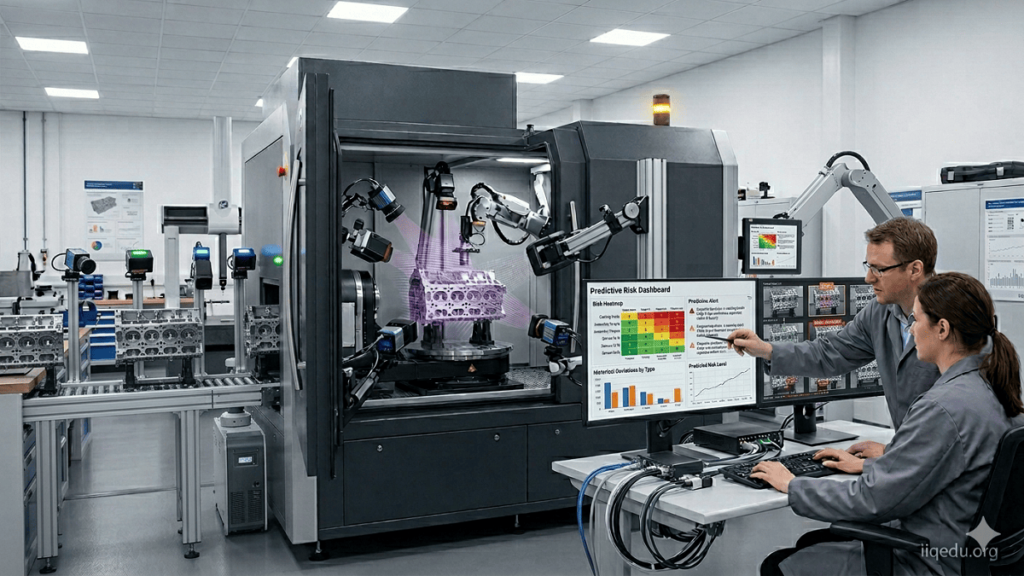
Who is AI-driven Defect Detection required?
AI-driven defect detection is required by organizations and professionals responsible for maintaining product quality, safety, and manufacturing efficiency. It is mainly used by industries where detecting defects quickly and accurately is critical.
Manufacturing Companies
Manufacturers use AI inspection systems to identify defective products during production.
Examples:
- Automotive manufacturers
- Electronics manufacturers
- Metal and machinery manufacturers
- Plastic and packaging companies
Quality Control (QC) and Quality Assurance (QA) Teams
Quality professionals use AI systems to improve inspection accuracy and reduce human error.
They use it to:
- monitor product quality
- detect defects early
- maintain compliance with quality standards
Electronics and Semiconductor Companies
These industries require very precise inspection because even small defects can cause product failure.
Examples:
- PCB manufacturers
- Semiconductor chip producers
- Consumer electronics companies
Food and Pharmaceutical Companies
These industries must ensure product safety and regulatory compliance.
AI helps detect:
- packaging defects
- contamination
- labeling errors
- damaged products
Logistics and Warehousing Companies
Companies handling large volumes of products use AI inspection systems to check:
- damaged goods
- packaging quality
- sorting accuracy
In simple words:
AI-driven defect detection is required by industries and quality control teams that need fast, accurate, and automated inspection to ensure product quality and reduce defects.
How is AI-driven Defect Detection required?
AI-driven defect detection is implemented by integrating cameras, sensors, artificial intelligence algorithms, and automated inspection systems to identify defects in products during manufacturing or quality control.
Data Collection
First, images or data of products are collected using:
- High-resolution cameras
- Sensors
- Scanners
Both defective and non-defective product samples are gathered to train the AI system.
Data Preparation and Labeling
The collected images are labeled and categorized.
Examples:
- Good product images
- Defective product images (cracks, scratches, dents, etc.)
This labeled dataset helps the AI system learn how to distinguish defects.
AI Model Training
Machine learning or deep learning models (such as computer vision algorithms) are trained using the labeled dataset.
The model learns to:
- recognize normal product patterns
- identify abnormal patterns or defects
Integration with Production Line
The trained AI system is installed in the manufacturing or inspection process.
It is connected with:
- cameras
- conveyor systems
- automated inspection machines
The system continuously scans products during production.
Real-Time Defect Detection
The AI model analyzes images in real time and detects defects such as:
- cracks
- scratches
- missing components
- packaging errors
If a defect is detected, the system can:
- reject the product automatically
- send alerts to operators
- stop the production line
Continuous Learning and Improvement
The AI system can be updated with new data to improve accuracy over time and adapt to new product designs or defects.
In simple terms:
AI-driven defect detection works by training AI models with product images and using cameras and software to automatically detect defects during production.
Case study of AI-driven Defect Detection
1. Background
An electronics manufacturing company producing Printed Circuit Boards (PCBs) faced quality issues during manual inspection. Inspectors had to check thousands of boards daily for defects such as soldering errors, missing components, and short circuits.
Manual inspection caused several problems:
- Slow inspection process
- Human errors due to fatigue
- Inconsistent quality checks
- Increased defective products reaching customers
2. Problem Statement
The company needed a system that could:
- Inspect large volumes of PCBs quickly
- Detect very small defects
- Reduce human error
- Improve product quality and reliability
3. AI Solution Implemented
The company implemented an AI-driven defect detection system using computer vision.
The system included:
- High-resolution industrial cameras installed above the production line
- AI algorithms (deep learning models) trained using thousands of PCB images
- Automated Optical Inspection (AOI) system integrated with the manufacturing process
Steps followed:
- Capture images of PCBs during production
- Train AI using images of defective and non-defective boards
- Integrate AI inspection with the assembly line
- Automatically detect and reject defective boards
4. Types of Defects Detected
The AI system successfully detected:
- Missing electronic components
- Solder bridging
- Broken circuit tracks
- Misaligned components
- Surface scratches
5. Results Achieved
| Parameter | Before AI | After AI |
|---|---|---|
| Inspection speed | Slow manual checking | Real-time inspection |
| Detection accuracy | ~80–85% | ~95–98% |
| Production defects | High | Reduced significantly |
| Labor effort | High | Reduced |
Key improvements:
- 30–40% reduction in defective products
- Faster inspection process
- Improved product reliability
6. Benefits for the Company
- Improved quality control
- Reduced production waste
- Lower operational costs
- Higher customer satisfaction
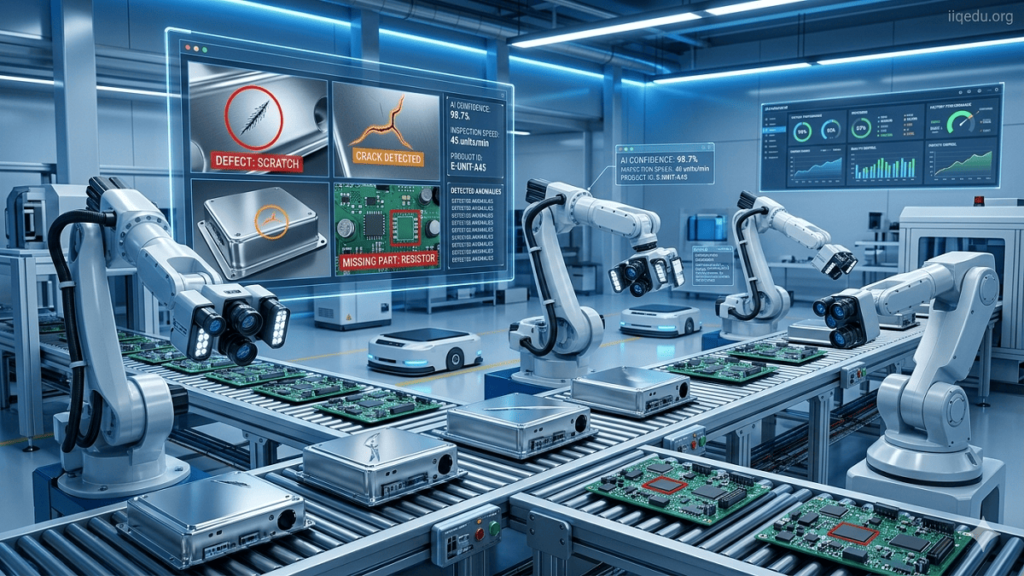
White paper of AI-driven Defect Detection
1. Abstract
AI-Driven Defect Detection refers to the use of Artificial Intelligence (AI), Machine Learning (ML), and Computer Vision to automatically identify defects in products during manufacturing and quality inspection. Traditional inspection methods rely heavily on manual observation, which can be slow, inconsistent, and prone to human error. AI-based systems enable real-time, accurate, and automated inspection, improving product quality, reducing waste, and increasing operational efficiency.
2. Introduction
Quality inspection is a critical component of manufacturing and industrial production. With the increasing demand for high product quality and faster production, traditional manual inspection methods are becoming inadequate.
AI-driven defect detection systems utilize:
- Image processing
- Deep learning algorithms
- High-resolution cameras
- Automated inspection systems
These technologies enable organizations to detect microscopic defects, surface irregularities, and structural issues quickly and accurately.
3. Technology Overview
AI-driven defect detection systems combine several technologies:
3.1 Computer Vision
Computer vision allows machines to analyze images and identify visual patterns, enabling automated inspection of products.
3.2 Machine Learning
Machine learning models learn from large datasets of images containing both defective and non-defective products.
3.3 Deep Learning
Deep learning models such as Convolutional Neural Networks (CNNs) improve the accuracy of defect recognition by identifying complex patterns in images.
3.4 Industrial Sensors and Cameras
High-resolution cameras and sensors capture images or data from products on production lines for analysis.
4. Working Principle
The AI-driven defect detection process typically follows these steps:
- Image Acquisition – Cameras capture product images during production.
- Data Preprocessing – Images are enhanced and prepared for analysis.
- Model Training – AI models are trained using labeled images of defects.
- Defect Detection – The system analyzes images in real time.
- Decision Making – Defective products are flagged or rejected automatically.
5. Applications
5.1 Manufacturing Industry
Detection of cracks, scratches, dents, and dimensional defects.
5.2 Electronics Industry
Inspection of Printed Circuit Boards (PCB) for missing components, soldering defects, and circuit faults.
5.3 Automotive Industry
Detection of paint defects, surface irregularities, and assembly errors.
5.4 Food and Beverage Industry
Inspection of packaging defects, contamination, and labeling errors.
5.5 Pharmaceutical Industry
Inspection of tablets, capsules, packaging integrity, and labeling accuracy.
6. Advantages
- High accuracy and consistency
- Real-time defect detection
- Reduced human error
- Improved production efficiency
- Lower operational costs
- Better quality assurance
7. Challenges
Despite its advantages, AI-driven defect detection also presents challenges:
- High initial investment cost
- Requirement for large labeled datasets
- Integration with existing production systems
- Need for continuous model updates
8. Future Trends
The future of AI-driven defect detection is closely linked with Industry 4.0 and smart manufacturing. Emerging developments include:
- Edge AI for real-time processing
- Integration with Industrial Internet of Things (IIoT)
- Predictive quality analytics
- Autonomous manufacturing systems
These advancements will further enhance production efficiency and quality control.
Industry application of AI-driven Defect Detection
AI-driven defect detection is widely used in industries where product quality, safety, and reliability are critical. It helps companies automatically detect defects during production using AI, machine vision, and data analytics.
1. Automotive Industry
AI inspection systems are used to check vehicle components and body parts.
Applications:
- Paint surface defect detection
- Scratch and dent identification
- Weld seam inspection
- Engine component defect detection
Benefit: Improves vehicle safety and reduces manufacturing defects.
2. Electronics and Semiconductor Industry
This industry requires extremely precise defect detection because even small defects can cause product failure.
Applications:
- Printed Circuit Board (PCB) inspection
- Soldering defect detection
- Chip and semiconductor inspection
- Missing component detection
Benefit: Improves product reliability and reduces electronic failures.
3. Food and Beverage Industry
AI systems inspect food products and packaging to maintain quality and hygiene standards.
Applications:
- Packaging defect detection
- Bottle cap inspection
- Contamination detection
- Label and expiry date verification
Benefit: Ensures food safety and regulatory compliance.
4. Pharmaceutical Industry
Strict quality standards require accurate inspection of medicines and packaging.
Applications:
- Tablet and capsule inspection
- Broken vial detection
- Label verification
- Packaging defect detection
Benefit: Maintains drug safety and prevents defective medicines from reaching consumers.
5. Textile and Garment Industry
AI systems inspect fabrics during production.
Applications:
- Fabric tear detection
- Color variation detection
- Stitching defect inspection
- Pattern alignment verification
Benefit: Improves textile quality and reduces wastage.
6. Metal and Steel Industry
AI systems are used to detect defects in metal surfaces and structures.
Applications:
- Crack detection
- Corrosion inspection
- Surface scratch detection
- Welding defect identification
Benefit: Prevents structural failures and improves material quality.
7. Logistics and Warehousing
AI inspection systems help monitor goods during packaging and distribution.
Applications:
- Damaged package detection
- Barcode verification
- Sorting error detection
- Product count verification
Ask FAQs
What is AI-driven defect detection?
AI-driven defect detection is a technology that uses artificial intelligence, machine learning, and computer vision to automatically identify defects in products during manufacturing or quality inspection. It helps detect issues such as cracks, scratches, missing components, or packaging errors.
How does AI detect defects in products?
AI systems use high-resolution cameras and sensors to capture images of products. Machine learning models analyze these images and compare them with trained data to identify abnormalities or defects in real time.
What industries use AI-driven defect detection?
AI-driven defect detection is widely used in industries such as:
Automotive manufacturing
Electronics and semiconductor production
Food and beverage processing
Pharmaceutical manufacturing
Textile and metal industries
What are the advantages of AI-driven defect detection?
Key advantages include:
Higher inspection accuracy
Faster detection of defects
Reduced human error
Real-time quality monitoring
Improved product quality and consistency
Why is AI-driven defect detection important in modern manufacturing?
AI-driven defect detection is important because it helps companies maintain high quality standards, reduce production waste, and improve efficiency. It also supports Industry 4.0 and smart manufacturing by enabling automated quality control systems.
Source: Stephen Thornton
Table of Contents
Disclaimer:
The information provided about AI-driven defect detection is for general informational and educational purposes only. While efforts have been made to ensure accuracy, the content may not cover all technical or industry-specific requirements and should not be considered professional or technical advice. Users should consult relevant experts or industry standards before implementing any AI-based inspection systems.