AI-powered Process Optimization
AI-Powered Process Optimization refers to the use of Artificial Intelligence (AI), machine learning, and data analytics to improve the efficiency, productivity, and performance of business or industrial processes. It involves analyzing large volumes of operational data to identify inefficiencies, detect patterns, and recommend improvements that help organizations operate more effectively.
Traditional process optimization methods often rely on manual analysis, historical reports, and human decision-making. In contrast, AI-powered systems can continuously analyze real-time data from machines, sensors, production systems, and enterprise software. This enables organizations to quickly identify problems, optimize workflows, and make better decisions based on accurate data insights.
AI algorithms evaluate different process variables such as production speed, machine performance, energy consumption, defect rates, and resource utilization. By analyzing these factors, AI can determine the most efficient way to run a process while minimizing waste, downtime, and operational costs.
How AI Improves Process Optimization
AI-powered systems collect data from various sources including Industrial IoT sensors, manufacturing execution systems (MES), enterprise resource planning (ERP) systems, and quality control databases. Machine learning models then analyze this data to identify trends, detect inefficiencies, and predict potential problems before they occur.
For example, AI can detect when a machine is operating outside optimal conditions or when a production step is causing delays. The system can then suggest adjustments such as changing machine settings, redistributing workloads, or scheduling maintenance to improve overall performance.
Key Benefits of AI-Powered Process Optimization
AI-driven process optimization offers several advantages to organizations, including:
- Improved operational efficiency
- Reduced production costs
- Minimized downtime and equipment failures
- Better product quality
- Faster decision-making based on real-time data
- Improved resource and energy utilization
Applications of AI-Powered Process Optimization
AI-powered optimization is widely used across different industries where process efficiency is critical. Some common applications include:
- Manufacturing – optimizing production lines and reducing defects
- Logistics and supply chain – improving routing, inventory management, and delivery schedules
- Healthcare – optimizing patient workflows and hospital operations
- Energy sector – improving energy distribution and consumption efficiency
- Retail and e-commerce – optimizing inventory management and demand forecasting
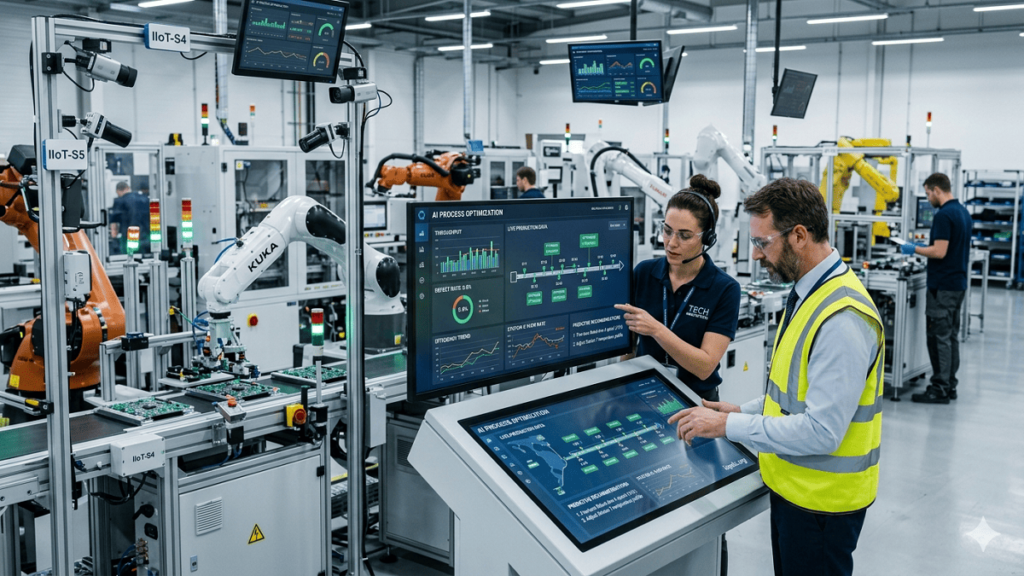
What is AI-powered Process Optimization?
AI-Powered Process Optimization is the use of Artificial Intelligence (AI), machine learning, and data analytics to improve the efficiency and performance of business or industrial processes. It helps organizations analyze large amounts of operational data and identify ways to make processes faster, more accurate, and more cost-effective.
In traditional process management, improvements are often made through manual analysis, experience, and periodic reviews. However, AI systems can continuously monitor real-time data from machines, sensors, software systems, and production lines. By analyzing this data, AI can detect inefficiencies, identify patterns, and recommend improvements that increase productivity and reduce waste.
AI-powered systems can evaluate important factors such as machine performance, production speed, energy usage, defect rates, and resource utilization. Based on this analysis, the system can suggest better operating conditions, adjust process parameters, or predict potential failures before they occur.
For example, in a manufacturing plant, AI can monitor a production line and identify that a particular machine is slowing down the entire process. The system can alert managers, recommend maintenance, or automatically adjust settings to improve performance and maintain product quality.
AI-powered process optimization is widely used in industries such as manufacturing, logistics, healthcare, energy, and retail, where efficient processes are essential for productivity and cost control. By using AI, organizations can improve operational efficiency, reduce downtime, minimize errors, and achieve better overall performance.
Who is AI-powered Process Optimization required?
AI-Powered Process Optimization is required by organizations that want to improve efficiency, reduce operational costs, and enhance productivity through data-driven decision-making. It is especially useful for industries where processes are complex and large amounts of operational data are generated.
1. Manufacturing Companies
Manufacturing industries use AI-powered process optimization to improve production efficiency, reduce machine downtime, minimize defects, and optimize the use of raw materials and energy.
2. Supply Chain and Logistics Companies
Logistics and supply chain organizations require AI to optimize transportation routes, warehouse operations, inventory management, and delivery schedules, ensuring faster and more efficient operations.
3. Healthcare Organizations
Hospitals and healthcare facilities use AI-powered optimization to improve patient workflow, manage medical resources, and enhance operational efficiency within healthcare systems.
4. Energy and Utilities Companies
Energy providers use AI to optimize power generation, distribution systems, and energy consumption patterns to improve efficiency and reduce operational losses.
5. Retail and E-commerce Businesses
Retailers and online businesses use AI-powered optimization to manage inventory levels, forecast demand, streamline order processing, and improve supply chain performance.
6. Large Enterprises and Data-Driven Organizations
Companies that rely heavily on large volumes of operational data can benefit from AI-powered optimization to improve business processes, increase productivity, and make faster strategic decisions.
How is AI-powered Process Optimization required?
AI-Powered Process Optimization is required to improve the efficiency, accuracy, and productivity of business and industrial operations. Organizations today generate large amounts of operational data from machines, systems, and workflows. AI helps analyze this data and identify opportunities to improve processes, reduce waste, and enhance overall performance.
1. Managing Large Volumes of Data
Modern industries generate massive amounts of data from sensors, machines, and software systems. AI is required to analyze this data quickly and extract useful insights that help improve processes.
2. Identifying Inefficiencies in Processes
AI can continuously monitor workflows and detect inefficiencies such as delays, bottlenecks, excessive energy consumption, or high defect rates. This helps organizations take corrective actions and improve productivity.
3. Predicting Equipment Failures
AI-powered systems can analyze machine performance and predict potential failures before they occur. This helps organizations schedule preventive maintenance and reduce unexpected downtime.
4. Improving Decision-Making
AI provides real-time insights and recommendations, allowing managers to make faster and more informed decisions about production, resource allocation, and operational strategies.
5. Reducing Operational Costs
By optimizing resource usage, improving workflow efficiency, and minimizing waste, AI-powered process optimization helps organizations reduce overall operational costs.
6. Enhancing Product Quality
AI can detect process variations and quality issues early, ensuring consistent product quality and reducing the chances of defects.
When is AI-powered Process Optimization required?
AI-Powered Process Optimization is required when organizations need to improve efficiency, reduce operational costs, and enhance the performance of their processes using data-driven technologies. It becomes especially important when traditional methods are no longer sufficient to manage complex operations and large amounts of data.
1. When Processes Become Complex
AI is required when business or industrial processes involve multiple steps, systems, and large data flows that are difficult to manage manually.
2. When There Are Frequent Operational Inefficiencies
If an organization experiences delays, bottlenecks, high defect rates, or wasted resources, AI-powered optimization can help identify the root causes and improve the process.
3. When Real-Time Decision Making is Needed
AI is useful when companies need to monitor operations continuously and make quick decisions based on real-time data.
4. When Equipment Downtime Needs to Be Reduced
Organizations implement AI-powered optimization when they want to predict machine failures and schedule maintenance before breakdowns occur.
5. When Companies Want to Improve Product Quality
AI helps monitor production conditions and detect variations that may lead to quality issues, ensuring consistent product standards.
6. When Businesses Aim to Reduce Costs and Increase Productivity
AI-powered optimization is required when organizations want to minimize waste, optimize resource utilization, and improve overall operational efficiency.
Where is AI-powered Process Optimization required?
AI-Powered Process Optimization is required in industries and organizations where improving efficiency, productivity, and operational performance is essential. It is especially useful in sectors that generate large amounts of data and involve complex processes.
1. Manufacturing Industry
In manufacturing, AI is used to optimize production lines, reduce machine downtime, improve product quality, and minimize material waste.
2. Supply Chain and Logistics
AI helps optimize transportation routes, warehouse operations, inventory management, and delivery schedules to improve overall supply chain efficiency.
3. Healthcare Sector
Hospitals and healthcare organizations use AI to optimize patient management systems, medical resource allocation, and hospital operations.
4. Energy and Utilities
AI-powered optimization helps manage energy production, distribution networks, and energy consumption more efficiently.
5. Retail and E-commerce
Retail companies use AI to optimize inventory levels, demand forecasting, order processing, and customer service operations.
6. Financial and Banking Sector
Banks and financial institutions use AI to optimize transaction processing, fraud detection systems, and customer service operations.
Case study of AI-powered Process Optimization
Company: Automotive Parts Manufacturing Company
Industry: Automotive Manufacturing
Objective: Improve production efficiency and reduce machine downtime.
Problem
The company was experiencing several operational challenges in its production line:
- Frequent machine breakdowns
- High production delays
- Increasing defect rates
- Inefficient use of machine capacity
Traditional monitoring methods could not identify the root causes quickly, which affected productivity and increased operational costs.
Solution
The company implemented an AI-powered process optimization system that used machine learning algorithms and data analytics to monitor production operations.
The system collected real-time data from:
- Machine sensors
- Production equipment
- Quality inspection systems
- Manufacturing execution systems (MES)
AI algorithms analyzed this data to detect abnormal machine behavior, process inefficiencies, and quality variations.
Implementation
The AI system was integrated with the factory’s production line to perform the following tasks:
- Monitor machine performance in real time
- Predict possible equipment failures
- Analyze production speed and process parameters
- Provide recommendations for optimal machine settings
Results
After implementing AI-powered process optimization, the company achieved significant improvements:
- 30% reduction in machine downtime
- 20% improvement in production efficiency
- 15% reduction in product defects
- Better utilization of production resources
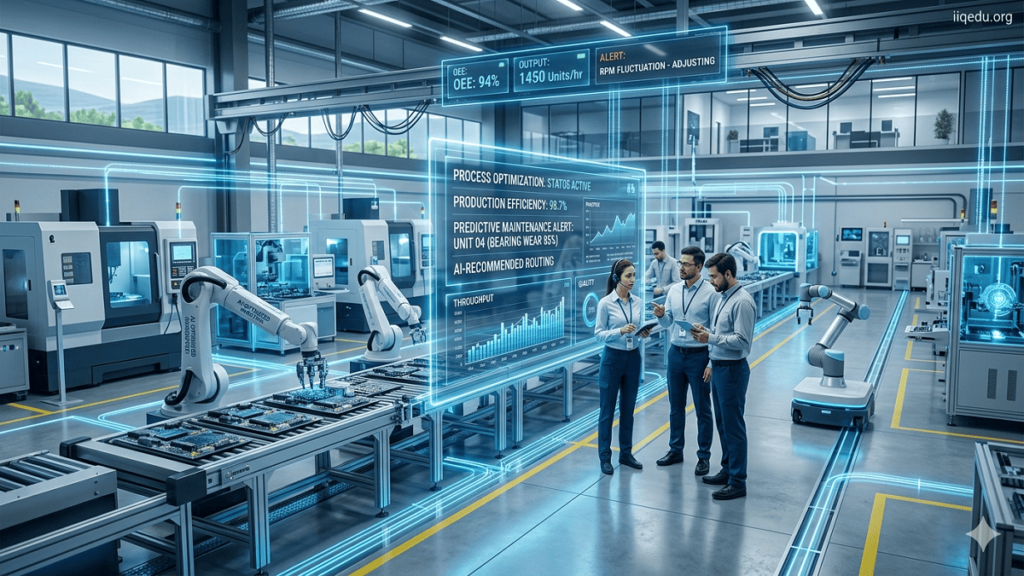
Artificial intelligence analyzing operational data to optimize industrial processes and improve productivity.
White paper of AI-powered Process Optimization
Abstract
Artificial Intelligence (AI) is transforming how organizations manage and improve their operational processes. AI-powered process optimization uses machine learning, advanced analytics, and automation to analyze operational data, identify inefficiencies, and recommend improvements. This white paper explores the concept of AI-powered process optimization, its technologies, implementation strategies, benefits, and applications across industries.
Introduction
Organizations today operate in highly competitive and complex environments where efficiency, speed, and quality are critical. Traditional process optimization methods rely on manual analysis, historical data, and periodic process reviews. While effective to some extent, these approaches often fail to address real-time operational challenges.
AI-powered process optimization enables businesses to continuously analyze large volumes of operational data and identify opportunities for improvement. By integrating AI technologies into operational systems, companies can enhance productivity, reduce operational costs, and improve overall performance.
Understanding AI-Powered Process Optimization
AI-powered process optimization refers to the application of artificial intelligence and data-driven technologies to improve the efficiency and effectiveness of business or industrial processes.
These systems collect and analyze data from various sources such as:
- Production equipment and sensors
- Enterprise resource planning (ERP) systems
- Manufacturing execution systems (MES)
- Quality control databases
- Supply chain management platforms
Using machine learning algorithms, AI identifies patterns, predicts potential issues, and recommends optimal process adjustments.
Key Technologies Involved
Machine Learning (ML)
Machine learning algorithms analyze historical and real-time data to identify patterns and predict future outcomes, enabling proactive decision-making.
Industrial Internet of Things (IIoT)
Sensors and connected devices collect real-time operational data from machines and equipment, which AI systems analyze to optimize processes.
Predictive Analytics
Predictive analytics helps organizations anticipate equipment failures, process inefficiencies, and production delays before they occur.
Automation and Robotics
AI-powered automation systems can automatically adjust process parameters, improving operational efficiency and reducing human intervention.
Implementation Framework
Successful implementation of AI-powered process optimization typically involves the following steps:
1. Data Collection and Integration
Organizations gather operational data from machines, systems, and digital platforms.
2. Data Processing and Analysis
AI algorithms analyze the collected data to detect inefficiencies and patterns.
3. Model Development
Machine learning models are developed to predict process outcomes and recommend improvements.
4. Process Optimization
AI-generated insights are used to adjust process parameters, optimize workflows, and improve resource utilization.
5. Continuous Monitoring
AI systems continuously monitor operations and provide real-time recommendations for further optimization.
Benefits of AI-Powered Process Optimization
Implementing AI-powered optimization provides several advantages:
- Improved operational efficiency
- Reduced downtime and equipment failures
- Lower operational costs
- Enhanced product quality
- Faster decision-making
- Better resource and energy utilization
These benefits help organizations achieve sustainable operational performance.
Industry Applications
AI-powered process optimization is widely used in multiple sectors, including:
Manufacturing – optimizing production lines and reducing defects
Logistics and Supply Chain – improving route planning and inventory management
Healthcare – optimizing patient flow and hospital operations
Energy and Utilities – improving energy generation and distribution efficiency
Retail and E-commerce – optimizing demand forecasting and inventory management
Challenges and Considerations
Despite its advantages, implementing AI-powered process optimization presents several challenges:
- Data integration from multiple systems
- High initial investment costs
- Data privacy and cybersecurity concerns
- Requirement for skilled AI and data professionals
- Change management within organizations
Organizations must address these challenges to successfully adopt AI technologies.
Future Trends
The future of AI-powered process optimization is closely linked with emerging technologies such as:
- Digital twins for real-time process simulation
- Edge computing for faster data processing
- Autonomous production systems
- Advanced predictive analytics
These innovations will further enhance the ability of organizations to optimize operations and improve efficiency.
Industry application of AI-powered Process Optimization
AI-Powered Process Optimization is widely used across many industries to improve efficiency, reduce costs, and enhance productivity. By analyzing large volumes of operational data, AI helps organizations identify inefficiencies and optimize their processes in real time.
1. Manufacturing Industry
In manufacturing, AI-powered process optimization helps improve production efficiency by monitoring machines, predicting equipment failures, and reducing production defects. AI systems analyze machine data and recommend optimal settings to maintain smooth production.
2. Supply Chain and Logistics
AI is used to optimize transportation routes, warehouse operations, and inventory management. It helps companies reduce delivery time, lower transportation costs, and improve supply chain efficiency.
3. Healthcare Industry
Hospitals and healthcare facilities use AI to optimize patient scheduling, manage medical resources, and improve hospital operations. AI helps reduce waiting times and ensures efficient use of medical equipment and staff.
4. Energy and Utilities
In the energy sector, AI-powered optimization helps manage power generation, energy distribution, and energy consumption. It improves efficiency and reduces operational losses.
5. Retail and E-commerce
Retail companies use AI to optimize inventory management, demand forecasting, and order processing. This helps ensure product availability and improves customer satisfaction.
6. Financial Services
Banks and financial institutions use AI to optimize transaction processing, detect fraud, and improve customer service operations.
Ask FAQs
What is AI-powered process optimization?
AI-powered process optimization is the use of artificial intelligence and data analytics to improve business or industrial processes. It helps organizations analyze operational data, identify inefficiencies, and make processes faster, more accurate, and more cost-effective.
How does AI improve process optimization?
AI analyzes large amounts of real-time and historical data from machines, systems, and workflows. It detects patterns, identifies process bottlenecks, predicts equipment failures, and suggests improvements to increase efficiency and productivity.
Which industries use AI-powered process optimization?
Many industries use AI-powered process optimization, including manufacturing, healthcare, logistics, retail, finance, and energy. These sectors benefit from improved operational efficiency and better resource utilization.
What are the main benefits of AI-powered process optimization?
The key benefits include increased efficiency, reduced operational costs, improved product quality, reduced downtime, and better decision-making through data-driven insights.
Is AI-powered process optimization suitable for small businesses?
Yes, small businesses can also use AI-powered process optimization. With modern cloud-based AI tools, even small organizations can analyze their operational data and improve processes without large investments.
Source: Augury
Table of Contents
Disclaimer:
The information provided in this article is for general informational and educational purposes only. While efforts have been made to ensure accuracy, the content should not be considered professional, technical, or business advice. Organizations should consult qualified experts before implementing AI-powered process optimization solutions.