AutoML for Quality Data Modeling
AutoML (Automated Machine Learning) for Quality Data Modeling is the use of automated machine learning tools to build, optimize, and deploy predictive models for quality data in manufacturing, production, and supply chain processes. Instead of manually designing and tuning machine learning models, AutoML automates data preprocessing, feature selection, model training, and hyperparameter optimization, allowing organizations to extract insights faster and more efficiently.
Key Benefits
- Faster Model Development: Automates repetitive ML tasks to reduce development time.
- Improved Prediction Accuracy: Uses advanced algorithms to select the best models for quality outcomes.
- Reduced Expertise Requirement: Allows non-data scientists to build and deploy predictive models.
- Real-Time Quality Insights: Provides actionable insights to improve product quality and reduce defects.
- Scalable Solutions: Can handle large volumes of quality data across multiple processes.
Industry Applications
- Manufacturing: Predict defects, optimize production quality, and reduce waste.
- Automotive: Forecast component failures and improve assembly quality.
- Electronics: Model complex quality metrics to prevent production errors.
- Pharmaceuticals: Predict batch quality issues and ensure regulatory compliance.
- Food & Beverage: Analyze ingredient and process data to maintain safety and consistency.
How AutoML Works
- Data Collection: Gather quality data from sensors, inspections, and production systems.
- Data Preprocessing: Clean and normalize data automatically.
- Feature Engineering: AutoML selects important variables affecting quality outcomes.
- Model Training & Selection: Automatically tests multiple machine learning algorithms to find the best model.
- Hyperparameter Optimization: Fine-tunes the model for maximum predictive accuracy.
- Deployment & Monitoring: Models are deployed for real-time quality prediction and continuously updated with new data.
What is AutoML for Quality Data Modeling?
AutoML for Quality Data Modeling is the use of Automated Machine Learning (AutoML) tools to build predictive models that analyze and improve product quality. Instead of requiring data scientists to manually prepare data, select features, train multiple models, and fine-tune algorithms, AutoML automates the entire workflow.
In Simple Terms
AutoML allows organizations to:
- Collect and clean quality-related data automatically
- Identify which factors most affect product quality
- Train multiple machine learning models simultaneously
- Select the most accurate model for predicting quality outcomes
This helps companies detect defects early, predict production issues, and optimize processes, all while saving time and reducing the need for specialized AI expertise.
Example
A manufacturing plant collects sensor data from its production line. Using AutoML, the system automatically identifies patterns that lead to defects, predicts which batches may fail quality checks, and provides actionable insights to improve the production process before defective products are produced.
Who is AutoML for Quality Data Modeling required?
AutoML for Quality Data Modeling is required by organizations that aim to improve product quality, reduce defects, and optimize production processes using predictive insights from data. It is particularly valuable for companies that deal with large volumes of quality-related data, have complex manufacturing or supply chain processes, or operate in industries with strict regulatory or safety standards.
Key Users and Industries
- Manufacturing Companies
- Companies producing goods at scale, such as consumer electronics, machinery, or industrial equipment, require AutoML to predict potential defects, improve process efficiency, and reduce scrap or rework.
- Automotive Industry
- Automotive manufacturers and suppliers use AutoML to forecast component failures, monitor assembly line quality, and prevent costly recalls.
- Pharmaceutical and Healthcare Companies
- Ensures batch quality, regulatory compliance, and minimizes risks of production errors by analyzing raw material quality and manufacturing data.
- Food & Beverage Industry
- Helps track ingredient quality, monitor production processes, and maintain safety and consistency across all batches.
- Electronics & Semiconductor Industry
- Assists in modeling complex quality metrics to prevent defects in high-precision components and assemblies.
- Large Enterprises with Multiple Production Lines or Suppliers
- Organizations with large-scale or geographically distributed operations use AutoML to standardize quality monitoring, predict risks, and make faster, data-driven decisions without depending entirely on specialized data scientists.
When is AutoML for Quality Data Modeling required?
AutoML for Quality Data Modeling is required whenever organizations need predictive insights from quality data to ensure product reliability, reduce defects, and optimize processes. Traditional methods of quality monitoring—manual audits, spreadsheets, or periodic statistical analysis—can be slow, error-prone, and insufficient to handle large, complex datasets. AutoML automates data analysis and predictive modeling, making it essential in situations where speed, accuracy, and scalability are critical.
Key Scenarios Where AutoML is Needed
- High Volume Production with Complex Data
- When manufacturing lines generate vast amounts of sensor, inspection, and production data, manual analysis becomes impractical. AutoML can process this data continuously to identify patterns affecting quality.
- Recurring Defects or Quality Issues
- If products repeatedly fail quality standards or batches are inconsistent, AutoML helps identify root causes and predicts which products or processes are at risk of defects.
- Strict Regulatory or Safety Requirements
- Industries like pharmaceuticals, aerospace, healthcare, and automotive need to comply with stringent regulations. AutoML enables proactive monitoring to ensure compliance and prevent costly violations.
- Complex Supply Chains or Multiple Production Lines
- Organizations sourcing materials from multiple suppliers or running several production lines require AutoML to standardize quality analysis and monitor supplier or line-specific risks.
- Need for Real-Time or Predictive Quality Insights
- When decisions must be made quickly to prevent defective products from reaching customers, AutoML provides real-time alerts and predictions, allowing proactive intervention.
- Resource or Expertise Constraints
- Companies with limited access to skilled data scientists can use AutoML to automate model building, selection, and tuning, enabling predictive quality analytics without deep AI expertise.
Where is AutoML for Quality Data Modeling required?
AutoML for Quality Data Modeling is required in industries, organizations, and production environments where quality control, predictive insights, and process optimization are critical. Essentially, any operation that deals with large-scale quality data or complex manufacturing processes can benefit from AutoML to ensure products meet the required standards consistently.
Key Areas of Application
- Manufacturing Plants
- In high-volume manufacturing environments, AutoML helps monitor production lines, detect defect patterns, and predict potential failures before they impact output.
- Automotive Industry
- Automotive assembly lines rely on AutoML to forecast component failures, optimize assembly quality, and reduce costly recalls.
- Pharmaceuticals and Healthcare
- AutoML models are used to analyze batch quality, raw material consistency, and compliance with regulatory standards, ensuring safe and effective products.
- Food & Beverage Production
- Used to monitor ingredient quality, production hygiene, and process consistency, reducing the risk of contamination or defective batches.
- Electronics and Semiconductors
- AutoML helps track precision, tolerances, and component quality in complex multi-stage production processes.
- Large Enterprises with Multi-Site Operations
- Organizations with multiple factories, suppliers, or production lines use AutoML to integrate quality data across locations, providing a centralized view of supplier and production performance.
- Supply Chain Quality Management
- AutoML is applied where supplier quality data needs to be monitored to prevent defective materials from entering production.
How is AutoML for Quality Data Modeling required?
AutoML for Quality Data Modeling is required as a strategic tool to automate, optimize, and scale quality data analysis in organizations. It enables companies to predict defects, identify process inefficiencies, and make data-driven decisions without relying entirely on manual analysis or specialized data science expertise.
How It Is Implemented and Required
- Automated Data Collection and Cleaning
- AutoML systems automatically gather data from production lines, sensors, inspections, and ERP systems.
- Data is cleaned, normalized, and prepared for modeling, reducing human error and ensuring consistency.
- Feature Selection and Predictive Modeling
- AutoML automatically identifies which factors or variables most influence product quality.
- Multiple machine learning algorithms are tested simultaneously to select the best predictive model.
- Hyperparameter Optimization
- AutoML fine-tunes model parameters automatically to maximize predictive accuracy and ensure reliable predictions across diverse production scenarios.
- Real-Time Monitoring and Alerts
- Deployed models can monitor quality metrics in real time, sending alerts for potential defects or process deviations before they impact production.
- This allows organizations to take proactive corrective actions, preventing waste, rework, or non-compliant products.
- Integration with Quality and Production Systems
- AutoML integrates with existing quality management, ERP, and supply chain systems, providing a centralized view of quality insights.
- Insights generated by AutoML guide decisions such as adjusting process parameters, prioritizing supplier audits, or modifying production schedules.
- Continuous Improvement
- AutoML continuously learns from new data, updating models to adapt to process changes, new suppliers, or evolving product designs.
- This creates a self-improving predictive quality system that evolves alongside operations.
Case study of AutoML for Quality Data Modeling
Company Overview
Industry: Electronics Manufacturing
Objective: Reduce defects in high-precision components and improve overall production quality.
The company produced complex electronic components for multiple clients globally. Despite strict quality protocols, frequent defects and inconsistencies were detected during inspections, causing rework, delays, and increased costs. Traditional quality monitoring methods relied on manual audits and spreadsheets, which were time-consuming and reactive.
Problem
- High defect rates leading to production delays
- Large volumes of quality data that were difficult to analyze manually
- Inconsistent detection of root causes for defects
- Dependence on data scientists for predictive modeling, slowing decision-making
AutoML Solution
The company implemented an AutoML platform to automate quality data modeling and predictive analytics.
How it worked:
- Data Integration: Collected data from inspection reports, production sensors, ERP systems, and historical defect logs.
- Automated Preprocessing: AutoML cleaned, normalized, and prepared data for modeling.
- Feature Selection & Model Training: AutoML identified key variables impacting quality and trained multiple predictive models to detect defects.
- Hyperparameter Optimization: Models were fine-tuned automatically to maximize predictive accuracy.
- Deployment & Monitoring: Models were deployed on production lines, providing real-time defect predictions and alerts.
Results
- 40% reduction in defective components within the first 6 months
- 30% faster identification of quality issues compared to manual inspection methods
- Improved collaboration between quality and production teams using actionable insights
- Reduced dependency on specialized data scientists for model building
- Enhanced regulatory compliance and customer satisfaction
White paper of AutoML for Quality Data Modeling
Abstract
In today’s fast-paced manufacturing and production environments, maintaining consistent product quality is a top priority. Traditional quality control methods are often reactive, labor-intensive, and unable to handle the large-scale data generated by modern production systems. AutoML for Quality Data Modeling leverages automated machine learning tools to analyze complex quality data, predict defects, and optimize production processes. This white paper explores the concept, implementation, benefits, and industry applications of AutoML in quality data management.
Introduction
Organizations across industries face challenges in quality management:
- Increasing production complexity and high-volume operations
- Rising customer expectations for product quality and reliability
- Manual quality monitoring is time-consuming and error-prone
- Regulatory compliance requires accurate and traceable quality data
AutoML addresses these challenges by automating the creation of predictive models, enabling organizations to make data-driven decisions to reduce defects, improve efficiency, and maintain compliance.
Understanding AutoML for Quality Data Modeling
AutoML automates the machine learning workflow, including:
- Data preprocessing: Cleans and normalizes data from sensors, inspections, and ERP systems.
- Feature selection: Identifies key variables influencing product quality.
- Model training and selection: Tests multiple algorithms to find the best predictive model.
- Hyperparameter optimization: Fine-tunes models for maximum predictive accuracy.
- Deployment and monitoring: Integrates models into production systems for real-time predictions.
By removing the need for extensive data science expertise, AutoML allows quality teams to focus on insights and decision-making rather than manual model building.
Implementation Framework
- Data Collection: Gather quality-related data from production lines, suppliers, and inspections.
- Data Integration & Cleaning: AutoML automatically processes large, diverse datasets.
- Model Building & Training: Multiple machine learning models are generated and evaluated for accuracy.
- Predictive Analytics: Models identify potential defects, process deviations, and quality risks.
- Actionable Insights: Quality teams receive recommendations to prevent defects and optimize processes.
- Continuous Improvement: Models are updated with new data for ongoing accuracy and adaptability.
Benefits
- Reduced Defects: Predict and prevent quality issues before they occur.
- Faster Insights: Automates data processing, modeling, and reporting.
- Cost Efficiency: Reduces manual analysis and reliance on specialized data scientists.
- Scalability: Handles large-scale, multi-line, or multi-site production data.
- Regulatory Compliance: Ensures traceable, accurate quality predictions for audits and reporting.
Industry Applications
- Manufacturing: Predict production line defects and optimize processes.
- Automotive: Forecast component failures and prevent costly recalls.
- Electronics & Semiconductors: Analyze complex quality metrics in multi-stage production.
- Pharmaceuticals & Healthcare: Ensure batch quality and compliance with global standards.
- Food & Beverage: Monitor ingredient quality and maintain safety compliance.
Case Study
Electronics Manufacturing Company:
- Challenge: High defect rates in high-precision components
- Solution: Implemented AutoML to predict defects from sensor and inspection data
- Result: 40% reduction in defective components, faster identification of quality issues, and reduced dependence on data scientists
Challenges and Considerations
- Integration with legacy systems
- Ensuring data security and privacy
- Initial setup costs and change management
- Staff training and adoption of AI-driven workflows
Future Trends
- Real-time AI-driven quality monitoring across global production lines
- Integration with IoT and digital twins for predictive maintenance and quality optimization
- Self-improving models that adapt automatically to evolving processes and materials

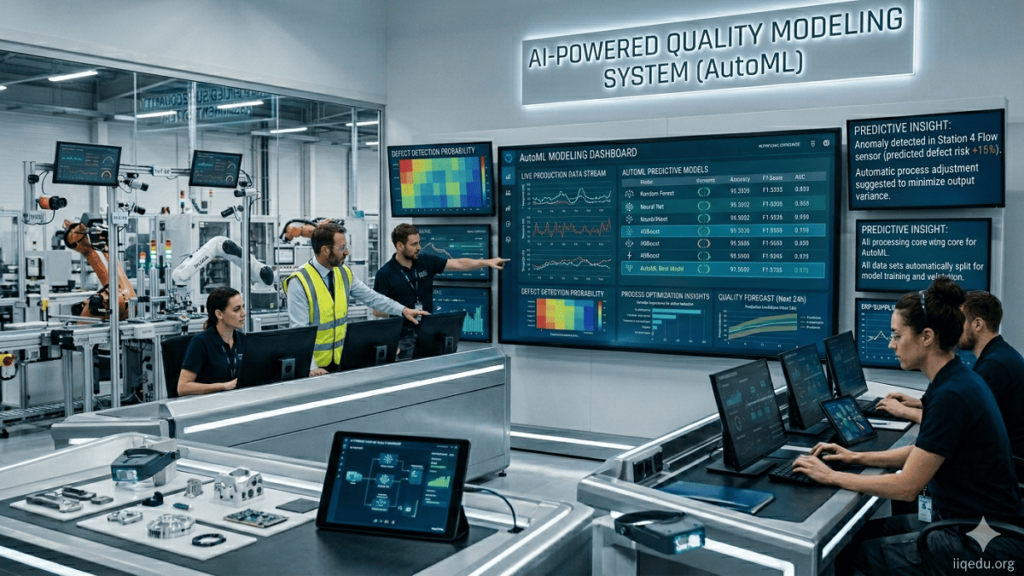
Automated machine learning analyzing production data to predict defects, optimize processes, and improve product quality in real time.
Industry application of AutoML for Quality Data Modeling
AutoML for Quality Data Modeling is applied in industries where product quality, process efficiency, and predictive insights are critical. By automating the creation of predictive models, organizations can identify defects, optimize production, and reduce operational risks across complex manufacturing and supply chain environments.
1. Manufacturing
- Predict defects in production lines and optimize processes
- Reduce scrap, rework, and operational downtime
- Monitor equipment performance to prevent failures
2. Automotive Industry
- Forecast component failures and ensure assembly line quality
- Detect early signs of supplier-related defects
- Reduce costly recalls and warranty claims
3. Electronics & Semiconductors
- Analyze complex quality metrics in multi-stage production processes
- Predict failures in high-precision components
- Improve yield rates and reduce defective batches
4. Pharmaceuticals & Healthcare
- Monitor batch quality and raw material consistency
- Ensure compliance with FDA or global regulatory standards
- Predict potential quality deviations before they impact product safety
5. Food & Beverage
- Track ingredient quality and production consistency
- Maintain hygiene standards and food safety compliance
- Predict potential contamination or process deviations
6. Large Enterprises & Multi-Site Operations
- Integrate quality data across multiple production lines or supplier locations
- Standardize quality monitoring and predictive modeling across sites
- Enable data-driven decisions for process optimization and risk reduction
Ask FAQs
What is AutoML for Quality Data Modeling?
AutoML for Quality Data Modeling is the use of Automated Machine Learning tools to create predictive models for analyzing quality data in manufacturing, production, or supply chains. It automates tasks like data cleaning, feature selection, model training, and hyperparameter tuning, allowing organizations to predict defects, optimize processes, and improve product quality without relying solely on data science experts.
Who requires AutoML for Quality Data Modeling?
Organizations that deal with complex production processes, large-scale data, or strict quality standards need AutoML. Industries like automotive, electronics, pharmaceuticals, food & beverage, aerospace, and large multi-site manufacturers benefit most because AutoML provides faster, more accurate predictive insights to prevent defects and ensure compliance.
When is AutoML for Quality Data Modeling required?
AutoML is required when manual quality monitoring is insufficient, such as during high-volume production, frequent defects, regulatory compliance demands, or when predictive insights are needed to prevent quality issues. It is especially critical for organizations that need real-time defect prediction and proactive process optimization.
Where is AutoML for Quality Data Modeling applied?
It is applied in industries where quality, safety, and process efficiency are critical:
Manufacturing: Predicting defects and optimizing production lines
Automotive: Forecasting component failures and assembly quality
Electronics & Semiconductors: Modeling complex multi-stage production quality
Pharmaceuticals & Healthcare: Ensuring batch quality and regulatory compliance
Food & Beverage: Maintaining ingredient consistency and food safety
Large multi-site enterprises: Integrating quality data across suppliers and plants
How does AutoML for Quality Data Modeling work?
Collecting and preprocessing data from production lines, sensors, and inspections
Selecting relevant features that influence product quality
Training multiple machine learning models and selecting the best-performing one
Optimizing model parameters automatically for high accuracy
Deploying models in production for real-time predictions, alerts, and actionable insights
Continuously updating models with new data for improved predictions over time
Source: Oracle Analytics
Table of Contents
Disclaimer:
The information provided about AutoML for Quality Data Modeling is for educational and informational purposes only. It is not professional, technical, or business advice. Organizations should consult qualified experts before implementing AutoML solutions for quality data management.