Virtual Commissioning of QA Systems
Virtual Commissioning (VC) is the process of testing, validating, and optimizing automated quality assurance (QA) systems in a virtual environment before they are implemented on the real production floor. Instead of directly deploying hardware and software on physical machines, VC allows manufacturers to simulate:
- Production lines
- Inspection systems
- Sensors and actuators
- Robotics and automation workflows
This approach ensures that the QA systems work as intended, reducing commissioning time, errors, and costs.
Key Benefits of Virtual Commissioning in QA
- Faster Deployment – QA systems are tested virtually before going live, shortening commissioning time.
- Cost Savings – Reduces expensive on-site debugging, rework, and downtime.
- Risk Mitigation – Identifies potential system failures or conflicts before physical deployment.
- Optimized QA Processes – Simulations help refine inspection sequences, sensor placements, and software logic.
- Integration Testing – Verifies compatibility with MES, ERP, and other factory systems in a controlled environment.
How Virtual Commissioning Works for QA Systems
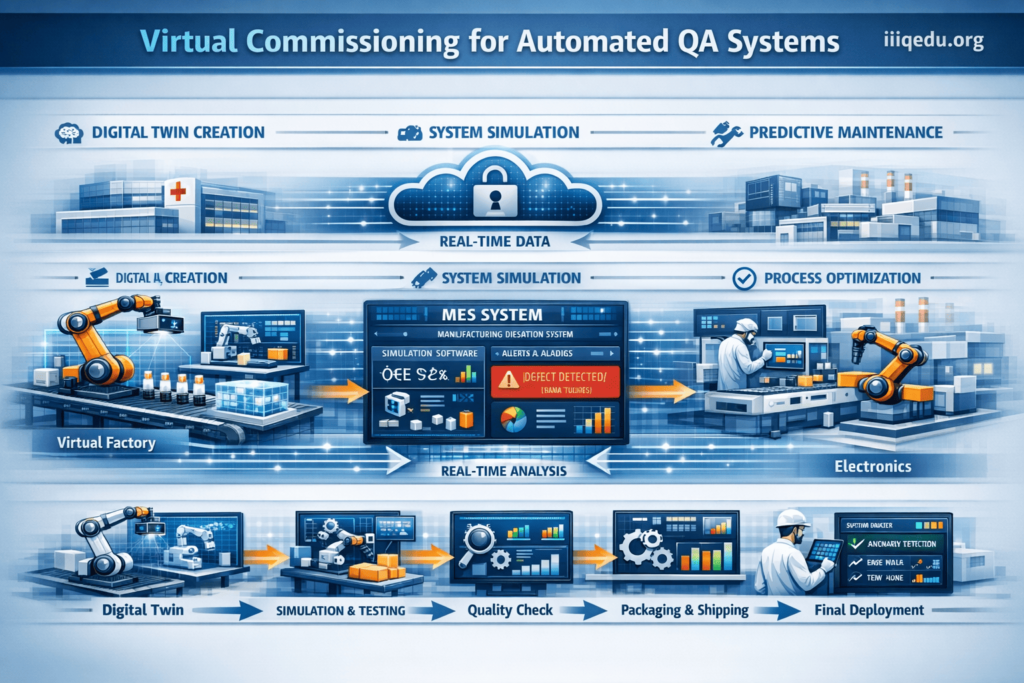
- Digital Modeling – Create a 3D model of the production line, machines, sensors, and QA inspection stations.
- System Simulation – Test the QA system logic, sensor responses, and data flow using simulation software.
- Process Optimization – Adjust inspection sequences, robot movements, and quality thresholds virtually.
- Integration Testing – Connect virtual QA systems with MES/ERP for seamless real-time data exchange.
- Physical Deployment – After virtual validation, deploy QA systems with minimal errors and downtime.
Applications in Industry
- Automotive Manufacturing – Virtual testing of robotic inspection and defect detection on car components.
- Electronics Production – QA of PCB assembly lines and solder joint inspection.
- Pharmaceuticals & Food – Simulation of automated inspection systems for packaging and labeling.
- Consumer Goods – Optimizing vision-based quality inspection for products like appliances or textiles.
Conclusion
Virtual Commissioning of QA systems is a game-changer for modern manufacturing, allowing companies to deploy automated quality systems faster, more reliably, Virtual Commissioning of QA Systems and at lower cost. It ensures that QA systems are fully optimized and integrated before touching real production lines, making it a key tool for Industry 4.0 smart factories.
What is Virtual Commissioning of QA Systems?
Virtual Commissioning of QA Systems is the process of testing, validating, and optimizing quality assurance (QA) systems in a virtual environment before implementing them on the physical production floor.
Instead of installing and debugging QA hardware and software directly on real machines, virtual commissioning uses digital models and simulations of the production line, machines, sensors, and inspection systems. This allows manufacturers to:
- Verify system functionality – Ensure sensors, robots, and inspection software behave as intended.
- Optimize processes – Test inspection sequences, robot movements, and sensor placement without disrupting production.
- Identify potential issues – Detect conflicts, software bugs, or misalignments early.
- Integrate systems – Check compatibility with MES, ERP, or other factory systems virtually.
In short, virtual commissioning reduces downtime, lowers costs, accelerates deployment, and improves the reliability of QA systems, making it an essential step in modern smart factories.
Who is Virtual Commissioning of QA Systems required?
1. Manufacturing Companies
- Especially those with automated or high-volume production lines.
- They use virtual commissioning to validate QA systems before physical deployment, reducing downtime and defects.
2. Quality Assurance (QA) Teams
- QA engineers and managers need to ensure inspection systems, sensors, and robots function correctly.
- VC allows them to test workflows and detection logic virtually, avoiding costly errors on the production line.
3. Production and Operations Managers
- Managers overseeing production efficiency benefit by reducing commissioning time and minimizing disruption during deployment.
4. Automation and Engineering Teams
- Engineers responsible for programming robots, integrating sensors, or configuring QA systems use VC to simulate real-world scenarios and fine-tune system performance.
5. Companies Undergoing Digital Transformation / Industry 4.0 Initiatives
- Organizations implementing smart factories, IoT, Virtual Commissioning of QA Systems or predictive quality systems require virtual commissioning to ensure smooth integration of hardware and software.
Summary:
Virtual commissioning is required wherever automated QA systems are deployed, especially in high-volume, high-precision, or digitally transformed manufacturing environments. It ensures QA systems are tested, optimized, and fully integrated before physical deployment.
When is Virtual Commissioning of QA Systems required?
1. Before Physical Deployment of QA Systems
- Any time a new QA system—robots, sensors, or inspection software—is being installed.
- Virtual commissioning allows testing before the system touches real production lines, reducing errors and downtime.
2. During Digital Transformation or Smart Factory Initiatives
- When a factory is implementing Industry 4.0 technologies, such as IoT, AI-driven inspections, or predictive maintenance.
- VC ensures seamless integration with MES, ERP, and production automation systems.
3. When High-Precision or Critical Quality is Required
- Industries like automotive, aerospace, pharmaceuticals, and electronics require zero-defect production.
- Virtual commissioning tests QA systems for accuracy, reliability, and compliance before real-world operation.
4. When Modifying or Upgrading Existing QA Systems
- If production lines are upgraded with new machines, sensors, or inspection software.
- VC validates that changes won’t cause defects, collisions, or workflow disruptions.
5. To Reduce Downtime and Costs
- Any scenario where production interruptions are expensive.
- VC identifies issues virtually, avoiding costly on-site debugging and delays.
Summary:
Virtual commissioning is required whenever QA systems are being deployed, upgraded, or integrated, especially in high-volume or high-precision manufacturing. It ensures systems work correctly, efficiently, and safely before going live on the production floor.
Where is Virtual Commissioning of QA Systems required?
1. Factory Floors and Production Lines
- Where robots, sensors, and automated inspection systems are installed.
- VC allows testing of QA workflows without stopping actual production.
2. Multi-Site Manufacturing Facilities
- Factories with multiple plants or production lines benefit from VC to simulate integration across sites before deployment.
3. Research & Development / Prototype Labs
- When designing new production lines or QA processes, VC enables testing before physical equipment is built or installed.
4. High-Precision or Regulated Industries
- Automotive, aerospace, electronics, pharmaceuticals, and food & beverage industries require VC to ensure compliance, accuracy, and defect-free operation.
5. Digital Transformation / Industry 4.0 Environments
- Smart factories integrating IoT, AI, and MES systems use VC to validate and optimize QA systems virtually before connecting to the live production environment.
Summary:
Virtual commissioning is required at every stage where QA systems interact with production, including factory floors, multi-site facilities, R&D labs, and digitally transformed smart factories. It ensures safe, efficient, and optimized deployment without disrupting actual operations.
How is Virtual Commissioning of QA Systems required?
1. Digital Modeling of Production Lines
- Create a 3D virtual model of machines, sensors, robots, and QA inspection stations.
- Simulate the entire workflow of the production line before installing physical systems.
2. System Simulation
- Test the QA system logic virtually, including sensor responses, robotic movements, and inspection sequences.
- Identify errors, conflicts, or inefficiencies early without stopping production.
3. Integration with Factory Systems
- Connect virtual QA systems with MES, ERP, and SCADA to validate communication, data flow, and process synchronization.
- Ensures smooth integration with existing production infrastructure.
4. Process Optimization
- Refine inspection sequences, sensor placement, and software logic using simulation results.
- Optimize production speed, QA accuracy, and resource allocation before real deployment.
5. Physical Deployment
- Once the QA system is validated virtually, install it on the actual production line.
- Reduces downtime, commissioning errors, and costs, since most issues were resolved in the virtual environment.
6. Continuous Improvement
- Virtual commissioning can be repeated whenever processes change or systems are upgraded.
- Helps maintain optimal performance and reduces future risk of errors or downtime.
Summary:
Virtual Commissioning of QA Systems is required by being embedded into the QA deployment process: model digitally, simulate workflows, test system logic, optimize processes, integrate with factory systems, and then deploy physically. This ensures efficient, safe, and reliable QA operations.
Case Study of Virtual Commissioning of QA Systems
A leading industrial automation provider, Wipro PARI, implemented virtual commissioning to validate the quality assurance and control systems of a complex engine assembly line for an automotive manufacturer. The goal was to accelerate QA system validation and reduce costly on‑site debugging and rework.
Challenges:
- Traditional commissioning led to delays and rework due to software bugs and control logic issues.
- On‑site validation slowed down delivery and prolonged deployment timelines.
- Complex assembly logic, with multiple robots and machines running mixed‑batch modes, made on‑site testing difficult.
Virtual Commissioning Approach:
Wipro PARI created a digital twin of the QA and assembly processes using advanced simulation tools within a virtual environment. The approach included:
- Testing robot programs, PLC logic, and HMI behaviors virtually before physical implementation.
- Simulating interactions between sensors (such as RFID and vision systems) and automation control logic.
- Breaking the assembly line into zones for more efficient virtual validation and calibration.
Results:
- 70% reduction in on‑site commissioning time compared to traditional methods.
- QA systems were validated in only three months from design to shop floor commissioning.
- 40–50% reduction in rework due to early issue detection.
- Improved process reliability and reduced risk of delays.
Conclusion:
By using virtual commissioning, the project team ensured that the QA systems were fully tested, optimized, and integrated before touching the real production equipment. This proactive simulation approach not only reduced deployment time and rework but also improved coordination among mechanical, electrical, and control engineers—making the QA system deployment faster, more reliable, and less costly.
Case Study: Virtual Commissioning Shortens Complex Machine Launch
In another example, an industrial automation company leveraged Siemens virtual commissioning solutions to launch complex machinery for a distribution centre. By building a comprehensive digital twin of the automation system and testing it off‑site, the team was able to:
- Cut commissioning time by three weeks.
- Increase machine throughput and meet client project deadlines in constrained time windows.
- Remotely simulate machine dynamics and configurations to validate control logic before physical installation.
This case reinforces how virtual commissioning benefits complex QA and automated systems by enabling remote testing, early code validation, and accelerated verification.
Key Takeaways for QA Systems:
- Virtual commissioning enables QA control logic and sensors to be validated before physical deployment, reducing downtime and rework.
- Creating digital twins of production processes helps detect issues early, improving reliability.
- Projects often achieve significant time and cost savings, especially in highly automated or complex environments.
White Paper of Virtual Commissioning of QA Systems
Executive Summary
Modern manufacturing demands high-quality production, minimal downtime, and rapid deployment of automated systems. Traditional commissioning of QA systems—directly testing on the production floor—can be costly, time-consuming, and prone to errors.
Virtual Commissioning (VC) of QA Systems provides a solution by allowing engineers to simulate, test, and optimize quality assurance systems in a virtual environment before physical deployment. This approach reduces risk, accelerates system launch, and ensures QA processes perform reliably from day one.
1. Introduction
Industry 4.0 and smart manufacturing rely heavily on automation, robotics, and advanced QA systems. However, deploying these systems on real production lines can be challenging due to:
- Complex assembly sequences
- Multiple robots and sensors interacting in real-time
- High precision and regulatory compliance requirements
- Potential for costly production downtime
Virtual Commissioning addresses these challenges by creating digital twins of QA systems to validate functionality and optimize operations before touching real equipment.
2. What is Virtual Commissioning of QA Systems?
Virtual Commissioning is the process of:
- Simulating QA workflows in a virtual environment
- Testing robotic, sensor, and software logic before physical deployment
- Integrating QA systems with MES, ERP, and SCADA systems virtually
- Optimizing inspection sequences, sensor placement, and control logic
The approach ensures that QA systems operate reliably, reduce defects, and maintain production efficiency once deployed physically.
3. Key Benefits
| Benefit | Description |
|---|---|
| Reduced Deployment Time | Systems are validated virtually, cutting on-site commissioning by 50–70%. |
| Cost Savings | Minimizes downtime, rework, and debugging costs. |
| Risk Mitigation | Identifies potential failures and logic errors before affecting production. |
| Process Optimization | Improves QA efficiency through simulation of inspection sequences and workflows. |
| Compliance Assurance | Ensures QA systems meet regulatory standards before physical launch. |
| Integration Validation | Verifies MES/ERP/SCADA communication and system synchronization. |
4. Who Needs Virtual Commissioning?
- Manufacturing Companies – Especially automated and high-volume operations.
- QA and QC Teams – To validate inspection workflows and sensor logic.
- Production Managers – To reduce downtime and improve launch reliability.
- Automation and Engineering Teams – To simulate robotic and control system interactions.
- Industry 4.0 Adopters – Companies integrating IoT, AI, or predictive QA systems.
5. When and Where is it Required?
When:
- Before deploying new QA systems
- During upgrades or modifications of production lines
- For complex, high-precision, or regulated production processes
Where:
- Factory floors and production lines
- R&D and prototyping labs
- Multi-site manufacturing facilities
- Digital transformation initiatives
6. How Virtual Commissioning Works
- Digital Modeling – Build a 3D digital twin of production lines, sensors, and QA systems.
- System Simulation – Test robotic, sensor, and software logic virtually.
- Integration Testing – Validate communication with MES, ERP, and SCADA systems.
- Process Optimization – Refine inspection sequences, sensor placement, and control logic.
- Physical Deployment – Launch QA systems with minimal downtime and errors.
- Continuous Improvement – Re-run simulations when processes are modified to maintain optimal performance.
7. Case Study
Automotive QA System Deployment with Virtual Commissioning:
A leading automotive manufacturer implemented VC for its engine assembly line QA systems. By creating a digital twin of the production line:
- On-site commissioning time was reduced by 70%
- Rework and errors were reduced by 40–50%
- QA system integration with MES was validated before production launch
This demonstrates that VC not only accelerates deployment but also ensures reliable, optimized QA operations.
8. Conclusion
Virtual Commissioning of QA Systems is a critical tool for modern manufacturing, ensuring QA processes are reliable, optimized, and integrated before they impact the production floor. By leveraging simulation, digital twins, and virtual testing, manufacturers can:
- Reduce deployment time and costs
- Minimize errors and downtime
- Ensure compliance with industry standards
- Improve overall production efficiency
Investing in virtual commissioning is essential for Industry 4.0-ready smart factories that prioritize quality, efficiency, and operational excellence.
Industry Application of Virtual Commissioning of QA Systems
1. Automotive Industry
- Application: Engine assembly lines, car body inspection, and robotic quality checks.
- Use Case: Virtual commissioning tests robotic QA workflows, sensor integration, and inspection sequences before physical deployment.
- Benefit: Reduces on-site debugging, deployment time, and defect rates while ensuring compliance with IATF 16949 standards.
2. Electronics and Semiconductor Manufacturing
- Application: PCB assembly, semiconductor wafer inspection, and electronics testing lines.
- Use Case: Simulate vision inspection systems, automated testing sequences, and robotic handling virtually.
- Benefit: Detects defects early, increases yield, and reduces downtime from on-site testing.
3. Aerospace and Defense
- Application: Turbine blade production, avionics assembly, and precision component inspection.
- Use Case: Validate high-precision QA processes and simulate interactions of multiple automated systems.
- Benefit: Ensures critical quality standards (e.g., AS9100) are met, reduces production errors, and mitigates costly rework.
4. Pharmaceuticals and Life Sciences
- Application: Drug manufacturing, packaging, and labeling QA systems.
- Use Case: Virtual commissioning ensures sterile inspection, automated sampling, and packaging compliance before physical deployment.
- Benefit: Supports GMP compliance, reduces contamination risks, and improves inspection reliability.
5. Food and Beverage Industry
- Application: Automated inspection for packaging, labeling, and filling processes.
- Use Case: Simulate sensor detection, vision systems, and robotic QA operations in a virtual environment.
- Benefit: Minimizes product recalls, improves production efficiency, and ensures regulatory compliance (e.g., FDA, ISO 22000).
6. Heavy Machinery and Industrial Equipment
- Application: Manufacturing of turbines, engines, and large-scale machinery components.
- Use Case: VC validates inspection logic, robotic handling, and quality control sensors before live deployment.
- Benefit: Reduces downtime, ensures equipment reliability, and improves overall product quality.
7. Consumer Goods Manufacturing
- Application: Appliances, electronics, and packaged goods inspection.
- Use Case: Simulate QA systems for vision-based inspections and automated quality checks.
- Benefit: Reduces returns, ensures consistent product quality, and accelerates system deployment.
Key Takeaways
- Virtual Commissioning is widely applicable across industries with automated QA systems, especially where precision, speed, and compliance are critical.
- It allows companies to simulate, validate, and optimize QA systems before physical deployment, reducing downtime, defects, and commissioning costs.
- Industries that adopt VC gain faster deployment, higher reliability, and cost-effective quality assurance.
#virtualcommissioningofqasysteminindia #virtualcommissioningofqasystemingorakhpur #virtualcommissioningofqasysteminbanglore #virtualcommissioningofqasysteminpatna #virtualcommissioningofqasysteminmumbai #virtualcommissioningofqasysteminkolkata #virtualcommissioningofqasystemindelhi #virtualcommissioningofqasysteminhyderabad #virtualcommissioningofqasysteminvasai #virtualcommissioningofqasysteminkochi #bestinstitueinindia #bestinstitueinmumbai #bestinstitueinvasai #bestinstitueintheworld
Ask FAQs
What is Virtual Commissioning of QA Systems?
Virtual Commissioning (VC) is the process of simulating, testing, and optimizing quality assurance systems in a virtual environment before they are deployed on the physical production line. It allows manufacturers to detect errors, optimize workflows, and integrate systems without disrupting real operations.
Who needs Virtual Commissioning of QA Systems?
VC is essential for manufacturers, QA engineers, production managers, automation teams, and Industry 4.0 adopters—anyone responsible for deploying automated QA systems in high-precision or high-volume production environments.
When is Virtual Commissioning required?
VC is required before installing new QA systems, upgrading or modifying existing systems, or implementing complex inspection workflows, especially in industries where downtime and defects are costly.
How does Virtual Commissioning improve QA system performance?
VC allows teams to simulate production processes, validate robotic and sensor logic, optimize inspection sequences, and integrate QA systems with MES/ERP/SCADA. This reduces errors, shortens commissioning time, and ensures reliable QA operations.
Which industries benefit most from Virtual Commissioning of QA Systems?
Industries that gain the most include:
Automotive and aerospace
Electronics and semiconductor manufacturing
Pharmaceuticals and life sciences
Food and beverage production
Heavy machinery and consumer goods manufacturing
Source: EKS InTec GmbH
Table of Contents
Disclaimer:
The information provided is for general informational purposes only and does not constitute professional advice. Results from virtual commissioning may vary depending on specific manufacturing processes, systems, and industry requirements. Consult qualified experts before implementing QA systems.